HISENSE H.A.(000921)

Search documents
国泰海通晨报-20251120
GUOTAI HAITONG SECURITIES· 2025-11-20 05:14
Group 1: Pet Food Industry - Petty Co., Ltd. - Petty Co., Ltd. maintains growth in its self-owned pet food brand, particularly solidifying its position in the dog snack segment [2][19] - The company is actively expanding its overseas customer base, particularly in Europe, which is expected to drive new order growth [2][20] - During the 2025 Double 11 shopping festival, the company achieved significant revenue growth for its self-owned brand through strategic marketing initiatives [2][19] - The company’s production technology is leading in the pet food sector, and it has made breakthroughs with its self-owned brands [19][20] - The company is focusing on the mid-to-high-end pet food market, supported by strong production, marketing, and R&D capabilities [20] Group 2: iQIYI, Inc. - iQIYI's revenue stabilized in Q3 2025, achieving 6.68 billion yuan, with a year-on-year decrease of 8% but a quarter-on-quarter increase of 1% [5][30] - The company’s overseas business showed strong growth, with Q3 2025 total revenue and membership income achieving the highest growth in the past two years [6][31] - AI is driving innovation in content creation and advertising efficiency, with over 70% of promotional materials generated through AI [6][31] - The company plans to expand its original content production in successful overseas markets like Thailand [6][31] - Adjusted revenue forecasts for 2025-2027 are 27.3 billion, 28.9 billion, and 29.9 billion yuan, with adjusted net profits of 0.9 billion, 1.04 billion, and 1.56 billion yuan respectively [5][30]



产业在线10月空调数据简评:压力释放,静待拐点
Guolian Minsheng Securities· 2025-11-19 08:54
证券研究报告 |报告要点 基数及经营节奏影响下,空调 10 月内外销压力如期释放,国内龙头终端表现好于出货,产业 健康运行,价格体系稳定为主,经营面α及积极变化值得关注;出口关税压力减轻,美国开启 降息,有望带动外需,龙头 OBM 势能强劲,海外转产持续推进,修复阶段或好于线性预期。 |分析师及联系人 行业研究|行业点评研究|家用电器 产业在线 10 月空调数据简评: 压力释放,静待拐点 请务必阅读报告末页的重要声明 glzqdatemark1 2025年11月19日 证券研究报告 请务必阅读报告末页的重要声明 1 / 6 孙珊 管泉森 蔡奕娴 SAC:S0590523110003 SAC:S0590523100007 行业研究|行业点评研究 glzqdatemark2 2025年11月19日 家用电器 产业在线 10 月空调数据简评: 压力释放,静待拐点 投资建议: 强于大市(维持) 上次建议: 强于大市 相对大盘走势 -10% 3% 17% 30% 2024/11 2025/3 2025/7 2025/11 家用电器 沪深300 相关报告 1、《家用电器:从双十一看家电:韧性收官, 关注结构红利》2025 ...



白色家电板块11月19日涨0.11%,海尔智家领涨,主力资金净流入2.36亿元
Zheng Xing Xing Ye Ri Bao· 2025-11-19 08:51
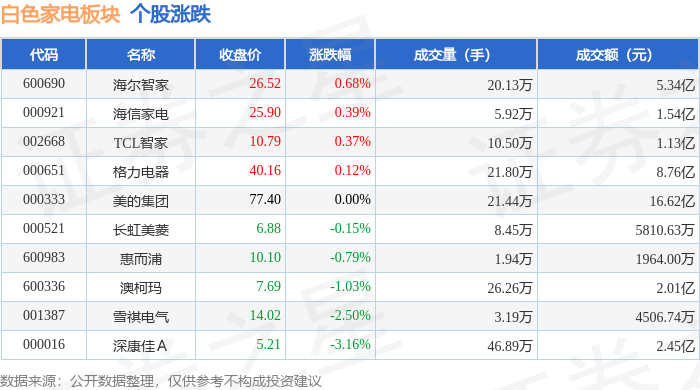
Market Overview - The white goods sector increased by 0.11% on November 19, with Haier Smart Home leading the gains [1] - The Shanghai Composite Index closed at 3946.74, up 0.18%, while the Shenzhen Component Index closed at 13080.09, unchanged [1] Individual Stock Performance - Haier Smart Home (600690) closed at 26.52, up 0.68% with a trading volume of 201,300 shares [1] - Hisense Home Appliances (000921) closed at 25.90, up 0.39% with a trading volume of 59,200 shares [1] - TCL Smart Home (002668) closed at 10.79, up 0.37% with a trading volume of 105,000 shares [1] - Gree Electric Appliances (000651) closed at 40.16, up 0.12% with a trading volume of 218,000 shares [1] - Midea Group (000333) closed at 77.40, unchanged with a trading volume of 214,400 shares [1] - Other notable performers include Changhong Meiling (000521) down 0.15% and Whirlpool (600983) down 0.79% [1] Capital Flow Analysis - The white goods sector saw a net inflow of 236 million yuan from institutional investors, while retail investors experienced a net inflow of 57.36 million yuan [1] - Notable net inflows from institutional investors include Midea Group with 21.11 million yuan and Gree Electric Appliances with 27.48 million yuan [2] - Conversely, retail investors showed significant outflows from Midea Group (-19.62 million yuan) and Gree Electric Appliances (-43.29 million yuan) [2]


海信家电20251118
2025-11-19 01:47
Summary of Hisense Home Appliances Conference Call Industry Overview - The home appliance sector typically outperforms the market in specific months, particularly before earnings periods in March-April and July, suggesting a focus on companies with low valuations and stable growth during market downturns [2][3] - The core growth point for the home appliance industry in 2026 is expected to be in overseas markets, with demand in Europe and the US anticipated to outperform emerging markets [2][4] - The US market is expected to benefit from the "Great American Rescue Plan" and a rate-cutting cycle, with a strong correlation to real estate, which is projected to positively impact economic and consumer activity in the second half of the year [2][4] Company Performance - Hisense's domestic sales are under pressure due to declining government subsidies, but leading companies show resilience in their financial reports [2][6] - The company’s sales strategy during the Double Eleven shopping festival was conservative, resulting in a year-on-year decline in overall sales, although structural products like fresh air conditioners performed well [11] - For the fourth quarter, Hisense expects a 10-15% year-on-year increase in orders for refrigerators and washing machines, despite challenges in domestic sales due to real estate pressures [12] Market Dynamics - The domestic market is facing challenges from the gradual withdrawal of government subsidies, but leading companies like Midea and Haier are showing strong dividend yields, indicating investment value [6] - The small appliance sector, particularly the robot vacuum market, is showing signs of improvement, with companies like Roborock achieving double-digit growth [7][9] - The competitive landscape in the small appliance market is improving, with product iterations driving revenue growth and margin improvements [9] Export Chain Considerations - The impact of Trump’s tariff policies on export chains is a key concern, with companies like Haier and Midea having flexible overseas production capabilities that provide an advantage [10] - Companies that have recently completed capacity expansions but are experiencing negative growth this year are expected to perform better next year [10] Future Outlook - Hisense is committed to its new energy strategy, transitioning towards new energy solutions and comprehensive thermal management systems, with plans to maintain or slightly increase dividend payouts in 2025 [4][16][17] - The central air conditioning business faces challenges due to declining demand in the renovation sector, but there are expectations for growth in the C-end and public construction segments [14] - The air conditioning market is reaching initial strategic goals, with limited price space for expansion, necessitating careful observation of consumer demand elasticity [19] Key Financial Metrics - Midea's dividend yield exceeds 5%, while Haier's is over 4%, indicating strong investment potential [6] - Hisense's overseas sales profit margins are expected to remain in the mid-single digits, supported by improved sales structures and reduced losses from the Monterrey factory [12] This summary encapsulates the key points from the conference call, highlighting the current state and future outlook of the home appliance industry and Hisense's strategic positioning within it.
白色家电板块11月18日跌1%,深康佳A领跌,主力资金净流出3.12亿元
Zheng Xing Xing Ye Ri Bao· 2025-11-18 08:04
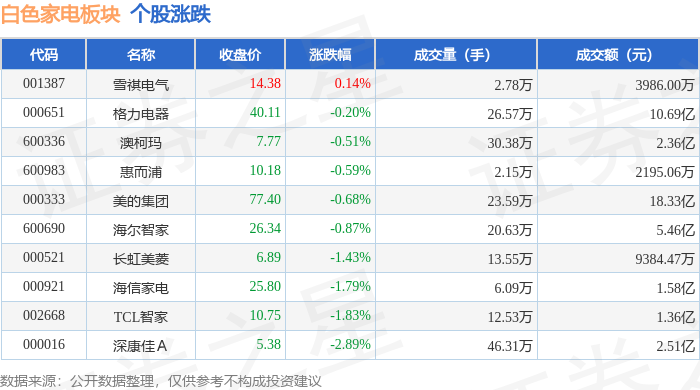
Market Overview - The white goods sector experienced a decline of 1.0% on November 18, with major stocks like Deep Konka leading the drop [1] - The Shanghai Composite Index closed at 3939.81, down 0.81%, while the Shenzhen Component Index closed at 13080.49, down 0.92% [1] Stock Performance - Key stocks in the white goods sector showed varied performance, with the following notable changes: - Snow Qi Electric: Closed at 14.38, up 0.14% - Gree Electric: Closed at 40.11, down 0.20% - Midea Group: Closed at 77.40, down 0.68% - Haier Smart Home: Closed at 26.34, down 0.87% - Deep Konka A: Closed at 5.38, down 2.89% [1] Capital Flow - The white goods sector saw a net outflow of 312 million yuan from institutional investors, while retail investors contributed a net inflow of 385 million yuan [1] - Detailed capital flow for specific stocks includes: - Deep Konka A: Net outflow of 55.04 million yuan from institutional investors, with a retail net inflow of 43.96 million yuan [2] - TCL Smart Home: Net outflow of 20.99 million yuan from institutional investors, with a retail net inflow of 15.50 million yuan [2] - Gree Electric: Net outflow of 3.94 million yuan from institutional investors, with a retail net inflow of 32.46 million yuan [2]


海信家电跌2.02%,成交额1.72亿元,主力资金净流出1719.46万元
Xin Lang Zheng Quan· 2025-11-17 05:51
Group 1 - The core viewpoint of the news is that Hisense Home Appliances has experienced a decline in stock price and significant net outflow of funds, indicating potential market challenges [1] - As of November 17, the stock price of Hisense Home Appliances was 26.20 yuan per share, with a total market capitalization of 36.283 billion yuan [1] - The company has seen a year-to-date stock price decrease of 5.32%, with a 2.38% decline over the last five trading days, but a 4.51% increase over the last 20 days and a 7.55% increase over the last 60 days [1] Group 2 - For the period from January to September 2025, Hisense Home Appliances achieved operating revenue of 71.533 billion yuan, representing a year-on-year growth of 1.35%, and a net profit attributable to shareholders of 2.812 billion yuan, with a growth of 0.67% [2] - The company has distributed a total of 6.964 billion yuan in dividends since its A-share listing, with 3.823 billion yuan distributed in the last three years [3] - As of September 30, 2025, the number of shareholders increased by 12.25% to 46,300, while the average circulating shares per person remained at 0 [2][3]
客厅里的智能战争
3 6 Ke· 2025-11-17 03:17
Core Insights - The home appliance industry in China is entering an era of full-home intelligence, with traditional appliance companies and tech firms like Huawei and Xiaomi intensifying competition through AI technology and smart ecosystems [1][2][7] Group 1: Market Dynamics - Traditional appliance companies such as Midea, Gree, Haier, and Hisense are seeking new growth points by developing AI technology, expanding product lines, and exploring international markets [1] - Tech companies like Huawei and Xiaomi leverage their established smart ecosystem advantages to enhance competition in the appliance market [1][2] - The trend towards smart appliances is evident, with many brands offering independent smart systems, often named with a prefix like "Xiao" [2] Group 2: Consumer Behavior - Consumers are increasingly drawn to smart appliances, with features like AI voice functionality appealing to families with children and elderly members [3] - A shift in consumer preferences is noted, with many opting for domestic brands over foreign ones, indicating a growing expectation for smart features in appliances [3][4] - The interest in full-home smart systems is rising, but many consumers face challenges due to incompatibility between different brands' systems [4] Group 3: Technological Advancements - Midea's full-home smart system integrates various home environments and appliances, evolving from passive responses to proactive services [5][6] - The interaction between vehicles and home systems is emerging, with Midea collaborating with companies like BYD and Tesla to enhance connectivity [5][6] - A report indicates that the smart home market in China is expected to grow at double-digit rates from 2023 to 2025, with smart security, lighting, and audio-visual products being the fastest-growing categories [6][7] Group 4: Competitive Landscape - Major players in the appliance sector include Gree, Midea, Haier, Hisense, and TCL, with the boundaries of the industry becoming increasingly blurred as companies embrace a broader home ecosystem [7][8] - The competition is intensifying, with a notable price war among domestic brands, as they strive to offer smart services that add higher value beyond traditional hardware manufacturing [8]
客厅里的智能战争
经济观察报· 2025-11-14 15:08
Core Viewpoint - The competition in the home appliance market is intensifying as traditional companies like Midea, Gree, Haier, and Hisense seek new growth through AI technology, product line expansion, and internationalization, while tech companies like Huawei and Xiaomi leverage their established smart ecosystem advantages to increase competition [2][3]. Group 1: Market Dynamics - Traditional home appliance companies are exploring new growth points through AI technology and expanding product lines [2][3]. - Tech companies are intensifying competition in the home appliance market by leveraging their smart ecosystem advantages [2][3]. - The shift towards a fully smart home environment is becoming evident, with consumers increasingly interested in integrated smart solutions [12]. Group 2: Consumer Behavior - Consumers are showing a preference for smart appliances, with features like AI voice control being particularly appealing to families with children and elderly members [6]. - There is a noticeable shift in consumer purchasing habits, with many moving from foreign brands to domestic brands due to the increasing expectations for smart features [6][7]. - Consumers are facing challenges with compatibility between different brands' smart systems, which complicates the integration of smart home devices [7]. Group 3: Technological Advancements - Home appliances are evolving from "single product intelligence" to "whole home intelligence," with systems like Midea's "Xiao Mei AI" integrating various smart functions [9][10]. - The interaction between vehicles and home systems is being developed, allowing for seamless integration and control of home environments from vehicles [11]. - The trend towards smart home integration is expected to continue, with significant growth projected in the smart home market over the next few years [12]. Group 4: Industry Trends - Major players in the home appliance sector, including Gree, Midea, Haier, and Hisense, are adapting to the blurred lines between home appliances and broader home ecosystems [14]. - The retail landscape is shifting, with smart home products being prominently displayed alongside traditional appliances to attract consumer interest [14]. - The release of technological potential in the home appliance sector is expected to reshape global competition, allowing Chinese companies to gain a more advantageous position in the market [15].

海信家电:管理层对公司未来发展充满信心
Zheng Quan Ri Bao· 2025-11-14 14:13
Core Viewpoint - The management of Hisense Home Appliances expresses confidence in the company's future development and is committed to enhancing shareholder value through diligent efforts and ongoing communication [1] Group 1 - The company is actively advancing its operational plans to achieve better performance [1] - Management emphasizes the importance of returning value to investors who have placed their trust in the company [1] - Continuous communication is highlighted as a key strategy to improve the company's overall value [1]
双十一登顶销售额NO1背后:容声方糖冰箱如何成为懂用户的“生活同行者”?
Huan Qiu Wang· 2025-11-14 10:55
Core Insights - The article highlights the success of the Rongsheng Fangtang series refrigerator, which topped the sales market share during the Double Eleven pre-sale period, showcasing a triumph in product positioning and technological innovation [5] Group 1: Market Positioning - The Fangtang series addresses the pain points of modern kitchen space integration, particularly for younger consumers living in small apartments and open kitchens [6] - The series features a "60cm true flat embedded design" that aligns perfectly with standard cabinets, eliminating protrusions and gaps, thus enhancing aesthetic appeal and space utilization [6] - The design includes a bottom-mounted cooling system that requires only 3mm of space for efficient heat dissipation, catering to the needs of compact kitchens [6] Group 2: Technological Innovation - The health preservation technology of the Fangtang series is a significant draw for consumers, with many prioritizing the net flavor function over traditional energy consumption metrics [8] - The IDP Dual Purification 2.0 technology offers a comprehensive purification process that includes identification, capture, and decomposition, achieving a 99.9999% sterilization rate in both refrigeration and freezing compartments [9][10] Group 3: Market Performance - The Fangtang series has achieved remarkable market performance, ranking first in offline sales for new products and leading online sales for French four-door models [11] - Within 14-16 weeks of its launch, the Fangtang 515 model entered the top 10 in industry sales, indicating strong consumer demand [12] - The series generated 250 million yuan in sales during the Double Eleven period, marking a significant milestone in the competition for net flavor technology [12] Group 4: Consumer Insights - The success of the Fangtang series stems from a deep understanding of contemporary consumer needs, particularly among Generation Z, who prioritize aesthetic compatibility in their refrigerator choices [13] - The series combines high aesthetic design, robust technology, and emotional resonance, creating a product that feels like a gift to the user every time it is opened [13] - Industry commentary suggests that the Fangtang series represents not just an evolution of products but a revolution in pure lifestyle choices, meeting the complex demands of urban youth [13]