
HISENSE H.A.(000921)

Search documents
吴桂英调研民营经济发展情况
Chang Sha Wan Bao· 2026-01-14 11:58
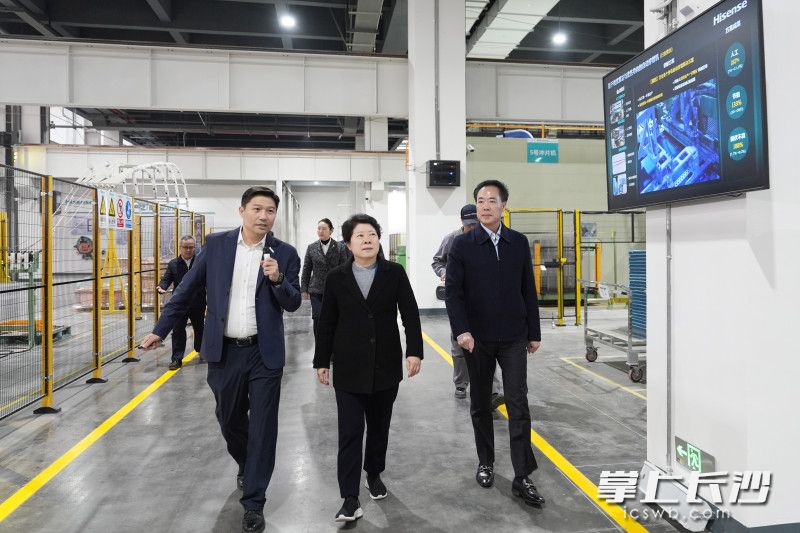
Group 1 - The core message emphasizes the importance of promoting the healthy and high-quality development of the private economy in Changsha, aligning with Xi Jinping's important discourse on private economic development and optimizing the business environment [1] - The government aims to provide proactive services and precise support to alleviate difficulties faced by private enterprises, thereby enhancing their capabilities and fostering a better business environment [1] Group 2 - During the visit to the Ningxiang Economic Development Zone, the focus was on the Hisense (Changsha) Appliance Industrial Park, which recently commenced production of its commercial air conditioning smart manufacturing base, encouraging enterprises to enhance their core business and lead the industry [4] - The Huazhong Technology Group is engaged in the research and development of new biological materials, medical devices, and 3D printing applications, with an emphasis on talent development and R&D investment to seize development opportunities in cutting-edge fields [4] Group 3 - In the Xiangjiang New Area, the visit included companies like Shengxiang Biotechnology, Anker Innovation, and ZTE Communications, highlighting the importance of building industrial ecosystems and expanding international markets [7] - Anker Innovation is encouraged to continue expanding its global market presence and enhancing brand and technological innovation, focusing on smart electricity, home automation, and audio-visual products [7] - ZTE Communications is urged to leverage its R&D advantages to integrate deeply with local industrial and supply chains, continuously shaping new competitive advantages [7] Group 4 - The government is committed to establishing a new type of government-business relationship that is both friendly and clear, ensuring that the needs of enterprises are accurately understood and addressed with tailored services [7] - There is a focus on supporting enterprises in R&D innovation, talent acquisition, and market expansion, while ensuring effective policy implementation and a regulatory environment that fosters investment and development [7]



白色家电板块1月14日涨0.59%,雪祺电气领涨,主力资金净流入2.41亿元
Zheng Xing Xing Ye Ri Bao· 2026-01-14 08:50
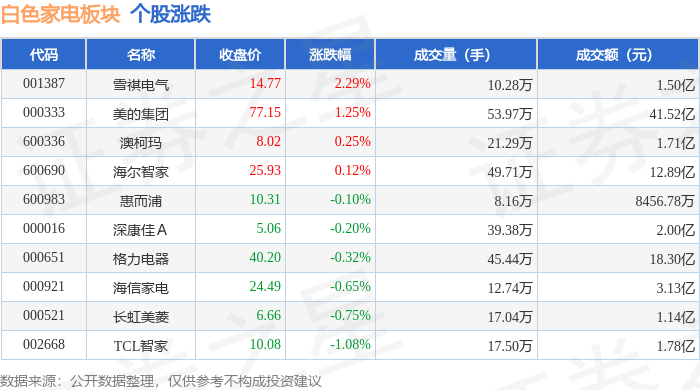
Core Viewpoint - The white goods sector experienced a slight increase of 0.59% on January 14, with Xueqi Electric leading the gains, while the overall Shanghai Composite Index fell by 0.31% [1] Group 1: Market Performance - The Shanghai Composite Index closed at 4126.09, down 0.31% [1] - The Shenzhen Component Index closed at 14248.6, up 0.56% [1] - The white goods sector's individual stock performance varied, with Xueqi Electric rising by 2.29% to a closing price of 14.77 [1] Group 2: Stock Details - Midea Group closed at 77.15, up 1.25%, with a trading volume of 539,700 shares and a transaction value of 4.152 billion yuan [1] - Gree Electric closed at 40.20, down 0.32%, with a trading volume of 454,400 shares and a transaction value of 1.830 billion yuan [1] - Haier Smart Home closed at 25.93, up 0.12%, with a trading volume of 497,100 shares and a transaction value of 1.289 billion yuan [1] Group 3: Capital Flow - The white goods sector saw a net inflow of 241 million yuan from main funds, while retail funds experienced a net outflow of 277 million yuan [1] - Retail investors contributed a net inflow of 35.78 million yuan to the sector [1] Group 4: Individual Stock Capital Flow - Midea Group had a net inflow of 25.17 million yuan from main funds, while retail funds saw a net outflow of 13.28 million yuan [2] - Xueqi Electric experienced a net inflow of 23.11 million yuan from main funds, but retail funds had a significant net outflow of 22.26 million yuan [2] - TCL Smart Home had a net inflow of 17.91 million yuan from main funds, while retail funds saw a net outflow of 22.50 million yuan [2]




家电行业2025年年报前瞻:黎明前夕,沉潜以待
Guolian Minsheng Securities· 2026-01-14 08:22
Investment Rating - The report maintains a "Recommend" rating for the home appliance industry [1] Core Insights - The industry is at a turning point, with expectations for improved performance in 2026 as domestic demand stabilizes and export orders recover [35] - The report highlights the resilience of leading companies in the white goods sector, with a focus on their ability to navigate through challenging market conditions [7][10] - The overall market dynamics indicate a potential for growth in emerging markets, alongside innovation and product expansion in domestic markets [35] Summary by Sections 1. White Goods - External sales are recovering steadily, while internal sales are expected to remain stable in Q4 2025. Leading companies are well-positioned to benefit from favorable demand and cost environments [7][10] - Q4 2025 internal sales for air conditioners, refrigerators, and washing machines are projected to decline by 31%, 11%, and 6% respectively, due to high base effects from the previous year [10] - External sales for refrigerators and washing machines are expected to show modest growth, with a 3% increase for refrigerators and a 9% increase for washing machines [10] 2. Black Goods - The report indicates that the color TV market is under pressure, with internal sales declining significantly due to high base effects from previous subsidies [15] - External sales remain relatively stable, with a slight decline of 2% expected in Q4 2025 [15][16] - Leading brands are expected to improve their profitability through product innovation and market share gains [15] 3. Cleaning Appliances - External sales continue to grow, while internal sales face challenges due to high base effects from previous subsidies [19] - The report notes a decline in retail sales for floor cleaning machines and washing machines, with internal sales dropping by 25% and 8% respectively [20] - The external market shows strong growth, particularly in Europe and Asia-Pacific, although competition remains intense [21] 4. Small Appliances - Domestic prices are rising, but external demand remains weak, with overall growth in retail sales expected to be between 0-10% [30] - The report highlights structural improvements in pricing and product upgrades, which may support profit margins in the domestic market [30] - External sales are under pressure due to overall weak demand in international markets [30] 5. Post-Cycle - The report indicates a downturn in demand for major kitchen appliances, with significant declines in retail sales across various categories [33] - The real estate market remains sluggish, impacting demand for kitchen appliances, and the report anticipates continued pressure on sales [33] - The upcoming subsidy policies are expected to have limited coverage, which may further affect market dynamics [33] 6. Industry Views and Investment Recommendations - The report suggests that the home appliance sector is poised for recovery in 2026, with expectations for improved fundamentals and potential surprises in export performance [35] - Recommended stocks include leading white goods manufacturers such as Midea Group, Haier Smart Home, Gree Electric, and Hisense Home Appliances, as well as TV manufacturers like Hisense Visual and TCL Electronics [35]



健康养鲜实力“出圈”!容声以原创科技拿下年度消费名品
Sou Hu Cai Jing· 2026-01-14 07:38
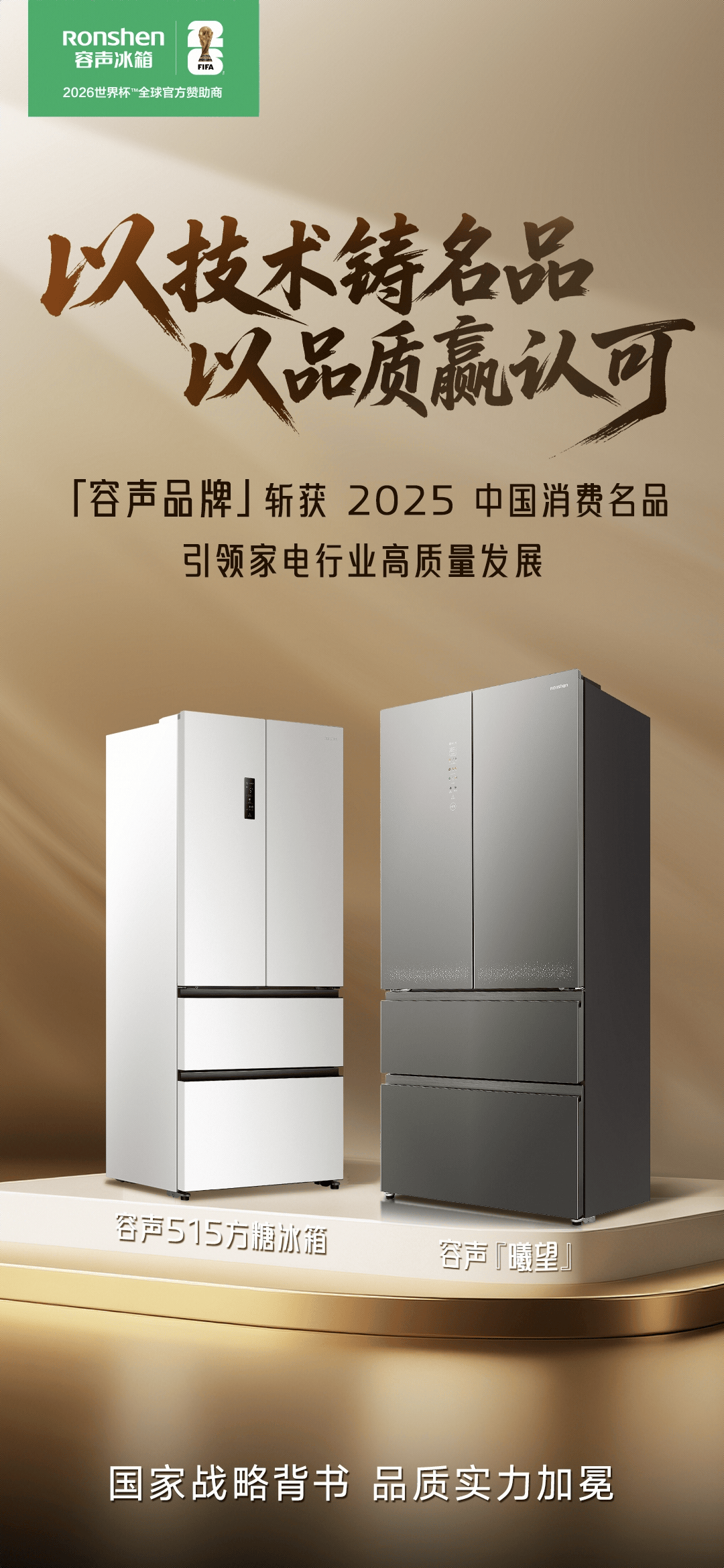
Core Insights - The Ministry of Industry and Information Technology of China officially announced the list of consumer brands for 2025, with Rongsheng Refrigerator being recognized for its product quality and brand strength, reflecting its user-centered development philosophy and industry-leading value [1][6]. Group 1: Product Innovation and Market Position - The selection of Rongsheng as a consumer brand aligns with the focus on meeting the quality consumption needs of the public, showcasing its long-term commitment to a "user-first" philosophy [6]. - Since its establishment in 1983, Rongsheng has prioritized consumer demand as the origin of innovation, evolving from basic preservation to health-oriented and scenario-adapted needs through continuous technological iterations and quality control [6]. - Rongsheng's core products, including the WILL fresh-keeping series, utilize advanced technologies such as the "light, water, and ion" system to redefine health preservation standards, achieving breakthroughs in nutrient retention [7]. Group 2: Targeting Young Consumers - Rongsheng has identified the trend of younger consumers and developed the Fangtang series, which combines classic design with modern aesthetics, meeting the demands for convenience and health in ice-making [8]. - The Fangtang flagship model features the "i-Smell Smart" technology for real-time monitoring of food odors, enhancing user trust through visible health protection [8]. - The introduction of the ultra-pure rapid automatic ice-making system has earned Rongsheng the first certification for automatic ice-making performance from the China Household Electrical Appliances Research Institute [8]. Group 3: Commitment to ESG and Sustainability - Rongsheng integrates ESG principles throughout its development process, establishing itself as a benchmark for green development in the industry [9]. - The company launched China's first CFC-free refrigerator in 1993 and has since built a comprehensive green system from R&D to production, receiving accolades for its environmental initiatives [9]. - Rongsheng's "Energy-Saving Forest Plan" and other community engagement projects demonstrate its commitment to social responsibility and ecological restoration [10]. Group 4: Market Performance and Recognition - Rongsheng's focus on technological innovation and user orientation has resulted in significant market success, with six of its products ranking among the top ten in industry sales in the first half of 2025 [11]. - The Fangtang flagship model achieved the top sales position within seven days of launch and maintained its lead for five consecutive months, while the 515 Fangtang refrigerator topped online sales for French four-door models [11]. - The recognition as a consumer brand for 2025 is part of a broader array of awards, including the People's Craftsmanship Product Award and the IFA "Annual Technology Innovation Achievement" Award, underscoring Rongsheng's leadership in health preservation and industry innovation [11].
家电周报:石头科技等CES展“秀肌肉”,开能完成原能部分子公司股权收购-20260111
Shenwan Hongyuan Securities· 2026-01-11 11:14
Investment Rating - The report maintains a positive outlook on the home appliance sector, highlighting the potential for growth in leading companies due to their low valuations, high dividends, and stable growth attributes [6]. Core Insights - The home appliance sector has shown mixed performance, with air conditioning sales declining significantly while washing machine exports continue to grow. The report emphasizes the resilience of leading brands in navigating market challenges and capitalizing on emerging opportunities [5][6]. - The report identifies three main investment themes: the undervaluation and growth potential of leading white and black appliance companies, the technological advancements in core component manufacturers, and the strong demand for small appliances in international markets [6]. Summary by Sections Air Conditioning - In November 2025, the air conditioning industry produced 10.577 million units, a year-on-year decrease of 36.7%. Total sales reached 10.492 million units, down 31.8%, with domestic sales falling by 39.8% and exports declining by 25.6%. Midea led the market with a 36.2% share, followed by Gree at 19.5% [2][41]. Refrigerators - The refrigerator sector saw a slight overall decline, with production at 8.257 million units, down 3.9% year-on-year. Sales totaled 8.0531 million units, a decrease of 2.99%. Domestic sales dropped by 15.59%, while exports increased by 10.04% [2][43]. Washing Machines - The washing machine industry experienced growth, with production reaching 8.605 million units, up 8.2% year-on-year. Sales were 8.4619 million units, an increase of 7.61%. Domestic sales fell by 5.47%, but exports surged by 23.31% [3][47]. Industry Dynamics - Notable developments include the CES debut of the G-Rover robot vacuum by Stone Technology, showcasing innovative cleaning technology, and the acquisition of subsidiaries by Kaineng Health, indicating strategic expansion efforts [5][12][13]. Component Data - In November 2025, the sales of rotary compressors decreased by 13.6%, while the sales of refrigerator compressors increased by 7.2%. The report highlights the contrasting performance of different components within the appliance sector [23][32].


白色家电板块1月9日涨0.5%,美的集团领涨,主力资金净流入1.58亿元
Zheng Xing Xing Ye Ri Bao· 2026-01-09 08:54
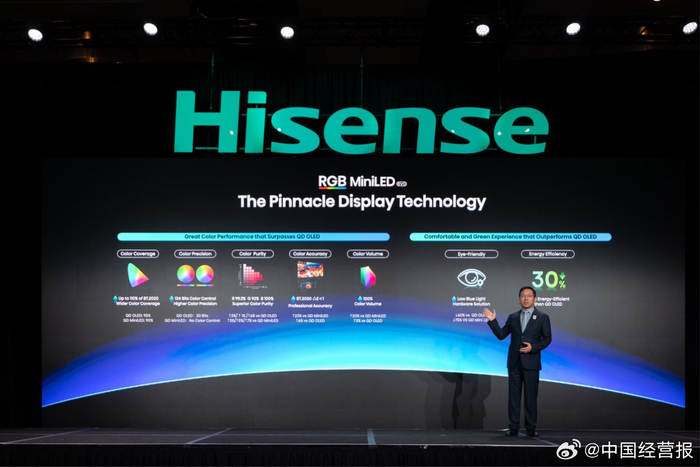
Group 1 - The white goods sector increased by 0.5% on January 9, with Midea Group leading the gains [1] - The Shanghai Composite Index closed at 4120.43, up 0.92%, while the Shenzhen Component Index closed at 14120.15, up 1.15% [1] - Midea Group's closing price was 79.77, reflecting a 0.94% increase, with a trading volume of 341,100 shares [1] Group 2 - The net inflow of main funds in the white goods sector was 158 million yuan, while retail funds saw a net inflow of 943,930 yuan [1] - Midea Group had a main fund net inflow of 1.27 billion yuan, but retail funds experienced a net outflow of 32.82 million yuan [2] - Haier Smart Home had a main fund net inflow of 7.12 million yuan, but retail funds saw a net outflow of 60.98 million yuan [2]


海信CES 2026发布RGB-Mini LED技术,UX系列3月国内上市
Zhong Guo Jing Ying Bao· 2026-01-09 02:50
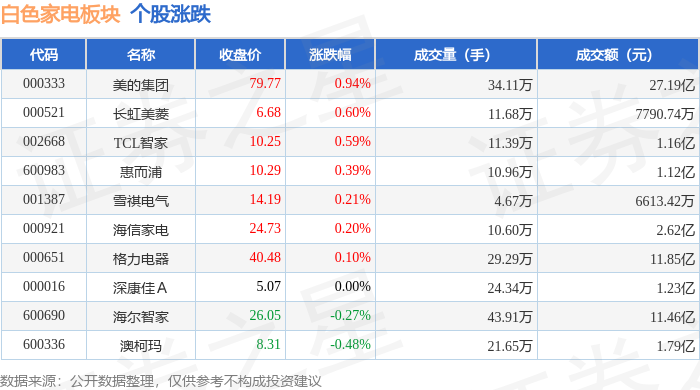
Group 1 - The 2026 International Consumer Electronics Show (CES 2026) is taking place in Las Vegas, showcasing advancements in AI technology and consumer electronics, with Hisense presenting its new RGB-Mini LED display technology [1] - Hisense has developed a new generation of RGB-Mini LED display technology, achieving a color gamut of 110% BT.2020 and a color control precision of 134 bits, marking a significant advancement in display technology [1] - The integration of RGB and Mini LED technologies is described as a revolutionary change, aimed at closely replicating the visual experience seen by the human eye [1] Group 2 - Hisense's UX series, featuring the world's first 4-core color backlight, won the "CES 2026 Honor Award" and is set to launch in China in March 2026 [2] - The showcased smart refrigerator incorporates AI capabilities, featuring dual high-definition screens for content display and user interaction, and is powered by Hisense's proprietary Star Sea model for a comprehensive cooking solution [2] - Hisense refrigerators have achieved the top sales volume or revenue in 11 countries by mid-2025, leading in markets such as Canada, France, and Mexico, and maintaining a strong presence in Eastern Europe [2]
白色家电板块1月8日跌0.33%,海信家电领跌,主力资金净流入2.97亿元
Zheng Xing Xing Ye Ri Bao· 2026-01-08 08:51
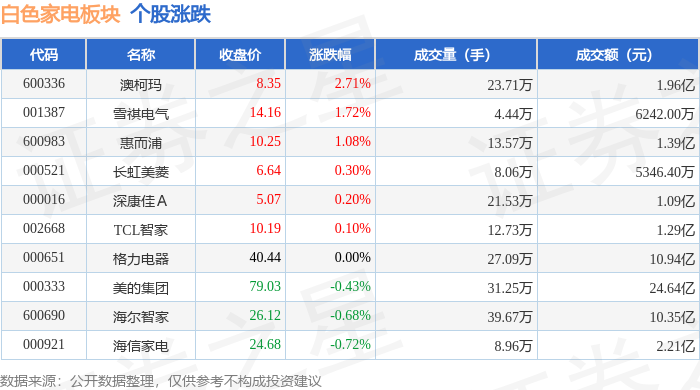
Market Overview - The white goods sector experienced a decline of 0.33% on January 8, with Hisense Appliances leading the drop [1] - The Shanghai Composite Index closed at 4082.98, down 0.07%, while the Shenzhen Component Index closed at 13959.48, down 0.51% [1] Stock Performance - Aokema (600336) saw a closing price of 8.35, with an increase of 2.71% and a trading volume of 237,100 shares, totaling a transaction value of 196 million yuan [1] - Snow Qi Electric (001387) closed at 14.16, up 1.72%, with a trading volume of 44,400 shares [1] - Whirlpool (600983) closed at 10.25, up 1.08%, with a trading volume of 135,700 shares, totaling 139 million yuan [1] - Gree Electric (000651) remained unchanged at 40.44, with a trading volume of 270,900 shares, totaling 1.094 billion yuan [1] - Hisense Appliances (000921) closed at 24.68, down 0.72%, with a trading volume of 89,600 shares, totaling 221 million yuan [1] Capital Flow - The white goods sector saw a net inflow of 297 million yuan from institutional investors, while retail investors experienced a net outflow of 4.7875 million yuan [1] - Midea Group (000333) had a net inflow of 3.27 billion yuan from institutional investors, but a net outflow of 2.40 billion yuan from speculative funds [2] - Haier Smart Home (600690) recorded a net inflow of 3.55 million yuan from retail investors, despite a net outflow of 30.6562 million yuan from speculative funds [2] - Hisense Appliances (000921) experienced a net outflow of 215,580 yuan from institutional investors [2]
家电轻工2026年策略报告:重点关注内需供给优化,外需新品类新市场-20260108
GOLDEN SUN SECURITIES· 2026-01-08 07:57
Group 1: Industry Overview - The home appliance and light industry in 2026 should focus on four investment themes: domestic demand supported by old-for-new policies, supply-side improvements in the power bank industry, and the rise of niche consumer products in service consumption [1] - The white goods sector is expected to benefit from the old-for-new policy, with a significant increase in consumer spending projected [44] - The overall performance of the light industry outperformed the CSI 300 index, with a cumulative increase of 24.68% from January to December 2025 [12][15] Group 2: Key Companies - Midea Group is developing a second growth curve through its B-end business, particularly in data center liquid cooling, which shows significant potential [2] - Haier Smart Home is enhancing its operational system through a data-driven approach, improving competitiveness across product, cost, and supply chain [2] - TCL Electronics and other companies in the black goods sector have shown strong performance, benefiting from the old-for-new subsidy policy [21] Group 3: Market Trends - The power bank industry is expected to see improved market conditions due to new regulations, which will raise industry standards and potentially eliminate many low-quality brands [2] - The "Guzi economy" is tapping into emotional consumption needs, with domestic IP supply increasing and consumer spending on IP expected to grow significantly [3] - The folding bicycle market is transitioning from niche to mainstream, with significant growth potential driven by urban mobility needs [3] Group 4: Export and New Markets - The export chain is gradually recovering from tariff disruptions, with a focus on companies that have strong overseas production capabilities to mitigate tariff risks [3] - New product categories, such as pool cleaning robots, have substantial growth potential, with Chinese companies expected to increase their market share [3] - Emerging markets in Africa and Latin America present new opportunities for multinational hygiene product companies [3]
多家企业回应空调涨价
Jing Ji Wang· 2026-01-08 02:44
Group 1 - The air conditioning industry is experiencing price adjustments, with major companies like Midea and Meibo announcing price increases of 5% for their products, while Gree Electric has committed to not raising prices [1] - The rise in raw material costs, particularly for copper and aluminum, is a significant factor driving the price adjustments in the air conditioning sector, with expectations of further increases by 2026 [1][2] - Industry experts suggest that the air conditioning market is shifting from a strategy of "price for volume" to "intelligence for profit," emphasizing the need for companies to leverage artificial intelligence and product innovation to enhance profitability [2][3] Group 2 - Companies are focusing on high-end product structures and innovative technologies to cope with rising costs, which is expected to accelerate industry consolidation [2] - The continuation of government subsidies for replacing old appliances is seen as a favorable opportunity for companies to promote high-efficiency and intelligent products, aiding the transition to a more profitable business model [3] - The recent price hikes reflect a deeper evolution in the competitive logic of the home appliance industry, driven by cost pressures, policy opportunities, and market reshuffling [3]