Focus Media(002027)

Search documents
未知机构:中信证券传媒分众传媒草根调研2026M2W2数据总结根据-20260213
未知机构· 2026-02-13 01:55
Summary of Conference Call Records Company and Industry Involved - The analysis focuses on **分众传媒 (Focus Media)** and the **advertising industry**, particularly in the context of digital and AI-driven advertising strategies. Core Insights and Arguments - In the week of 26M2W2, the number of unique advertisers on Focus Media's Shanghai network decreased to **17**, a decline from the previous week (26M2W1) [1] - Despite the decrease in the number of advertisers, there was an increase in the concentration of advertising spend, with **阿里千问 (Alibaba Qianwen APP)** significantly increasing its advertising efforts [1] - The structure of advertisers showed that major internet platforms like **京东 (JD.com)** and **淘宝 (Taobao)** maintained their advertising presence, focusing on promotions and traffic acquisition leading up to the Spring Festival, with overall advertising duration accounting for nearly **15%** [1] - The **daily consumer goods sector** remained active, with a focus on personal care and functional consumer products. Brands like **杜蕾斯 (Durex)**, **洒脱机器人 (Sato Robot)**, and **娇韵诗 (Clarins)** led in advertising share, while **金纺 (Jin Fang)** maintained stable exposure [1] - In the **food and beverage sector**, there was a concentration on single products, with **妙可蓝多 (Miaokelando)** accounting for over **10%** of advertising duration, and **柚香谷宋柚汁 (Youxiang Valley Song Grapefruit Juice)** close to **10%** as well [1] Additional Important Content - The standout highlight of the week was the **AI application advertising** by 阿里千问, which accounted for over **30%** of advertising duration, marking it as the core advertiser of the week. This indicates a critical window for traffic competition as major companies ramp up investments in AI application operations to enhance user scale and engagement [2] - 阿里千问 has officially launched offline channel advertising, indicating that leading internet companies are entering a phase of aggressive customer acquisition and brand awareness competition in the AI application sector [2] - As competition among major AI product companies intensifies, it is anticipated that marketing budgets for offline channels related to AI applications will likely increase [2] - A risk warning was issued stating that the data represents sampling results from grassroots research and may contain statistical biases [3]

分众传媒:公司将持续夯实主业经营,提升经营质量
Zheng Quan Ri Bao· 2026-02-12 08:37
Group 1 - The company stated that it operates in strict compliance with laws, regulations, and regulatory requirements [2] - The fluctuations in the secondary market stock price are influenced by multiple factors, including macroeconomic environment, industry cycles, and market sentiment [2] - The company aims to strengthen its core business operations and improve operational quality to provide stable performance for investors [2]

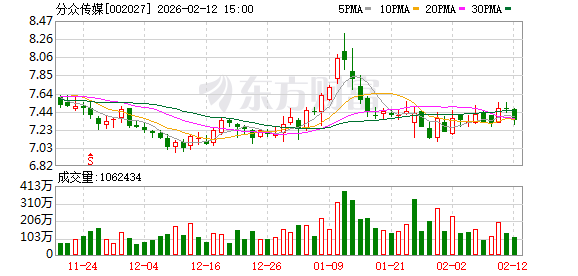
AI应用持续火热,影视ETF涨停,游戏ETF涨超6%,传媒ETF涨超5%
Sou Hu Cai Jing· 2026-02-10 04:17
Core Insights - The AI application in the media and gaming sectors is driving significant market activity, with various ETFs experiencing substantial gains, particularly the Film ETF which saw a limit-up increase [1] - ByteDance's launch of the AI video generation model Seedance 2.0 has sparked interest in AI-related stocks, although the model's ability to reference real human materials has been temporarily suspended for optimization [2] - The domestic gaming market is projected to continue its growth, with a notable increase in the number of game licenses issued, indicating a robust pipeline for future products [3] Group 1: ETF Performance - The Film ETF has increased by 10.03% year-to-date, with an estimated scale of 238 million [2] - The Gaming ETF has seen a rise of 6.68% year-to-date, with an estimated scale of 3.537 billion [2] - The Media ETF has grown by 5.87% year-to-date, with an estimated scale of 11.47 billion [2] Group 2: Market Trends - The pre-sale box office for new films during the 2026 Spring Festival has exceeded 86 million, indicating strong consumer interest [3] - The number of domestic game licenses issued in January increased by 33 compared to the previous month, and by 54 compared to the same period last year, suggesting improved approval processes [3] - The actual sales revenue of the domestic gaming market is projected to reach 350.79 billion in 2025, a year-on-year increase of 7.68% [3] Group 3: Industry Analysis - The gaming sector is expected to maintain a high growth trajectory, with the mobile gaming market projected to generate 257.08 billion in revenue, up 7.92% year-on-year [3] - The SW Media sector's allocation has shifted, with the gaming segment seeing an increase in overweight positions to 40.26% [4] - The revival of PC gaming and the increasing budget for mobile game development are expected to enhance the market's product offerings [5]




传媒行业跟踪报告:2025Q4传媒行业重仓配置回落至低配,游戏板块备受青睐
Wanlian Securities· 2026-02-09 05:36
Investment Rating - The industry is rated as "Outperforming the Market" with an expected relative increase of over 10% in the industry index compared to the broader market within the next six months [47]. Core Insights - In Q4 2025, the SW Media Industry Index decreased by 4.92%, with a slight reduction in capital activity, yet it remains at a high level. The fund's heavy allocation in the media sector has shifted to an underweight status, while the gaming sector continues to attract market attention and remains overweight [1][2][10]. - The gaming sector occupies a significant portion of the top ten heavy stocks, indicating high market interest. Among the top ten heavy stocks, eight are from the gaming industry, with notable declines in stock prices for most, except for one stock that saw an increase [2][24]. Summary by Sections 1. Capital Activity - The SW Media Industry Index closed at 819.69 points at the end of Q4 2025, down from 862.14 points at the beginning of the quarter, reflecting a 4.92% decline. The average daily trading volume was 51.09 billion yuan, a decrease of 5.20 billion yuan from the previous quarter [10]. 2. Industry Allocation Status - The allocation ratio for the SW Media Industry in Q4 2025 was 1.63%, with a fund heavy allocation ratio of 1.22%, indicating a low allocation of 0.41%. This reflects a shift from overweight to underweight status [13][16]. - The number of heavy allocation stocks accounted for 50.77% of the total, showing a slight decrease in concentration, ranking 14th among all primary industries [17]. - The gaming sector maintained an overweight status with a 40.26% allocation, while other sub-sectors remained underweight [35][39]. 3. Fund Concentration - The concentration of fund heavy stocks decreased slightly, with the top five, ten, and twenty stocks accounting for 68.74%, 85.72%, and 97.33% of the total fund heavy stock value, respectively, indicating a high concentration in leading stocks [3][43]. 4. Investment Recommendations - Given the current fund allocation and valuation levels in the SW Media Industry, it is suggested to focus on leading companies in the gaming sector, particularly those with rich game license reserves and applications in AI [45].





经济越来越差,这八大行业越赚爆!
创业家· 2026-02-07 10:24
Core Insights - The article discusses how certain industries are thriving despite a general perception of economic downturn, highlighting eight key sectors that present significant business opportunities in a low-desire society [3][4]. Group 1: Key Industries - **Second-Hand Economy**: The second-hand luxury market in Japan, represented by companies like Daikokuya, has seen a surge in revenue. In China, platforms like Hongbulin and Panghu are experiencing similar growth, indicating a shift in consumer spending towards second-hand goods [6][7][8][9]. - **Pet Economy**: With declining birth rates, young people are spending more on pets, leading to significant growth in pet food and healthcare products. Companies like Inaba in Japan and Guobao in China are capitalizing on this trend [11][12][14][15]. - **Adult Care Products**: The adult diaper market in Japan has surpassed $10 billion, indicating a growing demand for adult care products in China, with companies like Kexin showing potential for growth [16][17][18]. - **Health Food and Beverages**: The rise in health consciousness has led to increased demand for sugar-free beverages and functional drinks. Brands like Dongfang Shuye and Jianchun are gaining traction in this sector [21][22]. - **Beauty Economy**: The demand for beauty products, including collagen supplements and at-home beauty devices, is on the rise. Companies like Jinbo Biological are seeing significant market value growth [23][25]. - **Outdoor and Leisure Products**: The outdoor equipment market is thriving, with brands like Kailas and Camel experiencing rapid sales growth, as consumers seek leisure activities despite economic constraints [25][26][27]. - **Emotional Economy**: Brands like Labubu and Rio are tapping into the emotional needs of consumers, providing products that offer comfort and joy, even in a tight economic climate [28][29][30]. - **Convenience Economy**: The demand for convenience products, such as frozen foods and smart home appliances, is increasing as younger generations spend less time cooking. Companies like Anjijia and Kewot are benefiting from this trend [33][35][36]. Group 2: Market Trends - The article emphasizes that the current economic climate, often viewed as a "winter," presents opportunities for those willing to invest in counter-cyclical sectors. The key to success lies in recognizing and seizing these opportunities [39].



分众传媒:公司目前主营业务稳健发展
Zheng Quan Ri Bao Wang· 2026-02-04 13:49
证券日报网讯2月4日,分众传媒(002027)在互动平台回答投资者提问时表示,公司目前主营业务稳健 发展,经营现金流健康,具备稳定实施现金分红的基础和能力。 ...
广告营销板块2月4日跌4.2%,天地在线领跌,主力资金净流出67.27亿元
Zheng Xing Xing Ye Ri Bao· 2026-02-04 08:57
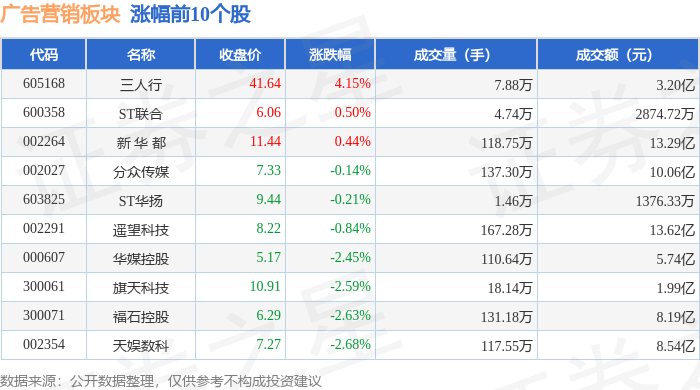
Core Viewpoint - The advertising and marketing sector experienced a decline of 4.2% on February 4, with Tian Di Online leading the drop, while the overall stock market indices showed slight increases [1]. Group 1: Market Performance - The Shanghai Composite Index closed at 4102.2, up 0.85% [1]. - The Shenzhen Component Index closed at 14156.27, up 0.21% [1]. Group 2: Individual Stock Performance - Tian Di Online (002995) saw a significant drop of 10.00%, closing at 33.29, with a trading volume of 308,900 shares and a transaction value of 1.055 billion [2]. - Other notable declines included InSai Group (300781) down 9.39% to 48.84, and YiDianTianXia (301171) down 9.25% to 63.85 [2]. - The top gainer was SanRenXing (605168), which increased by 4.15% to 41.64, with a transaction value of 320 million [1]. Group 3: Capital Flow - The advertising and marketing sector experienced a net outflow of 6.727 billion in main funds, while retail investors saw a net inflow of 5.481 billion [2][3]. - The main funds showed a net inflow of 39.924 million into SanRenXing (605168), while other stocks like FenZhongChuanMei (002027) and JiaYunKeJi (300242) experienced net outflows [3].


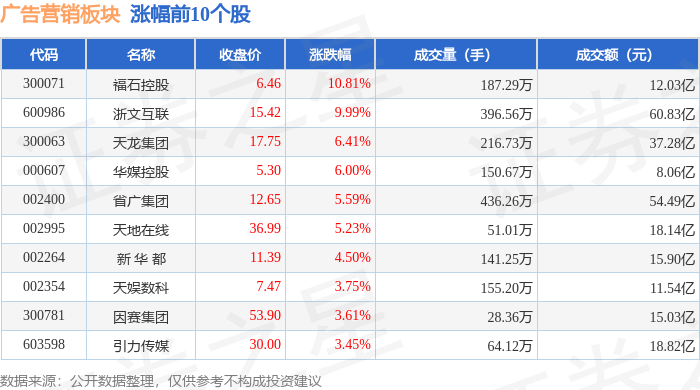
广告营销板块2月3日涨2.62%,福石控股领涨,主力资金净流出10.12亿元
Zheng Xing Xing Ye Ri Bao· 2026-02-03 09:10
Core Insights - The advertising and marketing sector experienced a rise of 2.62% on February 3, with Fushi Holdings leading the gains [1] - The Shanghai Composite Index closed at 4067.74, up 1.29%, while the Shenzhen Component Index closed at 14127.1, up 2.19% [1] Group 1: Stock Performance - Fushi Holdings (300071) closed at 6.46, with a significant increase of 10.81% and a trading volume of 1.8729 million shares, amounting to a transaction value of 1.203 billion [1] - Zhejiang Wenlian (600986) saw a closing price of 15.42, up 9.99%, with a trading volume of 3.9656 million shares and a transaction value of 6.083 billion [1] - Tianlong Group (300063) closed at 17.75, increasing by 6.41%, with a trading volume of 2.1673 million shares and a transaction value of 3.728 billion [1] Group 2: Capital Flow - The advertising and marketing sector experienced a net outflow of 1.012 billion from institutional investors, while retail investors saw a net inflow of 929 million [2][3] - Among individual stocks, Huamei Holdings (000607) had a net inflow of 153 million from institutional investors, representing 18.95% of its trading volume [3] - Zhejiang Wenlian (600986) had a net inflow of 732 million from institutional investors, accounting for 12.03% of its trading volume [3]


多家中小行暂停新增助贷联合贷业务
Jing Ji Wang· 2026-02-03 06:19
Core Viewpoint - The implementation of the new lending regulations (Document No. 9) has led to a significant halt in cooperation between banks and lending platforms, particularly affecting personal business loans and shrinking the overall internet finance loan market [1][2]. Group 1: Impact on Banks - Many banks, especially small and medium-sized ones, have ceased cooperation with lending platforms, reflecting a broader industry trend following the new regulations [2][3]. - A specific bank in East China has stopped all personal business loan collaborations with lending platforms, while maintaining a non-renewal stance on non-business internet loans [2]. - The new regulations have prompted banks to become more cautious, with one bank reporting a loan balance of 20 billion to 50 billion yuan with its partnered platforms, and subsequently terminating relationships with four non-compliant institutions [2]. Group 2: Effects on Lending Platforms - The new regulations have had a disruptive impact on lending platforms, leading to significant financial losses and valuation declines, as evidenced by the case of Shuhe Technology, which reported a net loss of approximately 684 million yuan in Q4 2025 [4][6]. - The valuation of Shuhe Technology dropped by 73.45%, from 29.44 billion yuan to approximately 7.82 billion yuan, following the new regulatory environment [4][5]. - Another example is Jia Yin Technology, which reported a quarterly loan facilitation volume of 32.2 billion yuan, a year-on-year increase of 20.6% but a quarter-on-quarter decrease of 13.2% [5]. Group 3: Strategic Adjustments by Platforms - Leading platforms such as Lexin and Xin Ye Technology have proactively adjusted their operations in anticipation of the new regulations, including changes to borrower contracts and risk management systems [7]. - As of October 2025, the proportion of new loans with interest rates exceeding 24% has dropped to 10%, the lowest in recent years, indicating a strategic shift to reduce high-risk lending [7]. - Platforms are actively shedding high-interest clients to mitigate the impact on short-term profits, which is expected to be reflected in their Q4 2025 financial reports [7].

千亿“梯媒巨头”25亿巨额计提背后,监管“导火索”已引燃半年之久
Xin Lang Cai Jing· 2026-02-02 09:47
Group 1 - The core point of the article is that Focus Media has announced a complete exit from its investment in Shuhua Technology for 791 million yuan, leading to a significant impairment charge of 2.529 billion yuan in Q4 2025, which will heavily impact its financial performance [3][27][29] - The impairment is a result of Shuhua Technology's net loss of approximately 684 million yuan in Q4 2025, and the assessment of the equity held by Focus Media in Shuhua shows a substantial decrease in value, with a write-down rate of 73.45% [6][29][30] - The decision to recognize this impairment charge is seen as a way to leave the financial burden in the previous year while presenting a potential boost to earnings in 2026 due to the transfer of previously recorded capital reserve to investment income [4][31][30] Group 2 - The regulatory framework that triggered the impairment was established in April 2025, with a clear transition period until its implementation in October 2025, indicating that Focus Media had ample time to assess the potential impact on its investment [11][32][34] - Experts have raised concerns about the timing of Focus Media's impairment recognition, suggesting that the company should have acted sooner based on the regulatory changes rather than waiting for the official implementation [12][35][33] - Focus Media's historical relationship with Shuhua Technology has evolved from a controlling stake to a joint venture, ultimately leading to the complete divestment, which reflects a strategic shift towards focusing on core business operations [14][36][44] Group 3 - The exit from Shuhua Technology is part of a broader strategy for Focus Media to divest non-core businesses and concentrate on its primary advertising operations, which is expected to enhance its market position [22][44] - The company is also in the process of acquiring 100% of New Trend Media for 8.3 billion yuan, which is seen as a significant move to strengthen its market dominance in the advertising sector [22][44] - If the acquisition of New Trend Media is completed within the year, along with the financial adjustments from the exit of Shuhua Technology, Focus Media is anticipated to present a more favorable financial outlook for the upcoming fiscal year [22][44]