IMDTECL(002128)

Search documents
电投能源:公司拟通过发行股份及支付现金方式购买国家电投集团内蒙古白音华煤电有限公司100%股权
Zheng Quan Ri Bao Zhi Sheng· 2025-09-11 11:41
(编辑 袁冠琳) 证券日报网讯 电投能源9月11日在互动平台回答投资者提问时表示,公司拟通过发行股份及支付现金方 式购买国家电投集团内蒙古白音华煤电有限公司100%股权,并将视具体情况募集配套资金事项,公司 及相关各方正在积极推进相关工作。截至目前,本次交易相关的审计、评估等工作尚未完成,公司将在 本次交易涉及的审计、评估等事项完成后,再次召开董事会会议审议本次交易的相关议案,公司董事会 再次审议通过后提交公司股东大会审议,并经相关监管机构批准后方可正式实施。 ...

电投能源:截至2025年6月30日公司普通股股东总数30505户
Zheng Quan Ri Bao Wang· 2025-09-11 11:40
Group 1 - The company, Electric Power Investment Energy (002128), stated that as of June 30, 2025, the total number of common stock shareholders will be 30,505 [1]
炭本溯源系列3:中国煤炭成本十年变迁:刚性抬升重塑安全边际
Changjiang Securities· 2025-09-11 05:36
Investment Rating - The report maintains a "Positive" investment rating for the coal industry [11]. Core Insights - The report emphasizes that the systematic increase in coal costs over the past decade has solidified the safety margin for coal prices, with current cash cost support for port thermal coal prices at approximately 550 RMB/ton [3][9]. - It highlights that the coal price bottom is unlikely to return to the low levels seen in 2015, reinforcing the profitability and dividend safety margins for coal companies [3][9]. Summary by Sections Introduction - The report introduces the importance of cost research in establishing the safety margin for coal prices, indicating that a high cost-supported price bottom can enhance dividend value [6][20]. Overall Cost Trends - Over the past decade, coal company costs have increased by nearly 50%, with a CAGR of approximately 4% [6][24]. - The weighted average sales cost for coal in 2024 is projected to be 300 RMB/ton, down 2% year-on-year, while the complete cost is expected to be 380 RMB/ton, down 3% year-on-year [6][24]. Cost Structure - The cost structure for coal companies in 2024 is composed of labor costs (32%), other expenses (30%), raw materials (14%), depreciation (12%), safety costs (9%), and manufacturing costs (3%) [7][41]. - Labor costs, depreciation, and safety expenses have seen the most significant increases over the past decade, with labor costs rising by 28 RMB/ton [7][41]. Cost Curve Analysis - The cash cost curve for port thermal coal has shifted, with the 90th percentile cash cost now supporting prices around 550 RMB/ton [8][9]. - The complete cost curve for thermal coal has also increased, with the 90th percentile complete cost now between 370-423 RMB/ton [8][9]. Investment Recommendations - The report suggests that the systematic increase in costs has solidified the safety margin for coal prices, recommending several companies for investment based on their resilience and growth potential [9][11]. - Recommended companies include Yanzhou Coal Mining Company, Jinneng Holding, and China Shenhua Energy [9].


煤炭2025中报总结(一):业绩压力测试结束,反转,不是反弹
GOLDEN SUN SECURITIES· 2025-09-05 08:41
Investment Rating - The report maintains a "Buy" rating for the coal mining sector, indicating a positive outlook for the industry moving forward [5]. Core Insights - The report emphasizes that the coal industry is experiencing a reversal rather than a rebound, with expectations for profitability to improve as coal prices have likely reached their lowest point [12][10]. - The report highlights that coal prices have begun to stabilize and recover, particularly in the context of both thermal and coking coal [15][19]. Summary by Sections Market Overview - As of September 1, 2025, the spot price for Q5500 thermal coal is reported at 695 CNY/ton, down 73 CNY/ton from the beginning of the year but up 77 CNY/ton from the lowest price in June [19]. - The average spot price for Q5500 thermal coal in Q2 2025 was 642 CNY/ton, reflecting a year-on-year decline of 211 CNY/ton (24.7%) and a quarter-on-quarter decline of 91 CNY/ton (12.5%) [19]. - Coking coal prices have also shown resilience, with the price for low-sulfur coking coal reported at 1480 CNY/ton, up 100 CNY/ton from the start of the year [23]. Performance Overview - The report notes that the coal sector has underperformed compared to the broader market, with the CSI 300 index rising by 16.37% from April 1 to September 1, 2025, while the coal index only increased by 8.99% [2][29]. - Among 26 sampled coal companies, 19 saw their stock prices rise, while 7 experienced declines during the same period [2]. Fund Holdings - As of Q2 2025, active funds held 0.43% of their portfolios in the coal sector, a slight decrease from Q1, while passive funds held 0.71%, also down from the previous quarter [3][34]. - The combined holding of both active and passive funds in the coal sector is 0.55%, reflecting a decline of 0.06 percentage points from Q1 2025 [3]. Financial Performance - The report indicates that coal companies' profits have been under pressure due to declining coal prices, with a total profit decline of 5.4% to 113.7% among the sampled companies [3][12]. - Notably, companies like Electric Power Energy and Kailuan achieved profit growth despite the overall downward trend in the sector [3]. Operational Insights - Coal companies are focusing on increasing production, improving quality, and reducing costs to mitigate the impact of falling prices [4][12]. - The total coal production for the sampled companies in H1 2025 was 586 million tons, a year-on-year increase of 4.5% [12]. Investment Recommendations - The report recommends stocks with strong earnings elasticity such as Lu'an Energy, Yanzhou Coal, and Jinkong Coal, while also highlighting key state-owned enterprises like China Shenhua and China Coal Energy for potential investment [10][11].




上市公司抢滩新能源发电项目
Zheng Quan Ri Bao· 2025-09-04 16:12
Core Viewpoint - The announcement from Gansu Energy indicates a significant investment in renewable energy projects, reflecting a broader trend among listed companies to enhance their renewable energy capacity in response to national policies and market demands [1][2]. Group 1: Company Developments - Gansu Energy plans to invest in a 1 million kW integrated wind and solar project in Minqin, with a total investment of 4.089 billion yuan [1][2]. - The project will consist of 500,000 kW from wind power and 500,000 kW from solar power, with expected annual electricity generation of 1.099 billion kWh from wind and 1.015 billion kWh from solar [2]. - The investment recovery period for the project is estimated at 14.91 years, with a financial internal rate of return of 6.76% [2]. Group 2: Industry Trends - The surge in renewable energy project announcements is driven by four main factors: supportive national policies under the "dual carbon" goals, increasing market demand for clean energy, technological advancements reducing costs, and strategic needs for energy security [3]. - As of the first half of the year, the total installed power generation capacity in China reached 3.65 billion kW, a year-on-year increase of 18.7%, with solar power capacity growing by 54.2% and wind power capacity by 22.7% [3]. - The industry is shifting from "scale expansion" to "quality first," facing challenges such as insufficient grid capacity and increased competition among projects [4][6]. Group 3: Policy Implications - The National Development and Reform Commission and the National Energy Administration have issued a notice promoting market-oriented pricing for renewable energy, which will require project holders to enhance their market transaction capabilities [5][6]. - This policy change aims to create a true market price for electricity, facilitating efficient resource allocation and guiding the healthy development of the renewable energy sector [5].

电投能源跌2.01%,成交额5957.04万元,主力资金净流入108.87万元
Xin Lang Cai Jing· 2025-09-03 02:53
Group 1 - The core viewpoint of the news is that 电投能源 (Electric Power Investment Energy) has experienced fluctuations in its stock price and financial performance, with a notable increase in stock price year-to-date and a slight decline in net profit [1][2]. - As of September 3, the stock price of 电投能源 was 20.94 yuan per share, with a market capitalization of 469.39 billion yuan, and a year-to-date stock price increase of 11.50% [1]. - The company reported a revenue of 144.64 billion yuan for the first half of 2025, reflecting a year-on-year growth of 2.38%, while the net profit attributable to shareholders decreased by 5.36% to 27.87 billion yuan [2]. Group 2 - The main business segments of 电投能源 include electrolytic aluminum (55.11% of revenue), coal products (30.29%), wind power products (6.44%), coal-electric products (5.53%), and others [1]. - The company has distributed a total of 118.15 billion yuan in dividends since its A-share listing, with 45.50 billion yuan distributed in the last three years [3]. - As of June 30, 2025, the number of shareholders for 电投能源 was 30,500, a decrease of 2.75% from the previous period, while the average number of circulating shares per person increased by 2.82% to 73,482 shares [2].
煤炭开采板块9月2日涨0.03%,电投能源领涨,主力资金净流出4.2亿元
Zheng Xing Xing Ye Ri Bao· 2025-09-02 09:09
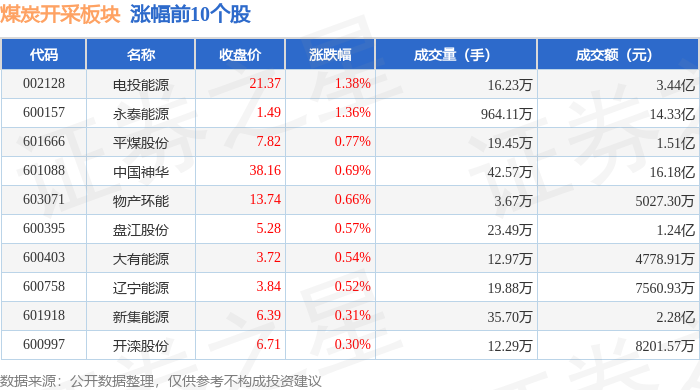
Group 1: Market Performance - The coal mining sector increased by 0.03% compared to the previous trading day, with Electric Power Investment leading the gains [1] - The Shanghai Composite Index closed at 3858.13, down 0.45%, while the Shenzhen Component Index closed at 12553.84, down 2.14% [1] Group 2: Individual Stock Performance - Electric Power Investment (002128) closed at 21.37, up 1.38% with a trading volume of 162,300 shares [1] - Yongtai Energy (600157) closed at 1.49, up 1.36% with a trading volume of 9.64 million shares [1] - China Shenhua (601088) closed at 38.16, up 0.69% with a trading volume of 425,700 shares [1] - Jinko Energy (601001) closed at 12.96, down 2.56% with a trading volume of 226,400 shares [2] Group 3: Capital Flow Analysis - The coal mining sector experienced a net outflow of 420 million yuan from main funds, while retail investors saw a net inflow of 314 million yuan [2] - The main funds showed a negative net flow in several stocks, including Yongtai Energy and Pingmei Shenhua [3] - Retail investors contributed positively to stocks like Gansu Energy and New Dazhou A, indicating varied investor sentiment across the sector [3]


国泰海通晨报-20250902
Haitong Securities· 2025-09-02 03:11
Group 1: Company Analysis - Weichai Power - Weichai Power's 2025 interim report shows significant growth in data center large-capacity engines, with nearly 600 units sold, representing a 491% year-on-year increase [4] - The company's AIDC business is rapidly developing, and the KION logistics equipment business is expected to improve profitability after management optimization [2][4] - Weichai Power's revenue for the first half of 2025 was CNY 1131.5 billion, a slight increase of 0.6% year-on-year, while net profit attributable to shareholders was CNY 56.4 billion, down 4.4% year-on-year [3][4] Group 2: Company Analysis - Tuojing Technology - Tuojing Technology's advanced process verification equipment has successfully passed customer certification and is gradually entering the mass production phase, leading to a significant improvement in profitability [13][14] - The company's revenue for the first half of 2025 reached CNY 1.954 billion, a year-on-year increase of 54.25%, with a net profit of CNY 38.18 million, up 91.35% year-on-year [14] - The sales gross margin for Q2 2025 was 38.82%, indicating a clear upward trend in profitability [14] Group 3: Company Analysis - Iwu Biological - Iwu Biological's core product, dust mite drops, is steadily growing, while the new product, Artemisia annua drops, is rapidly gaining market share [17][18] - The company reported a revenue of CNY 484 million for the first half of 2025, a year-on-year increase of 12.81%, and a net profit of CNY 177 million, up 18.61% year-on-year [17][18] - The company is focusing on new research directions, including stem cells and natural medicines, which may enhance its growth potential [18] Group 4: Industry Analysis - Textile and Apparel - The textile and apparel industry faces significant operational challenges, with A-share apparel revenue declining in Q2, although some companies are showing strong performance [7][10] - The retail sales of clothing and accessories in China showed a year-on-year increase of 1.8% in July, indicating a slight recovery in consumer demand [9] - The export of textiles and garments from China saw a year-on-year decline of 0.3% in July, with garment exports weakening [9][11]


能源周报(20250825-20250831):乌克兰袭击俄罗斯能源设施,本周油价震荡运行-20250901
Huachuang Securities· 2025-09-01 11:13
Investment Strategy - The global oil and gas capital expenditure trend is declining, leading to a slowdown in supply growth. Since the signing of the Paris Agreement in 2015, the global carbon neutrality process has accelerated, resulting in a significant decrease in upstream capital expenditure, which was $351 billion in 2021, down nearly 22% from the 2014 peak. The capital expenditure is expected to continue to shrink as major energy companies face pressure from policies and the need for transformation [8][24][25] - The report suggests focusing on companies that benefit from high oil prices and increased capital expenditure, such as China National Offshore Oil Corporation (CNOOC), China National Petroleum Corporation (CNPC), and Sinopec [9][24] Oil Market - The oil market is experiencing fluctuations due to Ukraine's attacks on Russian energy facilities, which have led to a decrease in Russian refining capacity. Brent crude oil is priced at $67.62 per barrel, down 0.43% week-on-week, while WTI crude oil is at $64.16 per barrel, up 1.63% week-on-week [9][27][28] - OPEC's unexpected speed in reducing production and the resilience of demand, supported by recent GDP growth forecasts from the World Bank and IMF, suggest that oil prices may continue to fluctuate [9][24] Coal Market - The thermal coal market is experiencing a slight decline in prices due to weakened downstream demand. The average market price for Qinhuangdao port thermal coal (Q5500) is 695 yuan per ton, down 1.14% week-on-week. The total inventory at the nine ports in the Bohai Rim is reported at 23.08 million tons, down 0.79% [10][11] - The report highlights that domestic coal production is being maintained at normal levels, but some areas are affected by rainfall, leading to supply tightness. The demand from power plants remains stable, but the cement market is weak [10][11] Coking Coal Market - The coking coal market is currently in a stalemate, with the price of coking coal remaining stable at 1,610 yuan per ton. The report notes that safety inspections are tightening, limiting the supply of coking coal, while steel mills are cautious about purchasing due to weak market conditions [13][14] - The report suggests focusing on coking coal producers with strong resource capabilities, such as Huabei Mining and Pingmei Shenma Group, as they are well-positioned to benefit from price increases [14] Natural Gas Market - The report mentions the potential restart of the Datang Group's coal-to-gas project in Liaoning, which is the largest single investment project in Fuxin's history. The average price of natural gas in the U.S. is $2.82 per million British thermal units, up 1.3% week-on-week [15][16] - European natural gas prices are also rising, with the UK IPE natural gas price at $10.95 per million British thermal units, up 2.0% week-on-week [15][16] Oilfield Services - The oilfield services industry is expected to maintain its prosperity due to government policies supporting energy security. The total capital expenditure of the three major oil companies is projected to be 583.3 billion yuan in 2023, with CNOOC showing a compound growth rate of 13.1% [18][19] - The global active rig count is reported at 1,621, with a slight increase in the Asia-Pacific region, indicating a stable outlook for the oilfield services sector [18][19]




煤炭开采板块9月1日涨0.66%,新大洲A领涨,主力资金净流出1.65亿元
Zheng Xing Xing Ye Ri Bao· 2025-09-01 08:53
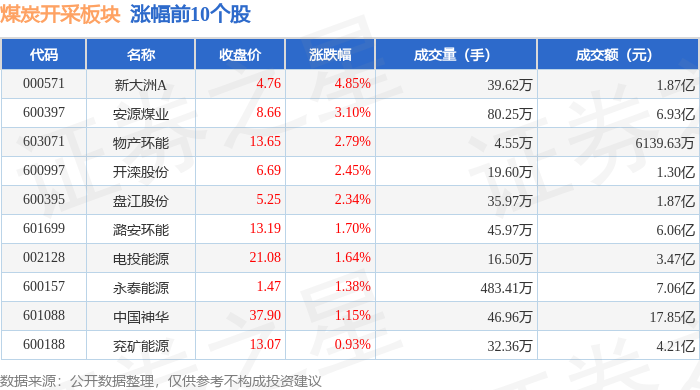
Group 1 - The coal mining sector increased by 0.66% on September 1, with Xindazhou A leading the gains [1] - The Shanghai Composite Index closed at 3875.53, up 0.46%, while the Shenzhen Component Index closed at 12828.95, up 1.05% [1] - Key stocks in the coal mining sector showed varied performance, with Xindazhou A rising by 4.85% and Huaihe Energy declining by 1.14% [2] Group 2 - The coal mining sector experienced a net outflow of 165 million yuan from institutional investors and 124 million yuan from retail investors, while retail investors saw a net inflow of 289 million yuan [2] - Specific stock fund flows indicated that Yongtai Energy had a net outflow of 43.62 million yuan from institutional investors, while Yanzhou Coal had a net inflow of 31.27 million yuan [3] - The overall trading volume and turnover for key stocks in the coal mining sector varied, with significant transactions recorded for stocks like Anyuan Coal and China Shenhua [1][2]