Binjiang Group(002244)

Search documents
上海楼市突传重磅利好!地产闻声领涨!全市场唯一地产ETF(159707)盘中上探5.5%吸引净申购3700万份
Mei Ri Jing Ji Xin Wen· 2025-08-25 06:04
Group 1 - The core message indicates that the Shanghai real estate market received significant positive news, leading to a surge in the real estate sector, with the CSI 800 Real Estate Index rising over 4% and major companies like Vanke A hitting the daily limit [1] - Starting from August 26, 2025, Shanghai will optimize and adjust real estate policies, including reducing housing purchase restrictions and improving housing provident fund and personal housing credit policies [1] - Despite low sales data in the first seven months of 2025, the real estate industry is expected to stabilize, with continued policy support aimed at boosting sales and funding, particularly in core cities [1] Group 2 - The real estate ETF (159707) tracks the CSI 800 Real Estate Index, comprising 13 leading quality real estate companies, showcasing a significant concentration of top-tier firms with over 90% weight in the top ten constituents [2] - The presence of central and state-owned enterprises in the ETF indicates a robust backing, suggesting that leading real estate companies may exhibit greater resilience amid industry challenges [2]



调整限购 上海楼市大招来了!地产股早盘大涨 万科时隔半年涨停
Mei Ri Jing Ji Xin Wen· 2025-08-25 04:46
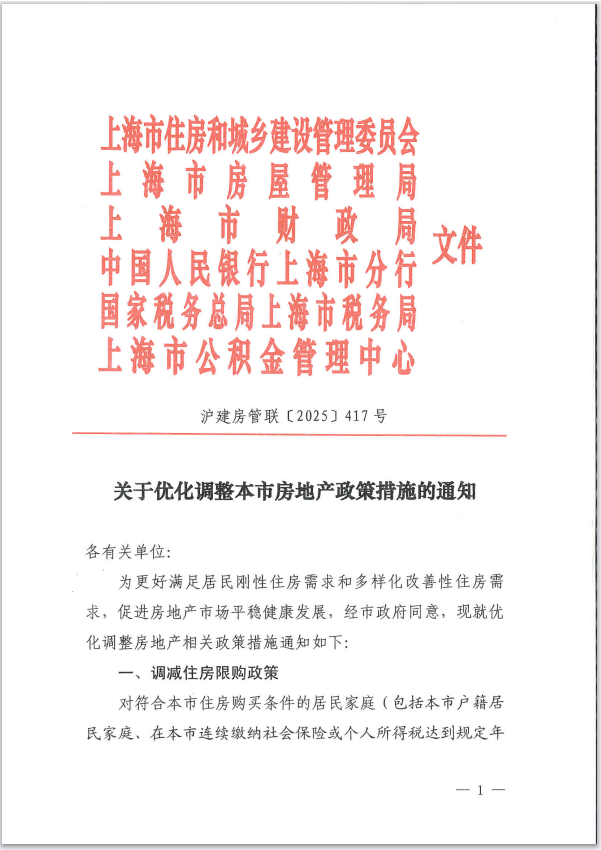
Core Viewpoint - The Shanghai government has announced a series of policy adjustments aimed at optimizing the real estate market to better meet residents' housing needs and promote stable development. These adjustments include reducing housing purchase restrictions, optimizing housing provident fund policies, adjusting personal housing loan interest rates, and improving property tax regulations. The new policies will take effect on August 26, 2025 [1][5]. Group 1: Housing Purchase Restrictions - The new policy reduces housing purchase restrictions, allowing eligible residents to buy an unlimited number of homes outside the outer ring road. This applies to both local residents and non-local residents who have paid social insurance or income tax in Shanghai for at least one year [2][5]. - Local residents and single adults can purchase an unlimited number of homes outside the outer ring road, while they are limited to two homes within the inner ring road. Non-local residents can buy without limit outside the outer ring road and are limited to one home within the inner ring road if they have paid social insurance or income tax for three years [2][5]. Group 2: Housing Provident Fund Policy - The policy enhances the housing provident fund support for home purchases. The maximum loan amount for first-time buyers of new green buildings is increased by 15%, with the maximum loan for first-time buyers rising from 1.6 million to 1.84 million yuan, and for families with multiple children from 1.92 million to 2.16 million yuan [3][6]. - Homebuyers can withdraw their provident fund to pay for the down payment of new pre-sale properties, and this withdrawal will not affect their loan eligibility [3][6]. Group 3: Personal Housing Loan Interest Rates - The policy optimizes the pricing mechanism for personal housing loans, allowing banks to set interest rates without differentiating between first and second homes, based on market conditions and customer risk profiles [4][6]. Group 4: Property Tax Policy - The policy provides a temporary exemption from property tax for the first home purchased by eligible non-local residents. For second homes and beyond, a tax exemption of 60 square meters per person will be applied when calculating the total housing area [4][6]. Group 5: Market Reaction - Following the announcement, real estate stocks surged in the market, with notable increases including Vanke A reaching a 10.06% rise, and other companies like Wan Tong Development and Rongsheng Development also hitting their daily limits [9][10].


调整限购,上海楼市大招来了!地产股早盘大涨,万科时隔半年涨停
Mei Ri Jing Ji Xin Wen· 2025-08-25 04:32
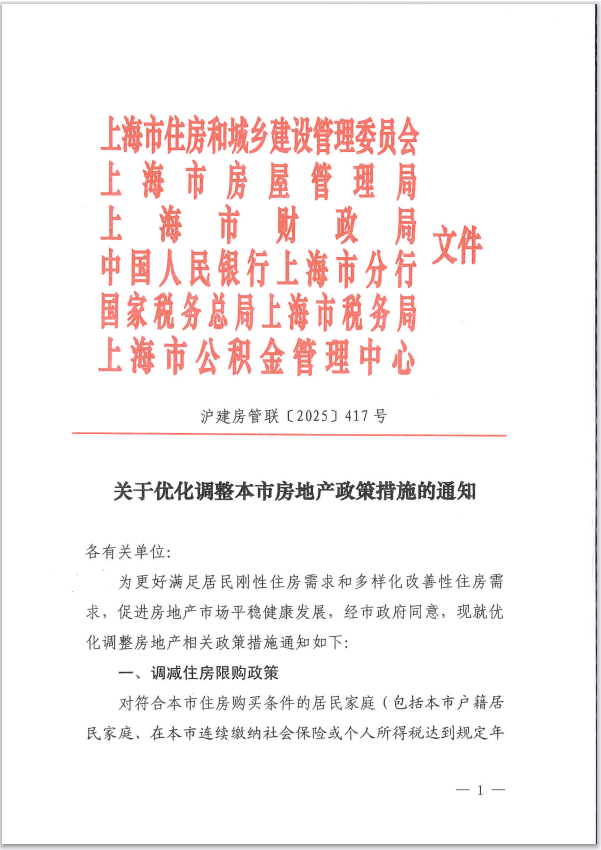
Core Viewpoint - On August 25, Shanghai's six departments jointly issued a notice to optimize and adjust real estate policies to better meet residents' housing needs and promote a stable and healthy real estate market, effective from August 26, 2025 [1]. Group 1: Housing Purchase Policy Adjustments - The housing purchase limit will be reduced, allowing eligible residents to buy an unlimited number of homes outside the outer ring road, including both new and second-hand homes [2][8]. - Local residents and single adults can purchase up to two homes within the inner ring road, while non-local residents can buy one home if they have paid social insurance or income tax for three years [2][9]. Group 2: Housing Provident Fund Policy Optimization - The maximum loan amount for housing provident fund loans will increase by 15% for those purchasing new green buildings rated two stars or above, with the first loan limit rising from 1.6 million to 1.84 million yuan [4][10]. - Homebuyers can withdraw their provident fund to pay the down payment for new homes, and this withdrawal will not affect their loan limit [4][10]. Group 3: Personal Housing Loan Interest Rate Mechanism - The interest rate pricing mechanism for personal housing loans will be optimized, with no distinction between first and second homes, allowing banks to set rates based on market conditions and customer risk [5][10]. Group 4: Property Tax Policy Improvements - Non-local residents purchasing their first home will be exempt from property tax, while those buying a second or additional homes will receive a tax exemption for 60 square meters per person after calculating the total housing area [6][10]. Group 5: Market Reaction - Following the announcement, real estate stocks surged, with Vanke A hitting a six-month high, and several other companies also experiencing significant gains, indicating positive market sentiment towards the new policies [12][13].
地产行业周报:地产板块相对滞涨,积极因素仍存-20250825
Ping An Securities· 2025-08-25 02:31
Investment Rating - The industry investment rating is "Outperform the Market" (maintained) [1] Core Viewpoints - The real estate sector has underperformed the market due to multiple factors, with a weekly increase of 0.5%, lagging behind the CSI 300's 4.18% rise. Key influences include a preference for more elastic sectors, a lack of stability in the housing market, and pressure on some real estate companies' interim performance [2][3] - Despite concerns, there are positive factors such as potential policy support and the ongoing demand for quality properties, which may sustain market interest [2][3] Summary by Sections Market Performance - As of August 22, the real estate sector has only increased by 3.4% year-to-date, significantly underperforming the CSI 300's 11.3% [2] - Recent comments from Premier Li Qiang emphasize the need for strong measures to stabilize the real estate market, indicating potential policy support [2][7] Market Monitoring - New home transactions in 50 key cities reached 15,000 units, a 17.4% increase week-on-week, while second-hand home transactions in 20 key cities reached 18,000 units, up 7.8% [2][9] - Inventory levels slightly increased, with a total of 9,149 million square meters and a depletion cycle of 20.1 months as of August 22 [2][12] Capital Market Monitoring - The real estate sector's PE ratio (TTM) stands at 45.69, significantly higher than the CSI 300's 13.97, indicating a valuation at the 99.84 percentile over the past five years [2][21] - This week, the issuance of domestic real estate bonds totaled 11.16 billion yuan, reflecting a rise in issuance volume [2][18] Key Company Recommendations - Recommended companies include: - China Resources Land, benefiting from stable dividends and a recovery in quality property sales [4] - Beike-W, a high-elasticity stock with significant market share in second-hand and new homes [4] - Jianfa International Group, known for its strong product quality and high dividends [4] - China Overseas Land, a leading state-owned enterprise with low valuation [4] - Greentown China, recognized for its quality and strong land acquisition capabilities [4]



房地产开发:2025W34:LPR报价持平,本周二手房成交同比+9.5%
GOLDEN SUN SECURITIES· 2025-08-24 08:42
Investment Rating - The report maintains an "Overweight" rating for the real estate industry [3][5]. Core Viewpoints - The report emphasizes that the current policy environment is being driven by fundamental pressures, suggesting that the policy response may exceed the levels seen in 2008 and 2014, and is still evolving [3]. - Real estate is identified as an early-cycle indicator, serving as a barometer for economic trends, making it a strategic investment focus [3]. - The competitive landscape within the industry is improving, with leading state-owned enterprises and select mixed-ownership and private firms performing well in land acquisition and sales [3]. - The report continues to favor investment in first-tier cities and two-thirds of second-tier cities, as this combination has shown better performance during sales rebounds [3]. - Supply-side policies, including land storage and management of idle land, are highlighted as critical areas to monitor, with first and second-tier cities expected to benefit more from these changes [3]. Summary by Sections Real Estate Development - The 5-year LPR remains stable at 3.5% as of August, with the 1-year LPR at 3.0% [10]. - The real estate index saw a cumulative change of 0.5%, lagging behind the CSI 300 index by 3.68 percentage points, ranking last among 31 sectors [13]. - New home sales in 30 cities totaled 1.57 million square meters, a 16.7% increase month-on-month but a 16.1% decrease year-on-year [20]. - Year-to-date, new home sales in the same 30 cities are down 2.1% year-on-year, with first-tier cities showing a 2.4% increase [25]. Secondary Housing - Secondary home sales in 14 sample cities reached 1.915 million square meters, reflecting a 6.4% month-on-month increase and a 9.5% year-on-year increase [30]. - Cumulative secondary home sales for the year are 6.8677 million square meters, up 16.7% year-on-year [30]. Credit Bonds - In the week of August 18-24, 18 credit bonds were issued by real estate companies, totaling 15.282 billion yuan, an increase of 6.921 billion yuan from the previous week [39]. - The net financing amount was 3.378 billion yuan, reflecting a significant increase [39].



滨江集团最新股东户数环比下降10.17% 筹码趋向集中
Zheng Quan Shi Bao Wang· 2025-08-22 09:21
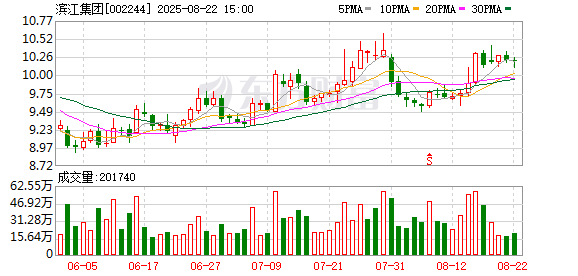
Group 1 - The core point of the article is that Binhai Group has seen a significant decrease in the number of shareholders, with a reduction of 3,413 shareholders, representing a 10.17% decline compared to the previous period [2] - As of the latest report, Binhai Group's closing price is 10.20 yuan, down 0.10%, but the stock has increased by 4.83% cumulatively since the concentration of shares began, with 6 days of increases and 4 days of decreases [2] - The company's Q1 report shows a total revenue of 22.508 billion yuan, a year-on-year increase of 64.27%, and a net profit of 976 million yuan, up 47.88%, with basic earnings per share at 0.3100 yuan and a weighted average return on equity of 3.48% [2] Group 2 - On July 15, the company released a half-year performance forecast, estimating a net profit between 1.633 billion yuan and 1.982 billion yuan, with a change range of 40.00% to 70.00% [2]
滨江集团出资80000万元成立杭州滨德房地产开发有限公司,持股100%
Jin Rong Jie· 2025-08-21 23:12
Group 1 - Hangzhou Binjiang Real Estate Group Co., Ltd. has invested 800 million RMB to establish Hangzhou Binde Real Estate Development Co., Ltd. with 100% ownership [1] - Hangzhou Binde Real Estate Development Co., Ltd. was established on July 29, 2025, with a registered capital of 800 million RMB [1] - The company is located in Hangzhou and is involved in the real estate industry, specifically in real estate development and operation [1]
低仓位+降息,推升Q4地产板块
ZHESHANG SECURITIES· 2025-08-21 07:49
Investment Rating - The industry investment rating is "Positive" [2] Core Viewpoints - The real estate sector is at a historical low in holdings, combined with interest rate cuts, which enhances the attractiveness of investments in this sector [4] - The report highlights that the fund holdings in real estate stocks have reached a historical low, with a significant drop in market value from 14.1 billion to 3 billion, a decrease of 80% [19] - The report identifies several driving factors, including low fund holdings, global policy cycles, and high base pressure in Q4 2025, which necessitate further policy support [5] Summary by Sections 1. Real Estate Heavyweight Stock Analysis: Historical Low Holdings - The number of funds holding real estate stocks has reached a five-year low, with a decline from 372 funds in Q4 2020 to 194 funds in Q4 2023 [13] - The total market value of funds holding real estate stocks has decreased significantly, reaching a historical low of 3 billion by H1 2025 [19] - The report notes that the proportion of funds overweight in real estate stocks has remained around 55% over the past five years, indicating a stable but low allocation [23] 2. Impact of US Rate Cuts on Chinese Real Estate Stocks - The report discusses the correlation between US interest rate cuts and the valuation recovery of Chinese real estate stocks, suggesting that these cuts can alleviate pressure on the Chinese yuan and provide opportunities for local rate cuts [56] - It emphasizes that the US rate cuts can improve the financing environment for Chinese real estate companies, thereby enhancing their credit profiles and market valuations [58] - The report anticipates a 92.1% probability of a rate cut by the Federal Reserve in September 2025, which could further influence the Chinese real estate market positively [61]






2024年业绩概览及“十五五”规划下房地产行业展望
EY· 2025-08-20 05:56
Investment Rating - The report does not explicitly state an investment rating for the real estate industry in 2024 Core Insights - The average revenue of the top 30 listed real estate companies in China is projected to decline by approximately 13.83% in 2024, totaling around RMB 2.77 trillion [9] - The average gross margin for these companies is expected to decrease to about 14.42%, down by 1.86% from the previous year [13] - The average net profit margin is projected to be around -10.81%, reflecting a significant decline of 12.45% compared to the previous year [16] - The average return on equity is expected to drop to approximately -20.75%, a decrease of 16.44% from 2023 [59] Summary by Sections 1. Revenue Overview - The total revenue for the top 30 listed real estate companies in 2024 is estimated at RMB 2.77 trillion, a decline of 13.83% year-on-year [9] - Financial Street leads the revenue growth with an increase of 51.74%, reaching RMB 190.75 billion [8] - 20 companies experienced revenue declines, with Midea Real Estate facing the largest drop at 94.94% [9] 2. Gross Margin Overview - The average gross margin for the top 30 companies is projected to be 14.42%, down 1.86% from the previous year [13] - Midea Real Estate shows the highest increase in gross margin at approximately 24.21% [14] - 23 companies reported a decline in gross margin, with Jinhui experiencing the largest drop of 30.80% [13] 3. Net Profit Overview - The average net profit for the top 30 companies is expected to be a loss of RMB 11.65 billion, a decline of 62.09 billion from a profit of RMB 50.44 billion in 2023 [23] - China Resources leads in net profit with RMB 336.78 billion, although this represents a 9.72% decrease from the previous year [24] - Over 70% of companies reported a decline in net profit, with Vanke transitioning from a profit of RMB 204.56 billion to a loss of approximately RMB 487.04 billion [23] 4. Inventory Overview - The total inventory for the top 30 companies is projected to be approximately RMB 60.85 billion, a decrease of 13.58% year-on-year [33] - Only one company, Ruian, reported an increase in inventory, with a growth of 16.03% [33] - Midea Real Estate experienced the largest inventory decline at 99.11% [33] 5. Liquidity Ratios - The average current ratio for the top 30 companies is expected to be 152.86%, a slight increase of 0.15% from the previous year [42] - 16 companies reported a decline in their current ratios, with Xinda showing the largest drop of 39.17% [42] 6. Cash Short-term Debt Ratio - The average cash short-term debt ratio is projected to be 1.52, a decrease of 0.11 from the previous year [54] - Ocean Group has the lowest cash short-term debt ratio at 0.01, while Binhai has the highest at 5.53 [54] 7. Return on Equity Overview - The average return on equity is expected to be -20.75%, a decline of 16.44% from 2023 [59] - Only two companies, Jinmao and New Town, are expected to report positive returns on equity [59]


房地产行业资金流出榜:万通发展等6股净流出资金超5000万元
Zheng Quan Shi Bao Wang· 2025-08-18 08:59
Market Overview - The Shanghai Composite Index rose by 0.85% on August 18, with 29 sectors experiencing gains, led by the communication and comprehensive sectors, which increased by 4.46% and 3.43% respectively [1] - The real estate and oil & petrochemical sectors were the biggest losers, declining by 0.46% and 0.10% respectively, with the real estate sector at the top of the decline list [1] Capital Flow Analysis - The net outflow of capital from the two markets was 16.057 billion yuan, with 8 sectors seeing net inflows. The electronics sector led with a net inflow of 5.040 billion yuan and a daily increase of 2.48%, followed by the communication sector with a net inflow of 4.904 billion yuan and a daily increase of 4.46% [1] - The non-bank financial sector had the largest net outflow, totaling 7.087 billion yuan, followed by the power equipment sector with a net outflow of 5.090 billion yuan. Other sectors with significant outflows included pharmaceuticals, basic chemicals, and real estate [1] Real Estate Sector Performance - The real estate sector declined by 0.46% with a total net outflow of 2.004 billion yuan. Out of 100 stocks in this sector, 40 rose, including 1 hitting the daily limit, while 45 fell, including 1 hitting the lower limit [2] - Among the stocks with net inflows, the top three were Tibet Urban Investment with a net inflow of 55.565 million yuan, Tianbao Infrastructure with 33.574 million yuan, and Rongsheng Development with 22.805 million yuan [2] - The stocks with the largest net outflows included Wantong Development with a net outflow of 757.669 million yuan, Quzhou Development with 581.442 million yuan, and Poly Development with 179.508 million yuan [3]