JA SOLAR(002459)

Search documents
A股异动丨马斯克力挺!太空光伏概念暴涨,爱旭股份、钧达股份等涨停
Ge Long Hui A P P· 2026-01-23 02:42
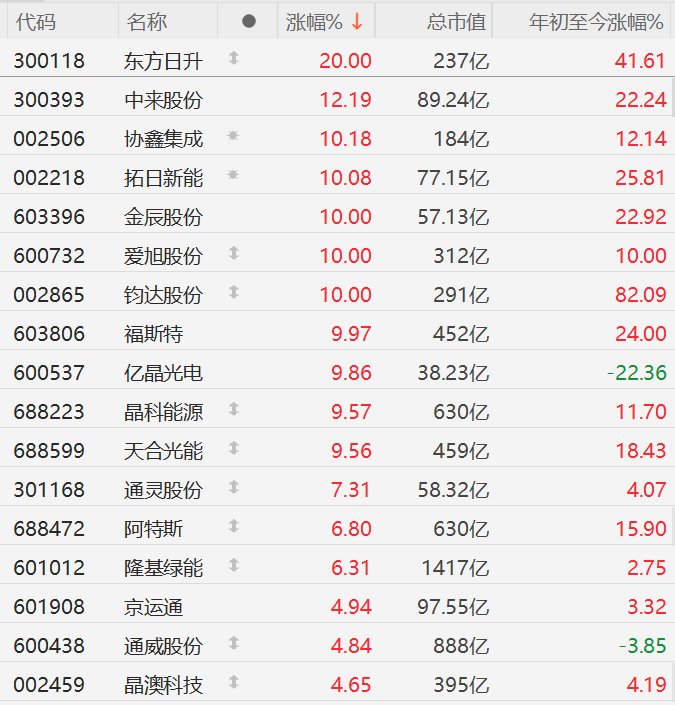
Group 1 - The A-share market has seen a significant surge in space photovoltaic concept stocks, with companies like Maiwei Co., Ltd. and Dongfang Risheng hitting the daily limit of 20%, while Zhonglai Co., Ltd. rose over 12% [1] - Tesla CEO Elon Musk expressed strong support for space photovoltaics during a discussion at the World Economic Forum, revealing plans for a solar manufacturing capacity of 100GW annually within three years [1] - Huaxi Securities highlighted that space photovoltaic energy involves utilizing solar technology in outer space to supply energy, marking a strategic solution for commercial aerospace and high-end applications [1] Group 2 - Shenwan Hongyuan's report indicated that over 200,000 satellite constellation applications have been submitted in China, signaling a new phase of large-scale deployment in commercial aerospace, which will drive long-term demand for space photovoltaics [2] - The technology evolution path for space photovoltaics is expected to transition from high-efficiency gallium arsenide to large-scale silicon-based HJT, and eventually to perovskite tandem cells [2] Group 3 - A detailed table of stock performance shows significant gains for various companies, with Dongfang Risheng at a 20% increase and a total market value of 23.7 billion, while Zhonglai Co., Ltd. has a market value of 8.9 billion and a year-to-date increase of 22.24% [3] - Other notable performers include Xiexin Integration with a 10.18% increase and a market value of 18.4 billion, and Tuorich New Energy with a 10.08% increase and a market value of 7.7 billion [3] - The overall trend indicates a positive momentum in the sector, with many companies experiencing substantial year-to-date gains, reflecting investor optimism in the space photovoltaic market [3]


重回1元/W时代?2026年光伏组件价格有三重强支撑
3 6 Ke· 2026-01-23 02:19
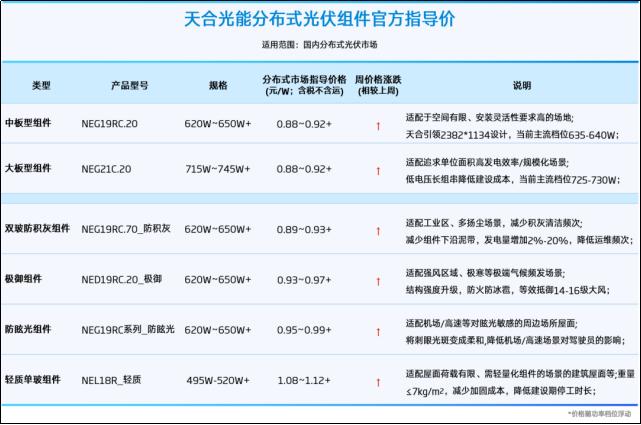
Core Viewpoint - The steady increase in photovoltaic module prices indicates a positive market trend, with major companies like Trina Solar raising their prices multiple times in January 2023, signaling strong demand and a potential return to the 1 yuan/W price point for modules [1][3]. Price Adjustments - Trina Solar has raised its distributed photovoltaic module market guidance price for the third time in January, with prices now ranging from 0.88 to 1.12 yuan/W depending on the module type [1][2]. - The average price of bifacial double-glass TOPCon modules reached approximately 0.7 yuan/W, reflecting a 0.3% increase from the previous week and a 1% increase from a month ago [3]. Demand Side - The photovoltaic industry has seen explosive growth since 2020, with China's new installed capacity expected to reach 277.17 GW in 2024, a significant increase from 48.2 GW in 2020 [4]. - Despite a generally pessimistic outlook for 2026, emerging markets like India are projected to see substantial growth, with an expected 25% increase in new installations [7][8]. Supply Side - The "anti-involution" policy is expected to continue, aiming to eliminate low-price competition and improve market conditions [10][12]. - Market-driven elimination of excess capacity is anticipated to accelerate in 2026, as many companies face financial difficulties and may exit the market [13][14]. Cost Factors - Rising silver prices, which have increased over 33% since the beginning of the year, are a significant factor driving up the costs of photovoltaic modules [15][17]. - The cancellation of export tax rebates is expected to increase cost pressures on exporting companies, further supporting price increases [18]. Overall Market Outlook - The combination of demand, supply, and cost factors is likely to keep module prices strong, with a potential return to the 1 yuan/W price point, indicating a recovery in the photovoltaic industry [19].



华民股份:晶澳无锡拟债转股方式对鸿新新能源增资2亿元
Zhi Tong Cai Jing· 2026-01-22 11:11
Core Viewpoint - The company Huamin Co., Ltd. plans to sign a debt restructuring and investment agreement with Hongxin New Energy and JA Solar (Wuxi) Technology Co., Ltd., where JA Solar Wuxi will increase its capital in Hongxin New Energy through a debt-to-equity swap, enhancing the latter's financial strength and optimizing its capital structure [1] Group 1: Investment Agreement Details - JA Solar Wuxi will convert its 200 million RMB debt into equity at a pre-investment valuation of 1 billion RMB, with 116 million RMB allocated to registered capital and 84 million RMB to capital reserves [1] - Existing shareholders of Hongxin New Energy will waive their preemptive rights regarding this capital increase [1] - After the capital increase, the registered capital of Hongxin New Energy will rise to 707 million RMB, with the company's ownership stake increasing to 73.74% [1] Group 2: Strategic Implications - The introduction of a strong investor in the photovoltaic sector is expected to facilitate deep cooperation between Hongxin New Energy and JA Solar, creating synergies across the industry chain [1] - This capital injection will enhance Hongxin New Energy's capital strength, further optimize its capital structure, reduce its debt-to-asset ratio, and promote sustainable operations [1]

最高预增628.43%!储能企业扎堆发布业绩预告
行家说储能· 2026-01-22 10:01
Core Viewpoint - The performance forecasts for 2025 from eight listed companies in the energy storage sector show a clear divergence, with four companies expecting losses while four anticipate profits or significant profit growth. Despite overall performance pressure, advancements in energy storage business are highlighted as a common positive aspect among these companies [2][4]. Group 1: Companies Expecting Losses - Trina Solar expects a net loss of 6.5 billion to 7.5 billion yuan, an increase from a loss of 3.443 billion yuan in the same period last year, primarily due to rising costs of key raw materials [5][6]. - Longi Green Energy forecasts a net loss of 6 billion to 6.5 billion yuan, a decrease from a loss of 8.592 billion yuan last year, citing a challenging operating environment in the photovoltaic industry [9]. - JinkoSolar anticipates a net loss of 5.9 billion to 6.9 billion yuan, shifting from a profit of 98.9276 million yuan last year, due to intensified price fluctuations and trade protection policies [10]. - JA Solar predicts a net loss of 4.5 billion to 4.8 billion yuan, slightly widening from a loss of 4.656 billion yuan last year, impacted by increased competition and declining sales prices [12]. Group 2: Companies Expecting Profits - Kstar Science expects a net profit of 600 million to 660 million yuan, a year-on-year increase of 52.21% to 67.43%, driven by a recovery in the European energy storage market [14]. - Penghui Energy forecasts a net profit of 170 million to 230 million yuan, recovering from a loss of 252 million yuan last year, attributed to increased sales orders and revenue growth [16]. - Hekang New Energy anticipates a net profit of 50 million to 75 million yuan, a significant increase of 385.62% to 628.43% compared to last year, focusing on green energy solutions and expanding its household energy storage business [18]. - Tongfei Co. expects a net profit of 240 million to 268 million yuan, a growth of 56.43% to 74.68% year-on-year, with significant contributions from its energy storage temperature control business [19][20].




光伏龙头企业“亏损潮”延续,专家:2026年三四月份有望迎来拐点
Hua Xia Shi Bao· 2026-01-22 09:35
Core Viewpoint - The photovoltaic industry is experiencing significant losses across all major segments, with a call for recovery and improvement in profitability by 2026, focusing on asset management and pricing power [2][11]. Group 1: Industry Performance - The photovoltaic sector is in a "dark moment," with all major segments, including silicon materials, wafers, cells, and modules, reporting losses [2]. - The overall performance of the industry is characterized by high inventory and weak demand, despite some signs of recovery in silicon material prices [3]. - The integrated companies face significant pressure, with a notable decline in profitability due to rising costs of key materials like silver paste [3][6]. Group 2: Company-Specific Insights - Daqo New Energy forecasts a net loss of 1 to 1.3 billion yuan for 2025, but with a reduced loss margin of 52.17% to 63.21% year-on-year due to improved operational efficiency [3]. - Longi Green Energy expects a net loss of 6 to 6.5 billion yuan, a reduction of over 2 billion yuan compared to the previous year, driven by increased production efficiency [5]. - Junda Co. anticipates a net loss of 1.5 to 1.2 billion yuan, significantly higher than the previous year's loss of 590 million yuan, citing supply-demand imbalance and price transmission issues [4]. Group 3: Component and Equipment Sector - Companies focusing on Bifacial (BC) modules, such as Aiko Solar, are seeing a significant reduction in losses, with expected losses narrowing from 5.319 billion yuan to between 1.9 billion and 1.2 billion yuan [5]. - The equipment sector, represented by Aotai Technology, is also facing declines, with expected revenue dropping by 26.71% to 30.50% year-on-year [8]. - Silver paste manufacturer Dike Co. is projected to shift from profit to loss, with expected losses of 200 to 300 million yuan due to rising silver prices [9]. Group 4: Future Outlook - The industry is still in a phase of "deleveraging and capacity reduction," but there are signs of recovery in upstream segments, with discussions about potential profitability improvements in 2026 [11][12]. - Aiko Solar reports that its ABC module sales volume is expected to double, indicating a positive trend despite overall losses [12]. - Analysts predict that the industry may see a shift from supply-demand pricing to cost-based pricing by early 2026, potentially improving profit margins significantly [12].





行业寒冬叠加银价暴击,12家光伏龙头集体“失血”超500亿
Xin Lang Cai Jing· 2026-01-22 08:03
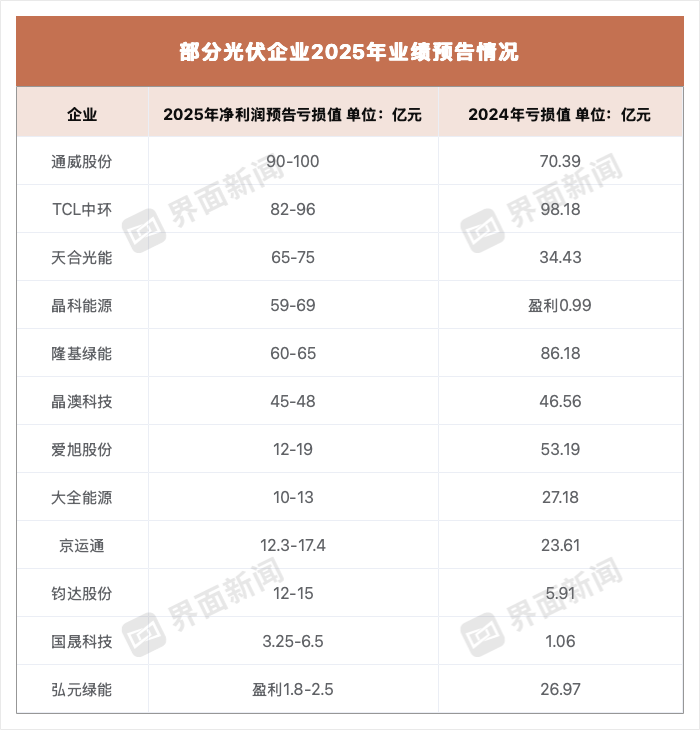
Core Viewpoint - The photovoltaic industry continues to face significant challenges, with major companies reporting substantial losses, totaling over 500 billion yuan, except for Hongyuan Green Energy, which is the only profitable entity among the analyzed firms [1][2]. Group 1: Financial Performance - Among 12 major photovoltaic companies, only Hongyuan Green Energy reported a profit, while the others collectively faced losses exceeding 500 billion yuan [1]. - Tongwei Co. is projected to incur the largest loss in 2025, estimated between 90-100 billion yuan, followed by TCL Zhonghuan and Trina Solar, with losses of 82-96 billion yuan and 65-75 billion yuan, respectively [2]. - JinkoSolar is expected to report a loss of 59-69 billion yuan for the previous year, while it anticipates a slight profit in 2024 [6][8]. Group 2: Cost Pressures - The rising prices of silver and silicon materials have significantly increased production costs for photovoltaic companies, with silver paste becoming a major cost component, accounting for approximately 17% of module costs [3][5]. - Silver prices have surged over 230% since the beginning of 2025, contributing to the financial strain on companies like Longi Green Energy and Trina Solar [5]. Group 3: Company Strategies and Developments - Longi Green Energy and TCL Zhonghuan have shown the most significant reduction in losses among leading firms, with Longi reducing its losses by nearly 20 billion yuan due to improved production yields and the development of alternative materials [10]. - Hongyuan Green Energy has successfully turned a profit, projecting a net profit of 1.8-2.5 billion yuan for 2025, attributed to its vertically integrated supply chain strategy [14][15]. - JinkoSolar and Trina Solar have both highlighted advancements in their energy storage businesses, indicating a potential area for growth despite current losses [8].

“印钞机”变“碎钞机”,光伏集体巨亏
投中网· 2026-01-22 06:06
Core Viewpoint - The photovoltaic industry is undergoing a significant restructuring, with major companies expected to report substantial losses in 2025 due to overcapacity, price wars, and rising raw material costs [5][10][12]. Group 1: Industry Overview - Trina Solar forecasts a loss of 65-75 billion yuan for 2025, contributing to a total expected loss of over 600 billion yuan across the photovoltaic sector [5][10]. - The entire industry chain, from upstream silicon materials to downstream components, is experiencing collective losses, with the gross profit margin for polysilicon dropping to -6.30% in the first half of 2025, compared to 73% in 2022 [12][13]. - The price of silver has surged by 140% over two years, further compressing profits as component prices have fallen below cash cost levels [6][14][16]. Group 2: Key Indicators for Industry Restructuring - Analysts suggest monitoring three key indicators for the industry's clearing process: energy consumption, conversion efficiency, and profit margins [7][19]. - The industry is expected to enter a brutal elimination phase in 2026, focusing on energy efficiency, technology, and cost [8][18]. Group 3: Company Performance and Differentiation - Major companies like LONGi Green Energy and Tongwei Co. are projected to incur significant losses, but some are showing signs of reduced losses compared to previous years [21]. - TCL Zhonghuan is facing challenges due to high energy consumption and outdated production processes, leading to a decline in competitiveness [21][23]. - Companies are investing in new technologies, such as LONGi's focus on BC cell technology and Tongwei's optimization of silicon material costs, to prepare for the upcoming technological competition in 2026 [25].

超级电力帝国崛起,从一块光伏板开始
3 6 Ke· 2026-01-22 05:05
Group 1 - The core point of the article highlights that China's electricity consumption is projected to exceed 10 trillion kilowatt-hours by 2025, marking a significant milestone in energy consumption and positioning China as a potential energy empire [1][3] - This electricity consumption is equivalent to more than double that of the United States and surpasses the total consumption of the EU, Russia, Japan, and India combined [1][3] - The rapid expansion of China's energy infrastructure is evidenced by the National Grid's announcement of a 40% increase in fixed asset investment during the 14th Five-Year Plan period, reaching 4 trillion yuan [1] Group 2 - The article emphasizes the strategic importance of electricity in the 21st century, suggesting that control over electricity and its pricing will determine global dominance [3][6] - Historical context is provided, detailing significant developments in China's electricity infrastructure, including the construction of high-voltage power lines, large hydropower stations, and nuclear power plants [5][6] - The article notes that while solar power currently accounts for only 5.95% of China's electricity generation, it is viewed as a sector with immense growth potential due to its adaptability and lower entry barriers compared to other energy sources [8][9] Group 3 - The solar power industry has seen rapid growth, with major companies like Longi Green Energy and Tongwei experiencing significant stock price increases following the end of European anti-dumping investigations [12][13] - However, the industry faces challenges, including overproduction and significant financial losses, with major companies forecasting losses in the billions due to aggressive market competition and capacity expansion [15][16] - The article suggests that despite these challenges, companies are reluctant to cut production, aiming to achieve economies of scale and maintain competitive advantages in the long term [18]
业绩反转!“光伏黑马”2025年业绩预计扭亏为盈,光伏ETF华夏(515370)上涨0.2%
Mei Ri Jing Ji Xin Wen· 2026-01-22 02:21
Group 1 - The core viewpoint of the news highlights the performance of the photovoltaic sector, particularly the rise of the Huaxia Photovoltaic ETF and its constituent stocks, indicating a positive trend in the market [1] - On January 21, Hongyuan Green Energy announced its 2025 annual performance forecast, expecting a net profit attributable to shareholders of 180 million to 250 million yuan, marking a turnaround from losses [1] - The company anticipates a non-recurring gain of approximately 291 million yuan from the transfer of part of its stake in Inner Mongolia Xinyuan Silicon Material Technology Co., which is crucial for achieving positive overall performance [1] Group 2 - According to Zheshang Securities, 2026 is expected to be a turning point for the industry, driven by factors such as a rebound in prices, with a 47% quarter-on-quarter increase in polysilicon prices in Q3 2025 [1] - Leading companies like Longi Green Energy and JA Solar have announced equity incentive plans aimed at achieving profitability by 2026 [1] - The proportion of fund allocations has decreased to levels seen before the 2020 market rally, indicating potential for recovery, alongside the establishment of silicon material storage platforms expected to drive supply contraction and demand recovery [1]


【转|太平洋新能源-光伏26年度策略】反内卷加速供需重塑,重视新技术、新场景
远峰电子· 2026-01-21 13:02
Group 1 - The core viewpoint of the article emphasizes that the "anti-involution" trend is reshaping supply and demand in the photovoltaic (PV) industry, accelerating the parity of solar storage in core markets and opening up new scenarios for future demand [1][3][5] - Global demand for solar energy is expected to grow significantly, with projected new installations of approximately 600GW in 2025 and 610GW in 2026, reflecting year-on-year growth rates of about 13.21% and 1.67% respectively [3][6] - The domestic and overseas production capacity is rapidly increasing, leading to a significant oversupply in the PV industry, which has resulted in continuous price declines and losses for many companies [5][6] Group 2 - The penetration rate of low-silver and silver-free technologies is expected to rise quickly, with leading companies likely to recover profitability ahead of the industry [1][22] - The article highlights that the profitability of auxiliary material companies is expected to improve as they diversify their business, with a focus on non-PV sectors [1][36] - The article identifies key beneficiaries in the market, including companies that lead in low-silver and silver-free technology iterations, such as Longi Green Energy and JinkoSolar, which are expected to benefit from cost advantages [1][46] Group 3 - The article discusses the impact of rising silver prices on the cost structure of solar cell manufacturers, indicating that the cost of silver paste is becoming a critical factor for cost reduction [22][23] - The introduction of new technologies, such as high-copper and pure copper solutions, is accelerating in the industry, which is expected to enhance efficiency and reduce costs [25][27] - The demand for space photovoltaics is anticipated to grow due to an increase in space launch missions, with a projected 263 launches in 2024, indicating a strong short-term demand for solar wings in low Earth orbit [29] Group 4 - The article notes that the profitability of battery materials is expected to improve as the pressure from the main chain eases, with low-silver and silver-free iterations likely to bring new benefits [36][39] - The photovoltaic glass sector is also expected to see a recovery in profitability due to industry self-discipline and a reduction in supply, with prices showing signs of recovery [41][46] - The article concludes with investment recommendations, suggesting that companies leading in low-silver and silver-free technology, as well as those involved in energy storage, are well-positioned to benefit from the ongoing market changes [46]