Zhujiang Brewery(002461)

Search documents
非白酒板块10月31日涨0.1%,*ST椰岛领涨,主力资金净流出4438.33万元
Zheng Xing Xing Ye Ri Bao· 2025-10-31 08:41
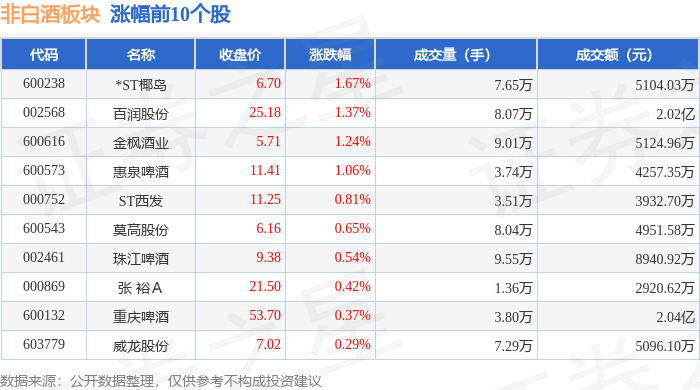
Market Overview - The non-liquor sector increased by 0.1% on October 31, with *ST Yedao leading the gains [1] - The Shanghai Composite Index closed at 3954.79, down 0.81%, while the Shenzhen Component Index closed at 13378.21, down 1.14% [1] Stock Performance - The top performers in the non-liquor sector included: - *ST Yedao: Closed at 6.70, up 1.67% with a trading volume of 76,500 shares [1] - Zhirun Co.: Closed at 25.18, up 1.37% with a trading volume of 80,700 shares [1] - Jinfeng Wine: Closed at 5.71, up 1.24% with a trading volume of 90,100 shares [1] - Other notable stocks included: - Huichuan Beer: Closed at 11.41, up 1.06% [1] - ST Xifa: Closed at 11.25, up 0.81% [1] Capital Flow - The non-liquor sector experienced a net outflow of 44.38 million yuan from institutional investors, while retail investors saw a net inflow of 51.71 million yuan [2] - The capital flow for specific stocks showed: - *ST Yedao: Net outflow of 6.65 million yuan from institutional investors [3] - Zhujiang Beer: Net inflow of 328,580 yuan from institutional investors [3] - Huichuan Beer: Net inflow of 105,040 yuan from institutional investors [3]


西部证券晨会纪要-20251031
Western Securities· 2025-10-31 02:03
Group 1: Global Technology Competition - The report outlines three potential scenarios for global technology competition over the next decade: baseline scenario (strategic equilibrium between China and the US), optimistic scenario (China becomes an innovation leader), and pessimistic scenario (China's industrial upgrade falls short) [6][7] - Key technologies are defined as frontier technologies (AI, semiconductors, quantum computing, biopharmaceuticals), advanced manufacturing, and critical infrastructure technologies (energy and advanced networks) [6][7] - The US focuses on invention and innovation, while China aims for large-scale innovation in key industries, with both countries undergoing reforms in their innovation systems [6][7] Group 2: Softcom Power (301236.SZ) - For the first three quarters of 2025, Softcom Power reported revenue of 25.38 billion yuan, a year-on-year increase of 14.30%, and a net profit of 0.99 billion yuan, up 30.21% [15][17] - The company is guided by four strategic directions: intelligence, autonomy, greening, and internationalization, with a focus on enhancing software and digital technology services [16][17] - Future revenue projections for Softcom Power are 35.9 billion yuan, 41.3 billion yuan, and 47.7 billion yuan for 2025-2027, with net profits expected to be 0.384 billion yuan, 0.526 billion yuan, and 0.855 billion yuan respectively [17] Group 3: Dingjie Smart (300378.SZ) - Dingjie Smart's revenue for the first three quarters of 2025 reached 1.614 billion yuan, a 2.6% increase year-on-year, with a net profit of 0.051 billion yuan, up 2.4% [19][21] - The company is experiencing short-term pressure in mainland China but is seeing stable performance in non-mainland markets, driven by deepening applications and market expansion [19][20] - Revenue projections for Dingjie Smart are 2.502 billion yuan, 2.726 billion yuan, and 2.989 billion yuan for 2025-2027, with net profits expected to be 0.191 billion yuan, 0.233 billion yuan, and 0.301 billion yuan respectively [21] Group 4: Hai Tian Wei Ye (603288.SH) - Hai Tian Wei Ye reported a revenue increase of 6.02% to 21.628 billion yuan for the first three quarters of 2025, with a net profit of 5.322 billion yuan, up 10.54% [22][24] - The company experienced a slowdown in revenue growth in Q3, with a 2.48% increase to 6.398 billion yuan, while net profit rose by 3.40% to 1.408 billion yuan [23][24] - The company is focusing on creating new growth points and enhancing efficiency through digital production [24] Group 5: Guizhou Moutai (600519.SH) - Guizhou Moutai's revenue for the first three quarters of 2025 was 130.904 billion yuan, a 6.32% increase, with a net profit of 64.627 billion yuan, up 6.25% [26][28] - The company reported stable sales performance for its flagship Moutai liquor, while other series faced pressure [27][28] - Future earnings per share (EPS) projections for Guizhou Moutai are 72.87 yuan, 77.31 yuan, and 82.70 yuan for 2025-2027, maintaining a "buy" rating [28] Group 6: Xian Cai Co., Ltd. (600095.SH) - Xian Cai Co., Ltd. reported a significant increase in net profit of 203.39% for the first three quarters of 2025, reaching 0.442 billion yuan [46][47] - The company's revenue for Q3 was 0.655 billion yuan, a 43.77% increase year-on-year, driven by a surge in commission income [47][48] - The company is expected to achieve a net profit of 0.608 billion yuan for 2025, reflecting a 456.6% increase [48]




非白酒板块10月30日涨0.32%,会稽山领涨,主力资金净流出4791.59万元
Zheng Xing Xing Ye Ri Bao· 2025-10-30 08:40
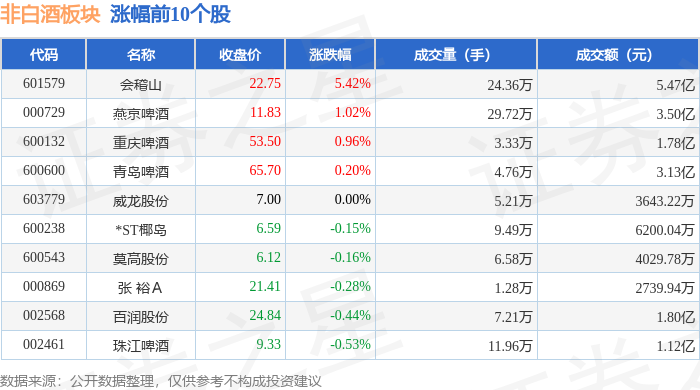
Market Overview - The non-baijiu sector increased by 0.32% compared to the previous trading day, with Kuaijishan leading the gains [1] - The Shanghai Composite Index closed at 3986.9, down 0.73%, while the Shenzhen Component Index closed at 13532.13, down 1.16% [1] Stock Performance - Kuaijishan (601579) closed at 22.75, up 5.42% with a trading volume of 243,600 shares [1] - Other notable stocks include: - Jiu You Xian Jiu (000729) at 11.83, up 1.02% [1] - Chongqing Beer (600132) at 53.50, up 0.96% [1] - Gu Zhi Lang La (600600) at 65.70, up 0.20% [1] - The overall performance of the non-baijiu sector showed mixed results, with several stocks experiencing declines [1][2] Capital Flow - The non-baijiu sector saw a net outflow of 47.92 million yuan from institutional investors, while retail investors contributed a net inflow of 8.39 million yuan [2] - Notable capital flows include: - Kuaijishan had a net inflow of 77.35 million yuan from institutional investors, but a net outflow of 78.27 million yuan from retail investors [3] - Zhujiang Beer (002461) experienced a small net inflow from retail investors of 2.12 million yuan despite a net outflow from institutional and speculative investors [3]


珠江啤酒(002461):Q3销量承压,结构升级延续
Western Securities· 2025-10-30 07:34
Investment Rating - The investment rating for the company is "Accumulate" [5] Core Views - The company reported a revenue decline of 1.34% to 1.875 billion yuan in Q3 2025, while net profit attributable to shareholders increased by 8.16% to 332 million yuan, indicating that revenue and profit fell short of market expectations [1][5] - For the first three quarters of 2025, the company achieved a revenue increase of 3.81% to 5.073 billion yuan and a net profit increase of 17.05% to 944 million yuan [1][5] - The company’s beer sales volume for the first three quarters was 1.2035 million tons, a year-on-year increase of 1.8%, while the average price per ton was 4,215 yuan, up 2.0% year-on-year [1] - In Q3 alone, beer sales volume decreased by 2.9% to 469,400 tons, with the average price per ton at 3,995 yuan, reflecting a slower growth rate compared to the first half of the year [1] Financial Performance - The gross profit margin in Q3 2025 increased by 1.16 percentage points to 50.93%, and the net profit margin rose by 1.36 percentage points to 17.83%, benefiting from improved product mix and lower raw material costs [2] - The company maintained stable expense ratios across sales, management, R&D, and financial costs, with slight increases in each category [2] - The company is actively enhancing its mid-to-high-end product lines and expanding into markets outside its home province, indicating potential for future growth despite current challenges [2] Earnings Forecast - The earnings per share (EPS) forecast for 2025-2027 is adjusted to 0.43, 0.47, and 0.52 yuan respectively, reflecting a downward revision due to external environmental impacts [2]
@东莞企业,快来申请纳入这个“正面清单”,可享多种便利
Nan Fang Du Shi Bao· 2025-10-30 03:20
Core Viewpoint - Dongguan's ecological environment bureau has announced a public solicitation for the "Positive List" of enterprises for ecological environment supervision and law enforcement for 2026, incentivizing compliant companies with reduced inspections and support measures [1][5]. Group 1: Conditions for Inclusion - Enterprises must meet five conditions to be included in the "Positive List," including compliance with ecological protection regulations, complete environmental permits, stable operation of pollution control facilities, good legal status without recent penalties, and effective emergency management [2][3]. - Priority for inclusion is given to enterprises with the best environmental credit ratings, small and micro enterprises with low environmental risks, and those classified as A-grade for volatile organic compounds (VOCs) [2][3]. Group 2: Exclusion Criteria - Enterprises involved in specific high-risk activities, those with poor environmental credit ratings, or those with serious environmental violations in the past five years are excluded from the "Positive List" [3][5]. Group 3: Benefits of Inclusion - Companies on the "Positive List" benefit from reduced on-site inspections and enhanced support, with a focus on non-intrusive monitoring methods [5][6]. - The list is valid for three years, and companies may receive financial and tax incentives, including leniency for minor first-time violations [5][6].

珠江啤酒(002461):大单品+多渠道共发展,公司实现盈利提升
Changjiang Securities· 2025-10-28 23:31
Investment Rating - The investment rating for the company is "Buy" and is maintained [8] Core Insights - The company reported total revenue of 5.073 billion yuan for Q1-Q3 2025, representing a year-on-year increase of 3.81%. The net profit attributable to shareholders was 944 million yuan, up 17.05% year-on-year, while the net profit excluding non-recurring items was 900 million yuan, an increase of 17.16% year-on-year [2][6] - In Q3 2025, the company achieved total revenue of 1.875 billion yuan, a decrease of 1.34% year-on-year. The net profit attributable to shareholders was 332 million yuan, an increase of 8.16% year-on-year, and the net profit excluding non-recurring items was 313 million yuan, up 7.14% year-on-year [2][6] Summary by Sections Revenue and Profitability - For Q1-Q3 2025, the company achieved a sales volume of 1.2035 million tons, an increase of 1.83% year-on-year. In Q3 2025, the sales volume was 469,400 tons, down 2.9% year-on-year. The average selling price per ton increased by 1.95% year-on-year for Q1-Q3 2025, with Q3 showing a 1.6% increase [13] - The company's cost per ton decreased by 0.75% year-on-year in Q3 2025, contributing to an improvement in gross margin, which rose by 1.16 percentage points to 50.93%. The net profit margin attributable to shareholders increased by 1.55 percentage points to 17.69% [13] Strategic Developments - The company has focused on its core product, 97 Pure Draft, enhancing its restaurant channel capabilities and innovating product offerings. It is also expanding its new retail layout and accelerating the construction of high-end, intelligent, and green production capacity [13] - The company forecasts earnings per share (EPS) of 0.44, 0.51, and 0.55 yuan for 2025, 2026, and 2027, respectively, with corresponding price-to-earnings (PE) ratios of 22X, 19X, and 18X [13]
珠江啤酒(002461):需求端承压致营收负增长,利润端保持韧性
Wanlian Securities· 2025-10-27 11:20
Investment Rating - The investment rating for Zhujiang Beer is maintained as "Add" [5][10]. Core Insights - The company experienced its first negative revenue growth due to significant pressure on the demand side, while maintaining resilience in profit growth [3]. - In Q3 2025, the company reported revenue of 1.875 billion yuan (YoY -1.34%) and a net profit of 332 million yuan (YoY +8.16%) [2][3]. - The gross margin and net margin both increased year-on-year, indicating effective cost control and a shift towards high-end products [4]. Revenue and Profit Analysis - For the first three quarters of 2025, the company achieved a cumulative revenue of 5.073 billion yuan (YoY +3.81%) and a net profit of 944 million yuan (YoY +17.05%) [2][3]. - The revenue growth rate has significantly slowed down compared to the previous year, with Q3 2025 showing a decline from +6.89% to -1.34% [3]. Margin and Expense Analysis - The gross margin for Q3 2025 was 50.93%, up by 1.16 percentage points year-on-year, while the net margin was 17.83%, up by 1.36 percentage points [4]. - The overall expense ratio saw a slight increase, with sales, management, R&D, and financial expense ratios showing minor year-on-year changes [4]. Profit Forecast and Investment Recommendations - The company is expected to continue its high-end product strategy, which may help in achieving profit growth despite the revenue decline [4]. - The profit forecast for 2025-2027 estimates net profits of 951 million, 1.021 billion, and 1.110 billion yuan, with corresponding EPS of 0.43, 0.46, and 0.50 yuan per share [4][11].
非白酒板块10月27日涨0.09%,*ST兰黄领涨,主力资金净流出79.71万元
Zheng Xing Xing Ye Ri Bao· 2025-10-27 08:25
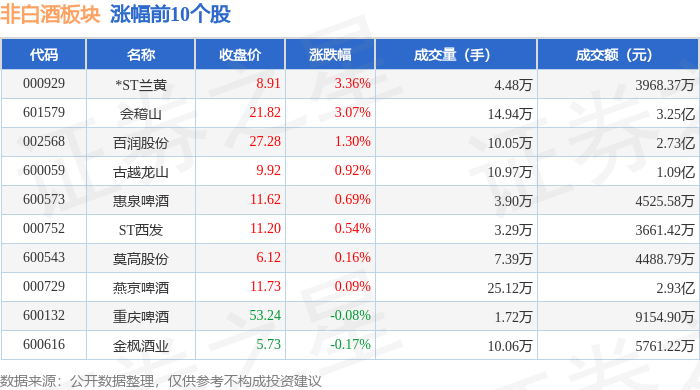
Market Performance - The non-liquor sector increased by 0.09% compared to the previous trading day, with *ST Lanhua leading the gains [1] - The Shanghai Composite Index closed at 3996.94, up 1.18%, while the Shenzhen Component Index closed at 13489.4, up 1.51% [1] Stock Highlights - *ST Lanhua closed at 8.91, with a rise of 3.36% and a trading volume of 44,800 shares, totaling a transaction value of 39.68 million yuan [1] - Huaiqian Beer (惠泉啤酒) and ST Xifa (ST西发) also showed modest gains of 0.69% and 0.54%, respectively [1] - Zhangyu A (张裕A) experienced a decline of 1.51%, closing at 21.53 with a trading volume of 33,500 shares [2] Capital Flow Analysis - The non-liquor sector saw a net outflow of 797,100 yuan from institutional investors, while retail investors experienced a net outflow of 6,544,780 yuan [2] - Speculative funds had a net inflow of 66,245,000 yuan, indicating a shift in investor sentiment [2] Individual Stock Capital Flow - Kuaijishan (会稽山) had a net outflow of 27,921,000 yuan from institutional investors, while it saw a net inflow of 12,754,600 yuan from speculative funds [3] - Qingdao Beer (青岛啤酒) recorded a net inflow of 20,624,600 yuan from institutional investors, with a significant net outflow of 40,225,200 yuan from retail investors [3]

珠江啤酒(002461):利润稳增长,成本改善较好
Xinda Securities· 2025-10-27 08:05
Investment Rating - The investment rating for the company is "Buy" [1] Core Insights - The company reported a revenue of 5.073 billion yuan for the first three quarters of 2025, representing a year-on-year increase of 3.81%. The net profit attributable to the parent company reached 944 million yuan, up 17.05% year-on-year [1][3] - The report highlights that despite a slight revenue pressure in Q3 due to adverse weather conditions in Guangdong, the company has maintained a good growth trend in its product offerings, particularly the 97 Pure Draft beer [3] - Cost improvements have led to a gross margin increase, with the gross margin rising by 1.16 percentage points to 50.93% in Q3 2025 [3] - The company is optimistic about its long-term growth potential, particularly in the regional market, and is actively developing new product categories [3] Financial Performance Summary - For 2023A, the total revenue is projected at 5.378 billion yuan, with a year-on-year growth rate of 9.1%. The net profit attributable to the parent company is expected to be 624 million yuan, with a growth rate of 4.2% [2] - The gross margin is expected to improve from 42.8% in 2023A to 51.6% by 2027E, indicating a positive trend in profitability [2] - The earnings per share (EPS) for 2025E is projected to be 0.43 yuan, with a corresponding price-to-earnings (P/E) ratio of 22.56 [2][4]
青岛啤酒收购即墨黄酒告吹,茅台换帅
2 1 Shi Ji Jing Ji Bao Dao· 2025-10-27 03:53
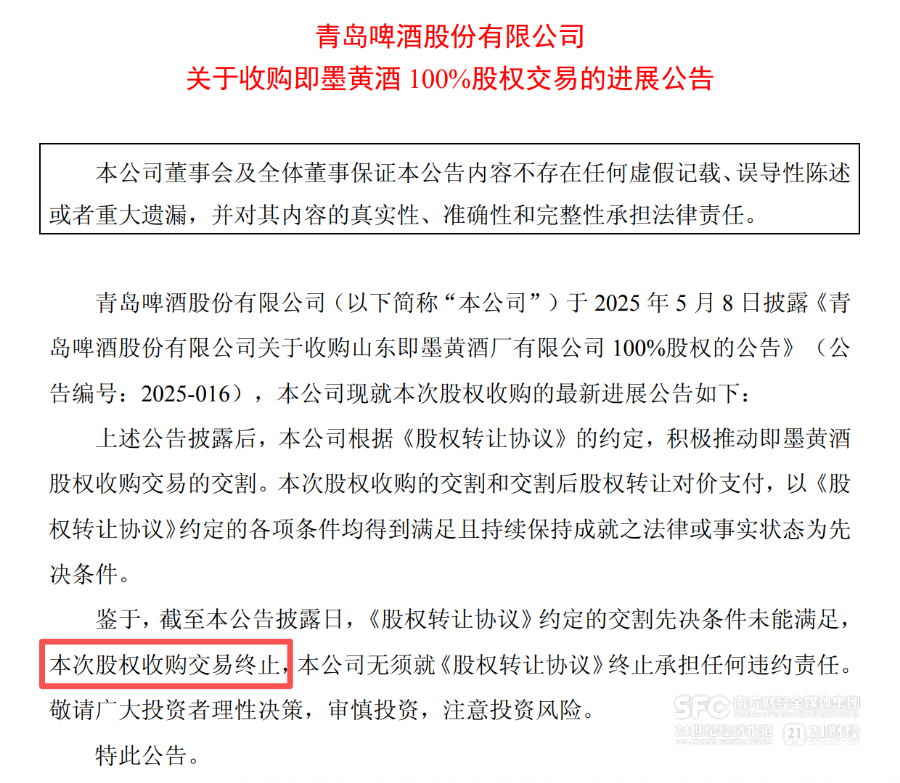
Group 1: Qingdao Beer Acquisition Termination - Qingdao Beer announced the termination of its acquisition of a 100% stake in Jimo Huangjiu due to unmet conditions in the share transfer agreement [2][4] - The acquisition was initially valued at 665 million yuan and was part of a trend where the capital market showed interest in Huangjiu [4] - The company stated it would not bear any liability for the termination of the share transfer agreement [4] Group 2: Leadership Changes in Major Alcohol Companies - Moutai Group appointed Chen Hua, the former director of the Guizhou Provincial Energy Bureau, as the new chairman, replacing Zhang Deqin after only a year and a half [10] - Xi Feng Wine announced the promotion of Zhang Yong to general manager of its marketing company, replacing Zhou Yanhua, who retired at the age of 55 [11] - Huichuan Beer appointed Yi Wenxin as the new general manager following the resignation of Liu Xiangyu and Chen Jiting [12][13] Group 3: Financial Performance of Alcohol Companies - Jin Hui Wine reported a revenue of 2.305 billion yuan and a net profit of 324 million yuan for the first three quarters, with a significant decline in Q3 net profit by 33% [15][16] - Yanjing Beer and Zhujiang Beer both reported slower growth in Q3, with Yanjing's revenue at 4.875 billion yuan, a 1.55% increase, and Zhujiang's revenue at 1.875 billion yuan, a 1.34% decline [17] - Heineken's Q3 net revenue decreased by 0.3%, with a 4.3% decline in organic sales volume, leading to a downward revision of its annual sales forecast [19][20] Group 4: Market Trends and Consumer Behavior - The National Bureau of Statistics reported a 1.6% year-on-year growth in the tobacco and alcohol sector for September, with a 4% increase for the first nine months of 2025 [23]