
Zhujiang Brewery(002461)

Search documents
食品饮料月月谈-如何展望春节旺季备货
2026-01-19 02:29
Summary of Key Points from Conference Call Records Industry Overview - **Industry**: Baijiu (Chinese liquor) and Soft Drinks - **Key Insights**: The Baijiu industry is nearing a bottom in terms of valuation, expectations, and holdings, with a potential turning point expected in Q3 2026. The soft drink market is showing strong performance from leading companies, with expectations for revenue growth above the industry average in 2026 [1][9]. Baijiu Industry Insights - **Market Dynamics**: The overall sentiment for Baijiu sales during the Spring Festival is cautious, with expectations of a year-on-year decline potentially reaching double digits. However, Moutai's significant price reduction may stimulate sales during low-frequency consumption scenarios [2][8]. - **Company Strategies**: - **Moutai**: Plans to stabilize overall product supply while adjusting the product mix to increase the availability of premium Moutai and 500ml Flying Moutai. This strategic shift is expected to have a profound impact on pricing and growth logic [4]. - **Luzhou Laojiao**: Focuses on maintaining stable apparent prices and ensuring stability in pricing, channels, and organizational structure to provide growth momentum during the recovery phase [5]. - **Investment Recommendations**: Companies such as Moutai, Fenjiu, and local brands like Gujing Gongjiu are recommended for their market share logic, while Wuliangye and Luzhou Laojiao are noted for their dividend security [1][8]. Soft Drink Market Insights - **Market Performance**: Leading companies in the soft drink sector are expected to maintain revenue growth above the industry average in 2026. Notable performers include Nongfu Spring and Dongpeng Special Drink, while Master Kong and Uni-President are seen as stable defensive investments [9][10]. - **Current Trends**: The market is experiencing significant competition, but leading companies are expected to leverage their channel and product advantages to maintain robust performance [9]. Tea Beverage Market - **Key Players**: Companies like Guming and Shanghai Auntie are rapidly expanding, with Guming planning to promote breakfast scenarios and Shanghai Auntie introducing coffee and health products. Both companies express confidence in same-store sales for 2026 [11]. Dairy Industry Insights - **Market Condition**: The dairy sector is currently experiencing weak demand but is expected to see a recovery in 2026. Companies like Yili, Mengniu, and New Dairy are recommended due to their stable fundamentals and growth potential [3][12][13]. Frozen Food Industry Insights - **Market Outlook**: The frozen food sector is showing positive prospects for 2026, with strong winter stocking and improved confidence among distributors. Companies like Anjijia, Qianwei Yangchun, and Sanquan Foods are optimistic about their outlook [14][15]. Seasonality and Consumer Behavior - **Consumer Trends**: The upcoming Spring Festival is expected to influence consumer behavior significantly, with increased stocking efforts noted across various sectors, including snacks and frozen foods. Companies are adjusting their strategies to meet this seasonal demand [17][18]. Recommendations for Investment - **Baijiu**: Focus on companies with strong market share logic and dividend security, such as Moutai and Luzhou Laojiao [8]. - **Soft Drinks**: Invest in leading brands like Nongfu Spring and Dongpeng, which are expected to outperform the market [9][10]. - **Dairy and Frozen Foods**: Look for opportunities in Yili, Mengniu, and Anjijia, which are positioned for growth in the recovering market [12][14]. Conclusion - The Baijiu industry is at a critical juncture, with potential for recovery in 2026, while the soft drink and dairy sectors are showing resilience and growth potential. Investors are advised to focus on companies with strong fundamentals and strategic positioning to capitalize on upcoming market opportunities [6][9][12].






【转|太平洋食饮-26年度策略】底部向阳,寻找结构性亮点
远峰电子· 2026-01-18 11:38
Overall Sector Review - The food and beverage sector significantly underperformed the market, with a year-to-date decline of -0.62%, lagging behind the Shanghai Composite Index by 15.0 percentage points [2] - The sector experienced a deep correction after an initial rebound driven by expectations of consumption recovery and supportive policies, but the actual recovery rate was lower than anticipated, leading to a consensus on weak domestic demand [2] Subsector Performance - The snack sector outperformed with a year-to-date increase of 28.88%, driven by channel expansion and a revenue growth rate of 30.97% in the first three quarters [4] - Soft drinks also showed resilience with a 10.11% stock price increase, benefiting from strong travel demand and low-cost, high-frequency consumption [4] - The restaurant chain sector saw a rebound with gains of approximately 10.34% and 10.29% for pre-processed and baked goods, respectively [4] - The liquor sector, particularly high-end liquor, faced challenges with weaker sales and declining prices, while beer performance was supported but affected by high-end market constraints [4] Investment Insights - The sector is under pressure from deflationary trends and a weak recovery, with consumer confidence remaining low, indicating a shift to a "new normal" of low growth [8] - High-end consumption has shown slight recovery due to stock market wealth effects, but sustainability remains a concern [9] - The food and beverage sector's valuation is at historical lows, with a current PE (TTM) of 21.9X, indicating potential investment opportunities in undervalued segments [12] Fund Holdings - As of Q3 2025, the food and beverage sector's fund holdings decreased to 6.38%, nearing levels seen in 2016, with the liquor segment comprising 5.52% of this [14] - Fund holdings in the liquor sector increased for certain subsectors, including white liquor and seasoning products, while others saw declines [16] Long-term Trends - The liquor industry is undergoing its longest adjustment period since 2003, with significant price corrections and a potential bottoming out of valuations [21] - The white liquor sector has underperformed the market with a year-to-date return of -4.87%, reflecting weak demand and a divergence from broader market trends [24] - The third quarter of 2025 saw a significant decline in revenue and net profit for the white liquor sector, indicating a deep adjustment phase [27] Pricing Dynamics - The white liquor market is experiencing a general decline in prices, particularly in high-end segments, while lower price segments show resilience [29] - The average price of high-end products like Moutai has dropped significantly, while mid-range and lower-range products have maintained stability or slight increases [31] Investment Recommendations - The white liquor sector is advised to focus on inventory reduction and demand recovery, with a preference for leading brands that can maintain pricing power and product stability [32]




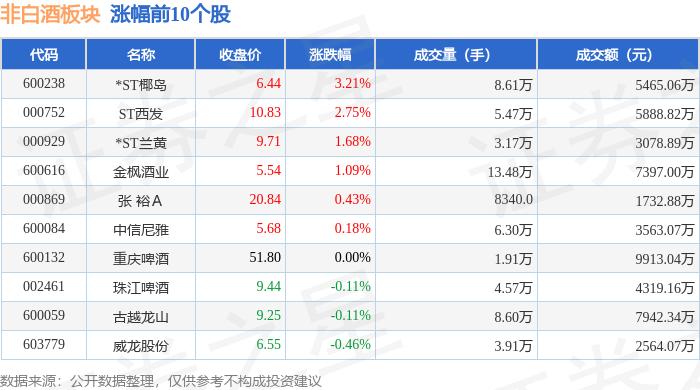
非白酒板块1月15日跌0.45%,会稽山领跌,主力资金净流出501.98万元
Zheng Xing Xing Ye Ri Bao· 2026-01-15 08:58
Market Overview - The non-white liquor sector experienced a decline of 0.45% on January 15, with Kuaijishan leading the drop [1] - The Shanghai Composite Index closed at 4112.6, down 0.33%, while the Shenzhen Component Index rose by 0.41% to 14306.73 [1] Stock Performance - Notable gainers in the non-white liquor sector included: - *ST Yedao: Closed at 6.44, up 3.21% with a trading volume of 86,100 shares and a turnover of 54.65 million yuan [1] - ST Xifa: Closed at 10.83, up 2.75% with a trading volume of 54,700 shares and a turnover of 58.89 million yuan [1] - *ST Lanhong: Closed at 9.71, up 1.68% with a trading volume of 31,700 shares and a turnover of 30.79 million yuan [1] - Conversely, Kuaijishan saw a decline of 2.25%, closing at 20.41 with a trading volume of 85,300 shares and a turnover of 175 million yuan [2] Capital Flow Analysis - The non-white liquor sector experienced a net outflow of 5.02 million yuan from institutional investors and 10.70 million yuan from retail investors, while retail investors saw a net inflow of 15.72 million yuan [2] - Key capital flows for selected stocks included: - Jinfeng Wine Industry: Net inflow of 11.50 million yuan from institutional investors, but a net outflow of 6.69 million yuan from retail investors [3] - *ST Yedao: Net inflow of 10.16 million yuan from institutional investors, with a net outflow of 6.46 million yuan from retail investors [3] - ST Xifa: Net inflow of 0.94 million yuan from retail investors, but a net outflow of 0.42 million yuan from institutional investors [3]


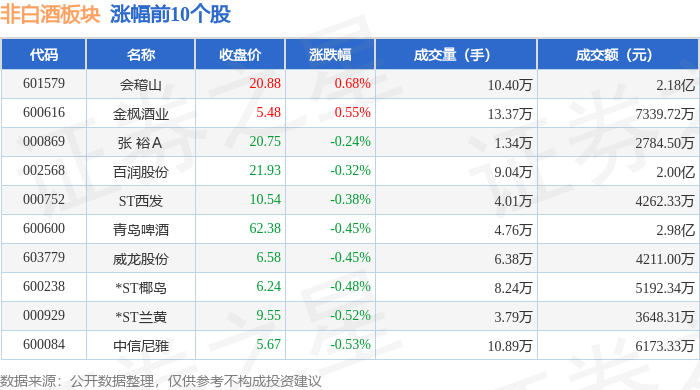
非白酒板块1月14日跌0.63%,燕京啤酒领跌,主力资金净流出7660.75万元
Zheng Xing Xing Ye Ri Bao· 2026-01-14 08:50
Market Overview - The non-baijiu sector experienced a decline of 0.63% on January 14, with Yanjing Beer leading the drop [1] - The Shanghai Composite Index closed at 4126.09, down 0.31%, while the Shenzhen Component Index closed at 14248.6, up 0.56% [1] Stock Performance - Key stocks in the non-baijiu sector showed varied performance, with Kuaijishan closing at 20.88, up 0.68%, and Zhangyu A at 20.75, down 0.24% [1] - Other notable declines included ST Xifa at 10.54, down 0.38%, and Qingdao Beer at 51.80, down 0.97% [2] Trading Volume and Value - Kuaijishan had a trading volume of 104,000 shares and a transaction value of 218 million yuan, while ST Xifa had a volume of 40,100 shares and a value of 42.62 million yuan [1] - The non-baijiu sector saw a total net outflow of 76.61 million yuan from main funds, with retail investors contributing a net inflow of 43.96 million yuan [2] Fund Flow Analysis - Main funds showed a net inflow of 10.61 million yuan for Kuaijishan, while Zhangyu A experienced a net outflow of 2.52 million yuan [3] - The overall fund flow indicates a mixed sentiment, with retail investors showing interest in certain stocks despite the overall outflow from main funds [3]


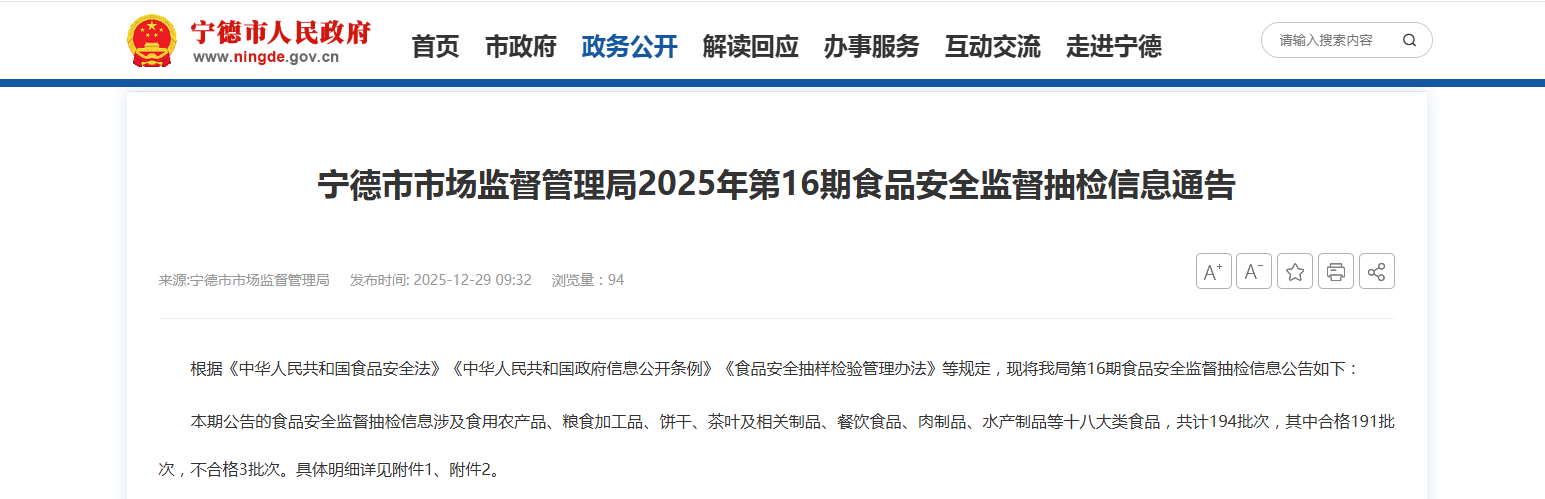
福建省宁德市市场监督管理局2025年第16期食品安全监督抽检信息通告
Zhong Guo Zhi Liang Xin Wen Wang· 2026-01-13 08:01
Core Viewpoint - The announcement details the results of the 16th food safety supervision sampling inspection, indicating that out of 194 batches tested, 191 were qualified and 3 were unqualified, with actions taken against the non-compliant products [2]. Group 1: Inspection Results - The inspection covered 18 categories of food products, including edible agricultural products, grain processing products, biscuits, tea, catering food, meat products, and aquatic products [2]. - A total of 194 batches were tested, with 191 passing and 3 failing the safety standards [2]. Group 2: Actions Taken - The Ningde Market Supervision Administration has mandated local market supervision departments to investigate and handle the non-compliant products, ensuring producers fulfill their legal responsibilities, including stopping sales, recalling products, and making public announcements [2]. - Consumers are advised to report any unqualified food products listed in the announcement by calling the complaint hotline 12315 [2].


啤酒行业专题报告:渠道变革,精酿崛起
GUOTAI HAITONG SECURITIES· 2026-01-13 05:15
Investment Rating - The report rates the beer industry as "Buy" [1] Core Insights - The beer industry is entering a new normal characterized by stock competition, with structural opportunities arising from category and channel changes. The demand for beer in China has been gradually declining in 2023, and it is expected to follow a long-term downward trend similar to overseas experiences. The average selling price (ASP) of leading companies is projected to increase by only 0.4% in 2024 due to weaker-than-expected demand recovery and inflation decline [4][7] - The rise of craft beer represents a significant opportunity for the industry, with leading companies likely to benefit from this trend. The penetration rate of craft beer in China is estimated to be around 3%, which is still significantly lower than the 5-15% levels seen in developed countries [4][20] - New retail channels are rapidly growing, driven by consumer demands for convenience, rationality, and differentiation. The estimated sales of beer through new retail channels are around 30 billion yuan, with a penetration rate of approximately 6% and an annual growth rate of about 20% [4][61] Summary by Sections 1. Industry New Phase: Stock Era, Channel Change, Craft Beer Rise - The beer industry in China is experiencing a new normal with both volume and price entering a downward trend. The production volume is expected to decline by 0.4% in 2023 and 1.0% in 2024 [7][4] - The concentration of leading companies is expected to decrease slightly, with the CR5 ratio projected to drop by 3.5 percentage points to around 74.8% in 2024 [14][4] 2. Category Change: Demand Shift Creates Opportunities, Large Companies to Benefit - The demand for beer in China is at a turning point, with potential for big single product opportunities. The younger generation is becoming the main consumer group, leading to a shift in drinking culture towards personal preference [23][24] - The craft beer market is expected to grow significantly, with an estimated annual growth rate in sales exceeding double digits. The penetration rate of craft beer is projected to reach around 3% by 2025 [29][30] 3. Channel Change: Demand Stock Competition, Impact on Structure Manageable - The structure of beer distribution channels is changing, with a decline in traditional on-premise sales and an increase in new retail channels. The new retail channel is expected to account for about 6% of total beer sales, with significant growth in instant retail and membership warehouse stores [56][61] - The rapid growth of new retail channels is driven by improved logistics efficiency and changing consumer preferences for convenience and differentiated products [57][61]

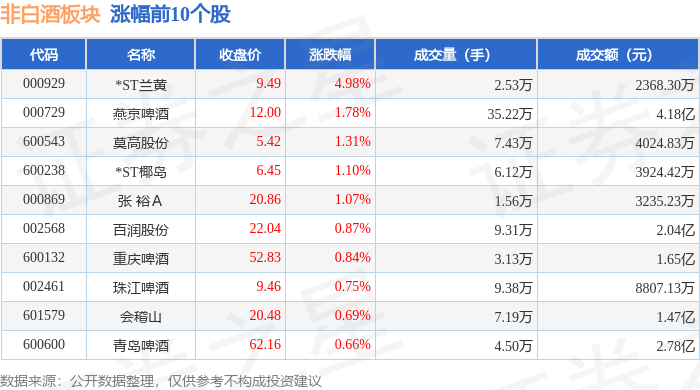
非白酒板块1月6日涨0.86%,*ST兰黄领涨,主力资金净流出1692.41万元
Zheng Xing Xing Ye Ri Bao· 2026-01-06 08:56
Market Overview - The non-baijiu sector increased by 0.86% compared to the previous trading day, with *ST Lanhua leading the gains [1] - The Shanghai Composite Index closed at 4083.67, up 1.5%, while the Shenzhen Component Index closed at 14022.55, up 1.4% [1] Stock Performance - The top-performing stock was *ST Lanhua, closing at 676 with a rise of 4.98% and a trading volume of 25,300 shares [1] - Other notable stocks included Zai Liang Beer, which rose by 1.78% to 12.00, and Mogaogongsi, which increased by 1.31% to 5.42 [1] - The overall trading volume and turnover for various stocks in the non-baijiu sector were significant, with Zai Liang Beer achieving a turnover of 418 million yuan [1] Capital Flow - The non-baijiu sector experienced a net outflow of 16.92 million yuan from institutional investors, while retail investors saw a net outflow of 6.90 million yuan [2] - Conversely, speculative funds recorded a net inflow of 23.83 million yuan [2] Individual Stock Capital Flow - Qingdao Beer had a net inflow of 22.44 million yuan from institutional investors, representing 8.06% of its total capital flow [3] - *ST Lanhua saw a net inflow of 6.04 million yuan from institutional investors, accounting for 25.51% of its capital flow [3] - In contrast, Huichuan Beer experienced a net outflow of 2.87 million yuan from institutional investors, indicating a negative sentiment [3]

年度投资策略报告:底部向阳,寻找结构性亮点-20260105
Tai Ping Yang Zheng Quan· 2026-01-05 14:15
Overall Industry Review - The food and beverage sector significantly underperformed the market, with a year-to-date decline of -0.62%, lagging behind the Shanghai Composite Index by 15.0 percentage points [7][11] - The snack sector showed strong performance with a year-to-date increase of 28.88%, driven by channel expansion and a total revenue growth of 30.97% in the first three quarters of 2025 [11] - The beverage sector, particularly soft drinks, benefited from travel demand and low-price, high-frequency consumption, achieving a revenue and profit growth in double digits [11][14] Alcoholic Beverages - The liquor sector exhibited weak performance, with a decline in sales and prices, particularly for white liquor, which saw a year-on-year revenue drop of -5.83% and a net profit decline of -6.93% in the first three quarters of 2025 [11][44] - The overall white liquor sector's revenue decreased by -5.8% and net profit by -6.9% in the first three quarters of 2025, with a significant drop in Q3, where total revenue fell by -18.4% [44] - The report indicates that the white liquor industry is in a prolonged adjustment phase, with the current downturn lasting 57 months, marking the longest adjustment period in history [35][40] Future Outlook - The central economic work conference emphasized the importance of boosting domestic demand in 2026, with expectations for policy support to stimulate recovery [3] - The report suggests focusing on sectors with low bases for recovery, such as frozen foods and beverages, which are expected to benefit from demand recovery and new product opportunities [3][4] - The report highlights the potential for structural opportunities in the food and beverage sector, particularly in overseas markets and cost improvements, recommending companies like Anqi Yeast and Mijiu Group for their overseas expansion strategies [4][34] Investment Strategies - The report identifies four key investment themes for 2026: opportunities in overseas markets, cost benefits, new product launches, and value-for-money consumption [4] - Companies with strong platform capabilities and innovative products, such as Dongpeng Beverage and Wancheng Group, are recommended for their potential in the beverage sector [4] - The report also emphasizes the importance of identifying companies that can adapt to a low-inflation, low-confidence environment by offering high-value products [14]


非白酒板块1月5日涨1.26%,燕京啤酒领涨,主力资金净流出5761.27万元
Zheng Xing Xing Ye Ri Bao· 2026-01-05 08:59
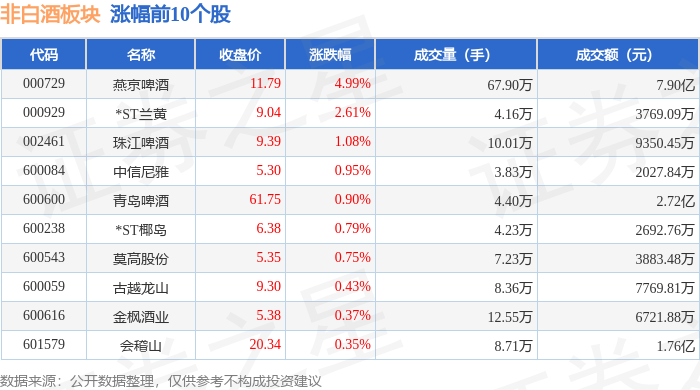
Market Overview - The non-liquor sector increased by 1.26% on January 5, with Yanjing Beer leading the gains [1] - The Shanghai Composite Index closed at 4023.42, up 1.38%, while the Shenzhen Component Index closed at 13828.63, up 2.24% [1] Stock Performance - Wujing Beer (000729) closed at 11.79, up 4.99% with a trading volume of 679,000 shares and a transaction value of 790 million yuan [1] - ST Lanhua (000929) closed at 9.04, up 2.61% with a trading volume of 41,600 shares and a transaction value of 37.69 million yuan [1] - Zhujiang Beer (002461) closed at 9.39, up 1.08% with a trading volume of 100,100 shares and a transaction value of 93.50 million yuan [1] - Other notable stocks include Chongqing Beer (600132) at 52.39, up 0.29%, and Huichuan Beer (600573) at 11.92, down 0.08% [2] Capital Flow - The non-liquor sector experienced a net outflow of 57.61 million yuan from institutional investors, while retail investors saw a net inflow of 86.47 million yuan [2] - The main capital inflow and outflow for specific stocks include: - Huichuan Beer had a net inflow of 14.29 million yuan from institutional investors [3] - Kuaijishan (601579) saw a net outflow of 22.50 million yuan from speculative funds but a net inflow of 17.31 million yuan from retail investors [3] - Zhujiang Beer had a net inflow of 4.08 million yuan from institutional investors [3]
2025年11月中国啤酒进出口数量分别为0.26亿升和0.66亿升
Chan Ye Xin Xi Wang· 2025-12-28 01:46
Group 1 - The core viewpoint of the article highlights the trends in China's beer import and export market, indicating a significant decline in imports and a notable increase in exports for November 2025 [1] Group 2 - In November 2025, China's beer import volume was 0.26 billion liters, representing a year-on-year decrease of 23.6%, while the import value was $0.38 billion, down 13.4% year-on-year [1] - Conversely, beer exports in November 2025 reached 0.66 billion liters, showing a year-on-year increase of 22.5%, with an export value of $0.44 billion, up 14.8% year-on-year [1] Group 3 - The article references a report by Zhiyan Consulting, which provides an analysis of the non-alcoholic beer industry market dynamics and competitive strategies in China from 2026 to 2032 [1] - Zhiyan Consulting is noted as a leading industry consulting firm in China, specializing in in-depth industry research reports, business plans, feasibility studies, and customized services [1]
