Zhujiang Brewery(002461)

Search documents
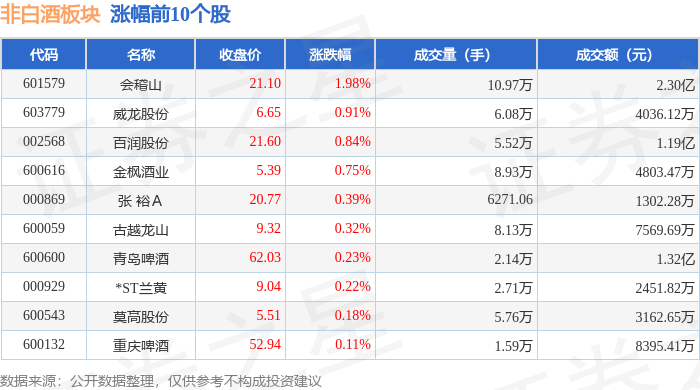
非白酒板块12月25日涨0.12%,会稽山领涨,主力资金净流入3861.1万元
Zheng Xing Xing Ye Ri Bao· 2025-12-25 09:07
Core Viewpoint - The non-white liquor sector experienced a slight increase of 0.12% on December 25, with Kuaijishan leading the gains. The Shanghai Composite Index closed at 3959.62, up 0.47%, while the Shenzhen Component Index closed at 13531.41, up 0.33% [1]. Group 1: Market Performance - Kuaijishan (601579) closed at 21.10, with a rise of 1.98% and a trading volume of 109,700 shares, resulting in a transaction value of 230 million yuan [1]. - Weilang Co. (603779) saw a closing price of 6.65, up 0.91%, with a trading volume of 60,800 shares [1]. - Zhirun Co. (002568) closed at 21.60, increasing by 0.84%, with a trading volume of 55,200 shares [1]. - The overall non-white liquor sector had a net inflow of 38.61 million yuan from main funds, while retail investors experienced a net outflow of 17.34 million yuan [2]. Group 2: Fund Flow Analysis - Huichuan Beer (600573) had a main fund net outflow of 29.06 million yuan, with a retail net outflow of 13.31 million yuan [3]. - Kuaijishan (601579) recorded a main fund net inflow of 10.01 million yuan, but a retail net outflow of 6.47 million yuan [3]. - Jinfeng Wine Industry (600616) experienced a main fund net inflow of 6.48 million yuan, with a significant retail net outflow of 5.36 million yuan [3].


珠江啤酒中山产能扩建项目顺利投产
Sou Hu Cai Jing· 2025-12-20 11:20
Core Insights - The core viewpoint of the news is the launch of the capacity expansion and upgrade project by Zhujiang Beer in Zhongshan, which aims to enhance production capabilities and support high-quality development in the manufacturing sector [1][3]. Group 1: Project Overview - The total investment for the Zhongshan beer capacity expansion project is 932 million yuan, which will add 300,000 tons of brewing capacity and a production line for 72,000 cans per hour [1]. - The project will also upgrade existing bottling production lines and is expected to generate an annual output value exceeding 800 million yuan [1]. Group 2: Technological and Environmental Focus - The expansion emphasizes digitalization, greening, and integration, introducing approximately 40 new technologies and equipment to enhance production efficiency [3]. - The project aims to achieve a 20% reduction in overall energy consumption by implementing advanced systems and energy-saving technologies, promoting a green production model [3]. Group 3: Company Performance and Future Outlook - In the first three quarters of the year, Zhujiang Beer reported beer sales of 1.2035 million tons, operating revenue of 5.073 billion yuan, and a net profit attributable to shareholders of 944 million yuan, reflecting year-on-year growth of 1.83%, 3.81%, and 17.05% respectively [3]. - The chairman of Zhujiang Beer emphasized that the project aligns with Guangdong's focus on a strong manufacturing sector and will contribute significantly to the development of the Guangdong-Hong Kong-Macao Greater Bay Area [3].
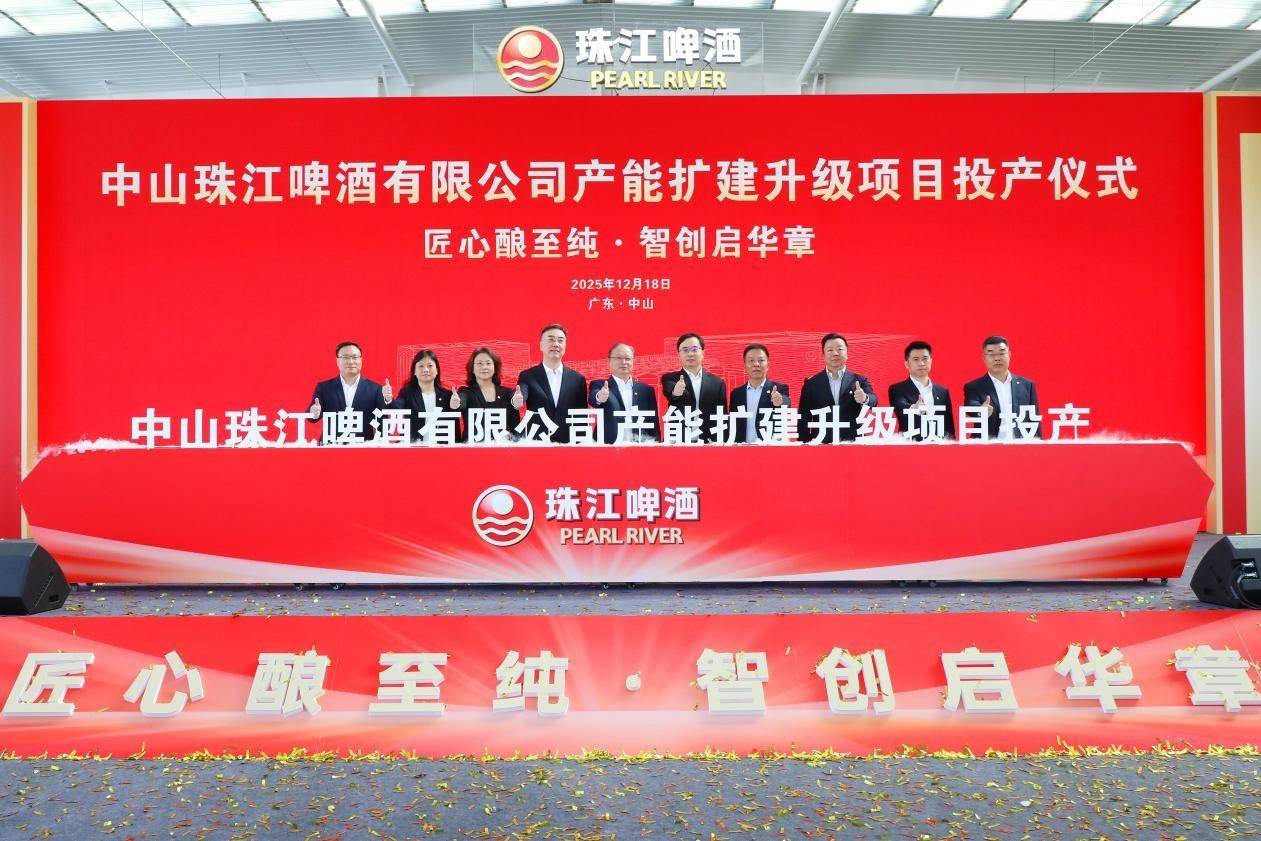
年产能最高30万吨!珠江啤酒中山产能扩建升级项目顺利投产
Nan Fang Du Shi Bao· 2025-12-18 13:41
Core Viewpoint - The production launch of the capacity expansion and upgrade project of Zhongshan Zhujiang Beer is a significant step towards enhancing production capacity, technological advancement, and green low-carbon levels, contributing to the high-quality development of the beer industry in Guangdong [1][2][8]. Group 1: Project Overview - The project involves a total investment of 932 million yuan, adding 300,000 tons of brewing capacity and a new can production line with a capacity of 72,000 cans per hour [1]. - The project aims to integrate smart manufacturing and green technology, enhancing the overall production efficiency and sustainability of Zhujiang Beer [2][3]. Group 2: Technological Innovations - The project incorporates approximately 40 advanced technologies and equipment, including intelligent integrated systems and automated storage solutions, to improve production processes from brewing to logistics [2][4]. - A digital management platform will facilitate one-stop digital management, including order issuance, data collection, and intelligent analysis [3][4]. Group 3: Economic Impact - The project is expected to generate an additional annual output value of over 800 million yuan, reinforcing the foundation of the real economy in Zhongshan [5]. - Zhujiang Beer has maintained a high-quality growth trajectory, achieving beer sales of 1.2035 million tons and revenue of 5.073 billion yuan in the first three quarters, with net profit increasing by 17.05% year-on-year [6]. Group 4: Consumer Engagement and Market Strategy - The project enhances consumer experience by providing fresher products and expanding the "beer+" model, which integrates various sectors such as sports, music, and food [7]. - Zhujiang Beer has established over 500 experience stores nationwide, creating a consumer service network that promotes active consumption [7]. Group 5: Strategic Alignment - The project aligns with the "14th Five-Year Plan" for optimizing the industrial structure and enhancing the manufacturing capabilities of Zhujiang Beer, contributing to the broader goals of Guangdong's economic development [6][8].
珠江啤酒:第四届董事会第八十八次会议决议公告
Zheng Quan Ri Bao· 2025-12-18 10:47
Group 1 - The core point of the article is that Zhujiang Brewery announced the approval of a proposal to conclude certain fundraising projects and permanently supplement working capital with the remaining raised funds [2] Group 2 - The announcement was made during the 88th meeting of the fourth board of directors [2] - The decision reflects the company's strategy to optimize its financial resources and enhance liquidity [2] - This move may indicate the company's confidence in its operational efficiency and future growth prospects [2]
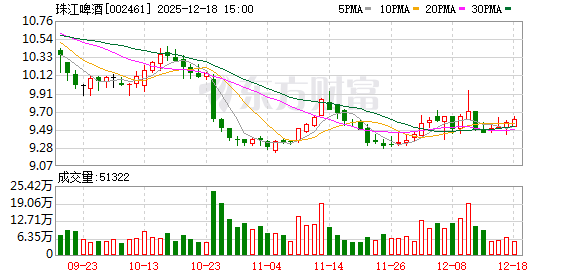
珠江啤酒:12月18日召开董事会会议
Mei Ri Jing Ji Xin Wen· 2025-12-18 08:04
Company Overview - Zhujiang Beer (SZ 002461) announced on December 18 that its 88th board meeting was held via telecommunication, where it reviewed proposals including the completion of certain fundraising projects and the permanent allocation of surplus funds to working capital [1] Financial Performance - For the first half of 2025, Zhujiang Beer's revenue composition was as follows: beer sales accounted for 96.94%, other businesses for 1.15%, leasing and catering services for 1.14%, yeast feed sales for 0.64%, and packaging materials for 0.13% [1] Market Position - As of the report date, Zhujiang Beer had a market capitalization of 21.3 billion yuan [1]
珠江啤酒:拟将3.55亿元节余募集资金永久补充流动资金
Xin Lang Cai Jing· 2025-12-18 07:49
Core Viewpoint - Zhujiang Brewery announced plans to conclude several fundraising projects, reallocating surplus funds of 355 million yuan to permanently supplement working capital for daily operations [1] Group 1 - The company intends to finalize the modernization of its marketing network, the construction and promotion of O2O sales channels, and the expansion and relocation of beer production capacity projects [1] - The surplus funds will be utilized to support the company's routine production and operational activities [1]
珠江啤酒(002461) - 中信证券股份有限公司关于广州珠江啤酒股份有限公司部分募投项目结项并将节余募集资金永久补充流动资金的核查意见
2025-12-18 07:46
中信证券股份有限公司 关于广州珠江啤酒股份有限公司 部分募投项目结项并将节余募集资金永久补充流动资金的核查 意见 中信证券股份有限公司(以下简称"中信证券"或"保荐人")作为广州珠 江啤酒股份有限公司(以下简称"珠江啤酒"或"公司")非公开发行 A 股股 票持续督导阶段的保荐人,根据《上市公司募集资金监管规则》、《深圳证券交 易所股票上市规则》和《深圳证券交易所上市公司自律监管指引第 1 号—主板上 市公司规范运作》等有关规定,对珠江啤酒部分募投项目结项并将节余募集资金 永久补充流动资金事项进行了审慎核查,核查情况及核查意见如下: 一、募集资金基本情况 经中国证券监督管理委员会"证监许可[2016]3231 号"核准,本公司向特定 对象非公开发行人民币普通股(A 股)不超过 426,502,472 股(每股面值 1 元), 每股发行价格人民币 10.11 元,实际发行人民币普通股 426,502,472 股,共计募 集资金人民币 4,311,939,991.92 元,扣除承销费、保荐费、律师费等发行费用人 民币 16,152,996.87 元(含税),实际募集资金净额为人民币 4,295,786,995.05 ...
珠江啤酒(002461) - 关于部分募投项目结项并将节余募集资金永久补充流动资金的公告
2025-12-18 07:45
证券代码:002461 证券简称:珠江啤酒 公告编号:2025-037 广州珠江啤酒股份有限公司 关于部分募投项目结项并将节余 募集资金永久补充流动资金的公告 本公司及董事会全体成员保证公告内容真实、准确、完整,没有虚假记 载、误导性陈述或重大遗漏。 广州珠江啤酒股份有限公司(以下简称"公司")于 2025 年 12 月 18 日 召开第四届董事会第八十八次会议,审议通过了《关于部分募投项目结项并 将节余募集资金永久补充流动资金的议案》(该议案已经公司董事会战略委 员会审议通过),同意对募投项目现代化营销网络建设及升级项目、O2O 销售 渠道建设及推广项目和啤酒产能扩大及搬迁项目进行结项,并将节余募集资 金永久补充流动资金,用于公司日常生产经营活动。现将相关事宜公告如 下: 一、募集资金基本情况 经中国证券监督管理委员会"证监许可[2016]3231 号"核准,本公司向 特定对象非公开发行人民币普通股(A 股)不超过 426,502,472 股(每股面值 1 元),每股发行价格人民币 10.11 元,实际发行人民币普通股 426,502,472 股,共计募集资金人民币 4,311,939,991.92 元,扣 ...
珠江啤酒(002461) - 第四届董事会第八十八次会议决议公告
2025-12-18 07:45
证券代码:002461 证券简称:珠江啤酒 公告编号:2025-036 广州珠江啤酒股份有限公司 第四届董事会第八十八次会议决议公告 审议通过《关于部分募投项目结项并将节余募集资金永久补充流动资金的 议案》。 公司《关于部分募投项目结项并将节余募集资金永久补充流动资金的公 告》详见 2025 年 12 月 19 日《中国证券报》、《证券时报》以及巨潮资讯网。 本议案已经公司董事会战略委员会审议通过。保荐机构中信证券股份有限公 司对此进行了审核,具体详见巨潮资讯网。 表决结果:同意 8 票,反对 0 票,弃权 0 票,赞成票数占董事会有效表决 权的 100%审议通过此项议案。 特此公告。 广州珠江啤酒股份有限公司董事会 2025 年 12 月 19 日 1 本公司及董事会全体成员保证公告内容真实、准确、完整,没有虚假记 载、误导性陈述或重大遗漏。 广州珠江啤酒股份有限公司(以下简称"公司")第四届董事会第八十八 次会议于 2025 年 12 月 18 日以通讯方式召开,会议由黄文胜董事长召集。召 开本次会议的通知及相关资料已于 2025 年 12 月 5 日通过电子邮件等方式送达 各位董事。本次会议应到董事 8 ...
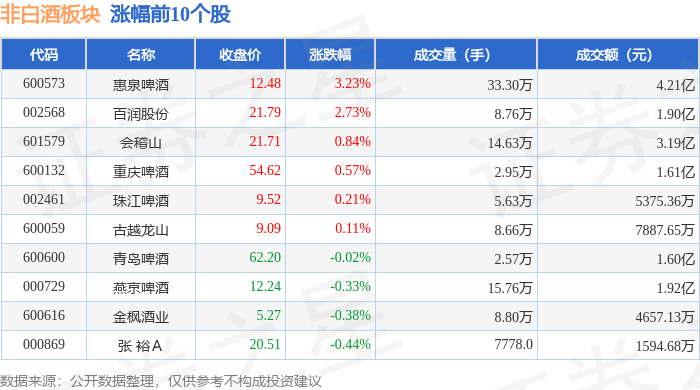
非白酒板块12月16日涨0.16%,惠泉啤酒领涨,主力资金净流出2505.5万元
Zheng Xing Xing Ye Ri Bao· 2025-12-16 09:09
Group 1 - The non-white liquor sector increased by 0.16% on December 16, with Huichuan Beer leading the gains [1] - The Shanghai Composite Index closed at 3824.81, down 1.11%, while the Shenzhen Component Index closed at 12914.67, down 1.51% [1] - Key stocks in the non-white liquor sector showed varied performance, with the highest gain being 3.23% for Yuanzhi Ban [1] Group 2 - The non-white liquor sector experienced a net outflow of 25.06 million yuan from main funds, while retail investors saw a net inflow of 53.38 million yuan [2] - The trading volume and turnover for key stocks in the non-white liquor sector varied, with Yuanzhi Ban achieving a turnover of 421 million yuan [1][2] - The net inflow from retail investors was significant, indicating a potential shift in market sentiment towards the non-white liquor sector [2][3] Group 3 - Specific stocks like Baorun Co. and Huichuan Beer had notable net inflows from retail investors, while others like ST Lanhua and Jin Feng Wine experienced net outflows [3] - The data indicates a mixed sentiment among institutional and retail investors, with some stocks attracting retail interest despite overall sector outflows [3] - The performance of individual stocks varied significantly, highlighting the importance of stock selection within the non-white liquor sector [3]