
Zhujiang Brewery(002461)

Search documents
珠江啤酒业绩快报:2025年净利润9.03亿元 同比增长11.42%
Ge Long Hui· 2026-02-25 08:15
格隆汇2月25日丨珠江啤酒(002461.SZ)公布2025年度业绩快报,报告期内,公司产品结构优化升级,市 场开拓稳中有进,渠道建设创新发力,品牌声量持续放大,管理效能不断提升,持续推动企业高质量发 展走深走实。2025年,公司实现啤酒销量146.24万吨,同比增长1.58%;实现营业总收入58.78亿元,同 比增长2.56%;利润总额、归属于上市公司股东的净利润、扣除非经常性损益后的归属上市公司股东的 净利润分别为10.57亿元、9.03亿元和8.32亿元,分别同比增长10.98%、11.42%和9.25%,基本每股收益 同比增长10.81%。本报告期末资产总额、归属于上市公司股东的所有者权益分别为160.66亿元、110.36 亿元,分别比本报告期初增长1.00%、5.00%。 ...

珠江啤酒:2025年营收58.78亿元 净利润同比增长11.42%
Xin Lang Cai Jing· 2026-02-25 08:14
珠江啤酒公告称,2025年公司实现营业总收入58.78亿元,同比增长2.56%;利润总额10.57亿元,同比 增长10.98%;归属于上市公司股东的净利润9.03亿元,同比增长11.42%;扣非后净利润8.32亿元,同比 增长9.25%;基本每股收益同比增长10.81%。2025年啤酒销量146.24万吨,同比增长1.58%。报告期末资 产总额、归属股东权益分别为160.66亿元、110.36亿元,较期初分别增长1.00%、5.00%。 ...
珠江啤酒(002461.SZ)业绩快报:2025年净利润9.03亿元 同比增长11.42%
Ge Long Hui A P P· 2026-02-25 08:14
格隆汇2月25日丨珠江啤酒(002461.SZ)公布2025年度业绩快报,报告期内,公司产品结构优化升级,市 场开拓稳中有进,渠道建设创新发力,品牌声量持续放大,管理效能不断提升,持续推动企业高质量发 展走深走实。2025年,公司实现啤酒销量146.24万吨,同比增长1.58%;实现营业总收入58.78亿元,同 比增长2.56%;利润总额、归属于上市公司股东的净利润、扣除非经常性损益后的归属上市公司股东的 净利润分别为10.57亿元、9.03亿元和8.32亿元,分别同比增长10.98%、11.42%和9.25%,基本每股收益 同比增长10.81%。本报告期末资产总额、归属于上市公司股东的所有者权益分别为160.66亿元、110.36 亿元,分别比本报告期初增长1.00%、5.00%。 ...
年度啤酒销量146.24万吨,珠江啤酒2025年归母净利润9.03亿元
Zhi Tong Cai Jing· 2026-02-25 08:13
珠江啤酒(002461)(002461.SZ)披露2025年度业绩快报,公司实现啤酒销量146.24万吨,同比增长 1.58%;实现营业总收入58.78亿元,同比增长2.56%;利润总额、归属于上市公司股东的净利润、扣除非经 常性损益后的归属上市公司股东的净利润分别为10.57亿元、9.03亿元和8.32亿元,分别同比增长 10.98%、11.42%和9.25%,基本每股收益同比增长10.81%。 ...
年度啤酒销量146.24万吨,珠江啤酒(002461.SZ)2025年归母净利润9.03亿元
智通财经网· 2026-02-25 08:12
智通财经APP讯,珠江啤酒(002461.SZ)披露2025年度业绩快报,公司实现啤酒销量146.24万吨,同比增 长1.58%;实现营业总收入58.78亿元,同比增长2.56%;利润总额、归属于上市公司股东的净利润、扣除非 经常性损益后的归属上市公司股东的净利润分别为10.57亿元、9.03亿元和8.32亿元,分别同比增长 10.98%、11.42%和9.25%,基本每股收益同比增长10.81%。 ...
珠江啤酒(002461) - 2025 Q4 - 年度业绩
2026-02-25 08:05
证券代码:002461 证券简称:珠江啤酒 公告编号:2026-001 广州珠江啤酒股份有限公司 2025 年度业绩快报 本公司及董事会全体成员保证信息披露的内容真实、准确、完整,没有虚假记载、误导性陈述或重 大遗漏。 单位:万元 | 项目 | 本报告期 | 上年同期 | 增减变动幅度(%) | | --- | --- | --- | --- | | 营业总收入 | 587,760.59 | 573,107.94 | 2.56% | | 营业利润 | 104,784.01 | 95,083.25 | 10.20% | | 利润总额 | 105,719.47 | 95,263.24 | 10.98% | | 归属于上市公司股东的 净利润 | 90,280.44 | 81,027.32 | 11.42% | | 扣除非经常性损益后的 归属于上市公司股东的 | | | | | | 83,226.42 | 76,182.89 | 9.25% | | 净利润 | | | | | 基本每股收益(元/ | 0.41 | 0.37 | 10.81% | | 股) | | | | | 加权平均净资产收益率 | 8.43% | ...
26年春节消费趋势解读专题:春节消费开门红:总量增长,结构分化



GUOTAI HAITONG SECURITIES· 2026-02-24 02:32
Investment Rating - The report rates the industry as "Buy" [5] Core Insights - The 2026 Spring Festival consumption exceeded expectations, with service consumption leading the growth, driven by a significant increase in dining and travel demand [2][7] - The report highlights a notable recovery in the travel sector, with an expected total of 9.5 billion people traveling during the Spring Festival, marking a historical high [10][12] - The report emphasizes the importance of quality and experience in consumer spending, with a shift towards premium products and services [7][19] Summary by Sections 1. Spring Festival Consumption Trends - The Spring Festival holiday from February 15 to 23, 2026, saw a "good start" in consumption, with key retail and dining enterprises reporting a 10.6% increase in average daily sales compared to the same period in 2025 [10][22] - The first four days of the holiday recorded an 8.6% increase in average daily sales for key retail and dining enterprises compared to the previous year [10][19] - Government initiatives, including a 20.5 billion yuan fund for consumer subsidies, significantly boosted consumer spending [11][10] 2. Baijiu (Chinese Liquor) Market - The Baijiu market showed signs of improvement, with a narrowing decline compared to previous major holidays, although brand differentiation became more pronounced [27][30] - High-end Baijiu brands like Moutai and Wuliangye continued to lead the market, with a focus on price elasticity and rational consumer behavior [27][30] - The report identifies three key changes in the Baijiu market: increased importance of personal consumption, a more relaxed approach from manufacturers regarding sales targets, and improved channel sentiment [30][31] 3. Snack and Food Market - The snack market is expected to benefit from an extended peak season, with a longer preparation and sales cycle compared to 2025 [33][34] - Offline channels, particularly membership-based supermarkets and discount stores, are performing better than online channels, with significant growth in sales during the holiday period [34][35] - The report notes a diversification in snack offerings, with strong performance in high-quality nut gift boxes and innovative packaging strategies enhancing brand visibility [35][36]
非白酒板块2月3日跌0.46%,*ST椰岛领跌,主力资金净流出1.31亿元
Zheng Xing Xing Ye Ri Bao· 2026-02-03 09:03
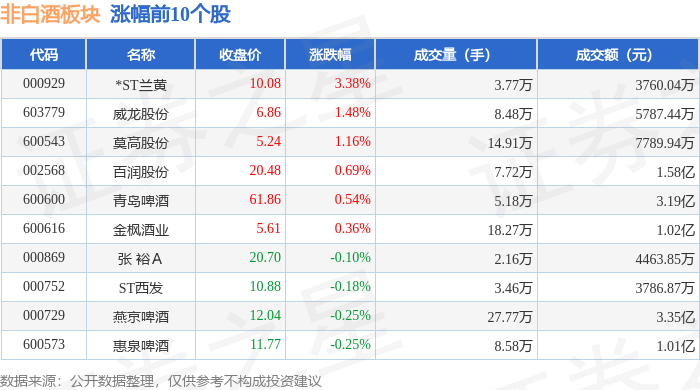
Core Viewpoint - The non-white liquor sector experienced a decline of 0.46% on February 3, with *ST Yedao leading the drop, while the Shanghai Composite Index rose by 1.29% and the Shenzhen Component Index increased by 2.19% [1][2]. Group 1: Market Performance - The closing price of *ST Yedao was 5.87, reflecting a decrease of 5.02% with a trading volume of 99,200 shares and a transaction value of 58.61 million yuan [2]. - The non-white liquor sector saw a net outflow of 131 million yuan from major funds, while retail investors contributed a net inflow of 106 million yuan [2][3]. Group 2: Individual Stock Performance - *ST Lanhua closed at 10.08, with an increase of 3.38% and a trading volume of 37,700 shares, resulting in a transaction value of 37.60 million yuan [1]. - The stock of Weilang Co. closed at 6.86, up by 1.48%, with a trading volume of 84,800 shares and a transaction value of 57.87 million yuan [1]. - The stock of Ziyun Co. closed at 20.48, with a slight increase of 0.69% and a transaction value of 158 million yuan [1]. Group 3: Fund Flow Analysis - Major funds saw a net inflow of 931.78 million yuan in Zhongxin Niya, while retail investors had a net outflow of 910.36 million yuan [3]. - In the case of *ST Lanhua, major funds experienced a net outflow of 85.99 million yuan, while retail investors had a net inflow of 137.59 million yuan [3]. - The stock of ST Xifa had a significant net outflow of 637.88 million yuan from major funds, but a net inflow of 447.99 million yuan from retail investors [3].


非白酒板块2月2日涨0.96%,中信尼雅领涨,主力资金净流出5108.94万元
Zheng Xing Xing Ye Ri Bao· 2026-02-02 09:15
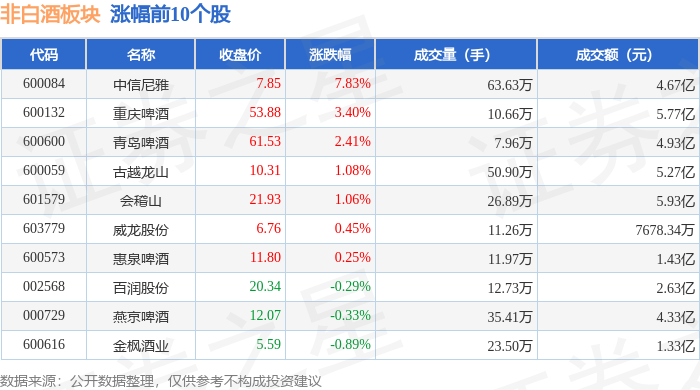
Group 1 - The non-white liquor sector increased by 0.96% compared to the previous trading day, with CITIC Niyah leading the gains [1] - The Shanghai Composite Index closed at 4015.75, down 2.48%, while the Shenzhen Component Index closed at 13824.35, down 2.69% [1] - Key stocks in the non-white liquor sector showed varied performance, with CITIC Niyah closing at 7.85, up 7.83%, and Chongqing Beer at 53.88, up 3.40% [1] Group 2 - The non-white liquor sector experienced a net outflow of 51.09 million yuan from institutional investors, while retail investors saw a net outflow of 7.08 million yuan [2] - The main capital flow data indicates that Kuaijishan had a net inflow of 22.89 million yuan from institutional investors, while CITIC Niyah had a net outflow of 4.01 million yuan [3] - Retail investors showed a significant net outflow in several stocks, including Baorun Co., which had a net outflow of 22.42 million yuan [3]


中国必选消费品1月需求报告:基础需求回暖,享乐型消费承压
Haitong Securities International· 2026-02-02 00:41
Investment Rating - The report rates multiple companies in the consumer staples sector as "Outperform," including Guizhou Moutai, Wuliangye, and Yili [1]. Core Insights - The consumer staples industry in January 2026 shows a recovery in basic demand while hedonic consumption remains under pressure, indicating a divergence in performance across different segments [3][29]. - Among the eight key consumer industries tracked, four are experiencing positive growth (condiments, frozen food, soft drinks, and catering), while four are facing declines (high-end and above Baijiu, mass-market Baijiu, dairy products, and beer) [29]. Summary by Segment Baijiu (High-end and Above) - In January, the revenue for high-end Baijiu reached 47 billion yuan, a year-on-year decline of 14.0%. The price pressure is significant, with expectations of over a 10% price drop throughout the year due to high inventory levels [11]. Baijiu (Mass-market and Below) - The mass-market Baijiu segment generated 22.9 billion yuan in January, down 3.0% year-on-year. Despite the decline, the segment shows resilience due to rigid demand and adaptability to consumption scenarios [13]. Beer - The beer industry reported revenues of 17 billion yuan in January, a decrease of 7.1% year-on-year. The demand was affected by adverse weather and the delayed Spring Festival, leading to a cautious inventory approach by distributors [15]. Condiments - The condiment sector achieved revenues of 46.9 billion yuan in January, reflecting a year-on-year growth of 3.5%. The recovery in the catering channel and increased demand from small and medium-sized businesses are key drivers [17]. Dairy Products - The dairy sector's revenue was 43.5 billion yuan in January, down 3.3% year-on-year. The demand remains under pressure, but a potential recovery is anticipated in the coming months due to low base effects [19]. Frozen Food - The frozen food segment saw revenues of 14.99 billion yuan in January, with a year-on-year increase of 8%. The demand is supported by pre-Spring Festival stocking and favorable weather conditions [21]. Soft Drinks - The soft drink industry generated 96.2 billion yuan in January, with a modest growth of 1.1% year-on-year. Increased promotional activities indicate heightened market competition [24]. Catering - The catering sector reported revenues of 16.2 billion yuan in January, up 2.5% year-on-year. The demand is gradually improving, particularly in small and medium-sized restaurants [26].


