
BANK OF QINGDAO(002948)

Search documents
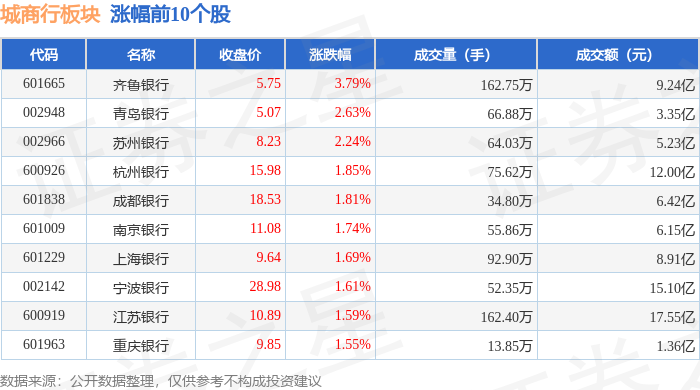
城商行板块9月2日涨1.65%,齐鲁银行领涨,主力资金净流入3.41亿元
Zheng Xing Xing Ye Ri Bao· 2025-09-02 08:59
Group 1 - The city commercial bank sector increased by 1.65% on September 2, with Qilu Bank leading the gains [1] - The Shanghai Composite Index closed at 3858.13, down 0.45%, while the Shenzhen Component Index closed at 12553.84, down 2.14% [1] - Qilu Bank's closing price was 5.75, reflecting a 3.79% increase, with a trading volume of 1.6275 million shares and a transaction value of 924 million [1] Group 2 - The city commercial bank sector saw a net inflow of 341 million from main funds, while retail funds experienced a net outflow of 138 million [2] - Jiangsu Bank had a net inflow of 140 million from main funds, but a net outflow of 90.16 million from speculative funds [3] - The overall trading activity in the city commercial bank sector indicates a mixed sentiment among different types of investors, with main funds showing positive interest while retail and speculative funds withdrew [2][3]

青岛银行(03866) - 截至二零二五年八月三十一日股份发行人的证券变动月报表
2025-09-02 08:33
FF301 股份發行人及根據《上市規則》第十九B章上市的香港預託證券發行人的證券變動月報表 截至月份: 2025年8月31日 狀態: 新提交 致:香港交易及結算所有限公司 公司名稱: 青島銀行股份有限公司 呈交日期: 2025年9月2日 I. 法定/註冊股本變動 | 2. 股份分類 | 普通股 | 股份類別 | A | | 於香港聯交所上市 (註1) | 否 | | | --- | --- | --- | --- | --- | --- | --- | --- | | 證券代號 (如上市) | 002948 | 說明 | | 於深圳證劵交易所上市 | | | | | | | 已發行股份(不包括庫存股份)數目 | | 庫存股份數目 | | 已發行股份總數 | | | 上月底結存 | | | 3,528,409,250 | | 0 | | 3,528,409,250 | | 增加 / 減少 (-) | | | | | | | | | 本月底結存 | | | 3,528,409,250 | | 0 | | 3,528,409,250 | 第 2 頁 共 10 頁 v 1.1.1 | 1. 股份分類 | 普通股 | ...
今天,A股再现“跷跷板
Zhong Guo Zheng Quan Bao· 2025-09-02 04:43
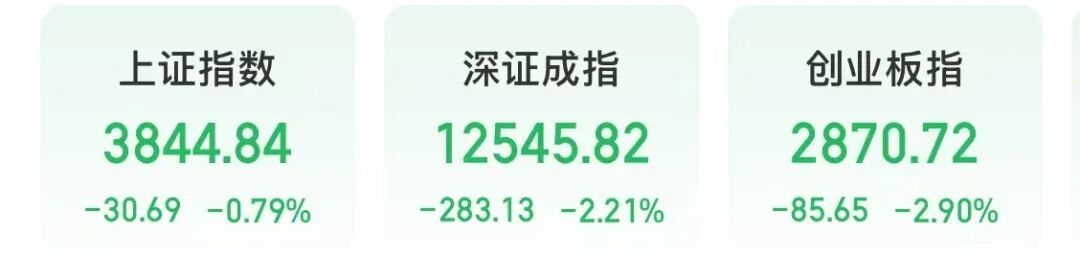
Market Overview - The market exhibited a "seesaw" effect with high dividend assets performing actively while technology stocks experienced a pullback [1] - The banking and electricity sectors saw gains, while the computing industry chain stocks, including Dekoli, Cambridge Technology, and others, faced significant declines [1] - The Shanghai Composite Index fell by 0.79%, the Shenzhen Component Index dropped by 2.21%, and the ChiNext Index decreased by 2.9% [2] Banking Sector - The banking sector rebounded with notable gains in stocks such as Chongqing Rural Commercial Bank and Shanghai Rural Commercial Bank [3] - The overall performance of the banking sector's mid-year reports showed improvement, with most banks experiencing revenue and profit growth, a stable non-performing loan ratio, and a steady provision coverage ratio [5] - Analysts suggest that the banking sector may see a rotation and rebound due to solid fundamentals and previous adjustments, with a focus on regional banks and high-dividend stocks [6] Electricity Sector - The electricity sector showed strong performance, with stocks like Jingyuntong and Huaguang New Energy experiencing significant increases [8] - In July, the total electricity consumption reached 10,226 billion kWh, marking an 8.6% year-on-year increase, indicating robust demand [9] - Analysts recommend focusing on leading companies in renewable energy, regional offshore wind power firms, and water power stocks with stable performance and growth potential [9]


青岛银行半年报折射韧性成长“密码”
Xin Lang Cai Jing· 2025-09-02 03:41
Core Insights - Qingdao Bank demonstrates resilient growth with a 7.69% increase in total assets and a 16.05% rise in net profit attributable to shareholders in the latest half-year report, reflecting its focus on quality and efficiency [1][5][4] - The bank's strategic focus on green finance and technology finance has resulted in significant loan growth, with increases of 38.18% and 20.85% respectively, showcasing its effective differentiation and regional economic advantages [1][5][10][12] - The establishment of Qingyin Financial Leasing and Qingyin Wealth Management signifies the bank's deepening group layout, enhancing its comprehensive financial service capabilities [1][6][7] Financial Performance - As of June 30, Qingdao Bank's total assets reached 743.03 billion yuan, with customer loans totaling 368.4 billion yuan and customer deposits at 466.1 billion yuan, marking growth rates of 8.14% and 7.9% respectively [4][5] - The bank achieved an operating income of 7.662 billion yuan, a year-on-year increase of 7.5%, and a net profit of 3.065 billion yuan, reflecting a robust performance amid a challenging economic environment [5][6] - The non-performing loan ratio improved to 1.12%, down by 0.02 percentage points from the previous year, while the provision coverage ratio increased to 252.8%, up by 11.48 percentage points, indicating strengthened risk mitigation capabilities [5][6] Strategic Initiatives - Qingdao Bank's diversified approach includes a focus on regional economic development, emphasizing support for small and micro enterprises, which enhances its adaptability to local market changes [9][10] - The bank has established a technology finance ecosystem, collaborating with venture capital and investment institutions to provide comprehensive financial services tailored to technology enterprises [10][11] - The bank's blue finance initiative has seen a loan balance increase of 14.56%, while green finance loans grew by 38.18%, reflecting its commitment to sustainable development [12][13] Brand and Market Position - Qingdao Bank has made its debut on the Fortune China 500 list, marking a significant milestone for local financial institutions and underscoring its growth and operational efficiency [14] - The bank's brand value reached 36.236 billion yuan, ranking it 317th in the "China's 500 Most Valuable Brands" list, demonstrating its strong market presence and brand influence [16] - The bank's participation in international financial exhibitions highlights its commitment to high-level openness and collaboration with the local economy, enhancing its visibility and reputation [16]
“科创中国”金融科技服务团走进青岛银行暨“人工智能+金融”青岛论坛成功举办
Zheng Quan Ri Bao Zhi Sheng· 2025-09-01 10:39
本报讯 (记者李冰)日前,"科创中国"金融科技服务团走进青岛银行暨"人工智能+金融"青岛论坛成功 举办。本次论坛由"科创中国"金融科技服务团、中国通信学会金融科技专家委员会、中国互联网协会数 字金融工作委员会及青岛银行共同主办,山东省科学技术协会、青岛市科学技术学会、青岛东方数字普 惠金融研究院、中央财经大学MBA金融科技研究会、启迪亦庄人工智能联合创新中心支持,腾讯云计 算(北京)有限责任公司协办。论坛期间,"科创中国"金融科技服务团专家工作站和"金科创新荟·金融 科技工作者之家"青岛站在青岛银行正式启动成立。 (编辑 张昕) "科创中国"金融科技服务团团长杨竑、山东省科学技术协会二级巡视员葛玉芝、中国互联网协会数字金 融工作委员会主任张永福等嘉宾先后致辞,一致强调人工智能在重塑金融业态、提升服务效率和防控风 险方面的重要作用。此外,来自多家科技企业的代表也分享了AI在理财、消费金融、知识管理与数据 安全等领域的应用实践。 论坛期间还举办了《AI大模型重塑现代银行》新书推介仪式及"人工智能+金融"项目交流展示活动,推 动技术成果与金融场景深度融合。 青岛银行党委书记、董事长景在伦表示,以AI大模型为代表的人 ...
调研速递|青岛银行接受中泰证券等4家机构调研 上半年营收增长7.50%等要点披露
Xin Lang Cai Jing· 2025-09-01 10:32
Group 1 - The core viewpoint of the news is that Qingdao Bank is actively engaging with investors and addressing their concerns regarding the bank's financial performance and future strategies [1] - In the first half of 2025, Qingdao Bank achieved operating revenue of 7.662 billion yuan, an increase of 534 million yuan, or 7.50% year-on-year [1] - The bank's net interest income grew due to the expansion of interest-earning assets and a reduction in interest expenses, while non-interest income also saw growth through strategic bond trading [1] Group 2 - As of June 30, 2025, Qingdao Bank's total customer loans amounted to 368.406 billion yuan, an increase of 27.716 billion yuan, or 8.14% compared to the end of the previous year [2] - The bank plans to continue optimizing its asset-liability structure and steadily increase loan disbursements to support the real economy, with a focus on eight key sectors including technology finance and green finance [2] - In retail lending, Qingdao Bank aims to meet personal customer needs for housing loans while optimizing the credit structure for balanced development [2]

青岛银行(002948) - 2025年9月1日投资者关系活动记录表
2025-09-01 09:28
Group 1: Financial Performance - In the first half of 2025, Qingdao Bank achieved operating income of 7.662 billion yuan, an increase of 534 million yuan, representing a growth of 7.50% [2] - The net profit attributable to shareholders of the parent company reached 3.065 billion yuan, an increase of 424 million yuan, reflecting a growth of 16.05% [3] Group 2: Loan and Credit Strategy - As of June 30, 2025, the total customer loans amounted to 368.406 billion yuan, an increase of 27.716 billion yuan, which is a growth of 8.14% compared to the end of the previous year [3] - The bank plans to continue increasing credit investment to support the development of the real economy, with a focus on eight key sectors including technology finance, inclusive finance, and green finance [3] Group 3: Operational Efficiency - The bank has implemented cost reduction and efficiency enhancement measures, resulting in a decrease in overall expenses while maintaining business growth [2] - Interest income has steadily increased due to the expansion of interest-earning asset scale and a significant reduction in interest expenses [2]
金融观察员|中金公司迎来新任总裁;东海证券遭6000万巨额罚单
Guan Cha Zhe Wang· 2025-09-01 08:51
Group 1: Donghai Securities - Donghai Securities was fined 60 million yuan by the China Securities Regulatory Commission for significant omissions and false records in its advisory role for Jinzhou Chihang Group's major asset restructuring in 2015, which is 2.55 times its net profit for the previous year and over half of its net profit for the first half of this year [1] - The fine may hinder Donghai Securities' ongoing IPO process, which has been in progress since March 2022, as regulatory bodies may require comprehensive internal control rectifications [1] - The company has faced frequent violations and management changes, with its investment banking revenue dropping 56.6% year-on-year in the first half of 2025, posing further challenges to its operations and IPO progress [1] Group 2: Minsheng Bank - Minsheng Bank reported a revenue of 72.384 billion yuan for the first half of 2025, a year-on-year increase of 7.83%, with a net interest margin rising by 1 basis point to 1.39% [2] - The bank's non-performing loan ratio was 1.48% as of June 30, 2025, an increase of 0.01 percentage points from the end of the previous year, while the proportion of special mention loans rose to 2.72% [2] - Minsheng Bank plans to distribute a cash dividend of 1.36 yuan per 10 shares to its A and H shareholders [2] Group 3: Sanxiang Bank - Sanxiang Bank reported a net loss of 214 million yuan for the first time in its nine-year history, primarily due to macroeconomic downturns and rising credit risks among small and micro enterprises [3] - The bank's shift from relying on personal loans through internet platforms to developing self-operated businesses like tax票 loans has led to increased losses due to insufficient risk control [3] - Frequent management changes and the introduction of talent from internet giants aim to drive digital transformation, but the bank's ability to return to profitability remains uncertain [3] Group 4: Jingjia Co. - Jingjia Co. announced that its controlling shareholder is involved in a significant lawsuit related to a borrowing contract dispute, with the amount in question reaching 67.85 million yuan [4] - Over the past year, the controlling shareholder and related parties have been involved in 15 major lawsuits, with a total amount exceeding 4 billion yuan [4] - The company's revenue and net profit for the first half of 2025 decreased by 16.56% and 32.54% respectively, indicating financial pressure [4] Group 5: Xiamen International Bank - Xiamen International Bank reported a revenue of 6.462 billion yuan for the first half of 2025, a year-on-year increase of 11.19%, with a net profit of 1.03 billion yuan, up 5.93% [4] - The bank's total assets and liabilities were 1.153 trillion yuan and 1.064 trillion yuan respectively, with a net asset value of 88.891 billion yuan [4] Group 6: Wenzhou Bank - Wenzhou Bank's revenue reached 4.664 billion yuan for the first half of 2025, reflecting a year-on-year growth of 14.23%, while its net profit increased by 2.43% to 1.146 billion yuan [4] - The bank's total assets and liabilities were 508 billion yuan and 477 billion yuan respectively, with a net asset value of 31.396 billion yuan [4] Group 7: Qingdao Bank - Qingdao Bank reported a revenue of 7.662 billion yuan for the first half of 2025, a year-on-year increase of 7.5%, with a net profit of 3.152 billion yuan, up 16.25% [5] - The bank's total assets and liabilities were 743 billion yuan and 696 billion yuan respectively, with a net asset value of 47.084 billion yuan [5] Group 8: Agricultural Bank of China - Agricultural Bank of China signed a significant agreement with Volant Aviation for 10 confirmed orders and 110 intended orders of aircraft, totaling a value of 3 billion yuan [6] - This partnership is supported by a 1 billion yuan credit facility from the Shanghai branch of Agricultural Bank of China [6] Group 9: Jiutai Rural Commercial Bank - Jiutai Rural Commercial Bank expects a net loss of 898 million yuan for the first half of 2025, primarily due to increased asset impairment losses despite rising revenue [7] - The bank anticipates a full-year net loss between 1.7 billion and 1.9 billion yuan for 2024, driven by reduced interest income and cautious credit risk assessments [7] Group 10: CICC - CICC appointed Wang Shuguang as the new president after a 16-month vacancy, with the company reporting a 43.96% increase in revenue and a 94.35% increase in net profit for the first half of 2025 [8] - The investment banking revenue surged by 149.70%, significantly contributing to the overall performance [8]



青岛银行股份有限公司向不特定对象发行A股可转换公司债券预案
Sou Hu Cai Jing· 2025-08-30 16:32
Core Viewpoint - The company plans to issue convertible bonds totaling up to RMB 4.8 billion, which can be converted into A-shares of Qingdao Bank, subject to approval from shareholders and regulatory bodies [2][3][42]. Summary by Sections Issuance Overview - The convertible bonds will be issued to unspecified investors, with original A-share shareholders given priority in allocation [2][22]. - The total issuance amount is capped at RMB 4.8 billion, with specific details to be determined by the board of directors [6][34]. - Each bond will have a face value of RMB 100 and will be issued at par [7]. - The bonds will have a maturity of six years from the date of issuance [8]. Interest and Payment Terms - The interest rate will be determined based on market conditions and company specifics, with annual interest payments [9][10]. - The interest calculation will be based on the total face value held by the bondholder [9]. - The payment of interest will occur annually, with specific dates outlined for interest payment and record keeping [9]. Conversion and Redemption - The conversion period for the bonds will start six months after issuance and last until maturity [11]. - The initial conversion price will be set based on the average trading price of the company's A-shares prior to the announcement [12]. - The company reserves the right to adjust the conversion price under certain conditions, such as stock dividends or capital increases [13][15]. - The company may redeem the bonds at maturity or under specific conditions if the stock price exceeds a certain threshold [20]. Use of Proceeds - Proceeds from the bond issuance will be used to support the company's future business development and to supplement core tier one capital after conversion [34]. Regulatory Compliance - The issuance plan has been approved by the company's board and requires further approval from shareholders and regulatory authorities [3][42]. - The company has confirmed compliance with relevant laws and regulations regarding the issuance of convertible bonds [4]. Financial Information - The company has undergone audits for its financial statements for the years 2022, 2023, and 2024, with reports issued by KPMG and Ernst & Young [43]. - Financial data referenced includes consolidated balance sheets, income statements, and cash flow statements [44][45]. Bondholder Rights and Meetings - Bondholders will have rights to interest payments, conversion, and the ability to attend bondholder meetings to vote on significant matters [22][24]. - The bondholder meetings will be convened by the bond trustee and will require a majority vote for key decisions [28][31].
上市银行探路转型新增长极:扩资产规模 增非息收入
Zhong Guo Jing Ying Bao· 2025-08-29 19:36
Core Viewpoint - The 2025 A-share banking mid-year report reveals significant profit differentiation among banks, with some city commercial banks achieving double-digit profit growth while others face negative growth due to narrowing interest margins and market volatility [1] Group 1: Profit Growth of City Commercial Banks - City commercial banks have emerged as the main contributors to profit growth among listed banks in the first half of 2025, with Hangzhou Bank reporting a net profit of 11.662 billion yuan, a year-on-year increase of 16.66% [2] - Factors contributing to the rapid profit growth of city commercial banks include stable asset scale growth, continuous optimization of asset-liability structure, and a recovery in fee and commission income driven by low base and wealth management growth [2][3] - Other city commercial banks such as Jiangyin Bank, Qilu Bank, and Qingdao Bank reported net profit growth rates of 16.63%, 16.48%, and 16.05% respectively [2] Group 2: Challenges Faced by Some Banks - In contrast, some banks like Guiyang Bank experienced negative profit growth, with a net profit of 2.474 billion yuan, a decrease of 7.20% year-on-year, attributed to declining interest income and weaker bond market performance [4] - The differentiation in profit performance among banks is largely due to variations in customer base, financing capabilities, risk preferences, and asset quality [4] Group 3: Interest Income and Margin Trends - The net interest margin for commercial banks narrowed to 1.42% in the first half of 2025, reflecting ongoing pressure on interest margins [7] - Strategies to manage interest margins include increasing the proportion of low-cost deposits and optimizing asset-liability management to improve net interest income [8][9] Group 4: Non-Interest Income and Business Diversification - Expanding non-interest income is seen as a crucial strategy for banks to mitigate the impact of declining interest margins, with a focus on enhancing middle business services such as custody, agency sales, and settlement [9] - Currently, non-interest income accounts for less than 30% of major listed banks in China, which is significantly lower than that of large international banks [9]



