BANK OF SUZHOU(002966)

Search documents
多家银行公告:增资扩股!
Xin Lang Cai Jing· 2025-12-09 09:32
Core Viewpoint - The capital replenishment of small and medium-sized banks is entering a "sprint period" as they increasingly rely on methods such as capital increase and targeted fundraising to address capital adequacy pressures, with a new wave of capital replenishment accelerating [1][4]. Group 1: Recent Developments in Capital Increases - On December 8, Suzhou Bank announced that its major shareholder, Suzhou International Development Group, would increase its holdings by 44.7 million shares, accounting for 1.00% of the total share capital, between July 1, 2025, and December 5, 2025 [1]. - Hunan Bank has completed its capital increase, receiving approval to raise its registered capital by 1 billion RMB, increasing from approximately 7.75 billion RMB to about 8.75 billion RMB, a nearly 13% increase [3][8]. - Hunan Bank issued 1 billion shares to nine specific entities, raising a total of 4.01 billion RMB, with a net amount of 4.009 billion RMB after deducting issuance costs [3][8]. Group 2: Capital Adequacy and Regulatory Context - As of the end of Q3 2025, the capital adequacy ratio for commercial banks (excluding foreign bank branches) was 15.36%, with tier one capital adequacy at 12.36% and core tier one capital adequacy at 10.87% [4][9]. - The capital adequacy ratios for city commercial banks and rural commercial banks were 12.40% and 13.20%, respectively, which are lower than the average levels of 17.99% for large commercial banks and 13.48% for joint-stock commercial banks [4][9]. Group 3: Role of Local State-owned Capital - Local state-owned capital has become a significant force in the current wave of capital increases among small and medium-sized banks, with Hunan Bank's issuance entirely directed to state-owned entities [10][11]. - The involvement of local state-owned capital not only provides immediate financial support but also contributes to long-term capital generation effects, as local governments often promote such investments [5][11].


持股比例升至16%,大股东国发集团再度增持苏州银行
Huan Qiu Lao Hu Cai Jing· 2025-12-09 06:08
Core Viewpoint - Suzhou Bank's major shareholder, Guofa Group, has significantly increased its stake in the bank, reflecting confidence in the bank's future and aligning with the local government's strategy to optimize state-owned capital layout [2][3]. Group 1: Shareholding Changes - Guofa Group and its concerted parties have cumulatively increased their holdings in Suzhou Bank by approximately 44.71 million shares, accounting for 1.00% of the total share capital from July 1 to December 5 [1]. - After the increase, Guofa Group holds a total of 715 million shares, representing 16.00% of Suzhou Bank's total share capital [2]. - This is the second large-scale increase by Guofa Group in 2023, following an earlier acquisition of 118 million shares from January 14 to June 26, with a total investment of 856 million yuan [2]. Group 2: Corporate Governance and Management - The continuous increase in shareholding has altered Suzhou Bank's ownership structure, with Guofa Group becoming the controlling shareholder, and the Suzhou Municipal Finance Bureau emerging as the actual controller [3]. - In September, 12 members of Suzhou Bank's board and senior management collectively purchased approximately 600,000 shares, representing 0.0134% of the total share capital, at a total cost of 4.96 million yuan [3]. Group 3: Financial Performance - For the first three quarters of the year, Suzhou Bank reported a revenue of 9.48 billion yuan, a year-on-year increase of 2.02%, and a net profit attributable to shareholders of 4.48 billion yuan, up 7.12% year-on-year [3]. - As of September 30, Suzhou Bank's total assets reached 776.04 billion yuan, an increase of 11.87% from the beginning of the year, with total loans and deposits growing by 10.56% and 13.08%, respectively [4]. - The bank's non-performing loan ratio remained stable at 0.83%, with a provision coverage ratio of 420.59% as of the end of September [4].
苏州银行股份有限公司关于大股东及其一致行动人增持股份触及1%整数倍的提示性公告
Shang Hai Zheng Quan Bao· 2025-12-08 18:28
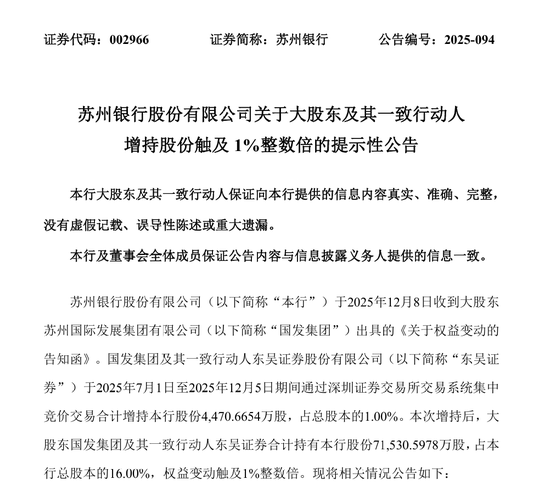
Core Viewpoint - The announcement details the increase in shareholding by the major shareholder, Suzhou International Development Group Co., Ltd., and its concerted action party, Dongwu Securities Co., Ltd., which has reached a significant threshold of 1% in shareholding [1] Group 1 - The major shareholder, Suzhou International Development Group, and its concerted action party, Dongwu Securities, increased their holdings by a total of 44,706,654 shares, representing 1.00% of the total share capital [1] - Following this increase, the total shares held by the major shareholder and its concerted action party amount to 715,305,978 shares, which is 16.00% of the total share capital of the bank [1] - The announcement confirms that the information provided is accurate and complete, with no misleading statements or significant omissions [1]
江苏又一家城商行获大股东增持!
Zhong Guo Ji Jin Bao· 2025-12-08 15:49
Core Viewpoint - Suzhou Bank's major shareholder, Suzhou International Development Group, and its concerted party, Dongwu Securities, have increased their stake in the bank by 44.71 million shares, raising their total ownership to 16% of the bank's total shares, reflecting confidence in the bank's future development and long-term investment value [1][2][3]. Shareholder Activity - The increase in shares occurred between July 1 and December 5, with a total of 44.71 million shares acquired, representing 1% of the total share capital [2]. - Following this transaction, the total shares held by the major shareholder and its concerted party reached 715 million shares [2]. - Earlier in the year, from January 14 to June 26, the major shareholder had already increased its stake by 11.8 million shares, totaling 856 million yuan in investment [3]. Financial Performance - As of September 30, Suzhou Bank reported total assets of 776.04 billion yuan, an increase of 11.87% from the beginning of the year [4]. - The bank's total loans reached 368.55 billion yuan, up 10.56%, while total deposits grew by 13.08% to 471.52 billion yuan [4]. - For the first three quarters, the bank achieved operating income of 9.477 billion yuan, a year-on-year increase of 2.02%, and a net profit attributable to shareholders of 4.477 billion yuan, up 7.12% [4]. Asset Quality - The non-performing loan ratio remained stable at 0.83%, with a provision coverage ratio of 420.59%, indicating a stable risk mitigation capacity [5]. - The trend of major shareholders and executives increasing their stakes in banks reflects a strong belief in the long-term investment value of these institutions, particularly in city commercial banks and rural commercial banks [5]. Market Performance - As of December 8, Suzhou Bank's stock price was 8.14 yuan per share, with a market capitalization of 36.39 billion yuan, showing a year-to-date increase of approximately 5.3% [6]. - The bank's total dividends for the year amounted to 1.833 billion yuan, with a dividend per share of 0.41 yuan, resulting in a dividend yield of approximately 4.5% to 6.2% [6].
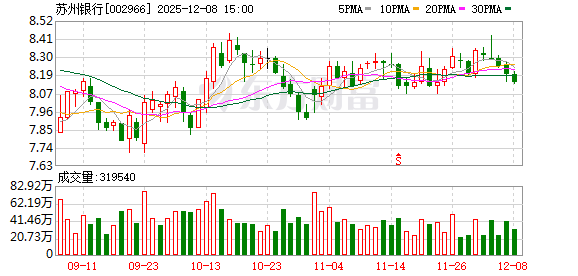
苏州银行:股东国发集团及其一致行动人东吴证券7月1日至12月5日增持1%股份
Mei Ri Jing Ji Xin Wen· 2025-12-08 10:08
Core Viewpoint - Suzhou Bank's major shareholder, Guofa Group, along with its concerted party Dongwu Securities, has increased its stake in the bank, reflecting a commitment to its investment strategy without altering control of the company [1] Group 1: Shareholding Changes - Guofa Group and Dongwu Securities acquired an additional 44,706,654 shares of Suzhou Bank, representing 1.00% of the total share capital [1] - Following this acquisition, Guofa Group and its concerted parties hold a total of 715,305,978 shares, which constitutes 16.00% of the total share capital [1] - The share increase occurred between July 1, 2025, and December 5, 2025, through centralized bidding transactions [1]

苏州银行:股东国发集团及其一致行动人东吴证券合计增持4470.6654万股股份
Bei Jing Shang Bao· 2025-12-08 10:03
Core Viewpoint - Suzhou Bank's major shareholder, Suzhou International Development Group Co., Ltd., has increased its stake in the bank, indicating confidence in the bank's future performance and potential growth opportunities [1] Group 1: Shareholder Activity - Suzhou International Development Group and its concerted party, Dongwu Securities Co., Ltd., have collectively increased their holdings in Suzhou Bank by 44,706,654 shares, representing 1.00% of the total share capital [1] - Following this increase, the total shares held by the major shareholder and its concerted party amount to 715 million shares, which constitutes 16.00% of Suzhou Bank's total share capital [1] - The stake increase occurred between July 1, 2025, and December 5, 2025, and the change in equity triggered a threshold of 1% [1]
苏州银行(002966.SZ):国发集团及其一致行动人东吴证券累计增持1%股份
Ge Long Hui A P P· 2025-12-08 09:40
格隆汇12月8日丨苏州银行(002966.SZ)公布,收到大股东苏州国际发展集团有限公司(简称"国发集 团")出具的《关于权益变动的告知函》。国发集团及其一致行动人东吴证券股份有限公司(简称"东吴 证券")于2025年7月1日至2025年12月5日期间通过深圳证券交易所交易系统集中竞价交易合计增持本行 股份4,470.6654万股,占总股本的1.00%。本次增持后,大股东国发集团及其一致行动人东吴证券合计 持有本行股份71,530.5978万股,占本行总股本的16.00%,权益变动触及1%整数倍。 ...
苏州银行获大股东国发集团增持:合计增持超4470万股,占总股本的1%
Xin Lang Cai Jing· 2025-12-08 09:37
12月8日金融一线消息,苏州银行今日发布公告称,该行于2025年12月8日收到大股东苏州国际发展集团 有限公司(以下简称"国发集团")出具的《关于权益变动的告知函》。国发集团及其一致行动人东吴证 券股份有限公司(以下简称"东吴证券")于2025年7月1日至2025年12月5日期间通过深圳证券交易所交 易系统集中竞价交易合计增持本行股份4470.6654万股,占总股本的1.00%。本次增持后,大股东国发集 团及其一致行动人东吴证券合计持有本行股份71,530.5978万股,占该行总股本的16.00%,权益变动触 及1%整数倍。 | 1. 基本情况 | | | | --- | --- | --- | | 信息披露义务人 1 | | 苏州国际发展集团有限公司 | | 住所 | | 江苏省苏州市人民路 3118 号国发大厦北楼 | | 信息披露义务人2 | | 东吴证券股份有限公司 | | 住所 | | 苏州工业园区星阳街5号 | | 权益变动时间 | | 2025年7月1日至2025年12月5日 | | 权益变动过程 | | 国发集团与东吴证券于 2025年7月1日至 2025年12 | | | | 月 5 日期间 ...
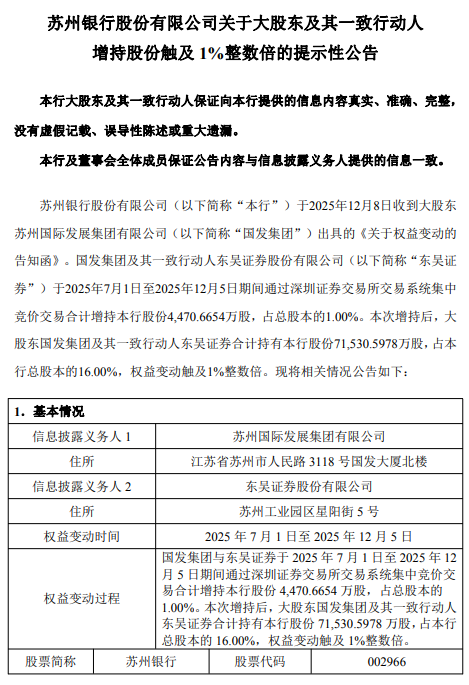
苏州银行(002966) - 关于大股东及其一致行动人增持股份触及1%整数倍的提示性公告
2025-12-08 09:31
证券代码:002966 证券简称:苏州银行 公告编号:2025-094 变动类型 上升 下降□ 一致行动人 有 无□ 是否为第一大股东或实际控制人 是 否□ 2.本次权益变动情况 股份种类 增持股数(万股) 增持比例(%) A 股 4,470.6654 1.00 合 计 4,470.6654 1.00 本次权益变动方式(可多 选) 通过证券交易所的集中交易 通过证券交易所的大宗交易 □ 其他 □ 本次增持股份的资金来 源(可多选) 自有资金 银行贷款 □ 其他金融机构借款 □ 股东投资款 □ 其他 □ 不涉及资金来源□ 3.本次变动前后,投资者及其一致行动人拥有上市公司权益的股份情况 股份性质 本次变动前持有股份 本次变动后持有股份 股数(万股) 占总股本 比例(%) 股数(万股) 占总股本 比例(%) 国发集团 66,684.9324 14.92 68,805.9511 15.39 东吴证券 375.0000 0.08 2,724.6467 0.61 合计持有股份 67,059.9324 15.00 71,530.5978 16.00 其中:无限售条件股份 67,059.9324 15.00 71,530. ...
城商行板块12月8日跌0.31%,上海银行领跌,主力资金净流入1.29亿元
Zheng Xing Xing Ye Ri Bao· 2025-12-08 09:09
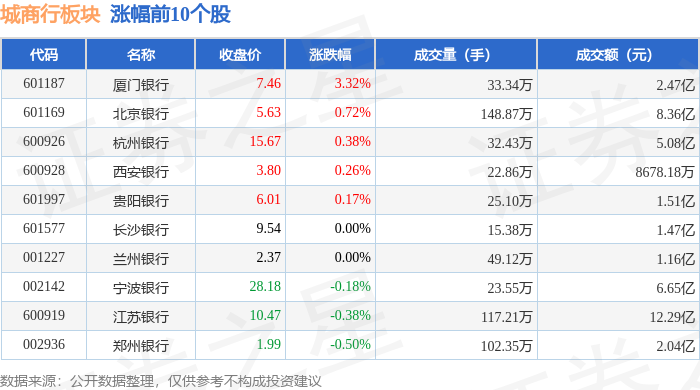
Group 1 - The city commercial bank sector experienced a decline of 0.31% on December 8, with Shanghai Bank leading the drop [1] - The Shanghai Composite Index closed at 3924.08, up 0.54%, while the Shenzhen Component Index closed at 13329.99, up 1.39% [1] - Key individual stock performances in the city commercial bank sector included Xiamen Bank rising by 3.32% and Shanghai Bank falling by 1.43% [1][2] Group 2 - The net inflow of main funds into the city commercial bank sector was 129 million yuan, while retail investors saw a net outflow of 156 million yuan [2] - The table of fund flows indicated that Jiangsu Bank had a net outflow of 56.86 million yuan from main funds, while Hangzhou Bank had a net inflow of 49.79 million yuan [3] - The overall trend showed that retail investors were withdrawing funds from several banks, with notable outflows from Suzhou Bank and Qingdao Bank [3]