Hanwei Electronics(300007)

Search documents
汉威科技:借力资本市场完善产业布局 强化科技实力拥抱行业机遇
证券时报· 2025-12-02 00:18
Core Viewpoint - Hanwei Technology is strategically investing in Chongqing Stabao Technology Co., Ltd. to enhance its capabilities in high-end temperature sensors, aiming to break the long-standing foreign monopoly in this field [1][2] Investment and Expansion - Hanwei Technology plans to invest nearly 28 million yuan of its own funds in Chongqing Stabao, which has developed various models of thin-film platinum resistance temperature sensors that meet international advanced technology standards [1] - The company is also planning to issue H-shares and apply for listing on the Hong Kong Stock Exchange to accelerate overseas business development and enhance its international brand recognition [1] Product Development and Market Position - Hanwei Technology holds a 70% market share in domestic gas sensor products, establishing itself as a leader in the sensor industry, with many products filling domestic gaps [2] - The company has developed over 300 types of sensors across 17 series, including semiconductor, catalytic combustion, electrochemical, infrared, and more, positioning itself to capitalize on trends in AI and robotics [2] Sensor Technology and Applications - The company has created a multi-dimensional sensor matrix covering smell, touch, balance, force control, and vision for robotics, enhancing the capabilities of intelligent robots [4][5] - Hanwei's electronic nose can detect various gases for environmental safety monitoring, while flexible tactile sensors enable real-time force perception for human-robot interaction [4][5] Future Prospects and Industry Trends - The domestic sensor industry is expected to grow significantly, with increasing localization rates presenting substantial market opportunities [6] - Hanwei Technology is committed to enhancing its R&D investments to maintain its technological edge, despite potential short-term impacts on financial performance from new business ventures [6] - The market for humanoid robots is projected to reach a scale of 10 trillion yuan, with electronic skin as a core component, indicating strong growth potential for Hanwei's products [6]



2只脑机接口概念股年内股价翻倍
2 1 Shi Ji Jing Ji Bao Dao· 2025-11-29 23:36
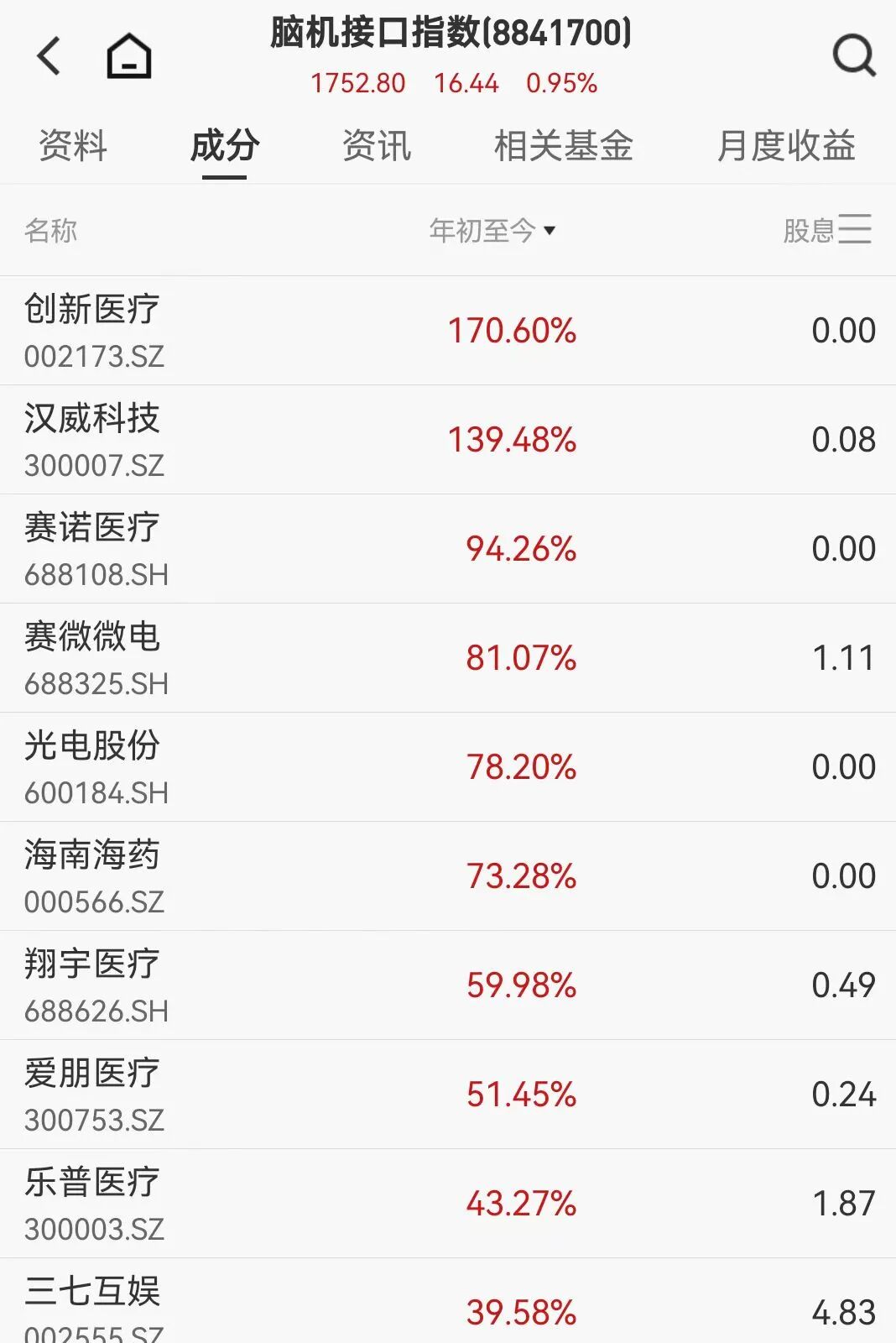
Core Insights - The brain-computer interface (BCI) industry in China is expected to enter a significant development phase by 2025, driven by strong policy support and capital investment [1][5][6] - The BCI sector has seen substantial investment activity, with 28 financing rounds completed in 2023, totaling over 5 billion yuan [1] - The A-share market has recognized BCI as a hot investment trend, with the BCI concept index rising by 52.13% over the past year, significantly outperforming the Shanghai and Shenzhen 300 index [1] Policy Support - The "14th Five-Year Plan" emphasizes BCI as one of the six key future industries, with a clear timeline for technological breakthroughs and industry development by 2027 and 2030 [5][6] - In July, a joint initiative from seven departments outlined strategies for BCI innovation and development, aiming to establish a robust industry ecosystem [5] - Shanghai has proactively developed a BCI action plan, targeting clinical applications and technological advancements by 2027 and 2030 [6] Market Performance - The BCI concept index (8841700.WI) has shown a remarkable increase, with notable stocks like Innovation Medical and Hanwei Technology experiencing gains of 170% and 139.48% respectively [2][1] - A total of 24 A-share companies are involved in the BCI sector, with an average revenue of 3.43 billion yuan and an average net profit of 431 million yuan for the first three quarters of the year [11] Industry Landscape - The BCI industry in China is rapidly evolving, with over 800 core enterprises identified, positioning China among the leading countries in this field [8] - Recent clinical trials, including the first invasive clinical trial in China, indicate significant advancements in BCI technology [8][9] - The launch of the "North Brain No. 1" GCP multi-center clinical trial marks a new phase in large-scale clinical validation of BCI systems [9] Company Developments - Companies like Lepu Medical and Aipeng Medical are actively pursuing commercialization of BCI products, with Lepu focusing on deep brain stimulation devices and Aipeng on EEG collection products [12][13] - Aipeng Medical has established a joint laboratory for ADHD treatment, indicating a focus on integrating BCI technology into clinical applications [13] - Recent regulatory changes, including the establishment of a "green channel" for insurance coding of innovative medical products, are expected to accelerate the clinical application of BCI technologies [13]



2只脑机接口概念股年内股价翻倍
21世纪经济报道· 2025-11-29 23:34
Core Viewpoint - The article highlights the rapid development and investment opportunities in China's brain-computer interface (BCI) industry, which is expected to become a key focus area by 2025, supported by strong government policies and significant capital market activity [1][6][9]. Policy Support - The "14th Five-Year Plan" emphasizes BCI as one of the six key future industries, with increasing policy support and strategic importance [6][7]. - In July, multiple government departments released implementation opinions to promote BCI innovation, setting clear development milestones for the industry [6]. - By 2027, breakthroughs in key technologies are expected, with the establishment of advanced technical, industrial, and standard systems [6]. - Shanghai has initiated a plan to cultivate the BCI industry from 2025 to 2030, aiming for clinical applications of semi-invasive BCI products by 2027 [7][8]. Market Performance - The BCI concept index in the A-share market has seen a significant increase of 52.13% over the past year, outperforming the Shanghai and Shenzhen 300 index, which rose by 15.04% [1]. - Notable BCI-related stocks include Innovation Medical and Hanwei Technology, with year-to-date increases of 170% and 139.48%, respectively [2][1]. Industry Landscape - China is positioned to lead in the BCI sector, with over 800 core enterprises in the industry, primarily located in China and the U.S. [10]. - The first invasive clinical trial in China was successfully conducted in June, marking a significant milestone in the country's BCI technology development [10][11]. - The "North Brain No. 1" GCP multi-center clinical trial was launched in October, representing a new phase in large-scale clinical validation of BCI systems [11]. Financial Performance - In the A-share market, 24 companies related to BCI reported an average revenue of 3.428 billion yuan and an average net profit of 431 million yuan for the first three quarters [13]. - 18 companies have a gross margin exceeding 30%, indicating strong profitability, although many companies are facing challenges in revenue and profit growth [13]. - Companies like Lepu Medical and Aipeng Medical are actively working on commercialization and product development in the BCI space, with recent regulatory approvals and strategic partnerships [14].

汉威科技涨2.00%,成交额1.75亿元,主力资金净流出18.39万元
Xin Lang Cai Jing· 2025-11-27 02:06
Core Viewpoint - Hanwei Technology's stock has shown significant volatility, with a year-to-date increase of 141.94% and a recent decline of 10.25% over the past 20 days, indicating fluctuating investor sentiment and market dynamics [1][2]. Financial Performance - For the period from January to September 2025, Hanwei Technology reported a revenue of 1.702 billion yuan, reflecting a year-on-year growth of 8.44%. The net profit attributable to shareholders was 84.843 million yuan, marking a 6.33% increase compared to the previous year [2]. - The company has distributed a total of 239 million yuan in dividends since its A-share listing, with 94.8185 million yuan distributed over the last three years [2]. Stock Market Activity - As of November 27, Hanwei Technology's stock price was 49.38 yuan per share, with a market capitalization of 16.169 billion yuan. The stock experienced a trading volume of 175 million yuan and a turnover rate of 1.27% [1]. - The stock has appeared on the "龙虎榜" (Dragon and Tiger List) five times this year, with the most recent appearance on September 16, where it recorded a net buying of 374 million yuan [1]. Shareholder Structure - As of September 30, 2025, Hanwei Technology had 79,400 shareholders, an increase of 6.87% from the previous period. The average number of circulating shares per shareholder was 3,566, a decrease of 6.43% [2]. - The top ten circulating shareholders include various funds, with notable changes in holdings, such as a decrease in shares held by Penghua Carbon Neutral Theme Mixed A and an increase by Hong Kong Central Clearing Limited [3].
通用设备板块11月26日跌0.21%,智能自控领跌,主力资金净流出6.14亿元
Zheng Xing Xing Ye Ri Bao· 2025-11-26 09:12
Market Overview - The general equipment sector experienced a decline of 0.21% on November 26, with smart control leading the drop [1] - The Shanghai Composite Index closed at 3864.18, down 0.15%, while the Shenzhen Component Index closed at 12907.83, up 1.02% [1] Stock Performance - Notable gainers in the general equipment sector included: - Wald (688028) with a closing price of 74.90, up 12.72% and a trading volume of 141,800 shares, totaling 1.024 billion yuan [1] - Zhongshun Group (000039) closed at 9.35, up 10.00% with a trading volume of 1,947,400 shares, totaling 1.764 billion yuan [1] - Huashu High-Tech (688433) closed at 62.18, up 7.21% with a trading volume of 74,100 shares, totaling 447 million yuan [1] Decliners - Key decliners included: - Smart Control (002877) with a closing price of 9.45, down 9.91% and a trading volume of 681,500 shares, totaling 657 million yuan [2] - Rongyi Precision (920223) closed at 21.50, down 6.52% with a trading volume of 89,600 shares, totaling 195 million yuan [2] - Huafeng Co. (605100) closed at 43.91, down 5.39% with a trading volume of 84,600 shares, totaling 377 million yuan [2] Capital Flow - The general equipment sector saw a net outflow of 614 million yuan from institutional investors and a net outflow of 119 million yuan from retail investors, while retail investors had a net inflow of 733 million yuan [2] - Specific stock capital flows indicated: - Zhongshun Group (000039) had a net inflow of 47.416 million yuan from institutional investors, while retail investors experienced a net outflow of 18.000 million yuan [3] - Wald (688028) had a net inflow of 96.345 million yuan from institutional investors, with retail investors seeing a net outflow of 78.723 million yuan [3] - Sifangda (300179) had a net inflow of 81.558 million yuan from institutional investors, while retail investors faced a net outflow of 85.899 million yuan [3]


汉威科技涨2.01%,成交额2.35亿元,主力资金净流出77.98万元
Xin Lang Cai Jing· 2025-11-26 02:30
Core Viewpoint - Hanwei Technology's stock has shown significant volatility, with a year-to-date increase of 138.76%, but a recent decline over the past 20 days of 15.31% [1][2]. Financial Performance - For the period from January to September 2025, Hanwei Technology achieved a revenue of 1.702 billion yuan, representing a year-on-year growth of 8.44%. The net profit attributable to shareholders was 84.843 million yuan, an increase of 6.33% year-on-year [2]. - The company has distributed a total of 239 million yuan in dividends since its A-share listing, with 9.481 million yuan distributed over the past three years [3]. Stock Market Activity - As of November 26, Hanwei Technology's stock price was 48.73 yuan per share, with a market capitalization of 15.956 billion yuan. The stock experienced a trading volume of 235 million yuan and a turnover rate of 1.73% [1]. - The stock has appeared on the "龙虎榜" (a list of stocks with significant trading activity) five times this year, with the most recent appearance on September 16, where it recorded a net buying of 374 million yuan [1]. Shareholder Structure - As of September 30, 2025, the number of shareholders increased to 79,400, with an average of 3,566 circulating shares per person, a decrease of 6.43% from the previous period [2]. - The top ten circulating shareholders include various funds, with notable changes in holdings, such as a decrease in shares held by Penghua Carbon Neutral Theme Mixed A and an increase by Hong Kong Central Clearing Limited [4].
汉威科技(300007) - 关于控股子公司股权转让完成工商变更登记的公告
2025-11-25 09:22
二、交易进展情况 截至本公告披露日,汉威智源已完成工商变更登记备案手续,并取得了郑州 高新技术产业开发区市场监督管理局换发的《营业执照》。本次工商变更完成后, 公司不再持有汉威智源股权,汉威智源不再纳入公司合并范围。 三、备查文件 汉威智源《营业执照》。 特此公告。 汉威科技集团股份有限公司 关于控股子公司股权转让完成工商变更登记的公告 本公司及董事会全体成员保证信息披露的内容真实、准确、完整,没有虚假 记载、误导性陈述或重大遗漏。 一、基本情况概述 汉威科技集团股份有限公司(以下简称"公司")于 2025 年 9 月 30 日召开 第六届董事会第二十三次会议和第六届监事会第十八次会议,并于 2025 年 10 月 16 日召开 2025 年第一次临时股东大会,审议通过了《关于拟出售郑州汉威智 源科技有限公司 65%股权的议案》,同意公司将郑州汉威智源科技有限公司(以 下简称"汉威智源")65%股权以 43,986.475 万元的交易价格转让给郑州高新投 资控股集团有限公司。具体内容详见公司在巨潮资讯网(www.cninfo.com.cn) 上披露的相关公告。 证券代码:300007 证券简称:汉威科技 公告 ...
周末重点速递 | 增量资金要来了!首批科创创业人工智能ETF+多只科创板芯片类ETF获批
Mei Ri Jing Ji Xin Wen· 2025-11-23 09:43
Group 1: Market Trends and Investment Opportunities - Multiple chip-related ETFs and AI-focused ETFs have been approved, indicating regulatory support for strategic emerging industries, which is expected to attract more capital into the market [1] - The 2026 A-share market outlook is optimistic, with expectations of a "confidence reassessment bull market" and a recovery in corporate earnings after a downward cycle from 2022 to 2024 [2][3] - Key sectors to watch include AI, semiconductor, and international cooperation, with potential for earnings to exceed expectations [2][3] Group 2: Robotics Industry Insights - 2026 is projected to be the year of mass production for domestic humanoid robots, with significant technological advancements and supply chain improvements [4][6] - Companies like Tesla and XPeng are making strides in humanoid robot development, with XPeng's new robot showcasing advanced technology and integration capabilities [5][6] - The IPO of Yushu, a notable player in the robotics sector, is expected to boost the industry and attract attention to its supply chain and strategic partnerships [6] Group 3: Electronic Skin Technology - Electronic skin technology is crucial for humanoid robots, enabling tactile perception and interaction, with various sensor types being explored [7][8] - The market for flexible tactile sensors is dominated by foreign companies, but domestic firms are rapidly closing the gap due to policy support and manufacturing capabilities [8][9] - Key companies in the electronic skin space include Fulei New Materials and Hanwei Technology, which are advancing their technologies and expanding production capabilities [9] Group 4: Solid-State Battery Development - The dry film formation process is becoming the mainstream method for solid-state battery production, offering advantages in cost and efficiency [10][11] - Various dry film formation technologies are being explored, each with unique benefits and suitable applications [11] - Investment recommendations focus on solid-state battery equipment suppliers and related technology firms, highlighting the growing importance of this sector [11]


电子行业2026年度投资策略:人工智能产业变革持续推进,半导体周期继续上行
Zhongyuan Securities· 2025-11-21 07:38
Group 1 - The report highlights the ongoing transformation in the artificial intelligence (AI) industry, with significant advancements in AI models and increasing capital expenditures from cloud service providers, driving demand for AI computing hardware infrastructure [8][20][39] - The semiconductor industry is expected to continue its upward trend, with AI driving a potential super cycle in the memory sector, as domestic manufacturers enhance their competitive advantages in technology and supply chains [11][18][19] - The electronic industry has significantly outperformed the CSI 300 index, with a year-to-date increase of 38.35% compared to the CSI 300's 16.85% [18][19] Group 2 - Major cloud companies are increasing their capital expenditures, with North American cloud providers collectively spending $96.4 billion in Q3 2025, a 67% year-on-year increase, to support AI infrastructure [39][40] - The report emphasizes the rapid growth of AI server demand, with the global AI server market projected to reach $158.7 billion in 2025, reflecting a compound annual growth rate of 15.5% from 2024 to 2028 [51][53] - The report identifies key investment opportunities in sectors such as AI computing chips, AI PCBs, and memory modules, recommending specific companies for investment based on their market positions and growth potential [11][12][52]


电子皮肤行业深度报告:实现机器柔性触觉,感知世界触手可及
Shanxi Securities· 2025-11-21 05:18
Investment Rating - The report maintains an investment rating of "B" for the electronic skin industry, indicating a leading position in the market [1]. Core Insights - The electronic skin is a key tactile sensing system for humanoid robots, enabling them to interact with their environment through pressure and temperature sensing [13]. - The market for electronic skin is projected to reach $756 million by 2030, driven by the increasing demand for humanoid robots [4]. - The industry faces three major barriers: materials, manufacturing processes, and algorithms, which are critical for establishing competitive advantages [24][32]. Summary by Sections 1. Electronic Skin: Key to Humanoid Robot Interaction - Electronic skin mimics natural skin functions and is essential for humanoid robots to perceive their surroundings [13]. - The technology can be categorized into resistive, capacitive, and piezoelectric types, with resistive sensors being the most common in humanoid robots [2][21]. 2. Domestic Enterprises Accelerating Layout - Overseas companies dominate the high-end market, holding approximately 57.1% of the global flexible tactile sensor market share [4][41]. - Domestic companies are rapidly closing the technology gap, supported by favorable policies and manufacturing capabilities, with firms like Fulei New Materials and Hanwei Technology emerging as key players [5][46]. 3. Key Companies to Watch - Fulei New Materials has completed pilot production and is supplying small batches to leading clients in the dexterous hand sector [5]. - Hanwei Technology has established partnerships with nearly 30 robot manufacturers and is expanding its production capacity [5]. - Keli Sensor and other companies are also making strides in the electronic skin sector, focusing on multi-physical sensors and flexible tactile sensors [5][46].