
EASTMONEY(300059)

Search documents

证券ETF龙头(159993)涨超5.6%,机构称券商板块或迎来持续上涨动能
Xin Lang Cai Jing· 2025-09-29 05:55
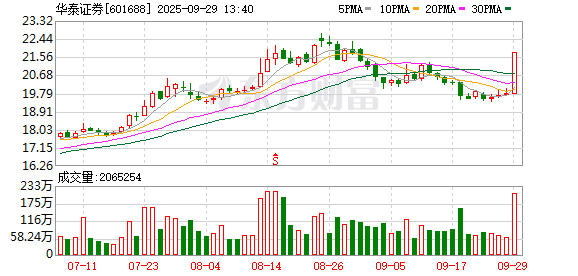
Group 1 - The core viewpoint indicates a strong upward trend in the securities sector, with the Guozheng Securities Leading Index rising by 5.71% and key stocks like Huatai Securities and GF Securities showing significant gains of 10.01% and 9.59% respectively [1] - The brokerage sector is expected to experience sustained upward momentum due to high certainty in fundamentals as the fourth quarter approaches, alongside a recovery in valuations after a decline of approximately 8% in September [1][2] - Institutional funds are currently under-allocated in the brokerage sector, with positive quarterly report expectations and a shift in demand for absolute return allocations, suggesting a favorable environment for continued growth in the sector [1] Group 2 - Recent data shows that the trading volume in A-shares remains high, with a year-on-year increase of 206% and a month-on-month increase of 6%, reaching 2.44 trillion RMB [2] - The brokerage sector's profit expectations are optimistic, with projected net profit growth of 48% year-on-year and 13% quarter-on-quarter for Q3 2025, leading to an annual growth forecast of 41% [2] - As of September 26, the A-share and Hong Kong brokerage sectors are trading at 1.53x and 0.98x P/B respectively, indicating they are at the 41% and 66% percentiles of their historical valuations over the past decade [2] Group 3 - As of August 29, 2025, the top ten weighted stocks in the Guozheng Securities Leading Index account for 79.16% of the index, with significant players including Dongfang Caifu, CITIC Securities, and Huatai Securities [3]





证券板块大幅走强 华泰证券涨停
Mei Ri Jing Ji Xin Wen· 2025-09-29 05:40
每经AI快讯,9月29日,券商股盘中持续走强,华泰证券拉升触及涨停,国盛金控此前封板,广发证 券、东方证券、东吴证券、中信证券、信达证券、东方财富、湘财股份、长江证券等纷纷冲高。 (文章来源:每日经济新闻) ...


创业50ETF(159682)涨2.07%,半日成交额2.95亿元
Xin Lang Cai Jing· 2025-09-29 03:40
Core Viewpoint - The article highlights the performance of the Chuangye 50 ETF (159682) as of September 29, noting a 2.07% increase in its value and a trading volume of 295 million yuan, indicating strong market interest and positive investor sentiment [1] Group 1: ETF Performance - The Chuangye 50 ETF (159682) closed at 1.477 yuan, with a trading volume of 2.95 billion yuan [1] - The ETF's performance benchmark is the return of the ChiNext 50 Index, managed by Invesco Great Wall Fund Management Co., with fund managers Wang Yang and Zhang Xiaonan [1] - Since its inception on December 23, 2022, the ETF has achieved a return of 44.75%, with a one-month return of 18.61% [1] Group 2: Top Holdings Performance - Key holdings in the ETF include: - Ningde Times up 3.05% - Dongfang Wealth up 2.92% - Huichuan Technology up 0.44% - Zhongji Xuchuang up 2.00% - Mai Rui Medical down 1.39% - Xinyi Sheng up 2.86% - Sunshine Power up 3.97% - Shenghong Technology up 2.29% - Yiwei Lithium Energy up 7.57% - Tonghuashun up 1.84% [1]





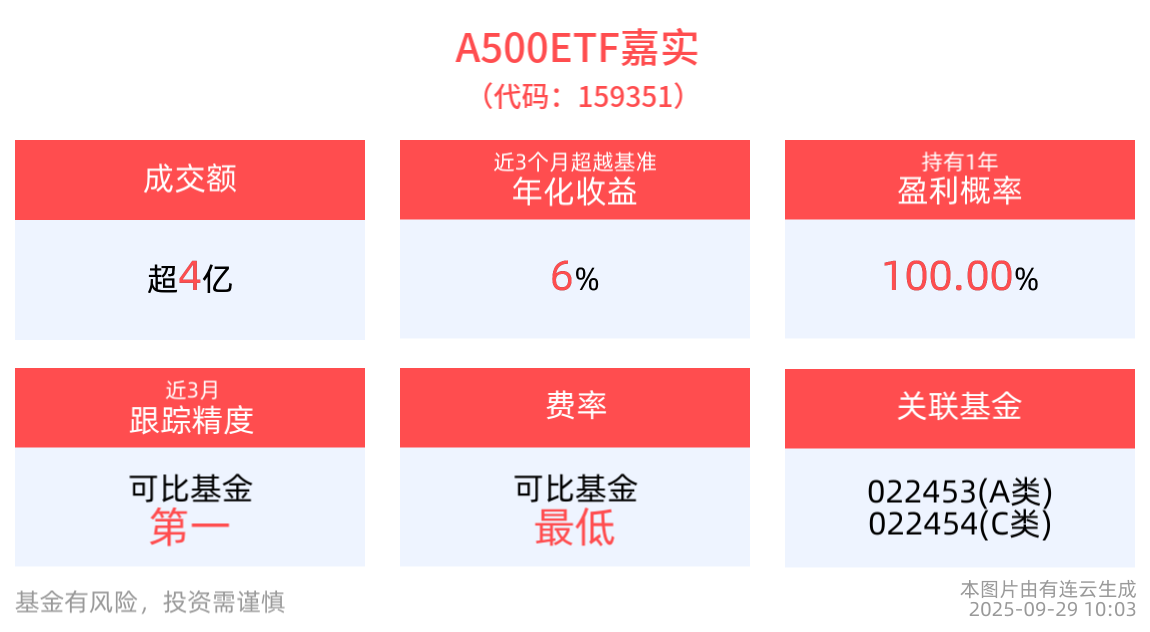
机构:A股有望迎来关键窗口期,风险偏好或将进一步回暖,A500ETF嘉实(159351)整固蓄势,成分股湖南裕能、多氟多涨超9%
Xin Lang Cai Jing· 2025-09-29 02:34
Group 1 - The A500ETF by Jiashi has a turnover rate of 3.57% and a transaction volume of 4.41 billion yuan, with an average daily transaction of 22.80 billion yuan over the past year as of September 26, 2025 [3] - The latest scale of A500ETF by Jiashi reached 116.54 billion yuan, with a net value increase of 18.59% over the past year as of September 26, 2025 [3] - The highest monthly return since inception for A500ETF by Jiashi was 11.71%, with the longest consecutive monthly gains being 4 months and a maximum gain of 22.93% [3] Group 2 - The top ten weighted stocks in the CSI A500 index as of August 29, 2025, include Kweichow Moutai, CATL, Ping An Insurance, and others, accounting for a total of 19.11% [4] - The individual weightings of the top stocks are as follows: Kweichow Moutai at 3.87%, CATL at 2.89%, and Ping An Insurance at 2.60% [6] - Investors without stock accounts can access the A500ETF Jiashi linked fund (022454) for exposure to the top 500 A-shares [6]





近22天连续"吸金"超72亿,券商ETF(512000)调整蓄势,机构:券商板块估值处于历史中枢偏下区间
Xin Lang Cai Jing· 2025-09-29 02:09
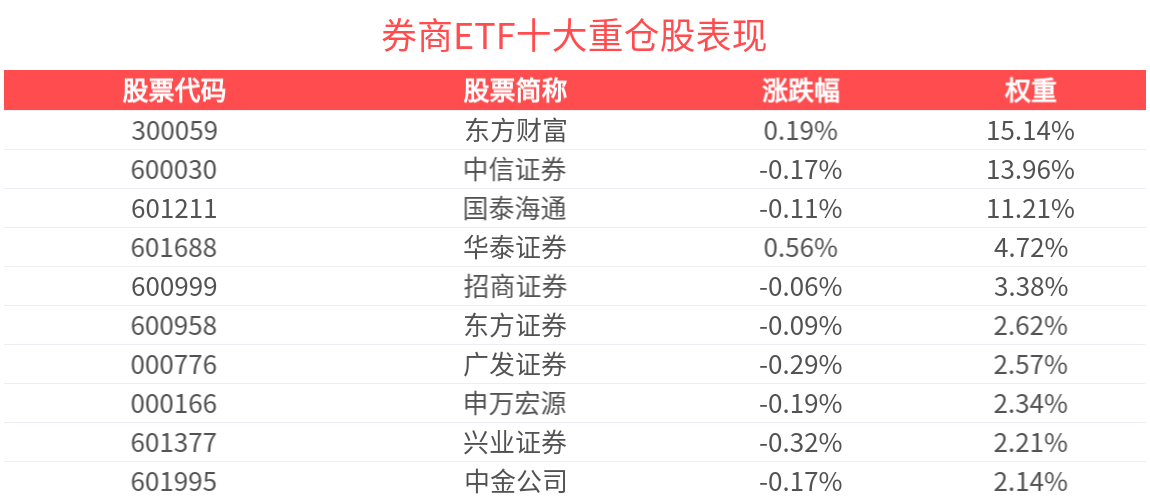
Core Insights - The overall sentiment in the securities industry remains optimistic, with expectations for continued profit growth in the third quarter driven by sustained demand for wealth management services [3][4]. Market Performance - As of September 29, 2025, the CSI All Share Securities Company Index experienced fluctuations, with Huayin Securities leading gains at 0.56% [1]. - The broker ETF (512000) saw a significant increase in scale, growing by 336 million yuan over the past week, ranking second among comparable funds [2]. - The broker ETF's latest share count reached 60.7 billion, marking a one-year high and leading among comparable funds [2]. Trading Activity - The broker ETF recorded a turnover of 0.04% during the trading session, with a total transaction value of 14.93 million yuan [2]. - Over the past 22 days, the broker ETF has experienced continuous net inflows, with a peak single-day inflow of 1.262 billion yuan, totaling 7.274 billion yuan in net inflows [2]. Profitability and Valuation - The securities industry is expected to maintain a double-digit profit growth rate year-on-year in the first half of 2025, reflecting a robust fundamental outlook [3]. - Despite a strong equity market performance year-to-date, the broker sector's index has lagged behind the broader market, indicating potential value in large broker valuations [4]. Investor Sentiment - As holidays approach, the topic of "holding cash or stocks" becomes crucial for investors, with many brokerages recommending "holding stocks through the holiday" based on optimistic market outlooks [2].



沪深300ETF中金(510320)开盘跌0.90%
Xin Lang Cai Jing· 2025-09-29 01:40
Core Viewpoint - The performance of the CSI 300 ETF managed by CICC shows a slight decline in opening price, while individual stocks within the ETF exhibit mixed results, indicating a volatile market environment [1] Group 1: ETF Performance - The CSI 300 ETF (510320) opened down by 0.90%, priced at 1.210 yuan [1] - Since its inception on April 16, 2025, the fund has achieved a return of 22.05%, with a monthly return of 2.22% [1] Group 2: Individual Stock Performance - Kweichow Moutai opened up by 0.31% [1] - Contemporary Amperex Technology Co. (CATL) increased by 1.56% [1] - China Ping An decreased by 0.07% [1] - China Merchants Bank fell by 0.07% [1] - Industrial Bank dropped by 0.30% [1] - Yangtze Power declined by 0.15% [1] - Midea Group rose by 0.31% [1] - Zijin Mining increased by 1.09% [1] - BYD fell by 0.27% [1] - East Money Information decreased by 0.08% [1]



2025年三季报前瞻:景气度持续提升
HUAXI Securities· 2025-09-28 11:02
Investment Rating - Industry Rating: Recommended [6] Core Insights - The securities market indicators for Q3 2025 are becoming clearer, with a significant increase in trading activity and capital market engagement expected [2][3][4] - The report anticipates that the revenue for 45 listed securities firms will reach approximately 3,987 billion yuan for the first three quarters of 2025, reflecting a year-on-year increase of about 44% [5][7] Summary by Sections 1. Securities Market Indicators for Q3 2025 - Trading activity continues to rise, with A-share transaction amounts reaching 132.63 trillion yuan in the first 63 trading days of Q3 2025, showing a year-on-year increase of 212% [2][15] - The average daily trading volume for Q1, Q2, and Q3 (to date) is 15,225 billion, 12,619 billion, and 21,053 billion yuan respectively, indicating significant growth [2][15] - Margin trading balances as of September 25, 2025, are at 24,443 billion yuan, with a year-on-year increase of 48% [2][16] 2. Capital Intermediary Activities - The report highlights a positive trend in capital intermediary activities, with a notable increase in leverage funds entering the market [2][16] - The ratio of self-operated equity securities to fixed-income securities among 45 listed securities firms is approximately 1:11.36, indicating a strong focus on fixed-income investments [3][29] 3. Equity Financing Recovery - There has been a resurgence in equity financing, with a total of 1,232 billion yuan raised through IPOs, placements, and convertible bonds in Q3 2025, marking a year-on-year increase of 145% [4][31][32] - The number of IPOs and placements has also increased significantly compared to the previous year [4][31] 4. Revenue Projections - The report projects that the 45 listed securities firms will achieve an adjusted revenue of 1,581 billion yuan in Q3 2025, representing a year-on-year increase of 50% [7][35] - The anticipated revenue for the first three quarters of 2025 is 3,987 billion yuan, with contributions from brokerage, investment banking, asset management, interest income, and proprietary trading [5][35] 5. Investment Recommendations - The report expresses optimism regarding the securities industry's role in capital market financing and the increasing allocation of residents' assets to equity [8][36] - Key beneficiaries identified include firms like Dongfang Caifu, Zhina Zhen, and Guangfa Securities, among others, due to their active roles in brokerage and investment banking [8][36]


非银金融周报:央行例会释放信号,维护资本市场稳定-20250928
HUAXI Securities· 2025-09-28 09:06
Investment Rating - The industry rating is "Recommended" [5] Core Insights - The average daily trading volume of A-shares for the week (September 21-27, 2025) was 23,132 million yuan, a decrease of 8.1% week-on-week but an increase of 17.5% year-on-year. The average trading volume for the third quarter of 2025 to date is 21,062 million yuan, up 212.2% compared to the same period in 2024. Year-to-date average trading volume in 2025 is 16,423 million yuan, an increase of 89.0% compared to 2024 [1][16] - The People's Bank of China held its monetary policy committee meeting on September 23, 2025, emphasizing the need to maintain stability in the capital market and exploring regular institutional arrangements for stock repurchase and increase loans [3][14] - The insurance sector saw a significant increase in premium income, with life insurance premiums rising by 47.25% year-on-year in August 2025, driven by strong market demand and a reduction in the preset interest rate [4][15] Summary by Sections Market and Sector Performance - The non-bank financial Shenwan index decreased by 0.09%, underperforming the CSI 300 index by 1.16 percentage points, ranking 9th among all primary industries. The securities sector fell by 0.18%, while the insurance sector rose by 0.46% [2][13] Securities - The average daily trading volume of A-shares was 23,132 million yuan, with a total of 2 new stock issuances raising 370 million yuan during the week. Year-to-date, there have been 76 IPOs in A-shares, raising 749.58 billion yuan [1][16] Insurance - The insurance industry reported original premium income of 4.8 trillion yuan for the first eight months of 2025, with life insurance premiums at 3.8 trillion yuan, reflecting a year-on-year growth of 11.32% [4][15] Industry News - Major state-owned banks announced they would no longer establish supervisory boards, which is expected to enhance governance efficiency [38] - The total scale of public funds in China has surpassed 36 trillion yuan for the first time, marking a significant milestone in the industry [39]

今日共73只个股发生大宗交易,总成交32.19亿元
Di Yi Cai Jing· 2025-09-26 09:45
Group 1 - A total of 73 stocks experienced block trades in the A-share market on September 26, with a total transaction value of 3.219 billion yuan [1] - The top three stocks by transaction value were Pudong Development Bank (782 million yuan), Guangqi Technology (273 million yuan), and Zhongwei Company (244 million yuan) [1] - Among the stocks, 10 were traded at par, 7 at a premium, and 56 at a discount; Dongfang Caifu, Aerospace Hongtu, and Taiping Bird had the highest premium rates of 15.08%, 9.14%, and 7.37% respectively [1] Group 2 - The top stocks by institutional buy amounts included Ningde Times (224 million yuan), Zhongwei Company (217 million yuan), and Haiguang Information (127 million yuan) [1] - The top stocks by institutional sell amounts were Ningde Times (187 million yuan), Jinkang Electric (101 million yuan), and Jinkai New Energy (37.29 million yuan) [2] - The MACD golden cross signal has formed, indicating a positive trend for certain stocks [2]


