CHANGELIGHT(300102)

Search documents
乾照光电(300102) - 第六届董事会第十八次会议决议公告
2026-01-26 10:45
本公司及董事会全体成员保证信息披露的内容真实、准确、完整,没有虚假 记载、误导性陈述或重大遗漏。 一、董事会会议召开情况 厦门乾照光电股份有限公司(以下简称"公司")第六届董事会第十八次会 议于 2026 年 1 月 26 日(星期一)以通讯会议的方式在公司会议室召开。会议通 知于 2026 年 1 月 20 日以电子邮件等方式发至全体董事。会议由公司董事长李敏 华先生召集并主持,会议应出席董事 9 名,实际出席董事 9 名,其中独立董事实 际出席 3 名,会议的召开符合《中华人民共和国公司法》和《公司章程》的有关 规定。 二、董事会会议审议情况 证券代码:300102 证券简称:乾照光电 公告编号:2026-008 厦门乾照光电股份有限公司 第六届董事会第十八次会议决议公告 为进一步提高资金使用效率,在确保不影响公司正常经营和募集资金正常使 用计划的情况下,公司拟使用最高额度不超过人民币 70,000 万元(含本数)闲 置募集资金购买短期(不超过十二个月)保本型理财产品,不包括《深圳证券交 易所上市公司自律监管指引第 2 号——创业板上市公司规范运作》中涉及的风险 投资品种。上述额度内资金可以滚动使用,投资 ...
龙虎榜丨机构今日买入这29股,卖出铜陵有色3.69亿元


Di Yi Cai Jing· 2026-01-26 10:13
Group 1 - On January 26, a total of 60 stocks were identified with institutional activity, with 29 showing net buying and 31 showing net selling [1] - The top three stocks with the highest net buying by institutions were DingTong Technology (9.13 billion), QianZhao Optoelectronics (4.15 billion), and WangSu Technology (2.18 billion) [1] - The top three stocks with the highest net selling by institutions were TongLing Nonferrous Metals (3.69 billion), XingYe Silver Tin (2.27 billion), and MingYang Smart Energy (2.11 billion) [1] Group 2 - DingTong Technology experienced a daily increase of 6.96% with a net institutional buying of 91.32 million [2] - QianZhao Optoelectronics saw a daily increase of 8.55% with a net institutional buying of 41.46 million [2] - WangSu Technology had a significant daily increase of 20.03% with a net institutional buying of 21.80 million [2] Group 3 - The stock with the highest net selling was TongLing Nonferrous Metals, which had a net outflow of 36.93 million and a daily increase of 10.06% [4] - MingYang Smart Energy had a net outflow of 21.07 million with a daily increase of 10.02% [4] - XingYe Silver Tin experienced a net outflow of 22.73 million with a daily increase of 10.00% [4]


厦门境内上市公司总市值突破万亿大关!其中31家市值达百亿
Sou Hu Cai Jing· 2026-01-26 09:13
Core Insights - The total market capitalization of listed companies in Xiamen has surpassed 1 trillion yuan, reaching 10,154.3 billion yuan, indicating strong capital support for industrial development in the region [1][4]. Group 1: Market Capitalization and Growth - Xiamen Tungsten Co., Ltd. leads the market capitalization rankings with a total value of 945.72 billion yuan, followed by companies like Shengton Mining, Xiamen Tungsten New Energy, and Yilian Network, showcasing a diverse industrial landscape [3]. - The number of listed companies in Xiamen with a market capitalization exceeding 100 billion yuan has reached 31, an increase of 12 companies since the beginning of 2025 [1]. Group 2: Company Performance and Investor Returns - Qian Zhao Optoelectronics has emerged as the "growth pioneer" with a market capitalization increase of 285.91%, reaching 360.49 billion yuan [3]. - In 2025, 26 listed companies completed refinancing totaling 22.66 billion yuan, while 80 companies implemented cash dividends amounting to 15.66 billion yuan, reflecting a commitment to enhancing investor returns [6][7]. Group 3: Industry Development and Competitive Advantage - Xiamen's listed companies are increasingly recognized for their quality, with 26 companies classified as national "specialized and innovative" small giants and 16 recognized as champions in specific manufacturing sectors [9]. - The establishment of a robust pipeline of potential listed companies has expanded to 597, with ongoing support for new listings, contributing to the sustained growth of the Xiamen market [10].




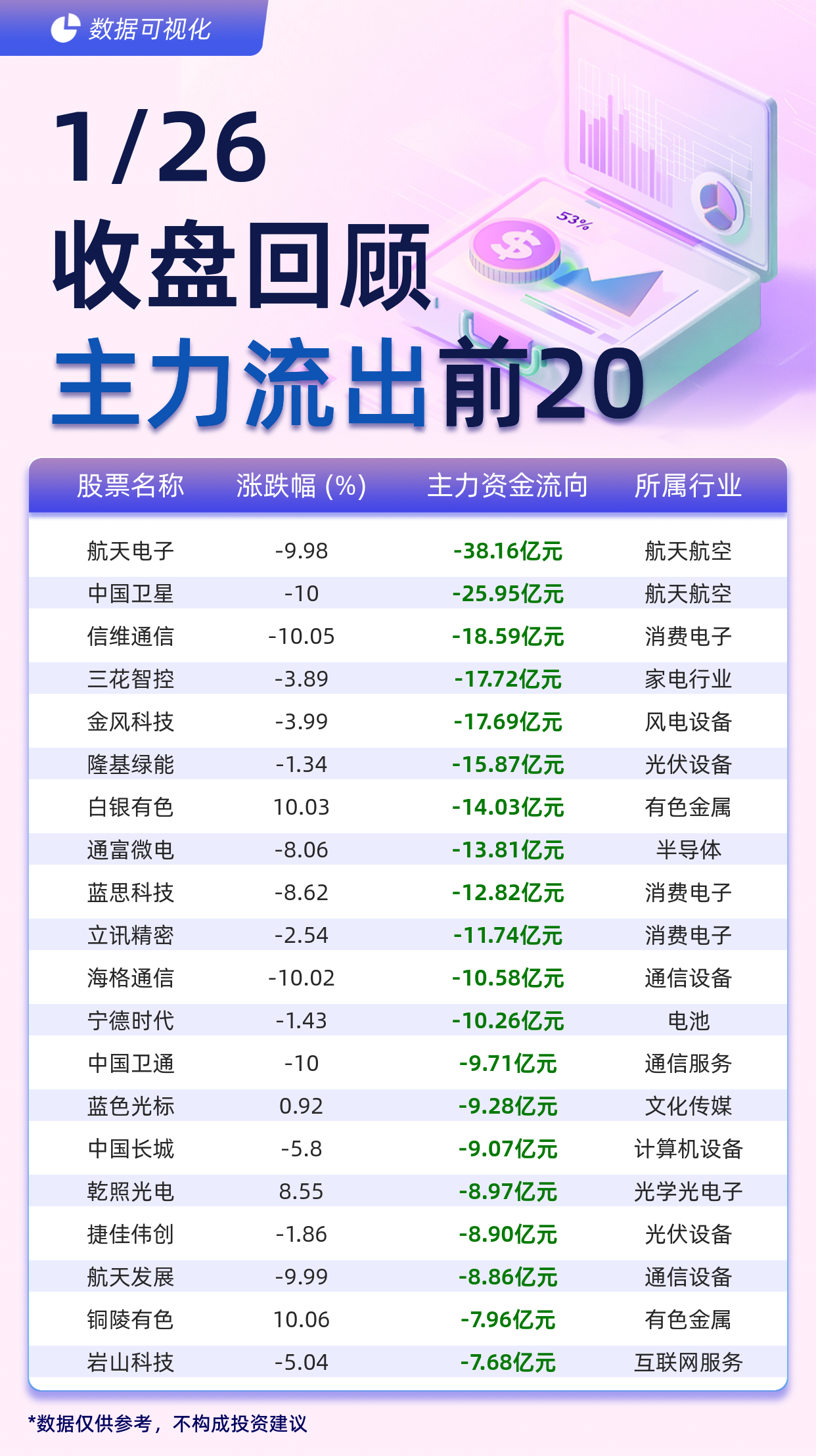
主力个股资金流出前20:航天电子流出38.16亿元、中国卫星流出25.95亿元
Jin Rong Jie· 2026-01-26 07:37
Core Viewpoint - The data indicates significant outflows of main funds from various stocks, particularly in the aerospace and consumer electronics sectors, reflecting a bearish sentiment among investors. Group 1: Stock Performance and Fund Flow - Aerospace stocks, such as Aerospace Electronics and China Satellite, experienced the largest fund outflows, with -38.16 billion and -25.95 billion respectively, and declines of -9.98% and -10% in their stock prices [1][2] - Other notable stocks with significant outflows include Xinwei Communication (-18.59 billion, -10.05%), Sanhua Intelligent Control (-17.72 billion, -3.89%), and Goldwind Technology (-17.69 billion, -3.99%) [1][2] - The outflow from Longi Green Energy was -15.87 billion with a stock price decrease of -1.34%, indicating a relatively smaller decline compared to others in the same sector [1][2] Group 2: Sector Analysis - The consumer electronics sector saw major outflows, particularly from companies like Xinwei Communication and Lens Technology, with outflows of -18.59 billion and -12.82 billion respectively [1][2] - The wind power equipment sector, represented by Goldwind Technology, also faced significant outflows, reflecting potential challenges in the renewable energy market [1][2] - The communication equipment sector, including companies like Haige Communication and China Satellite, showed substantial fund outflows, indicating investor caution in this area [1][3]





商业航天产业化提速引爆太空光伏概念,明阳智能等多股涨停!多家上市公司披露最新进展
Jin Rong Jie· 2026-01-26 05:01
消息面上,1月22日,达沃斯世界经济论坛年会期间,特斯拉CEO埃隆·马斯克在与贝莱德CEO拉里·芬克的对谈中明确力挺太空 光伏,并披露关键产能规划。他表示,SpaceX与特斯拉正同步推进太阳能产能提升,目标在未来三年内实现每年100GW的太阳 能制造能力。 商业航天崛起打开太空光伏新空间 太空光伏走红的背后是我国商业航天产业的快速崛起。当前,我国商业航天已迈入规模化、商业化新阶段,产业红利逐步释 放,驱动太空光伏从技术探索逐步迈向产业探索阶段。 近年来,低轨卫星星座建设明显提速,通信、遥感、导航等下游应用需求持续释放,而商业火箭发射成本的下降与发射能力的 提升,也让航天器在轨运行时间更长、载荷更复杂成为常态。在此背景下,可靠的能源支撑系统成为保障航天器稳定运行的关 键,太空光伏凭借其独特优势成为业内关注的焦点。 《证券日报》援引商业航天业内人士观点称,太空极端环境对能源供应提出极为严苛的要求,太空任务的特殊性也决定了能源 系统须具备长期稳定性与可靠性。而光伏技术可将太阳能直接转化为电能,兼具持续性、稳定性和轻量化等优势,目前已成为 航天器最成熟、应用最广泛的能源形式,有效适配太空场景需求。 据中信证券预测,2 ...


上市公司纷纷布局太空光伏 “追光者”实力参差不齐
Shang Hai Zheng Quan Bao· 2026-01-23 18:12
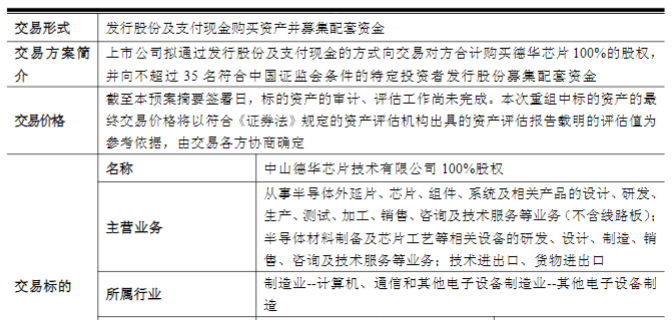
Group 1 - The core viewpoint of the article highlights the growing interest and investment in space photovoltaic technology among various companies, despite some facing significant losses in the traditional photovoltaic sector [2][3] - Several companies in the photovoltaic industry are actively pursuing space photovoltaic opportunities through investments, acquisitions, and self-research, with some already having products in mass production [2] - The market has seen a surge in stock prices for companies involved in space photovoltaic, such as Optec, JinkoSolar, and others, indicating a renewed optimism in this segment [2] Group 2 - Mingyang Smart Energy is making a strategic move by acquiring control of Zhongshan Dehua Chip Technology Co., which specializes in high-end compound semiconductor technology, to extend its reach into the space photovoltaic sector [4] - Gallium arsenide solar cells are identified as a mature solution for space photovoltaic applications, with Qianzhao Optoelectronics being the leading supplier of gallium arsenide solar cell epitaxial wafers in China [4] - The P-type ultra-thin heterojunction (HJT) battery technology is viewed as a key cost-reduction strategy for satellite solar wings, with companies like Dongfang Risen capable of mass delivery of HJT products [5] Group 3 - Some companies have issued risk warnings regarding their involvement in space photovoltaic, indicating that their products or technologies are not yet applicable in this field [6] - JunDa Co. has highlighted several risks associated with its investment in space photovoltaic, including technical, business, and market uncertainties, emphasizing that its current focus remains on ground photovoltaic applications [6] - Other companies, such as Solar Energy and Yamaton, have stated that their business does not currently involve space photovoltaic technology, focusing instead on their respective core areas [7]



A股延续上攻势头航天相关题材表现火热
Shang Hai Zheng Quan Bao· 2026-01-23 18:12
Market Overview - The A-share market continued its upward trend, with significant gains in sectors such as non-ferrous metals and renewable energy, leading to all four major indices closing in the green [2] - The Shanghai Composite Index closed at 4136.16 points, up 0.33%, while the Shenzhen Component Index rose by 0.79% to 14439.66 points [2] - The total trading volume in the Shanghai and Shenzhen markets reached 30.853 trillion yuan, an increase of over 390 billion yuan compared to the previous day [2] Space Industry Developments - The commercial aerospace sector saw a surge in interest, particularly in space photovoltaic technology, which became a focal point for active capital [2][3] - Blue Arrow Aerospace's IPO process on the Sci-Tech Innovation Board is progressing rapidly, with its application status changing to "under inquiry" as of January 22 [3] - SpaceX announced plans to launch its second-generation Starlink system by 2027, while Blue Origin is set to deploy a satellite communication network consisting of 5408 satellites by the fourth quarter of 2027 [3] Photovoltaic Sector Performance - The photovoltaic equipment index rose by 8.69%, with 64 stocks in the sector, of which only two declined, and several stocks, including Maiwei Co. and Jiejia Weichuang, hitting the 20% limit up [4] - Longi Green Energy, a leading company in the photovoltaic sector, also recorded a limit-up performance [4] - Space photovoltaic energy utilizes solar technology in outer space environments, providing a stable and lightweight energy solution compared to traditional fossil fuels and nuclear energy [4] Technological Advancements - SpaceX has confirmed the use of P-type HJT battery technology for large-scale production of space solar cells, which is seen as a short-term optimal alternative due to its cost-effectiveness and material flexibility [5] - The demand for GW-level space photovoltaic solutions is expected to grow significantly, with the existing arsenide gallium batteries unable to meet deployment needs [5] Investment Outlook - Market sentiment is optimistic, with institutions suggesting a focus on company performance as the annual earnings forecast period approaches [5] - The strategy team at CITIC Securities indicates that the market is in an upward trend, with active capital likely to seek thematic investment opportunities, particularly in commercial aerospace [5] - Investors are advised to concentrate on high-growth sectors, such as semiconductor equipment driven by storage expansion [5]



一图看懂 | 太空光伏概念股
市值风云· 2026-01-23 12:55
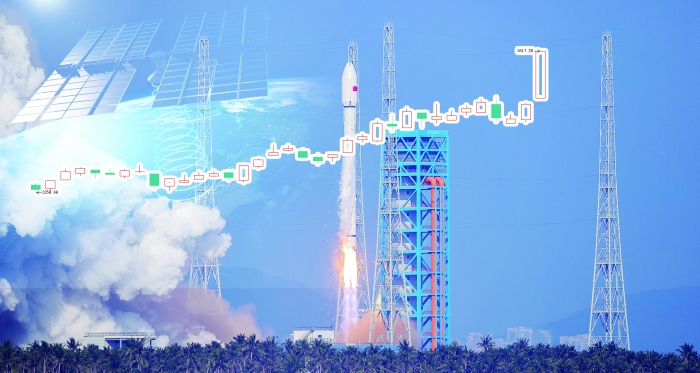
Core Viewpoint - Elon Musk, CEO of Tesla, supports space photovoltaics and reveals key production plans during a discussion with Larry Fink, CEO of BlackRock, at the World Economic Forum in Davos [3]. Group 1: Solar Energy Production - SpaceX and Tesla aim to achieve an annual solar manufacturing capacity of 100GW within the next three years [3]. Group 2: Related Companies and Technologies - Key players in the solar energy sector include: - Core battery manufacturers: Qianzhao Optoelectronics, Dongfang Risen, Junda Co., Trina Solar, Tuojiri New Energy, and Sanan Optoelectronics [4]. - Upstream equipment and materials: Jing Sheng Machinery, Juhe Materials, Zhonglai Co., and Maiwei Co. [4]. - Midstream packaging and components: Lushan New Materials and Lens Technology [4]. - Downstream system integration and on-orbit verification: Shanghai Port and Wan [4]. - Frontier technology investments and layouts: Xizi Clean Energy [4].





商业航天28股封板,巨头密集砸钱入局
2 1 Shi Ji Jing Ji Bao Dao· 2026-01-23 10:53
Core Insights - The commercial space sector in China has seen significant growth since 2025, with 50 commercial launches accounting for 54% of total space launches that year [1] - The commercial space index (886078.TI) surged by 73.13% in 2025, indicating a strong market performance [1] - The traditional dominance of state-owned enterprises in the space sector is being challenged as private capital and venture capitalists increasingly enter the market [1][10] Investment Trends - Corporate venture capital (CVC) investments in commercial space have nearly doubled from 19 events in 2023 to 35 in 2025, reflecting a growing interest in the sector [3] - CVC investments are characterized by a trend towards earlier and smaller investments, with 9 seed and angel round investments and 16 A-round investments in 2025 [5] - The geographical distribution of CVC investments shows Beijing leading with 8 events, followed by Jiangsu with 6 and Guangdong with 4 [7] Notable Investments - The largest disclosed investment in 2025 was a 300 million yuan (approximately 43 million USD) Pre-A round for Shaanxi Xingyi Space Technology Co., backed by a consortium of 8 investors [7] - Beijing Lizheng Technology Co., which provides drone control solutions, also secured 300 million yuan in a C+ round from 7 institutions [7] Industry Expansion - CVC investments are expanding beyond traditional rocket and launch services to include areas such as engines, aerospace electronics, and downstream applications [8] - Notable investments include Shenzhen Xiandeng Aerospace Technology Co., which focuses on ground support for rockets, and Hunan Lanyue Electromechanical Technology Co., which manufactures satellite components [8] Investment Institutions - The investment landscape includes three main types of institutions: state-owned enterprises and national capital platforms, local state-owned capital, and industry leaders' investment platforms [9] - Examples include China Electronics Technology Group's investment arm and local funds like Shenzhen Innovation Capital [9] Cross-Industry Involvement - Increasingly, non-space industry giants from sectors like automotive, oil, and AI are investing in commercial space, indicating a shift in investment dynamics [12] - Companies like Huichuan Technology, a leader in industrial automation, have made significant investments in the space sector, reflecting a broader trend of cross-industry capital flow [13] Market Dynamics - The commercial space industry is evolving into a competitive landscape focused on large-scale delivery and system capabilities, with leading firms gaining market share through technological and operational advantages [15] - The entry of diverse capital sources is expected to enhance the growth potential of the commercial space sector, making it more integrated into the broader industrial ecosystem [10][15]


数据复盘丨钙钛矿电池、商业航天等概念走强 191股获主力资金净流入超1亿元



Zheng Quan Shi Bao Wang· 2026-01-23 09:56
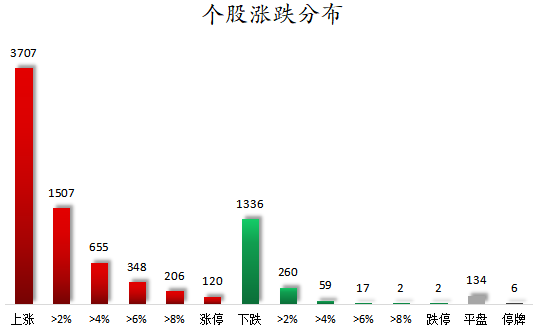
Market Overview - The Shanghai Composite Index closed at 4136.16 points, up 0.33%, with a trading volume of 1.3369 trillion yuan. The Shenzhen Component Index rose 0.79% to 14439.66 points, with a trading volume of 1.7484 trillion yuan. The ChiNext Index increased by 0.63% to 3349.50 points, with a trading volume of 822.63 billion yuan. The STAR Market 50 Index closed at 1553.71 points, up 0.78%, with a trading volume of 110.8 billion yuan. The total trading volume of both markets was 3.0853 trillion yuan, an increase of 393.5 billion yuan compared to the previous trading day [1]. Sector Performance - The market saw more sectors gaining than losing, with notable increases in power equipment, non-ferrous metals, precious metals, defense and military, steel, media, computer, environmental protection, and textile and apparel sectors. Concepts such as perovskite batteries, commercial aerospace, satellite internet, sapphire, lithium mining, cultivated diamonds, small metals, gold, and interactive short dramas were particularly active. In contrast, sectors like communication, insurance, banking, coal, and home appliances experienced declines [1]. Individual Stock Performance - A total of 3707 stocks rose, while 1336 stocks fell, with 134 stocks remaining flat and 6 stocks suspended. Excluding newly listed stocks, there were 120 stocks hitting the daily limit up and 2 stocks hitting the limit down [2]. - Among the stocks that hit the daily limit up, 23 stocks had consecutive limit-up days of 2 or more, with Fenglong Co., Ltd. leading with 18 consecutive limit-ups [3]. Capital Flow - The net capital outflow from the two markets was 4.167 billion yuan, with the ChiNext seeing a net inflow of 1.515 billion yuan. The CSI 300 index experienced a net outflow of 1.005 billion yuan, while the STAR Market saw a net outflow of 3.171 billion yuan. Out of 31 sectors, 13 sectors had net capital inflows, with the power equipment sector leading with a net inflow of 8.977 billion yuan [4][6]. - The top sectors with net inflows included non-ferrous metals (4.552 billion yuan), media (2.173 billion yuan), and defense and military (2.157 billion yuan). Conversely, the communication sector had the highest net outflow of 7.992 billion yuan, followed by electronics (6.350 billion yuan) and machinery (5.077 billion yuan) [4][6]. Notable Stocks - 191 stocks had net capital inflows exceeding 1 billion yuan, with Jin Feng Technology receiving the highest net inflow of 1.861 billion yuan. Other notable stocks included Lens Technology (1.594 billion yuan), Qian Zhao Optoelectronics (1.267 billion yuan), and Xian Dao Intelligent (1.217 billion yuan) [7][8]. - Conversely, 116 stocks experienced net capital outflows exceeding 1 billion yuan, with Xin Yi Sheng leading with a net outflow of 3.471 billion yuan, followed by Zhong Ji Xu Chuang (3.103 billion yuan) and Li Ou Shares (2.604 billion yuan) [10][11]. Institutional Activity - Institutional investors had a net selling of approximately 1.02 billion yuan, with 22 stocks seeing net purchases and 14 stocks net sales. Jin Feng Technology was the most purchased stock by institutions, with a net purchase amount of approximately 266 million yuan [13][14].