Maxwell(300751)

Search documents
钙钛矿电池板块走强 杭萧钢构涨停
Xin Lang Cai Jing· 2026-02-09 03:53
Group 1 - The perovskite battery sector is experiencing significant growth, with multiple companies seeing stock price increases [1] - Companies such as Hangxiao Steel Structure, Jinjing Technology, Xizi Clean Energy, Shanghai Port Bay, and Tuori New Energy have reached their daily price limits [1] - Other notable companies with substantial stock price gains include Baoxin Technology, Maiwei Co., Mingyang Smart Energy, Dier Laser, and Dike Co. [1]


东方证券:海内外同步催化驱动太空光伏景气度向上 优选高市占率设备厂及核心材料企业
智通财经网· 2026-02-09 03:32
Group 1 - The core viewpoint is that the space photovoltaic industry has significant potential, driven by both domestic and international developments, particularly with SpaceX's plans for a solar energy satellite network and China's increasing satellite launch capabilities [1][2] - The global market for space photovoltaics could reach 8GW annually, with a potential market size of 8 trillion yuan, even if the cost of components decreases significantly [2] - China's photovoltaic industry is strong, with leading manufacturers in equipment and materials, such as Maiwei and Aotwei, which are expected to gain incremental orders due to the expansion of overseas leaders [3] Group 2 - The report suggests focusing on key photovoltaic equipment manufacturers like Aotwei, Maiwei, and others that are likely to benefit from the expansion of overseas leaders [3] - It also highlights core material manufacturers like Dongfang Risen and others that have established deep relationships with overseas clients, which will drive profit growth [3]





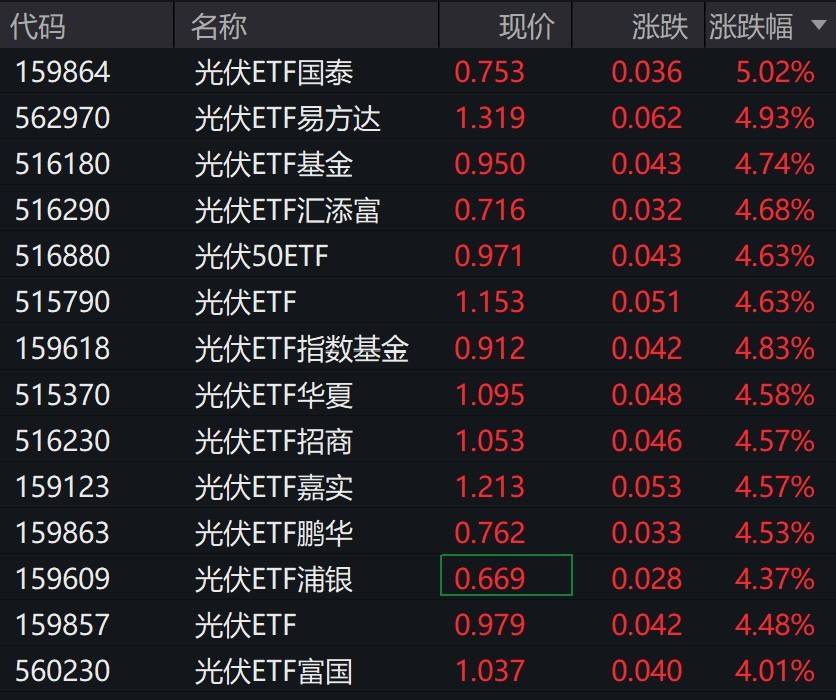
光伏概念股走强,光伏相关ETF涨超4%
Sou Hu Cai Jing· 2026-02-09 02:57
Group 1 - The photovoltaic concept stocks have strengthened, with TCL Zhonghuan hitting the daily limit, Maiwei shares rising over 7%, and Longi Green Energy increasing by over 6% [1] - Affected by the market, photovoltaic-related ETFs have risen by over 4% [1] Group 2 - Various photovoltaic ETFs have shown significant gains, with the Guotai Photovoltaic ETF up by 5.02%, E Fund Photovoltaic ETF up by 4.93%, and others also experiencing increases ranging from 4.01% to 4.74% [2] - Brokerages indicate that the current valuation of the photovoltaic industry remains historically low, suggesting potential for valuation recovery [2] - Future policies regarding product sales price measures, mergers and acquisitions among companies, increased industry entry barriers, and improved product quality standards are expected to be implemented, which may optimize the competitive landscape and industry chain ecology [2]



未知机构:国海机械张钰莹Again继续持续再次Call太空光伏设备0208-20260209
未知机构· 2026-02-09 02:45
Summary of Conference Call on Space Photovoltaic Equipment Industry Overview - The conference call focuses on the space photovoltaic industry, particularly in the context of China's satellite deployment plans and the evolution of satellite technology, including the Starlink project [1][2]. Key Points and Arguments 1. **China's Satellite Deployment Plans**: - By the end of 2025, China plans to submit approximately 203,000 satellites to the ITU, covering 14 satellite constellations. This includes 96,714 satellites for each of the CTC-1 and CTC-2 constellations, totaling nearly 193,000 satellites [1]. - Operators and commercial satellite companies are advancing medium-scale constellations, with China Mobile applying for 2,520 satellites, Yuanxin Satellite for 1,296, and Guodian Gaoke for 1,132 [1]. - As of December 2025, the overall launch completion rate for major domestic constellations remains low, indicating a "low launch rate and early networking stage" [1]. 2. **Starlink Project Development**: - As of January 25, 2026, Starlink has cumulatively launched approximately 11,034 satellites and applied for about 41,943 [2]. - The annual launch volume has increased from "hundreds" in 2018-2019 to an expected peak of around 3,200 satellites in 2025 [2]. 3. **Cost and Efficiency Dynamics**: - Gallium arsenide (GaAs) remains the mainstream technology for space photovoltaic applications, but it is no longer the only viable option due to high costs. The industry is exploring lower-cost alternatives such as silicon-based and perovskite solar cells [2]. - Starlink's V1-V3 satellites utilize crystalline silicon technology to achieve supply chain scalability and system-level cost reductions, sacrificing some unit efficiency for significant cost advantages [2]. 4. **Future Directions for Starlink**: - Starlink V4 may adopt P-type silicon HJT or P-type silicon HJT-perovskite tandem structures, which are expected to offer better reliability in space environments [3]. 5. **Domestic Space Photovoltaic Developments**: - The core technology remains multi-junction GaAs, but several companies are reporting progress in testing perovskite systems in orbit. For instance, Jiangyin Jinghao has completed over three months of stable operation for perovskite components in orbit as of May 6, 2025 [4]. - The industry outlook is positive, with an upgrade in the rating for the space photovoltaic sector to "recommended" due to accelerated satellite launches and ongoing validation of new photovoltaic technologies [4]. Additional Important Content - **Related Companies**: The call mentions several companies involved in the space photovoltaic sector, including Maiwei Co., Aotewi, High Measurement Co., Jing Sheng Machinery, Jiejia Weichuang, and Shanghai Port [5]. - **Risk Factors**: The report highlights several risks, including uncertainties in technology maturity and reliability, challenges in industrialization and commercialization, early investment and project execution risks, market space and competitive landscape uncertainties, and potential changes in policy and regulatory environments [7].


钙钛矿电池板块大涨 中来股份涨幅居前
Xin Lang Zheng Quan· 2026-02-09 02:24
Group 1 - The perovskite battery sector experienced a significant surge, with multiple companies reaching their daily price limit [1] - Notable companies that saw substantial gains include Hangxiao Steel Structure, Jinjing Technology, Xizi Clean Energy, Shanghai Port Bay, and Tuori New Energy [1] - Other companies with notable price increases include Zhonglai Co., Maiwei Co., Mingyang Smart Energy, Dongfang Risheng, and JA Solar Technology [1]


商业航天深度:太空光伏的技术底层逻辑(附29页PPT)
材料汇· 2026-02-08 15:24
Core Viewpoint - The article discusses the emergence of a new era in satellite technology, emphasizing the urgent need for efficient power supply systems for satellites as China prepares to launch a significant number of satellites by the end of 2025 [6][9]. Group 1: Satellite Launch and Development - By the end of 2025, China plans to submit approximately 203,000 satellites to the ITU, covering 14 satellite constellations, with the Radio Innovation Institute applying for two constellations, each with 96,714 satellites, totaling nearly 193,000 satellites [7][8]. - Major operators and commercial satellite companies are also advancing medium-scale constellations, with China Mobile applying for 2,520 satellites, Yuxin Satellite for 1,296, and Guodian Gaoke for 1,132 [8][10]. - As of December 2025, the overall launch completion rate for major domestic constellations remains low, indicating they are in the early stages of network formation [13]. Group 2: Starlink Program and Launch Trends - The Starlink program exhibits a clear generational rhythm, with cumulative launches reaching approximately 11,034 satellites and applications totaling about 41,943 as of January 2026 [2][16]. - The annual launch volume has increased significantly, with projections for 2025 reaching around 3,200 satellites, reflecting a trend of accelerating deployment [15][20]. - Starlink's V1 to V3 satellites utilize crystalline silicon technology to prioritize supply chain scalability and system-level cost reduction, while V4 may adopt P-type silicon HJT or P-type silicon HJT-perovskite tandem structures [3][4]. Group 3: Photovoltaic Technology in Space - The current mainstream technology for space photovoltaic applications in China is multi-junction gallium arsenide (GaAs), although there is ongoing testing and validation of perovskite systems by various companies [4][26]. - The high unit price of GaAs photovoltaic cells is becoming a significant factor limiting system economics, prompting the industry to explore lower-cost alternatives such as silicon-based and perovskite technologies [21][34]. - The article highlights the unique requirements for photovoltaic cells in space, including radiation resistance, thermal stability, and long-term reliability under extreme conditions [22][25]. Group 4: Industry Outlook and Recommendations - The acceleration of satellite launches and the continuous validation of new photovoltaic technologies indicate a rising industry outlook and long-term growth potential for the space photovoltaic sector [5][6]. - The article recommends a "buy" rating for the space photovoltaic industry, citing key companies such as Maiwei Co., Aotewi, and others as relevant investment targets [5][6].



马斯克点火A股光伏,奥特维等股价翻倍
2 1 Shi Ji Jing Ji Bao Dao· 2026-02-07 01:48
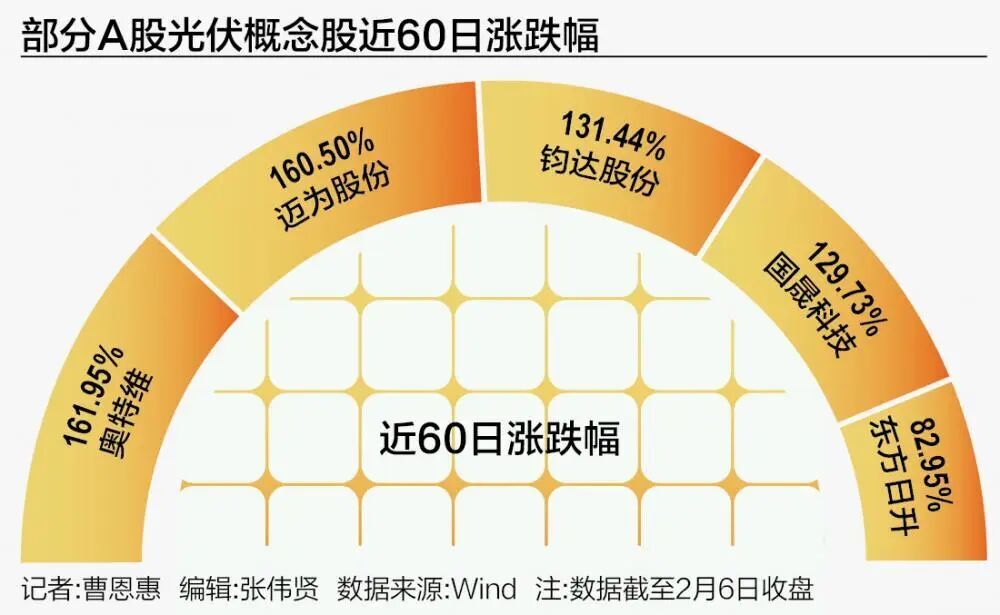
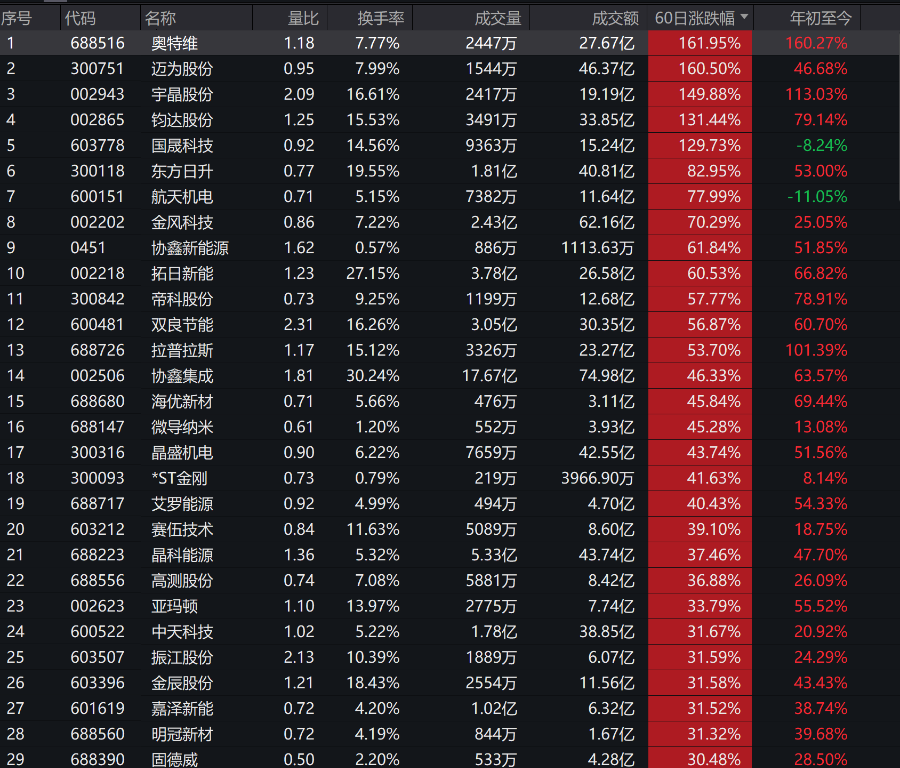
Core Viewpoint - Elon Musk is significantly influencing the Chinese A-share photovoltaic sector, with his comments on solar energy and its potential to provide substantial power, which has led to a surge in stock prices within the sector [2][3][4]. Group 1: Market Reaction - On January 23, 2026, following Musk's remarks at the World Economic Forum, 24 photovoltaic stocks in China hit their daily limit up, with the photovoltaic index rising by 7.46% [2]. - Two weeks later, Musk's interest in Chinese photovoltaic companies, including JinkoSolar and TCL Zhonghuan, further ignited stock price increases, with many stocks reaching their daily limit up again [3]. - The excitement surrounding Musk's "space photovoltaic" vision has injected new vitality into the previously stagnant A-share photovoltaic market [3][4]. Group 2: Industry Context - The photovoltaic industry is currently facing challenges, with nearly 70% of A-share photovoltaic companies reporting losses due to low prices in the supply chain [8]. - Despite some companies showing signs of recovery, the overall market sentiment remained negative, as indicated by a 4.10% decline in the Wind photovoltaic index during a week of earnings announcements [8]. - Musk's "space photovoltaic" concept has shifted the focus of the industry from terrestrial applications to potential space-based solutions, which could represent a new growth avenue for the sector [12]. Group 3: Future Prospects - Analysts predict that the "space photovoltaic" market could become a significant growth area, with estimates suggesting a market size of approximately 295 billion RMB by 2030, which is ten times the current scale [15]. - Musk's plans for deploying 100GW of solar power in space could potentially open up vast opportunities for new technologies and applications in the photovoltaic sector [15]. - However, the current competitive landscape and the need for immediate solutions to existing challenges in the industry remain pressing concerns [16].


钙钛矿:迎来GW级量产
GOLDEN SUN SECURITIES· 2026-02-06 13:26
Investment Rating - The report maintains a rating of "Increase" for the industry [4] Core Insights - Perovskite solar cells are entering the era of GW-level mass production, with leading companies like JinkoSolar and LONGi Green Energy accelerating capacity release [2][35] - The efficiency of perovskite cells is rapidly improving, with laboratory efficiencies reaching 27.3% for single-junction cells and 35.0% for perovskite-silicon tandem cells, significantly surpassing the maximum efficiency of silicon cells at 27.9% [15][19] - The cost competitiveness of perovskite cells is expected to improve, with unit production costs projected to drop to 1.0 RMB/W by 2026, potentially surpassing silicon cells [2][35] Summary by Sections Section 1: Perovskite as the Next Generation Photovoltaic Solution - Perovskite solar cells utilize a hybrid organic-inorganic metal halide semiconductor as the light-absorbing material, offering advantages such as high efficiency, low cost, and lightweight [8][11] Section 2: Efficiency and Stability Breakthroughs - The report highlights significant advancements in efficiency and stability, with perovskite cells achieving rapid efficiency improvements compared to silicon cells [15][18] - The industry is overcoming stability challenges through material modifications and process optimizations, with some products achieving IEC commercial standard certification [25][26] Section 3: GW-Level Production Era - The first GW-level production line for perovskite solar cells has been launched, marking the beginning of large-scale production [35] - By 2027, global production capacity is expected to exceed 5GW, with a complete supply chain being established [2][35] Section 4: Investment Recommendations - The report suggests focusing on leading companies in the perovskite supply chain, particularly those with clear capacity deployment and advancements in tandem technology, such as LONGi Green Energy and Trina Solar [3] - Equipment manufacturers with high domestic production rates and sufficient orders, like JinkoSolar and Mibet, are also recommended for investment [3]




中国光伏估值,因马斯克重塑?
2 1 Shi Ji Jing Ji Bao Dao· 2026-02-06 12:10
Core Viewpoint - Elon Musk's recent statements and activities have significantly influenced the A-share photovoltaic sector, leading to a surge in stock prices for various companies in this industry [2][3][5]. Group 1: Market Reaction - On January 23, 2026, 24 photovoltaic stocks reached their daily limit up, with the photovoltaic index rising by 7.46%, outperforming the overall market [2]. - Following Musk's remarks about the potential of solar energy in China, several companies, including JinkoSolar and TCL Zhonghuan, saw their stock prices rapidly increase [3][6]. - The A-share photovoltaic sector experienced a collective surge, with stocks like Aotaiwei and Maiwei doubling in price over a two-month period [6]. Group 2: Industry Fundamentals - Despite the recent stock price increases, many photovoltaic companies are still facing financial difficulties, with nearly 70% of 75 companies reporting losses for 2025 [4]. - The photovoltaic industry is currently at a low point, and while some companies are seeing a narrowing of losses, this has not translated into positive market sentiment [4][12]. - The concept of "space photovoltaics" has emerged as a potential new growth area for the industry, driven by the need for new market opportunities amid intense competition in ground-based solar energy [10][13]. Group 3: Future Prospects - Analysts predict that the space photovoltaic market could reach significant sizes, with estimates suggesting a potential market space of 200 billion yuan if 10,000 satellites are launched annually [10]. - Musk's exploration of Chinese photovoltaic companies signals a demand for support from the Chinese supply chain for his space energy ambitions [10][12]. - The push for space photovoltaics may compel companies to focus on new technologies and product quality, potentially leading to a return to value development in the industry [14].


深市规模最大的光伏ETF(159857)标的指数涨超2%,机构:白银价格高位回落有助于缓解电池片环节的成本压力
Mei Ri Jing Ji Xin Wen· 2026-02-06 07:08
Group 1 - The photovoltaic sector showed strong performance with the photovoltaic ETF (159857) rising over 2% during trading, with a transaction volume of 268 million yuan [1] - The ETF has seen a net inflow of 260 million yuan over the last ten trading days, with a current fund size of 2.322 billion yuan, making it the largest in its category in the Shenzhen market [1] - The ETF closely tracks the photovoltaic industry index, with major allocations in photovoltaic equipment (61.53%), grid equipment (13.3%), and electricity (8.57%) [1] Group 2 - Recent discussions by the Ministry of Industry and Information Technology emphasized guiding the photovoltaic industry towards healthy competition and avoiding "involution" [1] - The Ministry of Finance announced that it will phase out the export tax rebate for photovoltaic products starting April 1, 2026 [1] - The space photovoltaic concept is gaining attention, with Elon Musk's space energy plan bringing new momentum to the industry [1] Group 3 - High silver prices are pushing the photovoltaic metallization sector towards a technological revolution, with copper alternatives like silver-coated copper and electroplated copper becoming key cost-reduction strategies [2] - Successful large-scale application of these alternatives could significantly enhance the performance of related materials and equipment companies [2]