
YKA(300999)

Search documents
一粒米的价值天花板 金龙鱼点“糠”成金,炼出健康稻米油还能节约1.1亿亩耕地
Jin Rong Jie· 2025-12-20 12:09
Core Insights - The article highlights the innovative advancements of Jinlongyu, a traditional grain and oil brand in China, which has integrated cutting-edge technology into its operations [1] Group 1: Fresh Rice Quality Control - Jinlongyu has developed a "6-step Fresh Rice Precision Control Technology" to enhance rice quality, focusing on six key processes: fresh harvesting, fresh storage, fresh milling, fresh packaging, and fresh cooking [2] - The "fresh harvesting" method, which involves harvesting rice at 90% maturity, can reduce field losses by approximately 5%, potentially saving around 2.35 million tons of rice, equivalent to the annual consumption of about 21 million people [2] - This technology has been recognized with a first-class award from the China Grain and Oil Society, achieving international leading standards [2] Group 2: Circular Economy and Resource Utilization - Jinlongyu has established a unique "Rice Circular Economy Model," effectively utilizing by-products like rice bran and husks, which were previously considered waste [3] - The company has developed over 50 patented technologies to stabilize rice bran and improve oil extraction rates from less than 50% to nearly 80%, while retaining about 85% of core active ingredients [3] - The production of high-quality rice oil, rich in nutrients, has not only created a new category of healthy cooking oil but also significantly increased the overall value of rice [3] Group 3: Strategic Importance of Rice Production - With a national annual rice production of 200 million tons, the potential oil yield from rice bran could equate to producing 13 million tons of soybeans, enhancing China's oil self-sufficiency and food security [4] - The use of rice husks for power generation and the extraction of white carbon black for industrial applications forms a complete green circular industry chain [4] - Jinlongyu's journey reflects a path of industrial upgrading driven by technological innovation, contributing to national strategies and improving food security [4]
金龙鱼:股东大会审议通过《关于2026年度向银行及其他金融机构申请融资额度预计的议案》等多项议案
Zheng Quan Ri Bao Zhi Sheng· 2025-12-19 15:08
Group 1 - The company announced the approval of several proposals at the first extraordinary general meeting of shareholders for 2025, including financing limits for 2026 from banks and other financial institutions [1] - The proposals also included expected external guarantee limits for 2026 and financial assistance related to related party transactions for the same year [1]
金龙鱼:选举李长平担任职工代表董事
Cai Jing Wang· 2025-12-19 13:27
Core Viewpoint - The company announced the convening of its first extraordinary general meeting of shareholders in 2025 to approve amendments to its articles of association, including the addition of a worker representative director to the board [1] Group 1 - The extraordinary general meeting is scheduled for December 19, 2025 [1] - The revised articles of association will allow for the election of one worker representative director by the workers' representative assembly [1] - The company held a workers' representative assembly on the same day, where Li Changping was elected as the worker representative director for the third board of directors [1]
金龙鱼(300999) - 2025年第一次临时股东大会决议公告
2025-12-19 10:52
证券代码:300999 证券简称:金龙鱼 公告编号:2025-052 益海嘉里金龙鱼食品集团股份有限公司 2025年第一次临时股东大会决议公告 本公司及董事会全体成员保证信息披露的内容真实、准确和完 整,没有虚假记载、误导性陈述或重大遗漏。 特别提示: 1、本次股东大会未出现否决议案的情形。 2、本次股东大会不涉及变更以往股东大会已通过的决议。 一、会议召开和出席情况 (一)会议召开情况 1、会议召开时间: (1)现场会议召开时间:2025 年 12 月 19 日(星期五)下午 15:00。 (2)网络投票时间:2025 年 12 月 19 日。 其中:通过深圳证券交易所(以下简称"深交所")交易系统进行网络投票 的具体时间为 2025 年 12 月 19 日上午 9:15-9:25,9:30-11:30,13:00-15:00;通过 深交所互联网投票系统(http://wltp.cninfo.com.cn)进行网络投票的具体时间为 2025 年 12 月 19 日上午 9:15 至下午 15:00。 2、会议召开地点:上海市浦东新区博成路 1379 号益海嘉里金龙鱼食品集团 股份有限公司(以下简称"公司") ...
金龙鱼(300999) - 北京市汉坤律师事务所关于益海嘉里金龙鱼食品集团股份有限公司2025年第一次临时股东大会的法律意见书
2025-12-19 10:52
北京市汉坤律师事务所 关于 益海嘉里金龙鱼食品集团股份有限公司 2025 年第一次临时股东大会的 法律意见书 汉坤(证)字 2025 第 35655-1-O-2 号 中国北京市东长安街 1 号东方广场 C1 座 9 层 100738 电话:(8610)85255500;传真:(8610)85255511/85255522 北京上海深圳香港海口武汉新加坡纽约硅谷 www.hankunlaw.com 北京市汉坤律师事务所 关于益海嘉里金龙鱼食品集团股份有限公司 2025 年第一次临时股东大会的 益海嘉里金龙鱼食品集团股份有限公司(以下简称"公司")2025 年第一次 临时股东大会(以下简称"本次股东大会")采取现场投票与网络投票相结合的方 式,现场会议于 2025 年 12 月 19 日下午 15:00 在上海市浦东新区博成路 1379 号 益海嘉里金龙鱼食品集团股份有限公司二楼会议室召开。北京市汉坤律师事务所 (以下简称"本所")接受公司聘任,指派本所律师参加本次股东大会现场会议, 并根据《中华人民共和国公司法》《中华人民共和国证券法》(以下简称《" 证券法》") 《上市公司股东会规则》(以下简称《" 股东会规 ...
金龙鱼(300999) - 关于选举职工代表董事的公告
2025-12-19 10:52
证券代码:300999 证券简称:金龙鱼 公告编号:2025-053 益海嘉里金龙鱼食品集团股份有限公司 关于选举职工代表董事的公告 本公司及董事会全体成员保证信息披露的内容真实、准确和完 整,没有虚假记载、误导性陈述或重大遗漏。 公司于同日在公司会议室召开职工代表大会,经职工代表审议表决,同意选 举李长平先生担任公司第三届董事会职工代表董事(简历附后),任期自本次职 工代表大会选举通过之日起至第三届董事会届满之日止。 根据《中华人民共和国公司法》(以下简称"《公司法》")、《上市公司章程指 引》的相关要求和规定,益海嘉里金龙鱼食品集团股份有限公司(以下简称"公 司")于 2025 年 12 月 19 日召开 2025 年第一次临时股东大会,审议通过了《关 于修订公司章程及其附件的议案》。根据修订后的《益海嘉里金龙鱼食品集团股 份有限公司章程》(以下简称"《公司章程》"),公司董事会增设职工代表董事 1 名,由职工代表大会选举产生。 李长平先生,1973 年出生,中国国籍,无境外永久居留权,毕业于黑龙江 商学院。1995 年至 1998 年,任冰城食品有限公司会计。1998 年至 2001 年,任 烟台斯科伊 ...
花生供强需弱难改 上下波动有限
Xin Lang Cai Jing· 2025-12-17 10:01
Core Viewpoint - The domestic peanut market has shown a trend of weak adjustment since mid-December, with persistent weak demand leading to a decline in market prices. Although some major oil factories have entered the market for procurement, the overall purchasing volume is limited and the impact on market confidence is less than expected [1][7]. Supply and Demand Analysis - The current peanut market is characterized by strong supply and weak demand, with oil factories performing poorly. The purchasing price for Shandong peanuts is between 7000 to 7200 yuan/ton, down 200 yuan/ton week-on-week and down 750 yuan/ton year-on-year. In Henan, the price is also 7000 to 7200 yuan/ton, down 100 yuan/ton week-on-week and down 1350 yuan/ton year-on-year [8][9]. - Oil factories have limited purchasing volumes and strict quality control, leading to continued price reductions for peanut procurement. For instance, the contract price for Shandong Laiyang Luhua oil factory is 7600 yuan/ton, while Hebei Shenzhou Luhua oil factory also quotes 7600 yuan/ton. Other factories have similar pricing trends with minor adjustments [2][8]. Market Sentiment - Industry insiders attribute the weak adjustment in the peanut market to soft demand from food processing factories. Although most processing plants do not have high inventory levels, there is no motivation to stock up. The cautious purchasing behavior of distributors and oil factories has led to a subdued market atmosphere [3][9]. - The supply-demand stalemate is expected to persist in the short term, with limited upward price momentum. However, the upcoming New Year and Spring Festival may prompt food processing factories to increase their stockpiling efforts, potentially providing an opportunity to boost peanut prices, depending on actual purchasing volumes and market reactions [4][11]. Future Outlook - The cautious purchasing strategies of oil factories, combined with the weak performance of downstream products like peanut oil and peanut meal, suggest that there may be adjustments in procurement strategies in the future. The overall trading atmosphere remains subdued, with farmers holding back on sales due to price expectations [4][11]. - It is recommended that farmers and distributors take advantage of the pre-holiday stockpiling opportunity to reduce supply pressure post-holiday, while closely monitoring the outflow of goods from production areas and the purchasing behavior of oil factories [5][11].


金龙鱼:2025年12月19日召开2025年第一次临时股东大会
Zheng Quan Ri Bao Wang· 2025-12-15 13:13
证券日报网讯12月15日晚间,金龙鱼(300999)发布公告称,公司将于2025年12月19日召开2025年第一 次临时股东大会。 ...
金龙鱼:公司管理层会继续努力做好各项经营工作
Zheng Quan Ri Bao· 2025-12-15 12:45
Core Viewpoint - The company, Jinlongyu, emphasizes its commitment to considering long-term interests, overall shareholder benefits, and sustainable development when deciding on dividend matters [2] Group 1 - The company will make dividend decisions based on its articles of association and relevant regulations [2] - The management team is dedicated to improving operational performance to provide good returns to investors [2]
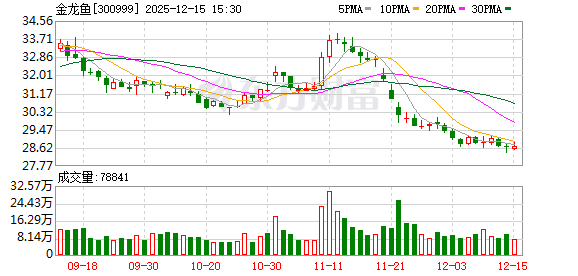
金龙鱼:截至2025年12月10日公司股东共计115847户
Zheng Quan Ri Bao Wang· 2025-12-15 12:10
Group 1 - The core point of the article is that Jinlongyu (300999) reported a total of 115,847 shareholders as of December 10, 2025 [1]