AMD(AMD)

Search documents
What the Nvidia-Groq deal means for the AI trade, plus precious metal bubble talk
Youtube· 2025-12-26 16:20
Group 1: Nvidia and Grock Acquisition - Nvidia has made its largest acquisition ever, purchasing assets from AI chip startup Grock for approximately $20 billion, with Grock previously valued at $6.9 billion in a recent capital raise [2][9]. - Grock's founder and CEO, Jonathan Ross, known for designing custom chips at Google, will join Nvidia, indicating a strategic move towards specialized chips for AI inference [3][10]. - The acquisition is viewed as an investment in capacity expansion beyond Nvidia's current GPU platform, affirming the ongoing growth in the AI sector [7][8]. Group 2: AI Market Dynamics - The deal reflects a broader trend where major tech companies may seek to acquire private companies to enhance their capabilities in AI, suggesting a potential evolution in the market [13][14]. - There is a growing belief that specialized chips, like those developed by Grock, represent the future of AI technology, which may justify Nvidia's high acquisition price [9][10]. - The AI market is expected to continue evolving, with significant investments needed to support infrastructure and technology development [15][54]. Group 3: AMD and OpenAI Partnership - AMD has announced a significant partnership with OpenAI, involving a 6-gigawatt deal projected to generate tens of billions in revenue over the coming years [39]. - This collaboration aims to enhance AI computing capabilities, with AMD's MI450 chip expected to play a crucial role in meeting the demands of AI applications [43][54]. - The partnership is seen as a strategic move to build the necessary infrastructure for AI, emphasizing the importance of collaboration across the industry [50][53]. Group 4: Precious Metals Market - Silver has seen a remarkable increase of 40% in the past month, driven by its industrial applications, particularly in AI and data centers [19][21]. - Copper prices are also at record highs, reflecting strong demand for industrial metals necessary for manufacturing and infrastructure related to AI [21][25]. - Analysts caution that while current prices are high, the underlying demand for these metals may support continued growth, although there are concerns about potential market corrections [22][26].


推迟半导体征税、放行高端芯片出口,美对华科技竞争策略转变
Sou Hu Cai Jing· 2025-12-26 15:30
Core Viewpoint - The U.S. has adjusted its semiconductor policies towards China, allowing high-end AI chip exports under strict licensing conditions while delaying new tariffs on Chinese semiconductor products for 18 months, indicating a shift from comprehensive restrictions to a more calibrated approach aimed at maintaining a competitive edge [1][2][3]. Group 1: Policy Adjustments - The U.S. Trade Representative (USTR) has decided to impose tariffs on Chinese chips starting in 2027, ending a previous trade investigation initiated by the Biden administration [1][2]. - The USTR's announcement indicates that the U.S. will initially impose zero tariffs on Chinese semiconductor products until June 2027, with specific tariff increases yet to be determined [2][3]. - The 18-month tariff delay is seen as a measure to stabilize global supply chain expectations, allowing multinational companies to adjust their chip procurement and manufacturing strategies in China [2][3]. Group 2: Strategic Implications - The delay in tariff implementation is perceived as a way to avoid immediate supply chain disruptions and inflation spikes in the U.S., as the country still relies on Chinese supplies for traditional process chips [3][4]. - The U.S. aims to retain negotiation leverage while signaling to China that tariffs could be enacted at any time, creating a strategic ambiguity [5][6]. - The U.S. government is also considering broader tariffs on semiconductor-containing electronic products, which could further complicate U.S.-China relations [4][5]. Group 3: Industry Reactions - Companies like NVIDIA and AMD have received approvals to export certain AI chips to China, indicating a significant influence of commercial interests on policy decisions [6][9]. - NVIDIA's H200 chip, now approved for export, is expected to generate substantial revenue for the company, highlighting the financial stakes involved in U.S.-China tech relations [7][9]. - AMD's CEO has expressed intentions to deepen investments in China, reflecting a trend among U.S. tech firms to navigate the complex regulatory landscape while seeking market opportunities [9][10]. Group 4: Long-term Outlook - The ongoing adjustments in U.S. semiconductor policy suggest that while there may be short-term improvements in U.S.-China tech cooperation, the long-term strategic competition and mutual distrust are likely to persist [10][11]. - The fluctuating nature of U.S. policies regarding chip exports indicates that the underlying tensions between the two nations remain unresolved, with potential implications for global supply chains and technological advancements [10][11].
100页深度报告:半导体产业的发展复盘与方向探索
材料汇· 2025-12-26 14:58
Global Semiconductor Market Analysis - The global semiconductor market is projected to reach $659.1 billion in 2024, representing a year-on-year growth of 20.0%, and is expected to grow to $789.3 billion by 2025 [2][14] - Integrated circuits will account for the largest share at 73.9%, while artificial intelligence chips will see the fastest growth at 49.3% [2][14] - In 2023, the top ten companies in the global semiconductor market are primarily from the US, Taiwan, and South Korea, with no mainland Chinese companies in the top ranks [2][16] China Semiconductor Market Analysis - China's semiconductor market is expected to reach $176.9 billion in 2024, with a year-on-year growth of 15.9%, and is projected to reach $206.7 billion by 2025 [2][16] - Integrated circuits will dominate the Chinese market, accounting for $139.3 billion, or 78.7% of the total market, with artificial intelligence chips growing at 48.3% [2][16] Historical Development of the Semiconductor Industry - The global semiconductor industry has evolved through four major phases: the rise of personal computers and the internet (1986-1999), network communications and consumer electronics (2000-2010), the smartphone and 3G/4G/5G era (2010-2020), and the current AI technology and data center phase (2023-present) [3][21][24] Semiconductor Industry Chain Overview - The semiconductor industry chain consists of upstream (EDA/IP, semiconductor equipment, semiconductor materials), midstream (semiconductor design, wafer manufacturing, and packaging/testing), and downstream (packaging and testing) segments [6][62] - Upstream EDA/IP is dominated by companies like Synopsys and Cadence, while semiconductor equipment is led by ASML for EUV lithography, with high industry concentration [6][62] Future Development Directions in the Semiconductor Industry - Key future development areas in the semiconductor industry include third-generation semiconductor materials, computing chips, RF communication chips, and high-bandwidth memory [8][10] Investment Recommendations - The domestic semiconductor industry is expected to make breakthroughs in upstream core equipment, materials, and software, driven by national policies and international dynamics [9] - Investment opportunities are particularly promising in third-generation semiconductor materials, computing chips, RF communication chips, and high-bandwidth storage [9][10]






大外交|推迟半导体征税、放行高端芯片出口,美对华科技竞争策略转变
Sou Hu Cai Jing· 2025-12-26 13:16
Core Viewpoint - The U.S. has adjusted its semiconductor policy towards China, allowing high-end AI chip exports under strict licensing while delaying new tariffs on Chinese semiconductor products by 18 months, indicating a shift from comprehensive restrictions to a more calibrated approach aimed at maintaining a competitive edge [1][2][5]. Group 1: Policy Adjustments - The U.S. Trade Representative (USTR) announced that tariffs on Chinese semiconductor products will not be imposed for at least 18 months, with zero tariffs on imports until June 2027 [2][3]. - The USTR's decision to delay tariffs is seen as a strategy to stabilize global supply chains and reduce uncertainty for multinational companies adjusting their procurement and manufacturing in China [2][3]. Group 2: Strategic Implications - The delay in tariffs is perceived as a way for the U.S. to retain negotiation leverage while signaling to China that tariffs could be imposed at any time [5][6]. - The focus of the U.S. investigation is on "mature process" chips, which are critical for various industries, and there are concerns about U.S. dependency on China for these chips despite maintaining an edge in high-end technology [3][4]. Group 3: Industry Reactions - Companies like NVIDIA and AMD are actively seeking to expand their presence in the Chinese market, with NVIDIA's H200 AI chip export approval expected to generate $10 billion to $15 billion annually [7][9]. - AMD's CEO has expressed intentions to deepen cooperation with China, indicating a trend among U.S. tech firms to navigate the complex regulatory landscape while pursuing market opportunities [9][10]. Group 4: Long-term Outlook - The ongoing adjustments in U.S. semiconductor policy reflect a broader strategy of maintaining competitive advantages while allowing for limited cooperation with China, though significant strategic distrust remains [10][11]. - The fluctuating nature of U.S. policies regarding semiconductor exports to China suggests that the underlying tensions in U.S.-China relations are likely to persist, complicating future interactions in the tech sector [10][11].
爱建电子深度报告:半导体产业的发展复盘与方向探索
Shanghai Aijian Securities· 2025-12-26 11:31
Investment Rating - The report rates the semiconductor industry as "Outperform" compared to the market [1] Core Insights - The global semiconductor market is projected to reach USD 659.1 billion in 2024, with a year-on-year growth of 20.0%, and is expected to grow to USD 789.3 billion in 2025 [2][13] - Integrated circuits will account for the largest share of the market at 73.9% in 2024, while artificial intelligence chips are anticipated to grow the fastest at 49.3% [2][13] - The report identifies four key future development directions for the semiconductor industry: third-generation semiconductor materials, computing chips, RF communication chips, and high-bandwidth memory [2] Summary by Sections 1. Semiconductor Market Analysis - The global semiconductor market is expected to grow significantly, with integrated circuits leading the market share [13][15] - The Chinese semiconductor market is projected to reach USD 1,769 billion in 2024, with a year-on-year growth of 15.9% [15][17] 2. Historical Development of the Semiconductor Industry - The semiconductor industry has evolved through four major phases, driven by technological advancements and market demands [20][22] - The current phase is characterized by AI technology and data centers driving growth [22][23] 3. Semiconductor Industry Chain - The semiconductor industry chain consists of upstream (EDA/IP, semiconductor equipment, materials), midstream (design, wafer manufacturing, packaging), and downstream (packaging and testing) segments [64][73] - The report highlights the importance of domestic companies in advancing technology and achieving breakthroughs in core areas [2][64] 4. Future Development Directions - The report emphasizes the potential of third-generation semiconductor materials, computing chips, RF communication chips, and high-bandwidth memory as key growth areas [2][4]


美国半导体及半导体设备:行业现状;2026 年前瞻-US Semiconductors and Semi Equipment _The State of The State; 2026 Preview
2025-12-26 02:18
Summary of the Conference Call on US Semiconductors and Semi Equipment Industry Overview - The semiconductor industry ended 2025 with a strong performance, returning +34%, and is expected to continue its growth trajectory, with the SOX index offering twice the growth of the S&P 500 for minimal valuation premium [10][30][31] - AI has emerged as the dominant theme in the market, contributing to 80% of the S&P's 17% return in 2025, despite concerns about sustainability [10][16][11] Key Insights Compute Sector - Demand for AI training continues to grow, with a decline in inference costs driving adoption [17][21] - Major players in the compute sector, such as NVIDIA (NVDA), Advanced Micro Devices (AMD), and Broadcom (AVGO), are expected to benefit significantly from AI demand [10][46][55] - NVDA's revenue share in Compute and Networking is projected to increase to 75% in 2025, with a forecasted 67% share in subsequent years [52] Memory Sector - The report favors High Bandwidth Memory (HBM) and DRAM over NAND and HDD, predicting that HBM will keep supply tight through 2026 [10][64] - AI server DRAM bit demand is on a robust growth path, with projections indicating significant increases in demand [65][69] Semiconductor Equipment (SPE) - The SPE sector is expected to benefit from AI, with strong industry fundamentals supporting a multi-year wafer fab equipment (WFE) super cycle [10][76] - WFE intensity as a percentage of semiconductor industry operating profit is projected to increase, indicating a healthy outlook for the sector [77] Analog Sector - The analog sector is viewed as a cyclical play that is relatively uncorrelated to AI, with select names like Texas Instruments (TXN) favored for investment [10][45] - Despite the overall market sentiment, the report suggests that the analog sector has potential for growth, particularly in industrial and automotive applications [96] Market Dynamics - The inventory cycle is reigniting, with revenue growth outpacing inventory growth, suggesting continued strength in the semiconductor sector [39] - Active investors remain underweight in semiconductors, indicating potential for increased investment as the sector's growth profile strengthens [33] Risks and Considerations - While the semiconductor sector shows promise, the report notes that misses in earnings guidance are often punished, while beats receive little reward, indicating a volatile market environment [36][37] - The report emphasizes the need for selectivity in investment choices, particularly in crowded sectors like memory [45] Conclusion - The semiconductor industry is poised for continued growth, driven by AI and strong demand in various subsectors. Investors are encouraged to focus on key players in compute, memory, and SPE while remaining cautious of market volatility and the need for selective investment strategies [10][30][45]


AMD Strix Halo对线Nvidia DGX Spark,谁最强?
半导体行业观察· 2025-12-26 01:57
Core Insights - The article discusses the comparison between Nvidia's DGX Spark and AMD's Strix Halo systems, highlighting their capabilities in AI workloads and performance metrics [1][57]. System Overview - Nvidia's DGX Spark, launched in October, features a built-in AI lab with 128GB of memory, capable of running various AI workloads, although it is not the cheapest option on the market [1]. - AMD's Strix Halo, priced significantly lower than Spark, offers a competitive alternative with a similar software stack, making it appealing for developers and enthusiasts [1][13]. Performance Comparison - The HP Z2 Mini G1a workstation was tested against the Spark to evaluate performance across various AI workloads, including single-user inference and image generation [2]. - The physical design of the HP G1a is larger than Spark, with integrated power supply and better cooling solutions, although Spark has superior build quality [4][5]. Technical Specifications - The DGX Spark features a 20-core Arm CPU and 6,144 CUDA cores, while the Strix Halo has a 16-core Zen 5 CPU and 2,560 stream processors [11]. - In terms of memory bandwidth, Spark offers 273 GB/s compared to Strix Halo's 256 GB/s, which may impact performance in memory-intensive tasks [26]. GenAI Performance - Nvidia claims Spark can achieve up to 1 petaFLOPS, but practical performance is closer to 500 teraFLOPS for most users, depending on workload types [18]. - Strix Halo's performance is estimated at 126 TOPS, but actual application performance may not fully utilize this potential due to software limitations [19]. LLM Inference - In single-batch processing, both systems perform similarly in token generation, but Spark's GPU speed is approximately 2-3 times faster than Strix Halo for shorter prompts [24][27]. - For batch processing, Spark outperforms G1a, but the performance advantage may not be significant for users running non-interactive tasks [31][32]. Fine-tuning and Image Generation - Both systems support up to 128 GB of memory, making them suitable for fine-tuning models, although Spark completes tasks faster [34][38]. - In image generation tasks, Spark demonstrates a significant performance advantage, achieving around 120 teraFLOPS compared to G1a's 46 teraFLOPS [42]. NPU Capabilities - Strix Halo includes a neural processing unit (NPU) that can provide an additional 50 TOPS, but software support for maximizing its performance is still limited [44]. - The NPU's integration into applications is still developing, with some success in specific use cases, but overall performance remains below expectations [46]. Software Compatibility - Nvidia's CUDA ecosystem remains a strong advantage over AMD's ROCm and HIP, although AMD has made significant progress in recent months [48][49]. - The older RDNA 3.5 architecture of Strix Halo limits its support for low-precision data types, impacting performance in certain AI applications [50]. Conclusion - The choice between DGX Spark and Strix Halo depends on the user's specific needs, with Spark being more suitable for dedicated AI tasks and Strix Halo offering a versatile option for general computing and AI workloads [54][57].

黄仁勋、苏姿丰CES大拼场 台积电、鸿海等供应商打强心针
Jing Ji Ri Bao· 2025-12-25 23:12
"2026美国消费性电子展"(CES 2026)将于美西时间明年1月6日起登场,英伟达CEO黄仁勋、AMD CEO苏姿丰都将在开展前一天发表主题演讲,畅谈AI未来发展。 两大AI天王天后CES大拼场,业界看好将打响2026年AI市场第一枪,助益台积电、鸿海、广达、纬创等 中国台湾厂商迎来新一波AI行情。 CES是全球最大消费电子展,2026年大展将于美西时间1月6日至9日于拉斯维加斯举行,主题为"AI Forward(前进AI)",重点展示AI如何融入日常生活,AI机器人、智能家电、自驾车到AI PC。 黄仁勋、苏姿丰都将在展前先后发表演讲,为大展暖身。其中,黄仁勋在2026年1月5日下午1时先亮 相,英伟达透露,他将分享未来AI发展趋势,以及英伟达与合作伙伴共同打造生态系,突破性技术付 诸实现等内容,产业将可亲见英伟达的解决方案推动各行各业发挥生产力。 据了解,英伟达在CES的活动主题聚焦AI机器人、无人机、车用等相关应用,延伸到AI计算市场展望。 业界预期,黄仁勋可望释出旗下Rubin平台最新进度;另外,英伟达推动的NVLink生态系可能公布与 ASIC生态系合作进展,将是推动光通信元件规格升级主要推手。 ...
Harbor Capital Appreciation Fund Added Advanced Micro Devices (AMD) in Q3
Yahoo Finance· 2025-12-25 15:43
Core Insights - Harbor Capital Appreciation Fund reported a solid performance in Q3 2025, with a return of 5.11%, while the Russell 1000® Growth Index and S&P 500 Index returned 10.51% and 8.12% respectively, driven by AI momentum and strong corporate earnings [1] Company Overview - Advanced Micro Devices, Inc. (NASDAQ: AMD) is highlighted as a key investment, with a market capitalization of $350.094 billion and a share price of $215.04 as of December 24, 2025 [2] - AMD's stock experienced a one-month return of 0.37% and a significant 70.27% increase over the past 52 weeks [2] Investment Thesis - The fund initiated a position in AMD, citing its leadership in high-performance computing and AI solutions, a strong product roadmap, and growth prospects with major cloud providers [3] - AMD's innovation in data center and AI accelerators, along with broad market adoption, positions it as a compelling long-term investment in expanding technology markets [3] Market Position - AMD ranks 19th among the 30 Most Popular Stocks Among Hedge Funds, with 115 hedge fund portfolios holding its stock at the end of Q3, an increase from 113 in the previous quarter [4] - Despite acknowledging AMD's potential, some analysts believe other AI stocks may offer greater upside with less downside risk [4]
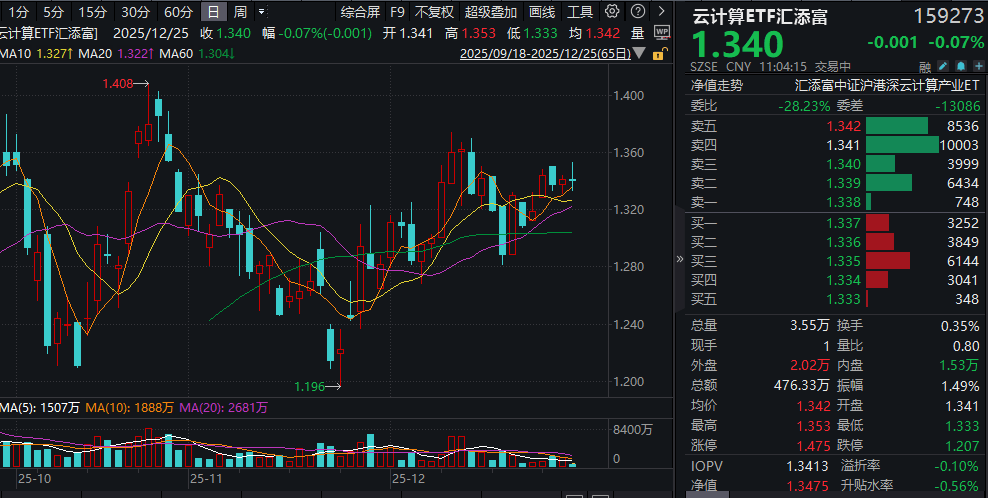
海外AI热潮再起,英伟达与Groq达成技术授权协议!云计算ETF汇添富(159273)冲高后小幅回落!光模块2026年投资机遇如何?
Sou Hu Cai Jing· 2025-12-25 03:43
Group 1 - The core viewpoint of the news highlights the ongoing developments in the AI and cloud computing sectors, particularly focusing on the demand for optical modules driven by AI training and inference needs [4][9] - Nvidia has entered a licensing agreement with AI startup Groq, indicating a strategic move to invest in AI-related companies while avoiding antitrust scrutiny [3] - The optical module market is expected to see significant growth, with 800G optical modules projected to maintain high growth rates and 1.6T shipments also expected to increase substantially [4][9] Group 2 - The demand for optical modules is primarily driven by Scale-out networks, which enhance processing capabilities by adding more computing nodes [8] - Future demand for optical modules in Scale-up networks is anticipated to be vast, as these networks increase the number of GPUs/XPUs in single computing nodes [9][11] - The average Scale-up bandwidth is significantly higher than Scale-out bandwidth, with a ratio of 12.5, indicating a larger market potential for network hardware in the Scale-up domain [11][12]