
AMD(AMD)

Search documents
10M2025 AI落地观察:大厂AI密集催化,关注高壁垒应用 | 投研报告
Zhong Guo Neng Yuan Wang· 2025-11-21 03:02
Investment Logic - The computer industry is witnessing a competitive landscape with Alibaba officially launching the Qianwen APP, which aims to compete with ChatGPT 5.1, integrating the latest Qwen3-Max model from Alibaba's Tongyi Lab [1] - Alibaba is working on joint development with its ecosystem applications such as Gaode, Taobao, Alipay, and Shanguo, enhancing the Qianwen APP's capabilities to naturally retrieve Taobao product information [1] - The Qianwen APP is evolving from a "user-initiated demand" model to a "product-guided demand" dialogue assistant, showcasing various functionalities like AI photo editing, translation, and intelligent writing [1] - The release of Google Gemini 3 Pro Model Card indicates significant advancements in multi-modal capabilities, outperforming previous models in various testing dimensions, solidifying its leading position in the market [1] - The positioning of "entry points" is becoming clearer, with major players like OpenAI, ByteDance, and Alibaba establishing their presence in the consumer market, potentially leading to a shift in control over consumer software [1] - The enterprise sector (B-end) is expected to have a higher Total Addressable Market (TAM) as AI becomes a productivity tool, despite short-term IT budget constraints [1] - Companies recommended for investment include Hikvision, Dahua Technology, Hehe Information, Wanxing Technology, and Suochen Technology [1] Electronics Industry Perspective - AI hardware companies are optimistic about long-term growth, with Nvidia's GTC conference indicating positive shipment and order guidance for 2026 [2] - Nvidia's Rubin has commenced production this quarter, and AMD has expressed optimism about its long-term growth over the next 3-5 years [2] - The rapid growth of AI chips is driving increased demand for storage data centers, with a recommendation to monitor Broadcom's performance in December for potential upward revisions in 2026 ASIC revenue [2] - The explosive growth in token numbers is expected to drive strong demand for ASICs, with significant growth anticipated in 2026-2027 for companies like Google, Amazon, Meta, OpenAI, and Microsoft [2] Communication Industry Perspective - North American AI data center construction is accelerating, with significant investments announced by companies like Anthropic ($50 billion), Microsoft ($10 billion), and Google (€5.5 billion) [3] - AMD's analyst day revealed a target of over 35% annual revenue growth in the next 3-5 years, with AI business revenue expected to grow at 80% annually [3] - The company has a clear product roadmap for its MI400 series GPUs, with the MI450 series expected to launch in Q3 2026 [3] - Zhongji Xuchuang plans to prepare for an H-share listing to expand overseas financing channels, enhancing its competitiveness in the global optical module market [3] - Tencent's Q3 performance exceeded expectations with revenue of 192.87 billion yuan, a 15% year-on-year increase, and net profit of 63.13 billion yuan, a 19% increase, although capital expenditure saw a significant decline of about 24% [3] - Alibaba's strategic shift towards the consumer market with "Tongyi Qianwen" reflects the ongoing iteration and upgrade of domestic large models, which is expected to accelerate the development of the entire industry chain [3]
Cathie Wood Dumps AMD Shares, Loads Up On Nvidia With $17 Million Buy Amid Earnings Buzz: Ark Scoops Up These Crypto Stocks As Bitcoin, Ethereum Crash - Advanced Micro Devices (NASDAQ:AMD)
Benzinga· 2025-11-21 02:35
Ark Invest Trading Activities - Ark Invest executed significant trades, including buying shares of Nvidia Corp and selling shares of Advanced Micro Devices Inc [1] - The firm also purchased shares of Bitmine Immersion Technologies Inc, Bullish, and Circle Internet Group Inc [1] Nvidia Trade - ARK Innovation ETF acquired 93,374 shares of Nvidia, valued at approximately $16.9 million based on a closing price of $180.64 [2] - Nvidia reported a 62% year-over-year revenue increase, reaching $57 billion, driven by demand for its Blackwell chips, although the stock ended the day 3.15% lower [3] AMD Trade - Ark Invest reduced its holdings in AMD by selling 14,087 shares across multiple ETFs, valued at approximately $2.9 million at a closing price of $206.02 [4] - Despite AMD's strategic wins in the AI market, the stock faced pressure due to broader sector concerns following Nvidia's earnings [4] Bitmine Immersion Trade - Ark Invest's ARKK and ARKF funds purchased 380,244 shares of Bitmine Immersion, totaling approximately $9.9 million based on a closing price of $26.02 [5] - Bitmine's stock is volatile, influenced by its significant holdings in Ethereum, which recently experienced a price drop [6] Bullish Trade - Ark Invest's ARKF, ARKK, and ARKW funds acquired 264,534 shares of Bullish, valued at approximately $9.65 million based on a closing price of $36.50 [8] - Bullish reported third-quarter revenue of $76.5 million, surpassing estimates, with adjusted EPS of $0.10 [9] Circle Trade - ARKK acquired 134,650 shares of Circle, valued at approximately $9 million based on a closing price of $66.93 [10] - Circle reported $740 million in revenue for Q3, with a 202% year-over-year gain, and received upgrades from Baird and Bernstein [11]


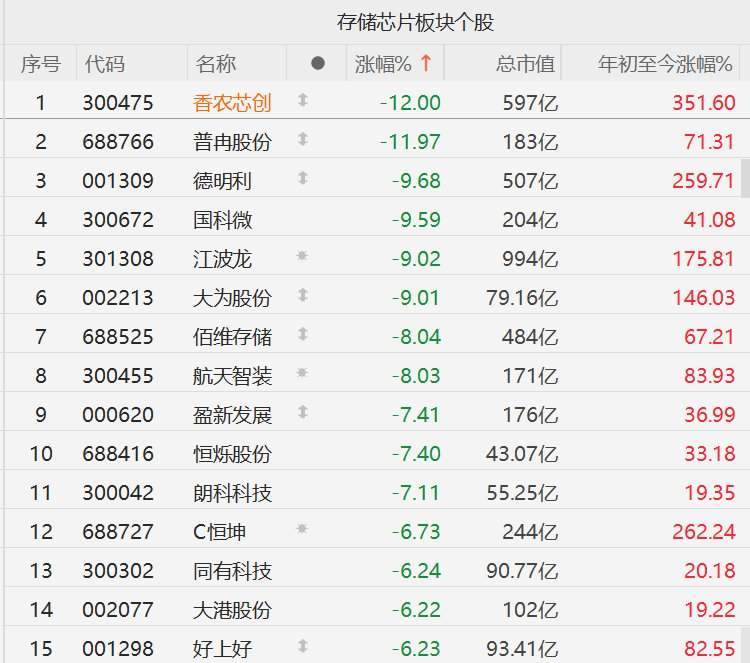
A股存储芯片概念股全线下挫,香农芯创跌12%,普冉股份跌近12%,德明利、江波龙跌超9%!隔夜美股英伟达剧震大跌
Ge Long Hui· 2025-11-21 02:33
Core Viewpoint - The overnight decline in U.S. semiconductor stocks has negatively impacted the A-share market, particularly affecting storage chip concept stocks, which saw significant drops across the board [1][2]. Group 1: Market Performance - The storage chip sector experienced widespread declines, with notable drops including Shannon Zhichuang down 12%, and Gai Shen Co. down nearly 12% [1]. - Other companies such as Demingli, Guokemi, Jiangbolong, and Dwei Co. fell over 9%, while Bawei Storage, Aerospace Zhizhuang, and Yingxin Development dropped over 8% [1][2]. Group 2: Individual Stock Performance - Specific stock performances include: - Shannon Zhichuang (300475) down 12% with a market cap of 59.7 billion and a year-to-date increase of 351.6% [2]. - Gai Shen Co. (688766) down 11.97% with a market cap of 18.3 billion and a year-to-date increase of 71.31% [2]. - Demingli (001309) down 9.68% with a market cap of 50.7 billion and a year-to-date increase of 259.71% [2]. - Guokemi (300672) down 9.59% with a market cap of 20.4 billion and a year-to-date increase of 41.08% [2]. - Jiangbolong (301308) down 9.02% with a market cap of 99.4 billion and a year-to-date increase of 175.81% [2]. Group 3: Market Sentiment and Analysis - The decline in U.S. semiconductor stocks was influenced by Nvidia's volatile performance, which fluctuated from a 5% increase to a closing gain of over 3%, while AMD and Micron Technology saw declines of nearly 8% and 11%, respectively [1][2]. - Analysts noted that Nvidia's attempts to counter bearish sentiments during its earnings call did not alleviate investor concerns regarding the sustainability of capital expenditures in AI over the next couple of years [2].


信达国际港股晨报快-20251121
Xin Da Guo Ji Kong Gu· 2025-11-21 02:32
Market Overview - The Hang Seng Index is expected to find short-term support around the 100-day moving average at approximately 25,600 points due to a hawkish stance from the Federal Reserve and ongoing uncertainties in the US-China trade relations [2] - The recent meeting between the US and Chinese leaders has led to a temporary easing of tensions, but core issues remain unresolved [2] - China's economic slowdown in Q3 has prompted the government to focus on expanding domestic demand and promoting technological self-reliance [2] Macro Focus - China is reportedly considering new support policies for the real estate sector, including interest subsidies for housing loans [4][10] - The government has announced a maximum funding of 400 million yuan to support 50 cities in developing new consumption models [10] - The US added 119,000 non-farm jobs in September, exceeding expectations, while the unemployment rate slightly increased to 4.4% [10] Corporate News - NetEase reported a 27% increase in adjusted profit for Q3, meeting expectations, but revenue growth of 8% fell short [5][11] - ByteDance's valuation has reportedly risen to $480 billion following a competitive auction for shares [11] - Xiaomi has produced its 500,000th vehicle in just 19 months, marking a significant milestone for the company [11] Sector Insights - The insurance sector is expected to benefit from strong investment returns in Q3 due to robust A-share performance [9] - Coal stocks are anticipated to see upward price momentum for thermal coal [9] - Lithium industry stocks are optimistic about a recovery in lithium carbonate demand, with supply and demand expected to balance [9]
日韩股市大跌,科技股成重灾区
财联社· 2025-11-21 02:29
Market Overview - The Asia-Pacific markets opened sharply lower, following the overnight decline in US stocks, with the Korean Composite Index dropping over 4% at one point [1] - The Nikkei 225 Index fell by 2.21%, closing at 48,772.01 points [3] - The Korean Kospi Index decreased by 3.27%, ending at 3,873.79 points [4] - Taiwan's Weighted Stock Index dropped by 2.72%, closing at 26,679.22 points [6] - The Australian S&P/ASX 200 Index opened down by 2% and is currently down 1.35%, at 8,436.9 points [9] Sector Performance - The technology sector was notably affected, with concerns over inflated valuations of AI-related stocks leading to renewed sell-offs [10] - SoftBank, a major tech investor in Japan, saw its stock price drop by 11%, marking the largest decline since November 5 [11] - In the Korean market, major memory chip manufacturers SK Hynix and Samsung Electronics experienced stock price declines of 9% and 5%, respectively [12] US Economic Data Impact - Recent US non-farm payroll data did not provide clear guidance on interest rate outlooks, despite Nvidia's strong earnings report [2][12] - The US added significantly more jobs than expected in September, but prior months' data were revised downwards, and the unemployment rate increased, adding uncertainty to the Federal Reserve's potential rate cuts [13] - Current market pricing indicates a 40% chance of a 25 basis point rate cut next month, which poses challenges for investors hoping for lower borrowing costs [14]


AI泡沫担忧加剧!日韩股市早盘大幅下挫,隔夜美股上演“过山车”式行情
Sou Hu Cai Jing· 2025-11-21 01:09
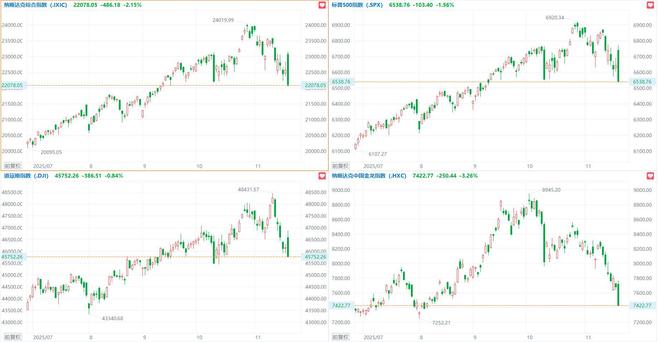
11月21日早盘,日韩股市早盘出现大幅下挫,此前隔夜的美国股市在大型科技股集体下跌下出现暴跌。 截至收盘,道琼斯指数跌0.84%,标普500指数跌1.56%,纳斯达克综合指数跌486.18点,跌幅2.15%。大 型科技股集体下挫,AMD跌超7%,甲骨文跌超6%,英伟达跌超3%,亚马逊跌逾2%,微软跌逾1%,特 斯拉跌超2%,谷歌跌超1%,苹果跌近1%,脸书跌0.19%。 导致美股上演"过山车"行情的背后,是美联储官员的鹰派言论和对AI高估值的担忧引发市场风险偏好回 落,这再度触发了美股大规模技术性抛售。 知名投资人、华尔街"大空头"迈克尔·伯里(Michael Burry)则在社交平台再度发文,抨击AI泡沫。他 表示:"下面列出的每家公司都存在可疑的收入确认问题。如果把所有交易都算进去,那图表简直难以 辨认。未来人们会把这看作是欺诈,而不是飞轮效应。真正的终端需求少得可怜,几乎所有客户都是靠 经销商出资的。" "认为芯片使用寿命更长(用于折旧)是因为3—4年前的芯片已被预订一空,这种想法混淆了物理利用 率和价值创造。仅仅因为某样东西被使用,并不意味着它就能盈利。"迈克尔·伯里写道。他举例称,通 用会计准则(G ...



The Chip CEO Staring Down Nvidia and Talk of an AI Bubble
WSJ· 2025-11-21 01:02
Core Insights - AMD's CEO Lisa Su has introduced a new chip aimed at capturing a significant share of the AI market, which is projected to reach $1 trillion annually [1] Company Developments - The new chip is part of AMD's strategy to enhance its position in the rapidly growing AI sector [1] - AMD is focusing on leveraging its technological advancements to compete effectively against rivals in the AI space [1] Industry Trends - The AI business is anticipated to grow substantially, with estimates suggesting it could reach $1 trillion per year [1] - Companies in the semiconductor industry are increasingly prioritizing AI capabilities to meet the rising demand for AI applications [1]
不降息?美联储最新!美股大跳水!
Zheng Quan Shi Bao· 2025-11-21 00:01
Group 1: Federal Reserve and Interest Rate Expectations - The expectation for a rate cut by the Federal Reserve in December has further decreased, with significant internal divisions among officials regarding the decision [1][4] - The CME "FedWatch" tool indicates a 29.8% probability of a 25 basis point rate cut in December, while the probability of maintaining the current rate is 70.2% [5] Group 2: Employment Data and Economic Indicators - The U.S. non-farm payroll report for September showed an increase of 119,000 jobs, significantly exceeding the expected 51,000, while the unemployment rate rose to 4.4%, the highest since October 2021 [3] - The Labor Department has decided to cancel the release of the October non-farm data and postpone the November report to December 16, limiting the Fed's access to recent employment data before the December meeting [3] Group 3: Market Reactions and Stock Performance - Major U.S. stock indices experienced declines, with the Nasdaq dropping 2.15% and the Nasdaq China Golden Dragon Index falling 3.26%, reflecting a broader downturn in Chinese concept stocks [1][2] - Large tech stocks also faced significant losses, with Nvidia down over 3%, AMD down over 7.8%, and Oracle down over 6%, indicating a negative sentiment in the tech sector [2]


纳指跌超2%,AMD跌超7%,英伟达跌3.1%,中国指数大跌3.26%
Xin Lang Cai Jing· 2025-11-20 22:29
Core Insights - Nvidia's strong earnings report failed to sustain market confidence, leading to a collective decline in major U.S. stock indices [1] Market Performance - The Dow Jones index fell by 0.84% - The S&P 500 index decreased by 1.56% - The Nasdaq Composite index dropped by 2.15% [1] Technology Sector - Major tech stocks experienced significant declines: - AMD fell over 7% - Oracle decreased by over 6% - Netflix and Nvidia both dropped over 3% - Tesla and Amazon fell over 2% - Microsoft declined by over 1% - Broadcom fell by 2.14% - Qualcomm decreased by 3.90% - Adobe dropped by 1.79% - Salesforce fell by 1.10% [1] Chinese Stocks - The Nasdaq Golden Dragon China Index declined by 3.26% - Notable declines among popular Chinese stocks: - Canadian Solar fell by 18.3% - Daqo New Energy dropped by 9.2% - NIO decreased by 6% - JinkoSolar fell by 5.7% - Other companies like Pony.ai, Xpeng, Xiaomi, Pinduoduo, and Baidu dropped over 4% - However, some stocks saw gains: - NetEase rose by 0.6% - Beike increased by 1.3% - GDS Holdings gained 1.8% - Yatsen Holding rose by 3.3% [1]


These Stocks Moved the Most Today: Nvidia, Exact Sciences, Walmart, AMD, Alphabet, Palo Alto Networks, and More



Barrons· 2025-11-20 21:23
Core Viewpoint - Stock futures increased following strong earnings from Nvidia and the release of delayed jobs data indicating U.S. hiring in September exceeded expectations [1] Group 1: Company Performance - Nvidia reported strong earnings, contributing to the rise in stock futures [1] - Other companies mentioned include Exact Sciences, Walmart, AMD, Palo Alto Networks, and Alphabet, indicating a broad market interest [1] Group 2: Economic Indicators - The delayed jobs data revealed that U.S. hiring in September outpaced expectations, which is a positive sign for the economy [1]