Boeing(BA)

Search documents
金价,大跌!原因找到了
Sou Hu Cai Jing· 2025-12-03 08:56
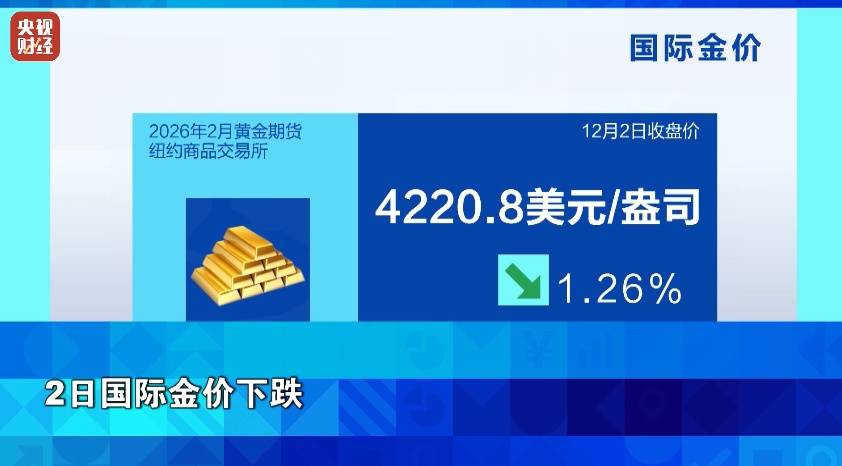
Group 1 - The market is focusing on the prospects of the Federal Reserve's interest rate cuts, with investor concerns about global financial market liquidity tightening easing [1] - Major U.S. stock indices closed higher, with the Dow Jones up 0.39%, S&P 500 up 0.25%, and Nasdaq up 0.59% [1] - Boeing executives indicated plans to gradually increase production, expecting to achieve positive cash flow of billions of dollars by 2026, which led to a 10.15% surge in Boeing's stock price [1] Group 2 - Gold prices fell over 1.2% as investors took profits ahead of key U.S. inflation data, with February gold futures closing at $4220.8 per ounce, down 1.26% [3] - European stock indices showed mixed results, with the Eurozone's November CPI rising 2.2%, slightly above expectations, influencing cautious trading [7] - The German stock market rose by 0.51%, while the UK and French markets saw slight declines of 0.01% and 0.28%, respectively [7] Group 3 - International oil prices declined due to expectations of a supply surplus in the global crude oil market, with January light crude futures closing at $58.64 per barrel, down 1.15% [9] - February Brent crude futures also fell, closing at $62.45 per barrel, down 1.14% [9]


The Boeing Company (BA) Presents at UBS Global Industrials and Transportation Conference - Slideshow (NYSE:BA) 2025-12-03
Seeking Alpha· 2025-12-03 07:34
To ensure this doesn’t happen in the future, please enable Javascript and cookies in your browser.If you have an ad-blocker enabled you may be blocked from proceeding. Please disable your ad-blocker and refresh. ...

Nasdaq Gains Over 100 Points: Investor Sentiment Declines, Fear & Greed Index In 'Extreme Fear' Zone
Benzinga· 2025-12-03 06:41
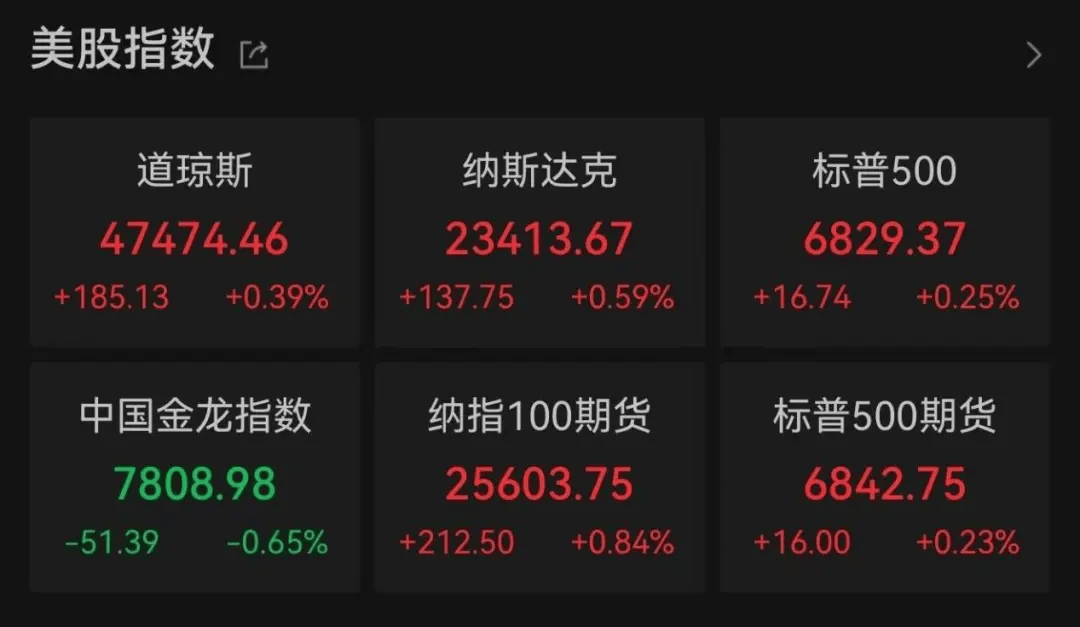
Market Overview - The CNN Money Fear and Greed index showed a slight increase in overall fear, remaining in the "Extreme Fear" zone with a reading of 24.4, down from 24.8 [5] - U.S. stocks experienced a modest rebound, with the Nasdaq Composite gaining over 100 points, as the global bond sell-off cooled [1] Company Performance - MongoDB Inc. reached an 18-month high after exceeding Street expectations, contributing to positive momentum in the broader chip sector [2] - Boeing Inc. had its best day since April, with the CFO projecting higher deliveries for the 737 and 787 models in 2026 and anticipating positive free cash flow next year, targeting "low single-digit billions" after a $2 billion burn in 2025 [2] Sector Performance - Most sectors on the S&P 500 closed negatively, with utilities, energy, and materials stocks experiencing the largest losses, while industrials and information technology stocks closed higher [3] - The Dow Jones Industrial Average increased by about 185 points to 47,474.46, the S&P 500 gained 0.25% to 6,829.37, and the Nasdaq Composite climbed 0.59% to 23,413.67 [3] Upcoming Earnings - Investors are anticipating earnings results from Dollar Tree Inc., Macy's Inc., and Salesforce Inc. [4]


美股三大指数集体收涨,英特尔涨超8%
Xin Lang Cai Jing· 2025-12-03 06:19
Core Points - The U.S. stock market indices collectively rose, with the Dow Jones up by 0.39%, Nasdaq up by 0.59%, and S&P 500 up by 0.25% on December 2 [1] - Intel saw a significant increase of 8.65%, while Apple rose over 1% and Nvidia nearly 1% [1] - Boeing experienced a notable surge of over 10%, marking its largest single-day increase since April, as the company anticipates a return to cash flow next year [1] Sector Performance - Semiconductor equipment and materials, along with cryptocurrency reserve concepts, led the gains, with Strategy and 康特科技 rising over 5%, ASML nearly 2%, and Coinbase over 1% [1] - Conversely, gold stocks and the energy sector declined, with U.S. energy stocks dropping over 5%, and companies like 金田 and 黄金资源 falling over 3% [1] - Major energy companies such as ExxonMobil and Chevron also saw declines of over 1% [1]

深夜,特朗普概念股多次熔断!下任美联储主席头号候选人曝光
Sou Hu Cai Jing· 2025-12-03 04:20
Market Performance - The three major U.S. stock indices experienced slight gains, with the S&P 500 up 0.25% to 6829.37 points, the Nasdaq Composite up 0.59% to 23413.67 points, and the Dow Jones Industrial Average up 0.39% to 47474.46 points [1][2] - The Philadelphia Semiconductor Index rose by 1.83%, with Intel surging over 8%, reaching a new high for the year [1][2] Sector Highlights - Semiconductor stocks generally saw an increase, with notable gains from NXP Semiconductors (over 7%) and Microchip Technology (over 6%) [2] - Boeing's stock rose over 10%, marking its largest single-day gain since April, following news that it could achieve a long-term cash flow target of $10 billion and that legal penalties from the U.S. Department of Justice may be delayed until 2026 [2] Chinese Stocks - Chinese stocks listed in the U.S. faced a downturn, with the Nasdaq Golden Dragon China Index falling by 0.65%. Key individual stocks like Xpeng and NIO saw declines of 7.92% and 2.9% respectively [3] Cryptocurrency Market - Bitcoin rebounded by 6%, leading to a recovery in related stocks, although American Bitcoin, considered a "Trump concept stock," experienced a significant drop of over 50% and triggered multiple trading halts due to volatility [4][5] Federal Reserve Leadership - Speculation regarding the next Federal Reserve Chair intensified, with Kevin Hassett being identified as the leading candidate to succeed Jerome Powell, whose term ends in May 2026. There are expectations of a 25 basis point rate cut in the upcoming December meeting due to a weak labor market [6][7]


US stocks rise on Fed rate cut optimism, Boeing jumps
The Economic Times· 2025-12-03 01:53
Market Overview - U.S. equities experienced a decline on Monday due to soft manufacturing data, rising U.S. Treasury yields, and a drop in bitcoin and crypto-related stocks, but recovered somewhat as bond yields eased and bitcoin rebounded [1][6] - The Dow Jones Industrial Average rose by 185.13 points (0.39%) to 47,474.46, the S&P 500 gained 16.74 points (0.25%) to 6,829.37, and the Nasdaq Composite increased by 137.75 points (0.59%) to 23,413.67 [8][9] Sector Performance - Boeing surged by 10.1%, significantly boosting the Dow, after forecasting higher deliveries for its 737 and 787 jets next year, contributing approximately 117 points to the index [8][9] - The technology sector rose by 0.8%, driven by gains in major companies such as Apple, Nvidia, and Microsoft, each up about 1%, while Intel shares saw a notable increase [5][9] Economic Indicators - Recent data indicates a gradually cooling economy, prompting policymakers to exercise caution regarding potential rate cuts, as inflation pressures could resurface [6][9] - Market expectations for a 25 basis point rate cut at the Federal Reserve's December meeting have surged to 89.2%, up from 63% a month ago, following comments from several Fed officials [6][9] Consumer Insights - Positive consumer sentiment was noted from Black Friday and Cyber Monday data, suggesting strength in consumer spending, which is viewed favorably compared to underlying market volatility [2][3] Cryptocurrency Market - Crypto stocks saw gains, with Strategy up 5.8% and Coinbase up 1.3%, as bitcoin prices rebounded after experiencing its largest dollar loss since May 2021 [7][9] Market Dynamics - Advancing issues outnumbered decliners by a 1.01-to-1 ratio on the NYSE, while on the Nasdaq, declining issues outnumbered advancers by a 1.07-to-1 ratio [8][9] - The S&P 500 recorded 11 new 52-week highs and three new lows, while the Nasdaq Composite noted 70 new highs and 100 new lows [8][9] - Trading volume on U.S. exchanges was 15.35 billion shares, below the 18.42 billion average over the last 20 trading days [8]


音频 | 格隆汇12.3盘前要点—港A美股你需要关注的大事都在这
Ge Long Hui A P P· 2025-12-03 01:08
Group 1 - The National Development and Reform Commission and other departments encourage local governments to utilize computing power vouchers, model vouchers, and data vouchers to provide convenience and discounts in computing power, algorithms, and data [1] - The Shanghai Cyberspace Administration has guided platforms like Xiaohongshu and Bilibili to self-check and clean up over 40,000 pieces of illegal and harmful information related to the real estate market [1] - Major US stock indices closed higher, with Intel rising over 8% and Boeing soaring over 10% [1] - WTI January crude oil futures fell over 1.14%, closing at $58.64 per barrel [1] - The US SEC chairman plans to introduce new capital market regulations in January to encourage more companies to go public [1] - Amazon has launched its latest AI chip, challenging Nvidia and Google [1] - The scale of US money market assets has surpassed $8 trillion for the first time [1] - The OECD has raised China's economic growth forecast for 2025 to 5% [1] Group 2 - A-share new account openings in November reached 2.38 million, a month-on-month increase of 3% but a year-on-year decrease of 12% [1] - Hong Kong's total value of residential sale and purchase agreements in November increased by 1.2% month-on-month but decreased by 9.8% year-on-year [1] - The order volume for effective drugs against influenza has surged nearly 9 times, indicating that the flu is at a moderate epidemic level nationwide [1] - Dragon Power Technology is communicating with customers regarding the reasons for the price increase of lithium iron phosphate [1] - Tianfu Communication's directors and executives plan to reduce their holdings by no more than 0.0611% of shares [1]




IIT placements bring startups into a hiring war with the bigwigs, who wins?
MINT· 2025-12-03 00:00
Core Insights - Startups are increasing salaries, bonuses, and employee stock options (Esops) to attract talent from Indian Institutes of Technology (IITs), but face challenges in securing top candidates as hiring shifts towards quality over quantity amid AI-driven productivity [1][20] Group 1: Competitive Landscape - Venture-backed startups like Razorpay, Fractal Analytics, Battery Smart, OYO, Navi, Meesho, and SpeakX are competing aggressively with tech giants such as Google, Microsoft, Amazon, and Nvidia for top engineering talent [2] - Startups are now sharing prime hiring slots with established firms and high-frequency trading companies, indicating a more assertive approach in recruitment [3] Group 2: Compensation Packages - Navi, co-founded by Flipkart's Sachin Bansal, is offering salaries between ₹38.2-45.2 lakh, along with bonuses and Esops [4] - Razorpay is expected to offer around ₹20 lakh in compensation, a ₹3 lakh joining bonus, and ₹20 lakh in Esops with a four-year vesting period [6] - Battery Smart is offering a total compensation of ₹25 lakh, including performance and joining bonuses, and Esops worth ₹7 lakh [11] Group 3: Hiring Trends and Challenges - SpeakX, despite offering competitive compensation, struggled to secure top candidates, indicating a preference among IIT students for established firms [7][8] - Interest in early-stage startups is reportedly higher at National Institutes of Technology (NITs) and Indian Institutes of Information Technology (IIITs) compared to IITs, suggesting differing risk appetites [9][20] Group 4: IPO Influence - The impending IPOs of companies like Razorpay, Fractal, OYO Rooms, and Meesho are being leveraged as incentives to attract talent, making their Esops appealing for quick wealth creation [20] - Companies are focusing on a well-rounded compensation package that includes fixed salary, performance-based incentives, and long-term value through Esops to attract top talent [13] Group 5: Student Preferences - Students are increasingly viewing Esops as a form of ownership in the company, although they need to understand the terms clearly, as many startup Esops require employees to buy shares before exercising them [17] - The trend indicates a growing interest in Esops among students, which is becoming a significant factor in their job choices [16]



英特尔涨超8%,特朗普概念股多次熔断,热门中概股下挫,小鹏跌近8%
2 1 Shi Ji Jing Ji Bao Dao· 2025-12-02 23:35
Market Overview - On December 2, U.S. stock indices experienced slight gains, with the Dow Jones up 0.39%, S&P 500 up 0.25%, and Nasdaq up 0.59% [1] - The Dow closed at 47,474.46, the Nasdaq at 23,413.67, and the S&P 500 at 6,829.37 [2] Technology Sector - The technology sector saw broad gains, with the Wande American Technology Index rising 0.61%. Notable performers included Apple, which rose over 1%, and Facebook, which increased nearly 1% [2] - Semiconductor stocks also performed well, with the Philadelphia Semiconductor Index up 1.83%. Intel surged over 8%, NXP Semiconductors rose more than 7%, and Microchip Technology increased over 6% [2] Boeing Company - Boeing's stock rose over 10%, marking its largest single-day gain since April. The company stated that achieving a long-term cash flow target of $10 billion is feasible and expects a decision from the U.S. Department of Justice to be delayed until 2026 [2][3] Cryptocurrency Market - Bitcoin rebounded by nearly 6%, reaching approximately $91,000, while Ethereum increased over 7%. This surge contributed to a broader recovery in cryptocurrency stocks [5][6] - However, American Bitcoin, a company associated with former President Trump, saw its stock plummet over 50%, leading to multiple trading halts due to volatility, ultimately closing down 38% [3] Chinese Stocks - Chinese stocks listed in the U.S. faced a downturn, with the Nasdaq Golden Dragon China Index falling 0.65%. Notable declines included XPeng down 7.92%, and other companies like NIO, Bilibili, and Alibaba also experiencing losses ranging from 1.91% to 6.15% [4] Commodity Market - In the commodities sector, international precious metals futures showed mixed results. COMEX gold futures fell 0.84% to $4,238.70 per ounce, while COMEX silver futures rose slightly by 0.01% to $59.15 per ounce [4] - Oil prices also declined, with U.S. crude oil futures down 1.23% to $58.59 per barrel, and Brent crude down 1.28% to $62.36 per barrel, influenced by an unexpected increase in U.S. API crude oil inventories by 2.48 million barrels [5]
全球市场早报|美股三大股指集体收涨,波音涨超10%
Sou Hu Cai Jing· 2025-12-02 23:30
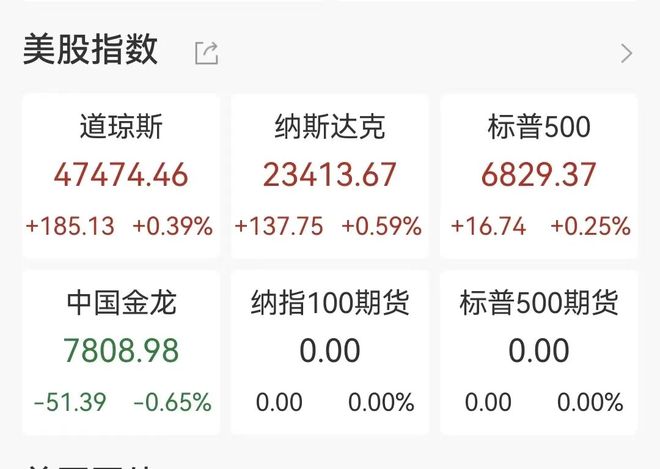
Market Performance - The Dow Jones Industrial Average rose by 185.13 points, closing at 47,474.46, an increase of 0.39% [1] - The Nasdaq Composite gained 137.75 points, ending at 23,413.67, up by 0.59% [1] - The S&P 500 index increased by 16.74 points, closing at 6,829.37, a rise of 0.25% [1] Sector Performance - Major technology stocks mostly increased, with Apple up over 1%, Facebook nearly 1%, Nvidia up 0.86%, Microsoft up 0.67%, Google up 0.29%, Amazon up 0.223%, while Tesla fell by 0.21% [1] - Energy stocks declined across the board, with ExxonMobil down over 1%, Chevron down more than 1%, ConocoPhillips down over 1%, Schlumberger down 0.7%, and Western Oil down nearly 1% [1] - Airline stocks collectively rose, with Boeing up over 10%, American Airlines up more than 2%, Delta Airlines up over 1%, Southwest Airlines up nearly 2%, and United Airlines up over 3% [1] - Semiconductor stocks mostly increased, with the Philadelphia Semiconductor Index rising by 1.83%, Intel up over 8%, NXP Semiconductors up more than 7%, Microchip Technology up over 6%, and Texas Instruments up over 4% [1] Chinese Stocks - The Nasdaq Golden Dragon China Index fell by 0.65%, with individual stocks like Xpeng Motors down nearly 8%, and Artis Solar down nearly 6% [2] - Some Chinese stocks saw gains, such as Wanwu Xingsheng up over 6%, Atour up more than 5%, and Tiger Brokers up nearly 2% [2] Economic Indicators - Recent data indicates a gradual cooling of the economy, with policymakers urging caution on interest rate cuts and warning of potential inflationary pressures [2] - The probability of a 25 basis point rate cut by the Federal Reserve in December has surged to 89.2% according to the Chicago Mercantile Exchange [2] European Market Performance - European stock indices showed mixed results, with the FTSE 100 in London down 0.01%, the CAC 40 in Paris down 0.28%, and the DAX in Frankfurt up 0.51% [2] Commodity Prices - International oil prices fell, with light crude oil futures for January 2026 down by $0.68, closing at $58.64 per barrel, a decrease of 1.15% [3] - Brent crude oil futures for February fell by $0.72, closing at $62.45 per barrel, a decline of 1.14% [3] Currency Exchange Rates - The US dollar index decreased by 0.06%, closing at 99.357 [3] - The euro traded at 1.1622 against the dollar, the pound at 1.3211, and the yen at 155.88 [3]