BABA(BABA)

Search documents
阿里巴巴-W早盘高开近4% 消息称其旗下芯片公司平头哥拟独立上市
Xin Lang Cai Jing· 2026-01-23 01:49
Core Viewpoint - Alibaba is preparing to advance the independent listing of its AI chip manufacturing subsidiary, T-Head, with plans for a restructuring that includes employee ownership, although the specific IPO timeline remains uncertain [1][4]. Group 1: Company Developments - Alibaba's stock opened nearly 4% higher and rose by 3.46% to HKD 170.50, with a trading volume of HKD 4.436 billion [1][4]. - T-Head, established in 2018, focuses on AI chips and RISC-V ecosystem technology, formed from the integration of acquired companies and internal teams [1][4]. - T-Head has launched several products, including the AI inference chip Han Guang 800, CPU Yitian 710, and AI chip PPU in the computing chip sector, as well as the SSD controller chip Zhen Yue 510 in the storage chip sector [1][4]. Group 2: Product Offerings - T-Head is reportedly planning to introduce additional networking chips and has established a comprehensive chip layout for data centers [1][4]. - The company has also launched the Yu Zhen IoT chip for edge computing, achieving shipments in the hundreds of millions, covering both cloud and terminal applications [1][4].


阿里巴巴高开近4%,据报旗下平头哥拟进行IPO
Ge Long Hui· 2026-01-23 01:47
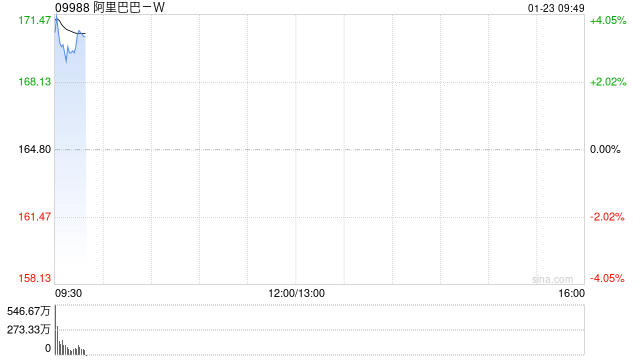
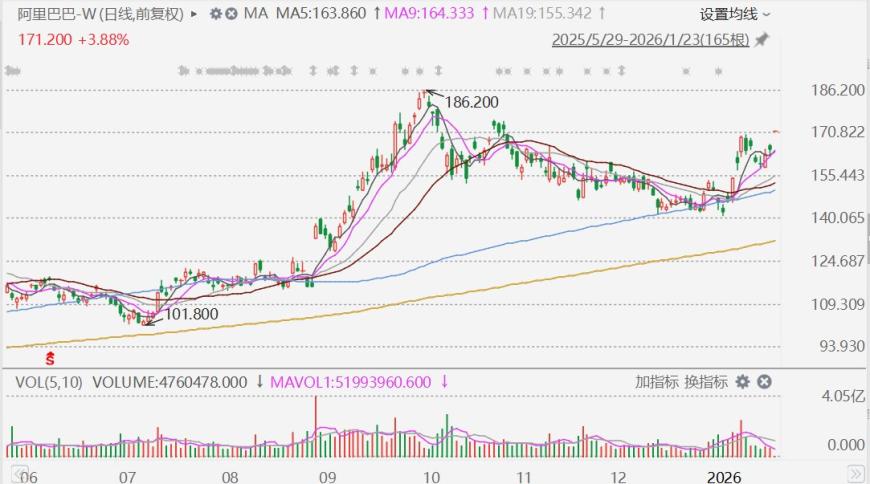
有消息称,阿里巴巴集团正准备推进旗下AI芯片子公司平头哥的独立上市。据悉,阿里巴巴将首先对平头哥的芯片业务进 行内部重组,将其改造成一个部分由员工持股的业务实体,随后再探索IPO的可能性。具体上市时间尚未确定,该行动仍处 于准备阶段。 1月23日,阿里巴巴-W(9988.HK)高开3.88%报171.2港元。隔夜美股市场阿里巴巴收涨5%报177.18美元,折算成港股市场价 格为173.2港元/股。 责任编辑:栎树 港股频道更多独家策划、专家专栏,免费查阅>> ...
恒生科技重回20日线!多因素共振,港股科技资产迎补涨
Mei Ri Jing Ji Xin Wen· 2026-01-23 01:43
Group 1 - The Hang Seng Tech Index has returned above the 20-day moving average, indicating a short-term bullish trend, with notable stock movements from major companies like Baidu, Alibaba, Bilibili, Kuaishou, SMIC, Hua Hong Semiconductor, and Li Auto [1] - Since October of last year, Hong Kong tech assets have been under pressure due to structural industry differences, negative impacts from delivery subsidies, and year-end liquidity constraints. However, these factors are expected to improve by 2026, driven by AI industry growth, a cycle of overseas interest rate cuts, foreign capital inflows, and the return of southbound funds, suggesting a potential rebound for undervalued Hong Kong tech stocks [1] - Year-to-date, southbound funds have seen a cumulative net inflow of nearly 68 billion HKD into the Hong Kong stock market. Looking ahead to 2026, domestic AI models like DeepSeek are expected to launch around the Chinese New Year, while major domestic companies are increasing capital expenditures to enhance overall model capabilities [1] Group 2 - The National Securities Hong Kong Stock Connect Technology Index includes biotech leaders such as BeiGene, Innovent Biologics, and WuXi Biologics, currently trading at a rolling P/E ratio of only 27 times, which is below the 50th percentile of the past decade, indicating significant mean reversion potential [2]


港股阿里巴巴高开近4%
Jin Rong Jie· 2026-01-23 01:37
本文源自:金融界AI电报 阿里巴巴-W(9988.HK)高开3.88%报171.2港元。隔夜美股市场阿里巴巴收涨5%报177.18美元,折算成港 股市场价格为173.2港元/股。 ...
港股异动丨阿里巴巴高开近4%,据报旗下平头哥拟进行IPO
Ge Long Hui· 2026-01-23 01:37
阿里巴巴-W(9988.HK)高开3.88%报171.2港元。隔夜美股市场阿里巴巴收涨5%报177.18美元,折算成港 股市场价格为173.2港元/股。有消息称,阿里巴巴集团正准备推进旗下AI芯片子公司平头哥的独立上 市。据悉,阿里巴巴将首先对平头哥的芯片业务进行内部重组,将其改造成一个部分由员工持股的业务 实体,随后再探索IPO的可能性。具体上市时间尚未确定,该行动仍处于准备阶段。 ...
阿里巴巴-W高开近4% 消息称其旗下芯片公司平头哥拟独立上市
Zhi Tong Cai Jing· 2026-01-23 01:31
Core Viewpoint - Alibaba is preparing to advance its AI chip manufacturing subsidiary, T-Head, towards an independent IPO, with plans for employee ownership integration, although the specific timeline for the IPO remains uncertain [1] Group 1: Company Developments - Alibaba's stock opened nearly 4% higher and is currently up 3.88%, trading at HKD 171.2, with a transaction volume of HKD 811 million [1] - T-Head, established in 2018, focuses on AI chips and RISC-V ecosystem technology, formed from the integration of acquired companies and internal teams [1] Group 2: Product Offerings - T-Head has launched several products in the computing chip sector, including the AI inference chip Lingang 800, CPU Yitian 710, and AI chip PPU [1] - In the storage chip sector, T-Head has introduced the SSD controller chip Zhenyue 510, and is reportedly set to release additional networking chips [1] - T-Head has also developed the Yuzhen IoT chip for edge computing, achieving shipments in the hundreds of millions, covering both cloud and terminal applications [1]
港股异动 | 阿里巴巴-W(09988)高开近4% 消息称其旗下芯片公司平头哥拟独立上市
智通财经网· 2026-01-23 01:28
Core Viewpoint - Alibaba is preparing to advance its AI chip manufacturing subsidiary, T-Head, towards an independent IPO, with plans for employee ownership integration, although the specific timeline for the IPO remains uncertain [1] Group 1: Company Developments - Alibaba's stock opened nearly 4% higher and is currently up 3.88%, trading at HKD 171.2, with a transaction volume of HKD 811 million [1] - T-Head, established in 2018, focuses on AI chips and RISC-V ecosystem technology, formed from the integration of acquired companies and internal teams [1] Group 2: Product Offerings - T-Head has launched several products in the computing chip sector, including the AI inference chip Lingang 800, CPU Yitian 710, and AI chip PPU [1] - In the storage chip sector, T-Head has introduced the SSD controller chip Zhenyue 510, and is reportedly set to release additional networking chips [1] - T-Head has also developed the Yuzhen IoT chip for edge computing, achieving shipments in the hundreds of millions, covering both cloud and terminal applications [1]
港股开盘:恒指涨0.87%、科指涨0.96%,商业航天、黄金及新消费概念股普涨,阿里巴巴涨近4%
Jin Rong Jie· 2026-01-23 01:28
Market Overview - The Hong Kong stock market opened higher on January 23, with the Hang Seng Index rising by 0.87% to 26,861.36 points, the Hang Seng Tech Index increasing by 0.96% to 5,817.51 points, and the National Enterprises Index up by 0.96% to 9,201.85 points [1] - Major technology stocks saw significant gains, with Alibaba up by 3.88%, JD Group up by 2.63%, Xiaomi up by 0.74%, NetEase up by 0.77%, Meituan up by 0.31%, Kuaishou up by 1.26%, and Bilibili up by 1.4% [1] - Commercial aerospace stocks opened high, with Yunda Holdings rising over 5%, while new consumption concept stocks mostly increased, with Pop Mart rising over 4% [1] - Gold stocks generally rose, with Chifeng Jilong Gold Mining up over 4% [1] Corporate News - Prudential (02378.HK) invested approximately $375 million to increase its stake in PAMB to 70%, focusing on traditional life insurance business in Malaysia [2] - Nanjing Panda Electronics (00553.HK) expects a net profit of between 10 million to 15 million yuan for 2025, marking a turnaround from losses [3] - Delta Electronics (00179.HK) reported a revenue of $2.726 billion for the nine months ending December 31, 2025, a decrease of approximately $4 million compared to the same period last fiscal year [3] - AsiaInfo Technologies (01675.HK) anticipates revenue of approximately 6.2 billion to 6.35 billion yuan for 2025, with profits expected between 70 million to 110 million yuan [3] - Minmetals Resources (01208.HK) projects a total copper production of 506,900 tons in 2025, representing a year-on-year increase of 27% [4] - Charoen Pokphand International (03839.HK) issued a profit warning, expecting a net profit of approximately $32 million for 2025 [5] - Fosun Pharma (02196.HK) plans to spin off its subsidiary Fosun Antengene and list it on the Hong Kong Stock Exchange [6] - Hisense Home Appliances (00921.HK) and its subsidiaries subscribed to a trust financial product worth 2.035 billion yuan [7] - Xiaomi Group (01810.HK) repurchased 5.7138 million shares for approximately HKD 201 million at prices ranging from HKD 34.92 to HKD 35.24 [8] - Sunny Optical Technology (02382.HK) repurchased 1.25 million shares for approximately HKD 79.26 million at prices between HKD 62.45 and HKD 63.85 [9] - Kuaishou (01024.HK) repurchased approximately 380,000 shares for about HKD 29.97 million at prices ranging from HKD 78.55 to HKD 79.15 [10] - Jiangsu Ninghu Expressway (00177.HK) saw its controlling shareholder increase holdings by 28.4 million H-shares from January 9 to 21, 2026 [11] - Kanglong Chemical (03759.HK) completed a placement of 58.4408 million shares, raising a net amount of HKD 1.319 billion [12] - Ying Tai Medical (01501.HK) completed a placement of 35.20 million shares, raising approximately HKD 884 million [12] Institutional Insights - Industrial Securities suggests that the Hong Kong stock market may continue to trend upwards, noting that the recent tightening of funds is easing, leading to continued inflows from domestic investors [13] - Credit Suisse indicates a recovery in Hong Kong property prices, with some new developments experiencing strong sales, predicting a continued upward trend in property prices, albeit at a moderate pace due to cooling interest rate expectations [13] - CITIC Securities believes that the white liquor industry is at a turning point, suggesting that the current adjustment phase may present a bottoming opportunity for capital market investments as the Spring Festival approaches [13]
阿里巴巴高开近4%,消息称旗下AI芯片子公司平头哥拟进行IPO
Xin Lang Cai Jing· 2026-01-23 01:27
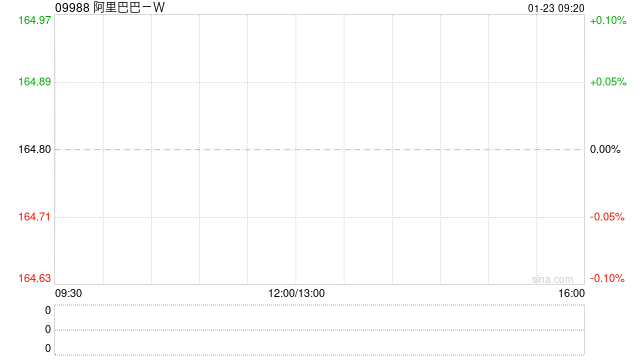
1月23日消息,阿里巴巴-W(9988.HK)高开3.88%报171.2港元,成交额逾8亿港元。隔夜美股市场阿里 巴巴收涨5%报177.18美元。 | 09988 阿里巴巴-W | | | | --- | --- | --- | | 171.200 + +6.400 +3.88% | | 一行升盘 01/23 09:20 | | * 2 × 5 × 9 × | | ● 快捷交易 | | 最高价 171.200 | 开盘价 171.200 | 成交量 476.05万 | | 最低价 171.200 | 昨收价 164.800 | 成交额 8.11亿 | | 平均价 170.352 | 市德图TM 23.80 | 总市值 3.27万亿 (m) | | 振 幅 -- | 市盈态(静) 23.31 | 总股本 190.99亿 | | 换手率 0.03% | 市净率 2.891 | 流通值 3.27万亿 | | 52周最高 186.200 | 委 比 -4.81% | 流通股 190.99亿 | | 52周最低 84.149 | 量 比 -- | 每 手 100股 | | 历史最高 304.852 | 股息TTM 1. ...
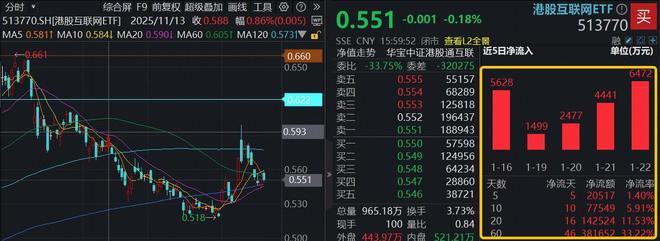
ETF盘前资讯|中概股大涨,阿里巴巴涨超5%,平头哥拟独立上市!港股互联网ETF(513770)低位揽金,逾14亿巨资进场
Jin Rong Jie· 2026-01-23 01:23
Group 1 - The market sentiment has improved significantly due to the easing of overseas geopolitical conflicts and trade friction, with US stocks rising and Chinese concept stocks performing well, particularly the Nasdaq China Golden Dragon Index which increased by 1.58% [1] - Alibaba has decided to support its subsidiary, Pingtouge, in pursuing an independent IPO, which is expected to have significant implications for both Alibaba and the Chinese semiconductor industry [1] - The Hong Kong stock market has shown volatility, with the Hong Kong Internet ETF (513770) experiencing a slight decline of 0.18%, but it has seen a net inflow of 1.425 billion yuan over the past 20 days, indicating strong buying interest [1] Group 2 - The commercialization of AI applications is accelerating, with Hong Kong internet stocks positioned as core beneficiaries, expected to receive ongoing catalysts [3] - Alibaba's Qianwen has integrated into the Taobao ecosystem to create a one-stop AI service application, while Kuaishou's AI model has surpassed 12 million active users, and Meituan has upgraded its app with AI search capabilities [3] - Analysts suggest that AI applications will become a core theme in the 2026 market, with a focus on internet platform companies that have traffic entry advantages [3] Group 3 - The Hong Kong Internet ETF (513770) tracks the CSI Hong Kong Internet Index, with Alibaba-W being the largest weighted stock at 14.71%, and the top ten weighted stocks collectively accounting for nearly 77% of the index [3][5] - For investors looking to reduce volatility while still gaining exposure to technology, the Hong Kong Large Cap 30 ETF (520560) is recommended, which combines high-growth tech stocks with stable dividend-paying companies [5]