BMW(BMWYY)

Search documents
聚焦中国用户需求!宝马携手Momenta,联合开发新一代智能驾驶辅助解决方案
Mei Ri Jing Ji Xin Wen· 2025-07-15 04:16
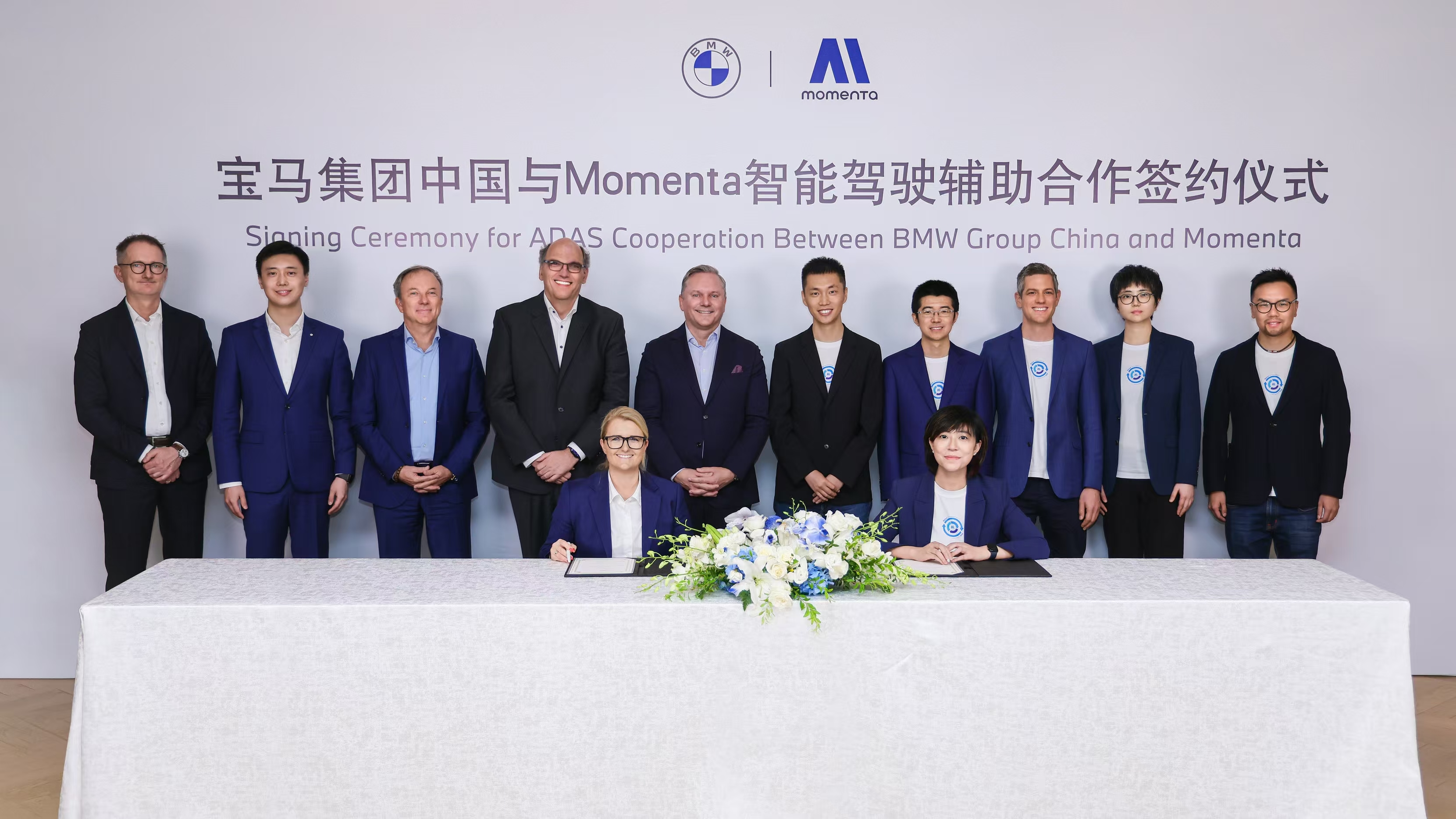
Core Insights - BMW Group announced a partnership with Chinese tech company Momenta to develop a new generation of intelligent driving assistance solutions tailored for the Chinese market [1][4] - The collaboration will focus on creating a locally developed driving assistance system that addresses specific Chinese travel scenarios and user needs [4][5] Group 1: Partnership and Development - The partnership aims to leverage BMW's new generation vehicle architecture and hardware platform to create AI-driven driving assistance software [1][4] - The new system will provide comprehensive point-to-point navigation assistance, covering both highways and urban roads, allowing for seamless cross-city travel [4][5] - The technology will utilize an integrated architecture driven by AI large models, enhancing the vehicle's ability to understand complex road conditions and make decisions similar to human drivers [4][6] Group 2: Safety and Compliance - BMW's development philosophy emphasizes safety, symbiotic driving, and smart technology, with a strong focus on safety as the primary requirement for driving assistance technology [6] - The new system will incorporate over 20 years of BMW's safety technology experience, establishing comprehensive safety redundancies and risk response mechanisms [6] - The collaboration will ensure compliance with Chinese laws and regulations regarding data security and user privacy throughout the data collection, storage, and usage processes [6] Group 3: Corporate Responsibility and Innovation - BMW is committed to social responsibility and sustainable development, as evidenced by its support for cultural heritage projects in China [6][7] - The "BMW China Cultural Journey" initiative aims to protect and promote cultural heritage along the Grand Canal, showcasing BMW's long-term commitment to corporate social responsibility [7][9] - The company emphasizes that innovation and responsibility can coexist, driving both commercial success and social accountability [9]

X @Bloomberg
Bloomberg· 2025-07-15 04:08
BMW executives will likely face tough questions this week about worsening sales in China and the impact of global trade tensions when they sit down with investors and analysts in Munich. https://t.co/4qHg2wTBQ0 ...
宝马与Momenta官宣合作 决心扎根中国市场
Xin Lang Cai Jing· 2025-07-15 03:36
Core Viewpoint - BMW has officially announced a partnership with Chinese tech company Momenta to jointly develop a new generation of intelligent driving assistance solutions tailored for the Chinese market, leveraging both companies' strengths in artificial intelligence and automotive engineering [1][3]. Group 1: Partnership Details - The collaboration aims to create intelligent driving assistance products that integrate German automotive excellence with cutting-edge AI capabilities, enhancing user safety, convenience, and efficiency in future mobility [5][6]. - The new driving assistance solution is specifically designed for the Chinese market, supporting full-scenario, point-to-point navigation assistance, and future capabilities for cross-city traffic management, including parking [8]. Group 2: Technological Integration - BMW's new generation models will feature a "super brain" that integrates power and chassis domains with a response delay of less than one millisecond and a tenfold increase in information processing speed, complementing the local intelligent driving assistance solutions [10]. - The partnership reflects BMW's commitment to deep integration of global technology with local demands, showcasing a forward-looking vision of leading the intelligent driving trend through localized innovation [11].
宝马与Momenta达成战略合作 开发面向中国市场的智驾解决方案
Feng Huang Wang· 2025-07-15 03:17
Core Viewpoint - BMW Group has announced a strategic partnership with Chinese autonomous driving technology company Momenta to develop intelligent driving assistance solutions tailored for the Chinese market, marking a new phase in BMW's smart driving strategy in China [1][2]. Group 1: Partnership Details - The collaboration will focus on developing AI-driven driving assistance software based on the intelligent architecture and hardware platform of BMW's new generation of domestically produced vehicles [1]. - The new solution will utilize an end-to-end large model technology architecture, integrating large-scale neural networks for environment perception, path planning, and vehicle control [1][2]. - The system aims to provide comprehensive point-to-point navigation assistance, covering both highways and urban roads, supporting full intelligent driving assistance from parking to destination [1]. Group 2: Technological Advancements - The AI large model solution offers self-learning and continuous optimization capabilities, allowing for remote upgrades and iterative evolution of vehicle software algorithms throughout the product lifecycle [1][2]. - The new system will incorporate over 20 years of BMW's experience in driving assistance technology, establishing comprehensive safety redundancies and risk response mechanisms [2]. Group 3: Strategic Significance - This partnership reflects the trend of localization and innovation among multinational automotive companies in the Chinese market, aligning with BMW's strategy of "innovating in China, for China, with Chinese speed" [2][3]. - The collaboration expands BMW's cooperation with Chinese tech companies from digital ecosystems and AI interaction to core intelligent driving technologies, showcasing the depth of its digital transformation strategy in China [3]. - This model may serve as a reference for other multinational automotive companies seeking localized innovation in the Chinese market and highlights the rising status of Chinese intelligent driving technology companies within the global automotive supply chain [3].
宝马集团:与Momenta签署协议,共同开发为中国定制的驾驶辅助系统。
news flash· 2025-07-15 02:41
Core Viewpoint - BMW Group has signed an agreement with Momenta to jointly develop a driving assistance system tailored for the Chinese market [1] Group 1 - The collaboration aims to leverage Momenta's expertise in artificial intelligence and autonomous driving technology [1] - The driving assistance system is expected to enhance safety and convenience for drivers in China [1] - This partnership reflects BMW's commitment to expanding its presence in the rapidly growing Chinese automotive market [1]
宝马敲定智驾合作方,新世代车型将搭载 Momenta 方案
Tai Mei Ti A P P· 2025-07-15 02:38
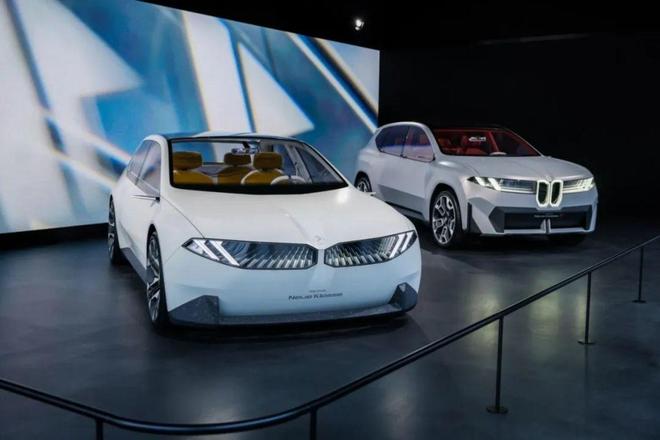
Group 1 - BMW has selected Momenta as its Chinese technology partner for advanced driver assistance systems (ADAS) in its next-generation electric vehicles [1][2] - The new generation iX3 is set to begin production in Hungary this year, with a launch in Europe by the end of the year, while the Chinese market will see the introduction of the new i3 and iX3 models next year [1][6] - Momenta's solutions will include point-to-point navigation assistance covering urban and highway scenarios, leveraging its self-developed end-to-end model [1][2] Group 2 - The competitive landscape in China is intense, with other luxury brands like Mercedes-Benz and Audi also collaborating with local suppliers for smart driving solutions [2][3] - Mercedes-Benz has announced its partnership with Momenta ahead of BMW, with the new CLA model expected to launch in China in Q4 of this year [2][3] - Momenta has been chosen by multiple joint venture and foreign car manufacturers, indicating its strong position in the market [2][3] Group 3 - BMW emphasizes safety in its ADAS offerings, with a focus on verified technologies rather than untested innovations [3][4] - The company aims to maintain a distinct driving experience even with AI-driven systems, integrating its "Heart of joy" system to enhance driving pleasure [3][4] - The collaboration with Momenta is seen as a way to adapt to the Chinese market and improve technological iteration efficiency [5][6] Group 4 - BMW's new generation vehicles will feature a centralized electronic architecture, allowing for better integration of smart solutions and higher communication bandwidth [6][7] - The company plans to introduce a range of hybrid models based on the new generation products to compete in the large SUV market [7] - BMW's R&D investment for 2024 is projected at €9.1 billion, a 17.1% increase, primarily directed towards electrification and smart technology [8]
宝马中国,重磅宣布!
第一财经· 2025-07-15 02:34
Core Viewpoint - BMW China has announced a partnership with Momenta to focus on intelligent driving assistance, aiming to create a China-specific solution based on a flywheel large model [1] Group 1 - The collaboration will target intelligent driving assistance solutions applicable to multiple vehicle models, including the domestically produced new generation [1] - The solution will cover both highway and urban road scenarios [1]
宝马携手Momenta共研中国专属智能驾驶辅助系统 跻身智能驾驶体验第一梯队
news flash· 2025-07-15 02:31
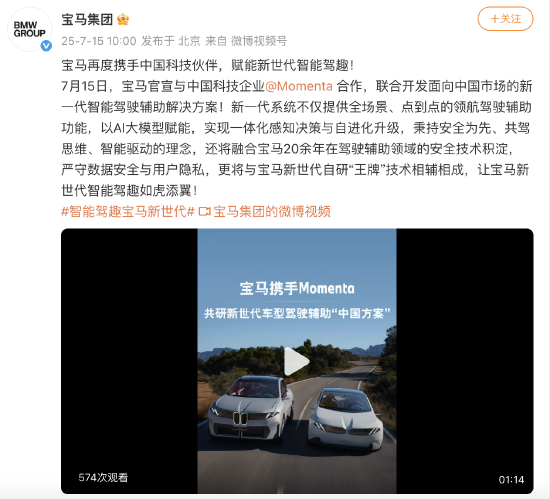
智通财经7月15日电,宝马宣布与Momenta达成合作,基于国产新世代车型的智能架构和硬件平台,聚 焦智能驾驶辅助前沿领域,开发基于AI大模型的驾驶辅助功能软件,并进行持续优化与测试验证。此 套全新"中国本土智能驾驶辅助方案"将在设计上融入宝马20余年来在驾驶辅助领域的安全技术积淀,提 供安全机制完备的全场景、点到点的领航驾驶辅助功能。方案将应用于包含国产新世代在内的多款车 型,覆盖多个细分市场,加持宝马新世代自研"王牌"技术,新世代智能驾趣如虎添翼。 宝马携手Momenta共研中国专属智能驾驶辅助系统 跻身智能驾驶体验第一梯队 ...
宝马与Momenta达成合作,将推出中国专属高阶辅助驾驶
Xin Lang Ke Ji· 2025-07-15 02:16
Group 1 - BMW has partnered with Momenta to develop AI-based driving assistance software for various domestic models, including the new generation vehicles [1][2] - The driving assistance solution is specifically designed for the Chinese market, supporting full-scenario, point-to-point navigation assistance, enabling cross-city travel from parking to destination [1] - The new system will integrate over 20 years of BMW's safety technology in driving assistance, emphasizing safety, co-driving philosophy, and intelligent driving while ensuring data security and user privacy [1] Group 2 - The bidding for the driving assistance project will begin in early 2025, with several domestic smart driving technology companies participating, including leading firms like Qingtian Zhihang and Yuanrong Qihang [2] - Momenta, established in 2016, won the bid and has been involved in mass production of driving assistance and autonomous robotaxi, collaborating with over ten global automakers and producing more than 100 mass-produced models [2]
中国汽车市场一周行业信息快报——2025年7月第2期
Zhong Guo Zhi Liang Xin Wen Wang· 2025-07-14 08:02
Group 1: Industry Developments - The National Development and Reform Commission and three other departments issued a notice promoting the open access of self-built high-power charging facilities by new energy vehicle companies, aiming for over 100,000 high-power charging stations nationwide by the end of 2027 [2] - The Ministry of Industry and Information Technology launched an online feedback window for key automotive enterprises to address issues related to payment cycles for small and medium-sized enterprises, aiming to enhance payment practices in the automotive industry [12] Group 2: Company Announcements - BMW Group introduced a comprehensive intelligent driving solution with the new BMW iX3, focusing on the integration of intelligent interaction, vehicle control, and driving assistance systems [3][5] - BYD announced full coverage for safety and losses related to its "Heavenly Eye" vehicles in smart parking scenarios, allowing users to directly contact BYD for assistance without going through insurance [13] - Lantu officially launched the Lantu FREE+ SUV, priced from 219,900 yuan, featuring a new design and equipped with Huawei's advanced driving and smart cabin systems [16][18] Group 3: New Vehicle Launches - The Chery Fengyun A9L was officially launched with a price range of 149,900 to 207,900 yuan, featuring a lifetime warranty and multiple safety features [9][11] - The new Enjoy brand vehicle, Enjoy S9T, is set to launch in the fall, expanding the product lineup of the brand [6][8]