Alphabet(GOOG)

Search documents
硅谷狂投万亿美元,黄仁勋火上浇油:现在不烧,更待何时
3 6 Ke· 2026-02-08 09:04
2026年刚刚走过一个月,中国都还没有迎来农历新年,这一年的AI战事会是什么基调已经初现端倪。 随着硅谷巨头进入财报周,很明显的信号是新的一年AI投入会加大,光是谷歌母公司Alphabet、Meta、亚马逊、微软四家的相关投入就可能 高达6500亿美元,超过以色列一年的GDP总和。 更不要说甲骨文、特斯拉、xAI、OpenAI、Anthropic等玩家也在努力奋进,零零总总加起来,2026年这些公司围绕AI的投入可能要达到7500 亿美元了。 更不要提OpenAI还有"八年1.4万亿"的基建承诺,若按照平均值粗略计算进去,这个数字冲着万亿美元去了。 这实在是疯狂。 而在国内,大厂的支出虽然不像硅谷"七巨头"那样夸张,但同样可以看到保持或加大AI投入的决心。头部大厂一年的投入也已经来到了千亿 人民币的水平。 最明显的是,距离春节还有几天,腾讯、百度、阿里等大厂就已经迫不及待打起"春节AI红包大战",承诺的规模已经超过了45亿元。 2026年,注定是AI战事大开大合的一年。 硅谷狂投9250亿美元 硅谷巨头已经"疯"了。 在硅谷"七巨头"中,谷歌母公司Alphabet、微软、Meta、亚马逊四家2026年计划给A ...





狂砸7000亿美元,美国科技巨头加码投资AI引担忧:资源都被抢了
Guan Cha Zhe Wang· 2026-02-08 08:08
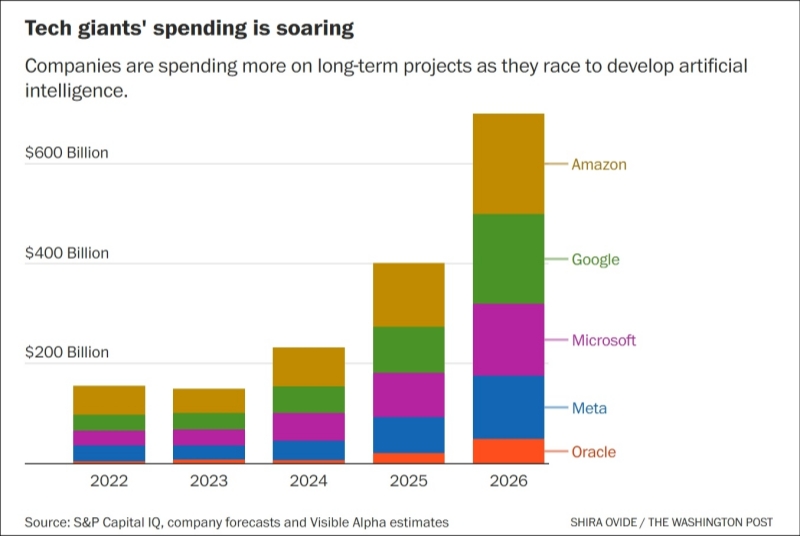
Core Insights - The unprecedented surge in AI investment by five major tech companies in the U.S. is projected to reach nearly $700 billion by 2026, raising concerns among experts and investors about resource allocation in other economic sectors [1][3][5] Group 1: Investment Trends - The five tech giants, including Amazon, Google, Microsoft, Meta, and Oracle, are expected to invest approximately $700 billion in large-scale AI projects this year, nearly doubling last year's spending [1][3] - The tech industry must generate an additional $650 billion in revenue annually to achieve reasonable returns on AI investments, a figure that may have increased with rising AI expenditures [3][4] Group 2: Economic Impact - The massive capital expenditures in AI are causing resource shortages in other sectors, leading to difficulties in finding skilled labor for construction projects and potentially increasing prices for consumer electronics [5][6] - The construction of AI data centers is consuming significant chip production capacity, which is expected to drive up prices for smartphones and computers by at least 5% later this year [5][6] Group 3: Labor Market Challenges - The construction industry is facing a shortage of skilled workers, with nearly 500,000 workers expected to be lacking next year, exacerbated by the demand for AI data center construction [9][10] - The focus on AI projects is diverting attention and resources away from other sectors, potentially stifling innovation and economic vitality in non-AI-dependent industries [10][11]


硅谷不相信忠诚!AI行业玩成NBA,科学家爽拿“转会费”
量子位· 2026-02-08 07:11
Core Viewpoint - The loyalty of employees in Silicon Valley has diminished, with significant "acqui-hire" events occurring, indicating a shift towards a "mercenary" culture in the tech industry [1][3]. Group 1: Major Acqui-Hire Events - In June 2025, Meta invested $14.3 billion to acquire Alexandr Wang from Scale AI [1]. - In July 2025, Google spent $2.4 billion to acquire technology from Windsurf, bringing in its founder Varun Mohan and research team into DeepMind [1]. - In December 2025, NVIDIA reached a $20 billion agreement with Groq to acquire its core inference technology and CEO Jonathan Ross along with key executives [1]. Group 2: Talent Mobility and Motivations - Talent mobility is categorized into "voluntary" and "involuntary" job changes, with motivations including high salaries, access to cutting-edge resources, and the pursuit of promising technologies [4]. - The trend of researchers moving from Google to OpenAI began in early 2023, with at least five Google Brain researchers joining OpenAI before the launch of ChatGPT [6][7]. Group 3: High Salaries and Recruitment Strategies - Meta's aggressive recruitment strategy included a compensation package of up to $300 million over four years, with the first year's salary exceeding $100 million [15]. - The competition for AI talent has led to a "mercenary culture," where employees prioritize financial incentives over loyalty to their companies [23][24]. Group 4: Acqui-Hire as a Strategy - Acqui-hire has become a popular strategy among Silicon Valley giants, allowing companies to acquire talent without the complexities of full mergers [40]. - The case of Google acquiring Windsurf illustrates the potential fallout from such strategies, as remaining employees felt abandoned and betrayed [44]. Group 5: Cultural Shifts in the Tech Industry - A cultural shift is occurring in the tech industry, where employees are increasingly wary of long-term commitments to a single company, driven by rapid technological advancements [54][57]. - The speed of innovation in AI means that working for a startup can yield experience equivalent to several years in traditional tech roles [57]. Group 6: Domestic Talent Wars - The competition for AI talent is not limited to Silicon Valley; domestic companies are also aggressively recruiting from top labs, with Tencent and ByteDance making significant hires from OpenAI and Google DeepMind [60][62]. Group 7: The Value of AI Talent - The scarcity of top AI talent makes them a strategic asset for companies, with the potential to significantly impact model training costs and performance [64].


四大科技巨头今年欲砸6500亿美元加码AI,分析师:别为AGI“倾家荡产”
Di Yi Cai Jing· 2026-02-08 06:49
美国科技巨头大举"撒钱"的举动正令资本市场感到忧虑。 上周,在亚马逊宣布计划向人工智能(AI)及相关基础设施领域注资2000亿美元后,股价于6日早盘应 声下跌近9%。然而,市场的冷静反应并未浇灭这场AI投资热潮。根据谷歌、微软、亚马逊和Meta在近 日披露的最新资本支出计划,这四大科技巨头在2026年的开支总额预计将高达约6500亿美元。 在理论定义中,AGI被视为AI的终极状态,意味着系统能在会计、法律等多个白领专业领域达到并取代 人类的智力水平。 而驱动这些巨头"不计成本"投入的核心逻辑,很大程度上寄希望于通用人工智能(AGI)的实现,以及 随之而来的数万亿美元潜在回报。正如硅谷风投机构红杉资本(Sequoia Capital)合伙人卡恩(David Cahn)所言:"唯有AGI的实现,才能证成未来十年这一量级的投资提案。" 然而,业内对AGI实现路径正涌现出越来越多的怀疑。彭博行业研究高级中国科技分析师罗伯特·李 (Robert Lea)在接受第一财经记者采访时表示,鉴于当代AI模型存在根本性的逻辑缺陷且方法论较为 单一,仅仅通过扩展现有模型,即行业目前盛行的做法,不太可能实现AGI。 模式识别并非真智 ...
计算机周观察20260208:AI军备竞赛持续升级,关注高壁垒软件及云服务
CMS· 2026-02-08 06:42
证券研究报告 | 行业定期报告 2026 年 02 月 08 日 AI 军备竞赛持续升级,关注高壁垒软件及云服务 计算机周观察 20260208 TMT 及中小盘/计算机 海外互联网大厂发布季报,资本开支持续超预期。过去一周,微软、META、 亚马逊、谷歌等海外科技大厂先后发布季度财报,四家公司明确表示将持续扩 大 AI 领域的相关投资。SaaS 商业模式遭受质疑,关注高壁垒软件及云服务。 ❑ 亚马逊 AWS 超预期大增,资本开支持续扩大影响自由现金流。亚马逊 25 财 推荐(维持) 行业规模 | | | 占比% | | --- | --- | --- | | 股票家数(只) | 285 | 5.5 | | 总市值(十亿元) | | 3.8 | | 流通市值(十亿元) | | 3.8 | 行业指数 % 1m 6m 12m 绝对表现 2.2 8.8 26.8 相对表现 5.3 -4.1 6.0 资料来源:公司数据、招商证券 -30 -20 -10 0 10 20 30 40 Feb/25 May/25 Sep/25 Jan/26 (%) 计算机 沪深300 相关报告 1、《板块配置进一步下降,服务器、 智驾获机 ...
大手笔AI投资之后:亚马逊、谷歌、Meta要花光现金流了?
Hua Er Jie Jian Wen· 2026-02-08 05:23
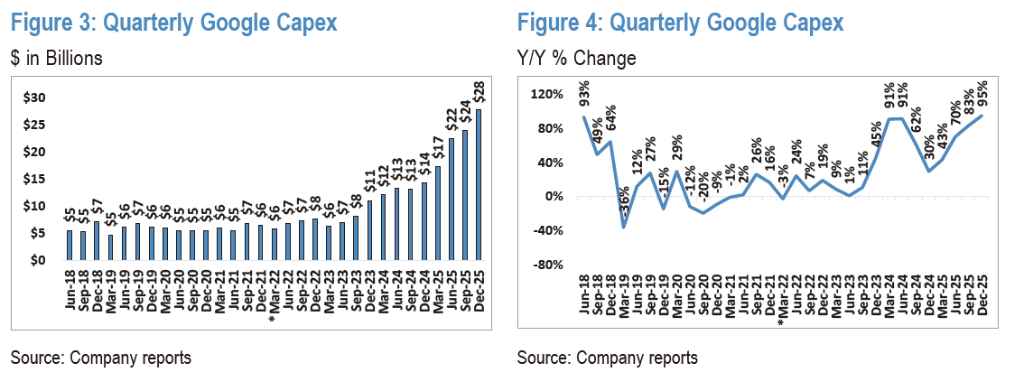
Group 1 - The core point of the article highlights a concerning turning point for investors as major tech companies like Amazon, Google, and Meta face the risk of depleting or even overdrawing their free cash flow to support AI infrastructure demands [1][24]. - According to a Morgan Stanley report, total capital expenditures for the four major cloud giants—Amazon, Google, Meta, and Microsoft—are expected to reach $645 billion in 2026, a staggering 56% increase year-over-year, with an additional $230 billion in spending [1]. Group 2 - Google is aggressively increasing its capital expenditures, with guidance raised to $175 billion to $185 billion for 2026, reflecting a 97% year-over-year growth as funds are directed towards servers and technological infrastructure [2]. - Amazon's capital expenditure guidance for 2026 is approximately $200 billion, a 52% increase, but its operating cash flow is projected to be around $178 billion, indicating a cash burn situation where expenditures exceed cash inflow [7][12]. - Meta's capital expenditures are expected to grow by 75% to between $115 billion and $135 billion in 2026, which will nearly eliminate its free cash flow, straining its previously robust financial position [12]. Group 3 - As cash flow diminishes, shareholder return plans are under pressure, with major tech companies likely to adjust their stock buyback strategies. Amazon has not engaged in stock buybacks since 2022 and is unlikely to restart them due to cash deficits [17]. - Microsoft, despite a projected capital expenditure exceeding $103 billion (over 60% growth), is expected to generate around $66 billion in free cash flow, allowing it to cover its substantial expenditures while facing higher dividend commitments [17]. Group 4 - Investors are cautioned to be vigilant about balance sheets in 2026, as the situation mirrors the "Oracle trap," where excessive debt to fund infrastructure led to a significant drop in stock price [20][23]. - The article emphasizes that the $645 billion expenditure is a critical juncture for Silicon Valley giants, as failure to convert this investment into tangible revenue growth could lead to a cash flow crisis in 2026, marking the beginning of a valuation restructuring [24].
豪赌!四家巨头狂砸4.6万亿押注AI!“没有一家愿意输!”黄仁勋力挺:AI需求火爆,庞大支出合理、可持续
雪球· 2026-02-08 05:04
Group 1 - The core viewpoint of the article is that major tech companies are significantly increasing their capital expenditures on AI infrastructure, with a total expected spending of $660 billion (approximately 4.58 trillion RMB) this year, which is a 60% increase compared to 2025 and more than double the spending of 2024 [4][5] - Companies like Amazon, Google, Meta, and Microsoft are leading this investment trend, with Amazon projected to spend $200 billion by 2026, exceeding analyst expectations by 38% [5] - The competition among these tech giants has shifted from business operations to a focus on the underlying computational power needed for AI, indicating a strategic pivot in the industry [5][6] Group 2 - The massive capital expenditures have raised concerns about the financial performance of these companies, leading to a collective decline in their stock prices, with Google, Microsoft, Amazon, and Meta experiencing drops of 4.48%, 6.77%, 12.11%, and 7.68% respectively [8] - Analysts predict that these high capital expenditures may negatively impact free cash flow, with forecasts indicating Amazon's free cash flow could be -$17 billion by 2026 and Alphabet's could plummet nearly 90% this year [10] - The market sentiment has shifted rapidly from fear of missing out (FOMO) to a defensive stance against tail risks, reflecting growing concerns over the sustainability of such high spending [8] Group 3 - NVIDIA's CEO Jensen Huang supports the substantial investment in AI infrastructure, describing it as reasonable and sustainable, driven by high demand for computational power [12][15] - Huang emphasizes that as long as companies continue to profit from AI, they will keep increasing their investments, highlighting the potential for ongoing growth in the sector [15] - He notes that this investment wave represents one of the largest infrastructure builds in human history, driven by the needs of AI companies and large-scale enterprises [15]

景林、但斌,大举买入谷歌!
Zhong Guo Zheng Quan Bao· 2026-02-08 04:37
继伯克希尔出手押注谷歌后,私募巨头景林和但斌旗下东方港湾都大举加仓谷歌。 东方港湾董事长但斌近日公开表示看好AI应用。他表示,如果说2025年是人工智能的起步蓄力阶段,那么2026年很可能成为AI应用万马奔腾的一年, (各类创新)此起彼伏。 谷歌成为景林在美第一大重仓股 当地时间2月6日,私募巨头景林资产的海外主体景林资产管理香港有限公司,向美国证券交易委员会(SEC)提交了截至2025年末的美股持仓数据。 2025年第四季度,景林香港公司大举增持谷歌-A(GOOGL)近93万股,使其成为新的第一大重仓股,季末持仓市值达到8.42亿美元,仓位占比超20%; 同时大幅减持英伟达154万股,减持Meta约23万股。 景林香港公司2025年第四季度主要持仓变动 图片来源:WhaleWisdom.com 增减持方面,除谷歌之外,景林香港公司还在2025年四季度增持了拼多多、富途控股、英特尔、华住集团等股票,新建仓博通;除减持英伟达、Meta之 外,景林香港公司还在2025年四季度减持了贝壳、联合健康、台积电等股票。 伯克希尔、但斌都重金买入谷歌 | BY CHANGE IN % PORTFOLIO | BY I | ...

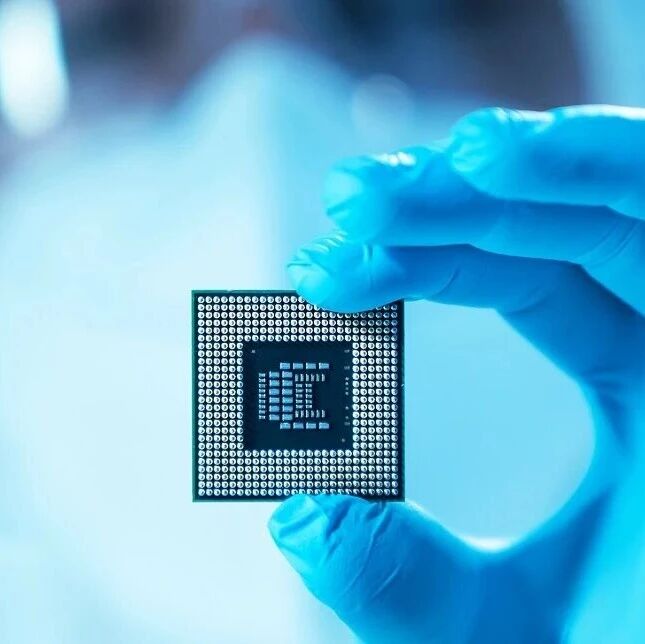
ASIC发力,GPU地位松动
半导体行业观察· 2026-02-08 03:29
Core Insights - The effectiveness and cost structure of AI are determined not just by general-purpose GPUs but by the ability to create application-specific integrated circuits (ASICs) tailored for specific workloads [2][3] - The demand for ASICs is surging as AI model scales and application scenarios expand, making them a critical component in AI infrastructure [2][3] ASIC Reshaping the Computing Landscape - ASICs offer a significantly better performance-to-power ratio and long-term cost advantages compared to general-purpose chips due to their highly customized hardware design [3] - By 2027, global shipments of AI server ASICs are expected to triple compared to 2024, with shipments surpassing 15 million units by 2028, exceeding those of data center GPUs [3][4] Market Dynamics and Competitive Landscape - Google’s TPU v7e has entered mass production, while Microsoft’s Maia series and Meta’s MTIA are being deployed at scale, indicating a significant growth in shipments by 2027 [4] - Taiwanese ASIC companies are transitioning from passive design contractors to core partners in system co-design, which is crucial for the success of complex AI ASIC projects [4] - Broadcom is currently the preferred supplier for cloud AI ASICs but faces increasing competition from emerging players, particularly a strategic alliance between Google and MediaTek [4]

200亿元,全国社保基金再落一子 | 融中投融资周报
Sou Hu Cai Jing· 2026-02-08 02:54
Group 1 - The Hubei Social Security Science and Technology Equity Investment Fund has been established with an initial scale of 20 billion yuan, focusing on industries such as optoelectronic information, automotive manufacturing, and life health in Hubei [2] - The Jiading Future Industry Fund, with a total scale of 800 million yuan, aims to support early-stage investments in disruptive technologies across five core sectors [2] - The Guangdong Hengjian Investment Holding Company has launched the Nanyue Green Beauty Ecological Investment Fund, the first provincial-level government investment fund focused on ecological construction, with an initial scale of 2 billion yuan [3] Group 2 - The Yanming Lake Fund, established to support the commercialization of technology from Yanshan University, has a registered capital of 10.2 million yuan and focuses on hard technology fields [4] - Waymo has completed a new funding round of 16 billion dollars, achieving a post-money valuation of 126 billion dollars, with significant backing from major investment firms [4][5] - SpaceX announced a stock-based acquisition of AI company xAI, resulting in a combined valuation of 1.25 trillion dollars, with SpaceX valued at 1 trillion dollars and xAI at 250 billion dollars [5][6] Group 3 - Meituan is set to acquire 100% of Dingdong Maicai's China business for approximately 717 million dollars, enhancing its instant retail capabilities [7] - AI startup ElevenLabs has raised 500 million dollars in funding, achieving a valuation of 11 billion dollars, with a significant increase from its previous funding round [7]