Alphabet(GOOGL)

Search documents
2025人工智能发展现状报告:超级智能与中美大模型PK,限制与超越 | 企服国际观察
Tai Mei Ti A P P· 2026-01-12 05:39
Core Insights - The report predicts that Chinese research institutions will surpass the US in frontier AI model research by 2025, with open AI agents gaining further research attention and AI-generated fraud videos prompting international discussions on AI safety [2][28] - The competition between open-source and closed-source models remains intense, with leading models like GPT-5 and Gemini 2.5 Pro still being closed-source, while Chinese open-source models are gaining traction [5][6] - AI applications are rapidly proliferating across industries, with significant revenue growth expected in sectors like audio-visual, virtual avatars, and image generation by 2025 [18][22] AI Model Development - The release of GPT-o1 is expected to ignite a wave of deep reasoning model development, with major players like Meta defining "superintelligence" [3] - Despite a lack of breakthroughs in foundational models from China, the country is becoming competitive in the open-source model space, with models like DeepSeek and Qwen emerging [6][9] - Recent improvements in reasoning models are questioned, as they may fall within the error range of baseline models, indicating limited real progress [9][11] AI Agent Frameworks - The development of AI agent frameworks is accelerating, with numerous options available beyond LangChain, including AutoGen and MetaGPT [13] - AI agents are evolving to incorporate memory capabilities, enhancing their coherence and operational efficiency [13] Industry Trends - AI-first companies are outpacing their SaaS counterparts in revenue, with increased enterprise spending expected as AI adoption rises [18][22] - The browser is becoming a new battleground for AI applications, with major companies integrating AI assistant features [21] Labor Market Impact - AI automation is not diminishing the demand for cognitive labor, with the labor market adapting to changes since the emergence of ChatGPT [28] - Entry-level positions, particularly in software and customer service, are most affected by AI technologies, leading to a decline in job openings in these areas [25] Policy and Regulation - The US is pursuing an "AI-first" strategy while China accelerates its domestic chip manufacturing, intensifying the AI competition between the two nations [28][31] - Regulatory measures in the US are becoming less prominent amid significant investment waves, with the FTC increasingly concerned about "reverse" mergers in the tech sector [31][35] Security Concerns - AI safety policies are shifting, with external safety research funding being significantly lower than global AI R&D spending, raising concerns about the prioritization of safety measures [36][39] - Cyberattack capabilities are rapidly advancing, with AI-generated threats becoming a major challenge for cybersecurity [39]







谷歌联合沃尔玛等零售商扩展AI模型购物功能
Xin Hua She· 2026-01-12 04:40
美国谷歌公司11日表示,将与沃尔玛公司等大型零售商合作,扩展其"双子座"人工智能(AI)模型的购 物功能,推动双子座应用从"智能助手"升级为可直接完成交易的"虚拟商家"。 谷歌、开放人工智能研究中心(OpenAI)和亚马逊等企业正竞相开发AI购物工具,力图把聊天机器人 打造为新的电商入口。去年10月,OpenAI与沃尔玛宣布类似合作,称将允许人工智能聊天机器人 ChatGPT的用户通过"即时结账"功能购买沃尔玛网站上除生鲜外的大部分商品。 谷歌表示,"双子座"人工智能模型的购物功能初期仅面向美国用户开放,未来数月将扩展至国际市场。 (文章来源:新华社) 据介绍,双子座应用将引入"即时结账"功能,消费者在聊天界面内即可从部分商家完成商品购买,无需 打开该应用以外的界面。 沃尔玛候任总裁兼首席执行官约翰·弗纳表示,从传统网页或应用搜索向"智能体主导的商业"转变,代 表零售业的下一次重要演进。 相关消息在11日开幕的美国全国零售商联合会年度大会上发布。大会在纽约举行,预计将吸引约4万名 来自零售和科技行业的参会者。业内人士认为,AI在电子商务领域的应用及其对消费者行为的影响将 成为会议焦点。 ...

沃尔玛(WMT.US)联手谷歌(GOOGL.US)推出AI购物,共推“对话式电商”
Zhi Tong Cai Jing· 2026-01-12 04:20
Group 1 - Walmart and Google announced a partnership to allow consumers to explore products and complete purchases through Google's AI assistant, Gemini, in Walmart and Sam's Club stores [1] - The service will initially launch in the U.S. before expanding internationally, although no specific timeline or financial details were disclosed [1] - Walmart is embracing AI-driven shopping experiences, having previously partnered with OpenAI to introduce an "instant checkout" feature in ChatGPT [1] Group 2 - Incoming CEO John Furner emphasized that the shift from traditional web or app searches to agent-driven commerce represents a significant evolution in retail [2] - Furner stated that the company is actively driving this change and aims to shorten the distance from "I want" to "I have" through AI [2] - Google CEO Sundar Pichai described the collaboration as a transformative moment, highlighting the shift in consumer behavior towards AI chatbots for product searches [3] Group 3 - Walmart's U.S. Chief E-commerce Officer, David Guggina, noted that agent-based AI will enhance customer interactions earlier in their shopping journey [3] - The impact of AI on the workforce and employee roles has been a frequent topic among Walmart executives, with outgoing CEO Doug McMillon acknowledging its profound effects on every job [3]

AI进入「拼爹」的时代
创业邦· 2026-01-12 03:27
Core Viewpoint - The AI industry is increasingly dominated by major tech giants like Google, Microsoft, and ByteDance, making it difficult for smaller companies to compete effectively [6][9][10]. Group 1: Competitive Landscape - Major players such as Google and Microsoft are leveraging their vast resources to enhance their AI offerings, with Google's Gemini surpassing OpenAI's ChatGPT in various evaluations [10][12]. - Smaller AI companies like Manus and Kimi are struggling to maintain their market positions as they face overwhelming competition from these tech giants [10][11]. - The integration of AI into widely used applications, such as Google's embedding of Gemini into Android and Microsoft's integration of AI into Office, creates a significant barrier for smaller firms [10][12]. Group 2: Resource Dependency - The success of AI applications is heavily reliant on the backing of large corporations, as smaller companies lack the necessary resources and ecosystem integration to thrive [11][12]. - AI startups often find it challenging to monetize their technologies compared to larger firms that can bundle services and leverage existing customer bases [15][18]. - The financial struggles of AI startups are evident, with many facing increasing losses and limited paths to profitability [24][25]. Group 3: Monetization Strategies - Larger companies can implement diverse monetization strategies, such as bundling AI services with existing products, which enhances their revenue potential [15][18]. - Smaller companies often lack the ability to create similar attractive packages, limiting their monetization options to straightforward subscription models [21][20]. - The competitive pricing landscape for AI subscriptions is constrained, making it difficult for startups to charge premium prices [21][23]. Group 4: Acquisition Trends - The trend of larger companies acquiring smaller AI firms is becoming more prevalent, as seen with Meta's acquisitions of Scale and Manus, which can provide these startups with enhanced capabilities and market access [27][28]. - Acquired companies can benefit from the resources and infrastructure of their parent companies, allowing them to operate more effectively within the market [27][28]. - The desire for independence among some AI firms, like OpenAI, complicates the landscape, as they aim to establish themselves as major players rather than being absorbed by larger entities [28].



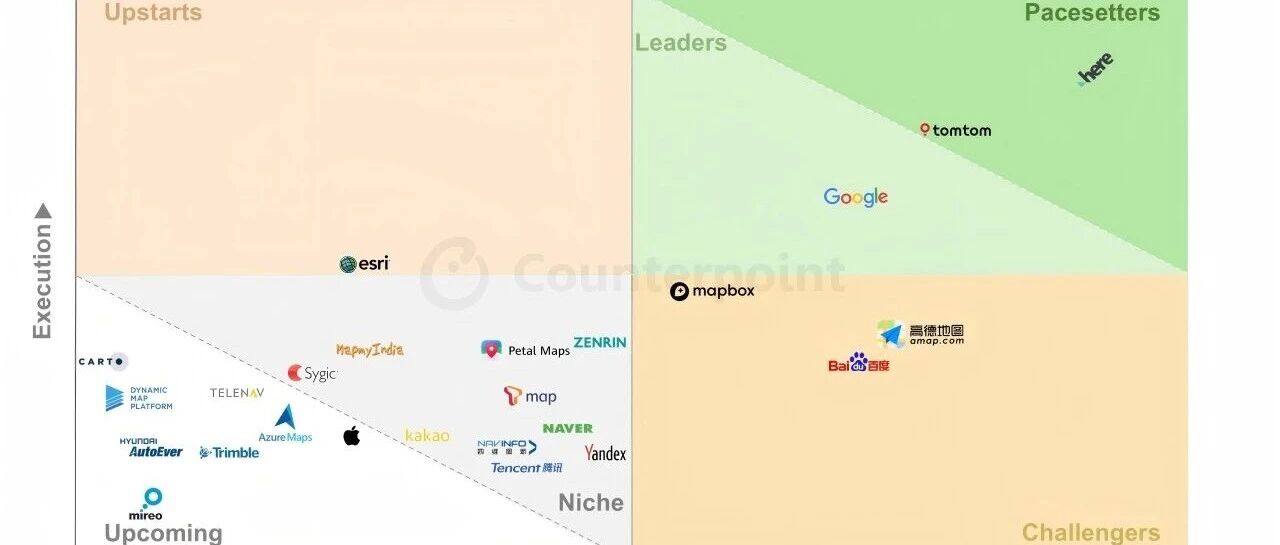
HERE 与 TomTom 在 2026 年定位平台竞争力评估指数中脱颖而出,成为先锋
Counterpoint Research· 2026-01-12 02:45
Core Insights - The article discusses the findings of the "2026 Positioning Platform Competitiveness Assessment Report" by Counterpoint Research, highlighting HERE and TomTom as "Pacesetters" in the positioning platform competitiveness index [4][7] - The report emphasizes the transformation of positioning platforms from traditional mapping solutions to AI-driven data platforms, enhancing user experience through real-time intelligence and personalized services [4][5] Group 1: Positioning Platform Competitiveness - HERE and TomTom are recognized as "Pacesetters" in the positioning platform competitiveness index, while Google is categorized as a "Leader" [4][7] - Baidu, Gaode, and Mapbox are classified as "Challengers" due to their strong platform capabilities but limited market coverage [4][8] - ESRI is noted as an "Upstart" for its execution capabilities, although it still lags behind leading companies in certain dimensions [4] Group 2: HERE's Performance - HERE excels in both platform capability and execution, supported by a comprehensive service product portfolio and a robust partner ecosystem across various verticals like automotive and logistics [5] - The company is leading the transition towards software-defined vehicles (SDVs) and collaborates closely with automakers to guide their transformation [5] - HERE is increasing its R&D investment in product technology and innovation, particularly in AI solutions for the automotive and logistics sectors [5] Group 3: TomTom's Innovations - TomTom has made significant strides with its Orbis map in 3D visualization and traffic analysis, earning its place alongside HERE as a "Pacesetter" [5] - The company is the second global entity, after Google, to launch a Model Context Protocol (MCP) server, facilitating rapid deployment of navigation systems for automakers [5] Group 4: Market Dynamics - The proliferation of location-aware AI features like "search" and "nearby" is leading to hyper-localized and highly personalized user experiences becoming mainstream [7] - Google Maps benefits from its strong core mapping capabilities and vast crowdsourced data from billions of monthly active users, solidifying its "Leader" status [8] - Baidu and Gaode are recognized as regional leaders in China, while Mapbox stands out for its developer-centric approach, offering customizable SDKs for users focused on personalization and visualization [8]

美科技七巨头星光暗淡 彭博:2025多数跑输大盘 主导地位动摇
Feng Huang Wang· 2026-01-12 02:35
股市对科技七巨头的热情正在降温 市场依旧对科技七巨头保持乐观的一个因素是,他们的估值水平相对适中。科技七巨头指数基于未来12 个月预期盈利的市盈率为29倍,远低于本十年前期的40多倍。目前,标普500指数的预期市盈率为22 倍,纳斯达克100指数为25倍。(作者/箫雨) 自2022年美联储开始加息以来,美国"科技七巨头"(Magnificent 7)首次出现大多数公司表现跑输标普 500 指数的情况。尽管2025年科技七巨头指数上涨25%,跑赢标普500指数的16%涨幅,但这主要是由于谷 歌母公司Alphabet、英伟达的巨大涨幅带动了整体指数上涨。 "市场并非一刀切。如果你只是单纯买入整个组合,表现不佳的股票可能会抵消表现出色股票的收 益。"Natixis投资管理解决方案公司首席投资组合策略师杰克·亚纳西维奇(Jack Janasiewicz)指出,该公 司管理着1.4万亿美元资产。 过去三年,科技巨头引领了美国牛市。自2022年10月牛市行情启动以来,仅英伟达、Alphabet、微软和 苹果四家公司就贡献了标普500超过三分之一的涨幅。然而,随着市场对标普500指数其他成分股的兴趣 升温,投资者对这些科技 ...

Here Are My Top 10 Artificial Intelligence (AI) Stocks for 2026
The Motley Fool· 2026-01-12 02:11
Core Viewpoint - The AI sector is experiencing significant growth, and there are numerous investment opportunities available, particularly in specific stocks that are well-positioned for the future [1]. Group 1: Key Companies in AI Investment - **Nvidia** is identified as the top AI stock for 2026, central to AI infrastructure with its GPUs, which are the leading option for parallel processing [2]. The company anticipates global data center capital expenditures to reach $3 trillion to $4 trillion by 2030, indicating strong future performance [3]. - **Broadcom** focuses on application-specific integrated circuits (ASICs) rather than general-purpose GPUs, which can outperform GPUs for specific tasks at a lower cost, suggesting significant growth potential in this segment [4][6]. - **AMD** is gaining traction in the GPU market, forecasting a compound annual growth rate (CAGR) of over 60% in its data center division revenues over the next three to five years, indicating a strong investment opportunity [7][8]. - **Taiwan Semiconductor** is the leading third-party chip manufacturer, essential for the AI buildout, making it a neutral investment option as it benefits from the overall growth in AI technology [9][10]. - **Alphabet** has shown unexpected success with its large language model, Gemini, and is expected to maintain momentum due to its strong advertising business [11][12]. - **Meta Platforms** is investing in AI capabilities for its social media platforms and exploring new products like AI-enabled glasses, which could provide new revenue streams [13][14]. - **Amazon** is expected to perform better in 2026, driven by growth in Amazon Web Services (AWS), which supports AI model training and operations [15]. Group 2: Emerging and Smaller Companies - **SoundHound AI** combines generative AI with voice recognition technology, showing rapid growth potential if widely adopted [16][17]. - **Nebius** is a data center operator focused on the AI market, with an expected revenue run rate of $551 million in Q3 2025, projected to reach $7 billion to $9 billion by the end of 2026, indicating substantial upside potential [18][19]. - **Applied Digital** operates a data center model that leases space to clients, providing long-term visibility into earnings through 15-year leases, representing a less risky investment with significant growth potential [20][21].



Ant International Partners with Google's Universal Commerce Protocol to Expand AI Capabilities
Businesswire· 2026-01-12 01:15
Core Insights - Ant International is collaborating with Google to launch the Universal Commerce Protocol (UCP), which is an open standard aimed at enhancing agentic commerce [1] Company Collaboration - The partnership between Ant International and Google signifies a strategic move towards establishing a new standard in the commerce sector [1] Industry Impact - The introduction of the Universal Commerce Protocol (UCP) is expected to influence the landscape of agentic commerce, potentially leading to increased interoperability and efficiency in transactions [1]

硅谷超级富豪们正在仓皇逃离加州
Xin Lang Ke Ji· 2026-01-11 23:43
Group 1 - The article discusses the potential implementation of a one-time 5% wealth tax on billionaires in California, driven by the state's ongoing budget deficit and increasing public spending, particularly in healthcare [2][5][27] - California is facing a projected budget deficit of nearly $18 billion for the 2026-27 fiscal year, marking the fourth consecutive year of fiscal shortfall, with structural deficits potentially rising to $35 billion by 2027-28 [2][5] - The wealth of California billionaires has surged from $300 billion in 2011 to over $2.2 trillion by 2025, with a significant disparity in tax rates compared to average Americans [5][26] Group 2 - The proposal for the wealth tax is supported by various labor unions and progressive groups, aiming to collect approximately $100 billion over five years, primarily for healthcare services [5][23] - However, there is notable division within the Democratic Party regarding the proposal, with Governor Gavin Newsom opposing it due to concerns about innovation and economic outflow [7][8] - Historical examples from Europe show that wealth taxes often lead to capital flight and do not yield the expected revenue, raising concerns about the potential impact on California's economy [8][27] Group 3 - Prominent billionaires, including Google co-founders Larry Page and Sergey Brin, have begun relocating their businesses and residences out of California in anticipation of the proposed tax [11][13] - Elon Musk has already moved his residence to Texas, significantly reducing his tax burden, which highlights the trend of wealthy individuals leaving California due to tax concerns [15][17] - The article emphasizes the challenges of taxing wealth primarily held in stock, as many billionaires may lack sufficient liquid assets to cover substantial tax bills, potentially leading to stock sales that could depress market values [20][22] Group 4 - The political climate surrounding the wealth tax reflects a broader shift in American politics, with increasing calls for wealth redistribution amid growing income inequality [24][26] - The article suggests that the outcome of the wealth tax debate could set a precedent for other states and influence the future of wealth distribution in the U.S. [28] - The discussion also highlights the need for a balance between fostering innovation and ensuring fair wealth distribution, as the current economic model faces sustainability challenges [28][30]


Gemini购物功能落地 ,巨头组团引爆AI电商
Xuan Gu Bao· 2026-01-11 23:42
Group 1 - Walmart and Alphabet have partnered to launch AI-supported shopping features on Gemini, marking a significant integration of large models with e-commerce [1] - The core integration point of large models and AI e-commerce lies in intent conversion and transaction closure, with AI understanding natural language needs to match products accurately and shorten decision paths [1] - In September, traffic from ChatGPT recommendations to Walmart reached 15%, a notable increase from 9.5% in August, indicating the effectiveness of AI in driving e-commerce [1] Group 2 - Alibaba's Qianwen APP achieved over 10 million downloads in its first week of public testing, aiming to integrate resources from Taobao and Gaode for a comprehensive AI shopping experience [1] - ByteDance's Douyin Mall has integrated with Douyin's product recommendation and purchasing capabilities, showcasing the trend of AI in guiding purchases [1] - ChatGPT's daily shopping intent queries have reached 60 million, highlighting the growing clarity in monetization pathways for AI e-commerce [1][2] Group 3 - AI e-commerce is reshaping traffic entry and distribution models, shifting from "people searching for goods" to "goods searching for people," with a broad market potential [2] - The core monetization logic consists of commissions and intent advertising, facilitated by the ACP protocol for seamless payment and fulfillment processes [2] Group 4 - SanTai Co. is committed to applying AI technology in vertical industries such as cross-border e-commerce and logistics, aiming to empower industry development [3] - YiWanYiChuang, a core operating service provider for Alibaba, is deeply engaged in AI e-commerce strategy and is set to be among the first batch of ecological Agent service providers by 2025 [3]