
Alphabet(GOOGL)

Search documents
Andrew Hill Investment Advisors Q4 2025 Client Letter
Seeking Alpha· 2026-01-06 07:45
Core Insights - The year 2025 saw client portfolios achieving double-digit gains for the third consecutive year, reflecting resilience in corporations and consumers despite economic challenges [2] - The Federal Reserve's rate cuts aimed at achieving a "soft landing" for the economy contributed to a favorable environment for both stocks and bonds [2] - Gold emerged as a standout performer, rising 70%, while cryptocurrencies struggled, with Bitcoin experiencing significant volatility [11][12] Equities Performance - Equities experienced volatility in 2025, with initial sell-offs due to tariff announcements, particularly affecting companies with exposure to China and Vietnam [3] - Strong corporate earnings in the latter half of the year led to a rebound in stock prices, although some stocks, like Oracle, faced corrections after initial surges [4] - The technology sector, while still dominant, is showing signs of waning momentum, with a shift in focus from AI producers to users [26][28] Fixed Income - Bond yields declined throughout 2025, with the 10-year Treasury falling from 4.57% to 4.11%, benefiting client portfolios [8] - The investment strategy includes a focus on high-grade bonds and tax-free municipal debt, which are viewed as attractive in the current market [9][23] Commodities - Commodities had a strong year, with gold significantly outperforming the stock market, while cryptocurrencies faced declines [11][40] - The demand for energy is increasing, driven by factors such as data centers and electric vehicles, with companies like GE Vernova and Constellation Energy positioned to benefit [33][37] Economic Outlook - The economy is projected to grow by 2% in 2026, with consumer spending expected to increase by 2% and private investment by 2.3%, largely driven by AI-related developments [17] - Concerns about a "K-shaped economy" highlight disparities in asset appreciation, with wealth concentration among asset holders [12][13] Investment Strategy - The investment strategy for 2026 is less aggressive, with a focus on underweighting stocks and overweighting fixed income due to premium valuations and peaking earnings growth [20] - The portfolio includes a mix of traditional and alternative investments, with gold remaining a core holding as a hedge against market volatility [40]



Right Tail Capital Q4 2025 Letter
Seeking Alpha· 2026-01-06 06:15
Core Insights - The article discusses the investment strategy of Right Tail, emphasizing a long-term approach focused on high-quality businesses rather than chasing short-term trends like artificial intelligence [4][19]. Performance Overview - Since its inception in May 2022, Right Tail's investments have increased significantly, with an initial $1 million growing to approximately $1.36 million under performance fees and $1.39 million under management fees [5]. - The portfolio's value is projected to grow to about $4.75 million in 10 years and $16 million in 20 years at a 13% annual compounding rate, or to approximately $3 million in 10 years and $6.5 million in 20 years at an 8% rate [6]. Market Comparison - In 2025, Right Tail's portfolio increased by approximately 0.34% before fees, lagging behind the S&P 500's 17.8% and the S&P 500 Equal Weight Index's 11.2% [7]. - Over a longer timeframe, Right Tail accounts have increased between 36% and 39%, which is significantly lower than the S&P 500's 79% increase [9]. Market Dynamics - The S&P 500 is increasingly concentrated, with the "Magnificent 7" companies representing 35-40% of the index, leading to a shift towards a large-cap growth index rather than a diversified one [10]. - The S&P 500 Equal Weight Index provides a different perspective, showing how most companies are performing amidst the AI-driven market enthusiasm [11]. Investment Philosophy - Right Tail's strategy focuses on investing in businesses with durable advantages and predictable earnings, aligning with the belief that markets reward such companies over time [19]. - The current market environment is seen as favorable for long-term active management, as passive investing has led to concentration in a few high-performing companies [21]. Specific Holdings - Alphabet (GOOG, GOOGL) has been a significant holding for Right Tail, with the company viewed as undervalued despite its strong performance in the AI sector [16][17]. - Other holdings include Constellation Software (CSU:CA), which is trading at low valuations despite strong fundamentals, and a coal royalty business expected to return substantial cash to shareholders [20]. Learning and Adaptation - The past year has reinforced the importance of patience and continual learning in investment practices, with a focus on improving investment processes over time [23].

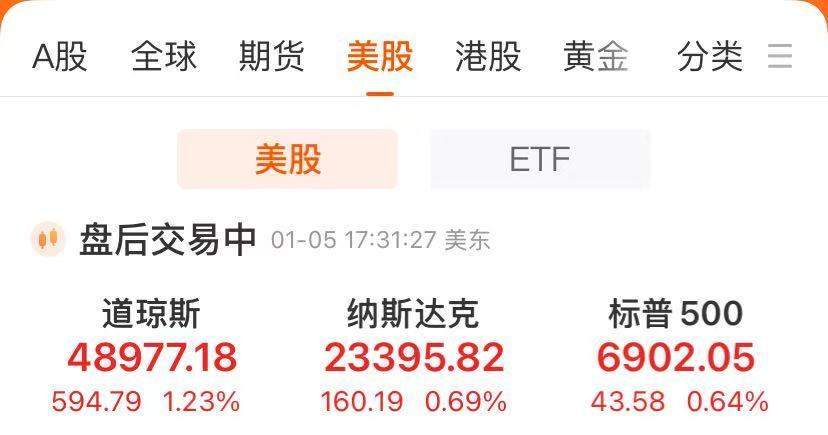
道指创历史新高,美股能源板块普涨
Zheng Quan Shi Bao Wang· 2026-01-06 03:31
Market Performance - Major US stock indices closed higher, with the Dow Jones reaching a record high, driven by strong gains in financial stocks [1][3] - The Dow rose by 594.79 points, or 1.23%, closing at 48,977.18 points; the Nasdaq increased by 160.19 points, or 0.69%, to 23,395.82 points; and the S&P 500 gained 43.58 points, or 0.64%, ending at 6,902.05 points [3] Sector Performance - The S&P 500 energy sector index rose by 2.7%, with major stocks like ExxonMobil and Chevron seeing significant increases due to military actions in Venezuela [5] - The S&P 500 financial sector index increased by 2.2%, with both Goldman Sachs and JPMorgan Chase rising over 3% and reaching all-time highs [6] Technology Stocks - Most large-cap tech stocks saw gains, with Tesla up 3.10%, Amazon up 2.9%, and Meta up 1.29%. However, Microsoft fell by 0.02%, Nvidia dropped by 0.39%, and Apple decreased by 1.38% [3][4] Cryptocurrency and Related Stocks - Cryptocurrency-related stocks experienced a rise, with Strategy stock increasing nearly 5% and Coinbase surging by 7.8% as Bitcoin prices hit a three-week high [6] Chinese Stocks - The Nasdaq Golden Dragon China Index rose by 0.49%, with notable gains in stocks like Beike up over 6% and Bilibili and Tencent Music each up over 3% [6]


谷歌取得替选循环限制专利
Jin Rong Jie· 2026-01-06 03:11
国家知识产权局信息显示,谷歌有限责任公司取得一项名为"替选循环限制"的专利,授权公告号 CN116663604B,申请日期为2018年4月。 作者:情报员 声明:市场有风险,投资需谨慎。本文为AI基于第三方数据生成,仅供参考,不构成个人投资建议。 本文源自:市场资讯 ...
高通与谷歌深化汽车合作
Zhong Guo Qi Che Bao Wang· 2026-01-06 01:41
Core Insights - Qualcomm and Google are deepening their decade-long collaboration in the automotive sector, integrating Snapdragon digital chassis solutions with Google's automotive software and cloud services to accelerate the deployment of software-defined vehicles and promote AI-enabled smart mobility experiences [1] Group 1: Partnership Development - The collaboration began in 2016, initially focusing on supporting embedded Android infotainment systems with Snapdragon processors [1] - The scope of the partnership has expanded to include AI cockpit, voice control, navigation, and has facilitated the widespread adoption of Android Automotive OS (AAOS), enhancing smart in-car experiences for millions of vehicles globally [1] Group 2: Technological Integration - The enhanced partnership focuses on intelligent AI agents and edge-cloud collaboration capabilities, creating end-to-end automotive technology solutions [1] - Snapdragon digital chassis will deeply integrate with Google's automotive AI agents and cloud services, utilizing a hybrid edge-cloud architecture for immediate response on the device side and continuous evolution on the cloud side, supporting multimodal interaction and personalized experiences [1] Group 3: AI Development - Based on Google's Gemini model, a dedicated automotive AI agent will be developed, covering conversational navigation, media entertainment, and vehicle control scenarios, enabling interaction through voice, touch, and visual methods to meet diverse driver needs [1] Group 4: Market Reach - Over 75 million vehicles globally have installed the Snapdragon cockpit platform, with the Snapdragon digital chassis covering more than 400 million vehicles [2] - The platform includes several new automotive companies such as Li Auto, Leapmotor, and Zeekr, with Leapmotor set to launch a central domain controller based on dual Snapdragon 8797 [2]

8点1氪:网约车司机捡乘客相机拒不归还,曹操出行回应;雷军再谈“丢轮保车”:非常成熟的安全设计;段永平否认卖课带货
36氪· 2026-01-06 00:33
Group 1 - A passenger lost a DJI Pocket 3 camera worth over 3,000 yuan in a Cao Cao ride-hailing vehicle and the driver refused to return it after receiving a payment of 50 yuan [2][4] - Cao Cao Chuxing has permanently banned the involved driver's account and is cooperating with the passenger to report the incident to the police [4] Group 2 - Xiaomi's CEO Lei Jun responded to claims regarding the "wheel loss protection" safety design in luxury vehicles, emphasizing that it is a mature safety feature [4] - Segment Yongping denied rumors of selling courses or engaging in commercial activities, clarifying his recent public appearances were for company events and personal reasons [4] Group 3 - Venezuela's oil exports have nearly dropped to zero due to U.S. sanctions, with the state oil company starting to cut production and close oil fields [5] - The global top ten billionaires saw their wealth increase by nearly $600 billion in 2025, with Elon Musk's net worth rising to $619 billion [11] Group 4 - Gree Electric Appliances announced that it will not raise prices for home air conditioners and has no plans to switch to aluminum instead of copper [15] - Schneider Electric's "Winning Plan" has attracted over 1,300 small and medium-sized enterprises, showcasing AI applications in various industrial sectors [7]



8点1氪丨网约车司机捡乘客相机拒不归还,曹操出行回应;雷军再谈“丢轮保车”:非常成熟的安全设计;段永平否认卖课带货
3 6 Ke· 2026-01-06 00:04
Group 1 - A passenger lost a DJI Pocket 3 camera worth over 3,000 yuan in a ride with Cao Cao Chuxing, and the driver refused to return it after receiving a payment of 50 yuan [2] - Cao Cao Chuxing has permanently banned the driver's account and is cooperating with the passenger to report the incident to the police while promising to compensate the passenger [2] Group 2 - Xiaomi's CEO Lei Jun responded to claims about the "wheel loss protection" design in their cars, stating it is a mature safety design used in many luxury vehicles [2][3] - The "wheel loss protection" strategy aims to prevent the wheel hub from causing secondary injuries to passengers during severe collisions [3] Group 3 - Venezuela's oil exports have nearly dropped to zero due to U.S. sanctions, leading to a saturation of domestic oil storage facilities [4][5] - The Venezuelan state oil company has begun to cut crude oil production and is implementing emergency measures to close some oil fields [4] Group 4 - The 2026 childcare subsidy application started on January 5, allowing eligible applicants to apply online or offline [6] - The new application process includes a renewal feature for those who applied in 2025 and meet the criteria for the new year [6] Group 5 - Microsoft China’s chairman Hou Yang denied rumors of leaving for ByteDance, clarifying that he is not considering a job change [6] - Tencent's AI product, Yuanbao, faced backlash for generating offensive responses, and the company is investigating the issue [6] Group 6 - The founder of Double Star Mingren, Wang Hai, announced a severance of ties with his son and daughter-in-law due to their U.S. citizenship [7] - The company, established in 1921, is one of China's earliest national shoe manufacturing brands [7] Group 7 - A court ruling ordered Xu Xiang and Xu Changjiang to compensate 23 investors over 3.29 million yuan, with the company Wenfeng Shares bearing joint liability [8] Group 8 - The company Pangu Technology announced the completion of over 100 million yuan in Pre-A round financing to support RRAM technology research and team expansion [19] - The AI automation platform Jiukexin completed B2 round financing, raising over 100 million yuan for product development and market expansion [20] Group 9 - Tencent's AI workbench, ima, launched a new feature for generating PowerPoint presentations, allowing users to create slides using personal knowledge bases [24] - NetEase Youdao's AI answering pen introduced a generative video explanation feature, marking a significant upgrade in AI learning hardware [25]
大爆发!美国油气股暴涨 高盛、小摩股价创历史新高 中概股低开高走上演反转行情
Di Yi Cai Jing· 2026-01-05 23:03
Market Overview - The three major U.S. stock indices opened higher, with the S&P 500 recovering to 6900 points, driven by rising oil prices and investor optimism that recent military actions in Venezuela would not lead to significant geopolitical conflict [1] - The Dow Jones Industrial Average rose by 594.79 points, or 1.23%, closing at 48977.18 points, marking its first intraday breach of 49000 points [1] - The 10-year U.S. Treasury yield fell to 4.16%, indicating a shift in investor sentiment towards riskier assets [1][5] Sector Performance - The energy sector saw significant gains, with Chevron rising by 5.1% and ExxonMobil by 2.2%, as companies are expected to benefit from the reconstruction of Venezuela's oil infrastructure [2] - Oilfield service companies like Halliburton and Schlumberger also performed well, increasing by 7.8% and nearly 9%, respectively [2] - The S&P 500 Aerospace and Defense Index reached a new all-time high, with major defense contractors General Dynamics and Lockheed Martin seeing stock increases of 3.5% and 2.9% [2] Financial Sector Insights - The S&P 500 Financial Index surged as investors anticipated a 6.7% year-over-year profit growth for the financial sector in the last quarter of the previous year [3] - Goldman Sachs and JPMorgan Chase both reached historical highs, with stock increases of 3.8% and 2.6%, respectively [3] Economic Indicators - The manufacturing sector in the U.S. is experiencing a contraction, with the ISM Manufacturing PMI dropping from 48.2 in November to 47.9, marking the lowest level in 14 months [5] - The market is closely watching the upcoming non-farm payroll report, which could influence the Federal Reserve's monetary policy for 2026 [5] Commodity Performance - International oil prices rose, with WTI crude oil increasing by 1.74% to $58.32 per barrel and Brent crude oil by 1.66% to $61.76 per barrel [6] - Precious metals saw significant price increases, with COMEX gold futures rising by 2.84% to $4436.90 per ounce and silver futures up by 7.95% to $76.15 per ounce [6]


Google, Nvidia, Reddit — And This Hot IPO — Lead Slew Of Stocks To Watch
Investors· 2026-01-05 21:00
BREAKING: S&P 500 Hits Record High, Joining Dow Today's Spotlight MarketSurge New Year Sale Invest smarter in 2026 with our BEST deal—14 months of MarketSurge for $1,499 ($600 off). Related news Dow Jones Futures: S&P 500 Hits New High, Amazon Leads Several Buys; Tesla Falters Free Investing Podcast Listen to IBD's podcast for new investing tips and trade ideas every week. Subscribe today! Get Market Insights on IBD Live Join IBD Live to watch and discuss the market action in real time with top market analy ...
Should Investors Be Worried That the "Magnificent Seven" Make Up 35% of the S&P 500?
Yahoo Finance· 2026-01-05 20:35
Group 1 - The Motley Fool research report highlights the performance of the "Magnificent Seven" stocks, which include Apple, Amazon, Alphabet, Meta Platforms, Microsoft, Nvidia, and Tesla, and their significant outperformance compared to the S&P 500 index [1][2][3] - From 2015 to 2024, the Magnificent Seven achieved a return of 697.6%, while the S&P 500 gained 178.3% during the same period, indicating robust growth among these companies [4] - As of December 2025, the Magnificent Seven represent 34.3% of the S&P 500, a significant increase from 12.3% in 2015, reflecting their growing market capitalization [5] Group 2 - The S&P 500 is a market-cap weighted index, meaning that the influence of each component is based on its total market value, which has led to the Magnificent Seven comprising a larger portion of the index [5] - The top holdings in the S&P 500, including the Magnificent Seven, contribute significantly to the index's overall value, which can create both advantages and challenges for investors [6] - The weight of the top components in the S&P 500 as of December 31, 2025, includes Nvidia at 7.32%, Apple at 6.49%, Microsoft at 5.8%, and others, showcasing their dominance in the index [7]
