
Alphabet(GOOGL)

Search documents
6600亿AI开支引恐慌!科技巨头市值蒸发9000亿,苹果独善其身
Jin Shi Shu Ju· 2026-02-06 09:52
科技巨头宣布今年将投入6600亿美元用于AI领域的资本开支后,股价随即遭遇重挫。投资者担忧这 笔"惊人的"资本支出,已远超这项新技术的盈利潜力。 过去一周,亚马逊(AMZN)、谷歌(GOOGL)和微软(MSFT)发布季度财报后,总市值合计蒸发 约9000亿美元。股东们对该行业庞大的资本开支计划表示抵触——这笔支出规模超过以色列的国内生产 总值,也让各家云业务的强劲营收增长黯然失色。 连同社交媒体巨头Meta(META)在内,这些企业计划投入数据中心以及训练、运行先进AI模型所需专 用芯片的资金,较2025年的4100亿美元增长60%,较2024年的2450亿美元更是飙升165%。 亚马逊首席执行官安迪・贾西(Andy Jassy)表示,需要投入如此巨额资金,才能让公司在AI、芯片、 机器人和卫星领域的发展抢占先机。他以亚马逊云科技营收增长24%为例,证明相关投资已开始产生回 报。 受创最严重的是微软,自上周三发布财报以来,其股价已下跌18%。微软云部门营收增长26%至515亿 美元,但这一增速略低于市场预期,而该公司季度数据中心支出激增66%的消息,也引发了市场的负面 反应。 微软还首次披露了其与OpenAI ...

谷歌翻倍注资猛攻AI
21世纪经济报道· 2026-02-06 09:48
记者丨 董静怡 编辑丨包芳鸣 增长主要由企业AI基础设施、企业AI解决方案以及核心谷歌云平台产品需求激增驱动。 Alphabet披露,到2025年末,谷歌云的年化营收已超过700亿美元,未履行订单金额达2400亿 美元,同比增长超一倍。 2025年对谷歌而言是一个标志性年份。 美东时间2月4日盘后,谷歌母公司Alphabet发布2025年财报,全年营收达到4028.4亿美元,首 次站上四千亿美元关口。在激烈的AI竞赛中,这家硅谷巨头依然掌握着主动权。 不过,伴随着亮眼业绩的还有巨额的投入。谷歌在财报会议中同时宣布,预计2026年资本支出 将达到1750亿美元至1850亿美元(折合人民币12142—12836亿元),较2025年的910亿美元 翻倍。财报披露后,谷歌股价在盘后交易中一度大幅跳水,最大跌幅超7%。 人工智能已不再是未来图景,而是驱动当下增长的强大引擎,但同时,要维持这股势头,其代 价正变得越来越高。 谷歌云增长4 8% 就在两年前,华尔街还在担忧ChatGPT的横空出世将瓦解谷歌的搜索护城河,甚至有人预言这 家互联网科技巨头将面临"柯达时刻"。然而,随着其2025财年第四季度及全年财务报告发布, ...



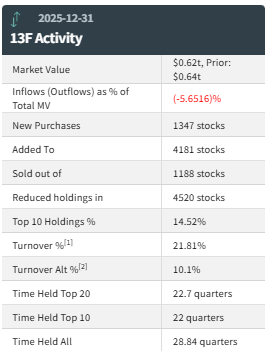
瑞银Q4持仓:批量减持明星科技股 “七巨头”仅Meta(META.US)获增持




智通财经网· 2026-02-06 09:46
Core Insights - UBS reported a total market value of $620 billion for its Q4 2025 holdings, reflecting a decrease of 5.65% from the previous quarter [1][2] - The firm added 1,347 new stocks and increased holdings in 4,181 stocks, while reducing holdings in 4,520 stocks and completely selling out of 1,188 stocks [1][2] - The top ten holdings accounted for 14.52% of the total market value [1][2] Holdings Overview - The largest holding is NVIDIA (NVDA.US) with approximately 77.49 million shares valued at about $14.45 billion, representing 2.34% of the portfolio, down 11.47% from the previous quarter [3][4] - Microsoft (MSFT.US) is the second largest holding with around 28.04 million shares valued at approximately $13.56 billion, making up 2.20% of the portfolio, a decrease of 7.64% [3][4] - Apple (AAPL.US) ranks third with about 44.55 million shares valued at around $12.11 billion, accounting for 1.96% of the portfolio, down 10.57% [3][4] - Other significant holdings include Broadcom (AVGO.US) and Amazon (AMZN.US), with respective values of $8.23 billion and $7.99 billion [3][4] Changes in Holdings - UBS reduced its positions in major tech stocks such as Micron Technology (MU.US) by 16.14%, Taiwan Semiconductor (TSM.US) by 15.56%, and AMD (AMD.US) by 24.28% [5] - The firm also decreased its holdings in Google (GOOGL.US) by 9.05% and Tesla (TSLA.US) by 15.09%, while slightly increasing its position in Meta (META.US) by 0.85% [3][5] - New investments included Walmart (WMT.US), Alibaba (BABA.US), and a new position in TotalEnergies (TTE.US) [6] Trading Activity - The top five purchases included Microsoft call options, SPDR S&P 500 ETF (SPY.US), and MP Materials call options [6][7] - The top five sales were SPDR S&P 500 ETF put options, Invesco QQQ Trust put options, and Microsoft and NVIDIA shares [6][7]
EnBW, Google sign PPA for 100MW clean power supply in Germany
Yahoo Finance· 2026-02-06 08:57
Core Insights - EnBW has signed a 15-year power purchase agreement (PPA) with Google to supply 100MW of clean electricity from the He Dreiht offshore wind farm, aligning with Google's goal of operating on 24/7 carbon-free energy by 2030 [1][2] Group 1: EnBW's Role and Projects - EnBW is reinforcing its role in customized, long-term energy offerings by providing green power from its offshore wind projects, helping Google achieve its sustainability goals [2][3] - The He Dreiht offshore wind farm, currently under construction, is set to be one of Europe's largest projects with a total capacity of 960MW, most of which has already been secured through long-term PPAs [2] - EnBW is negotiating with other potential buyers for the remaining capacity of the He Dreiht project [2] Group 2: Industry Impact and Sustainability - The agreement with Google is seen as a strong signal for the transformation of the energy market, contributing to the decarbonization of industry and the digital economy [3][4] - Google emphasizes the importance of reliable and clean electricity for its global data centers, which support AI and other data-driven technologies [4][5] - PPAs are crucial in the technology sector for achieving climate objectives, especially as energy demand rises due to digitalization and AI applications [5][6] Group 3: Recent Developments - EnBW has decided to halt the development of the Mona and Morgan offshore wind projects in the UK, which had a planned total capacity of 3GW [6]
【特稿】科技巨头庞大AI投资“吓坏”美股
Xin Hua She· 2026-02-06 08:49
加上"元"公司,这些科技巨头今年拟用于训练、运行先进AI模型所需的数据中心以及专业芯片的支出高 达6600亿美元,将比它们2025年实际花费的4100亿美元高出约60%,更是2024年所花费2450亿美元的 2.5倍以上。 美国联博资产管理公司一基金负责人吉姆·蒂尔尼说:"资本支出规模令人咋舌。"即使这些公司年度总 营收增长14%至1.6万亿美元,也难以支撑如此大规模支出。 科技巨头庞大AI投资"吓坏"美股 卜晓明 近期相继公布今年在人工智能(AI)领域投资共计多达6600亿美元的计划后,美国几家科技巨头在股市遭 遇重挫。投资者担忧,相关资本支出规模正超越新技术本身的盈利潜力。 据英国《金融时报》6日报道,自过去一周陆续公布季度财报以来,亚马逊、谷歌和微软的市值已合计 蒸发9000亿美元。投资者对这些公司庞大的资本支出计划感到震惊。相关投资金额总和甚至超过了以色 列的国内生产总值,让这些公司的云业务营收增长相形见绌。 微软股价受冲击最大,自1月28日公布财报以来已下跌18%。市场对其数据中心单季支出飙升66%有所 反应。此外,微软首次披露,在其未来总额达6250亿美元的云服务合同中,有45%来自美国开放人工智 ...
资本开支超GDP,硅谷巨头6600亿美元押注AI,市场却越烧钱越恐慌
3 6 Ke· 2026-02-06 08:40
Group 1 - The core point of the article highlights that major US tech companies plan to invest a total of $660 billion in AI infrastructure by 2026, a figure that exceeds Israel's GDP and represents a 60% increase from the previous year's $410 billion [1][2] - Amazon, Microsoft, and Google have collectively seen their market value drop by $900 billion following their quarterly earnings reports, despite strong revenue growth in their cloud businesses [1][2] - Apple's strategy of minimal capital expenditure has allowed it to achieve record sales, making it the only major tech company to avoid the recent market sell-off [1][5] Group 2 - Amazon's capital expenditure for the year is projected to reach $200 billion, exceeding expectations by $50 billion, which has led to an 11% drop in its stock price [2] - Microsoft has experienced the most significant decline, with its stock price falling 18% after revealing a 66% increase in data center spending, raising concerns among investors [2] - Despite Google's record revenue of over $400 billion, its stock has also been negatively impacted by plans to double its capital expenditure to $185 billion [2] Group 3 - The rising capital expenditures signal that the realization of AI commitments may require more time and resources, testing investor confidence in long-term returns [3] - Analysts express concerns that the increased capital spending may not yield attractive returns, leading to a cautious market sentiment towards tech stocks [3] - The Nasdaq index has dropped 4% over the past five days, reflecting a shift in market sentiment towards AI investments [3] Group 4 - The failure of a $100 billion investment and infrastructure deal between OpenAI and Nvidia has contributed to market volatility, with Oracle's stock dropping 18% due to its heavy reliance on OpenAI [4] Group 5 - Apple's minimal capital expenditure strategy, with a reported $2.4 billion in Q4 and a total of approximately $12 billion for the year, contrasts sharply with the massive investments of its competitors [5] - Apple's collaboration with Google to enhance its AI capabilities through a pay-as-you-go model has allowed it to benefit from AI advancements without significant capital outlay [5] Group 6 - Nvidia is set to report earnings amid a turbulent market, with investors looking for signs that the escalating capital expenditures will soon translate into revenue growth [6] - Meta has announced plans to double its capital expenditure to $135 billion, but its stock gains have been reversed in the broader market sell-off [6] - Despite a 14% increase in combined annual revenue to $1.6 trillion for the four companies, market pessimism continues to overshadow positive financial results [6]
Senator Ed Markey Warns Waymo Is Using People 8,000 Miles Away To 'Help Guide' Self-Driving Cars: 'This Should Scare Us All' - Alphabet (NASDAQ:GOOGL)
Benzinga· 2026-02-06 08:08
Sen. Ed Markey (D-Mass.) has warned that Alphabet Inc.'s (NASDAQ:GOOGL) (NASDAQ:GOOG) self-driving service Waymo is employing remote workers in the Philippines to guide AVs in some situations.This Should Scare Us AllIn a post on the social media platform X on Thursday, the senator criticized Waymo for using remote workers. He shared that he "got Waymo to admit" that it was "using people 8000 miles away in the Philippines" to help guide the company's autonomous cabs in the U.S."This should scare us all. It m ...

Bitcoin falls 8% and Asian shares mostly slip after Wall Street is hit by tech stock losses
ABC News· 2026-02-06 07:57
Market Overview - Asian shares traded mostly lower, following Wall Street's losses driven by technology stocks [1] - The S&P 500 fell 1.2% to 6,798.40, marking its sixth loss in seven days, while the Dow Jones Industrial Average also dropped 1.2% to 48,908.72 [5] Technology Sector - Technology stocks were significantly impacted, with Qualcomm sinking 8.5% despite better-than-expected quarterly revenues, and Alphabet losing 0.5% due to concerns over its AI spending [5] - Amazon's shares fell 11% in after-hours trading after announcing plans to increase capital spending by over 50% to $200 billion in AI and other areas [6] - The sell-off in technology stocks was exacerbated by new AI tools from American startup Anthropic, which raised concerns about the disruption of traditional software services [6] Cryptocurrency - Bitcoin's price dropped to just under $65,000, down approximately 8% and giving back all gains since President Trump's re-election, with a peak of over $124,000 in October [4] - The cryptocurrency experienced a significant decline, briefly sinking over 12% to below $64,000 [4] Automotive Industry - Shares of Toyota Motor rose 2% following the announcement that CEO Koji Sato will step down in April, to be replaced by CFO Kenta Kon [3] Commodity Prices - Gold prices fell 0.6% to $4,858.60 per ounce after nearing $5,600 last week, while silver prices dropped 5.5% to $72.52 per ounce [7] - U.S. benchmark crude oil gained 35 cents to $63.64 a barrel, and Brent crude rose 36 cents to $67.91 a barrel [8]
谷歌:高CapEx投入强化云业务增长动能-20260206
HTSC· 2026-02-06 07:25
证券研究报告 谷歌 (GOOGL US) 高 CapEx 投入强化云业务增长动能 华泰研究 年报点评 投资评级(维持): 买入 目标价(美元): 415.00 何翩翩 研究员 SAC No. S0570523020002 SFC No. ASI353 夏路路 研究员 SAC No. S0570523100002 SFC No. BTP154 丁骄琬 研究员 SAC No. S0570523040003 dingjiaowan@htsc.com +(86) 21 2897 2228 易楚妍 联系人 SAC No. S0570124070123 SFC No. BXH065 韩冬冰* 联系人 SAC No. S0570125070150 handongbing@htsc.com +(86) 21 2897 2228 股价走势图 资料来源:S&P (25) 1 28 54 80 Feb-25 Jun-25 Oct-25 Feb-26 (%) 谷歌 标普500 经营预测指标与估值 | 会计年度 (美元) | 2025 | 2026E | 2027E | 2028E | | --- | --- | --- | --- ...
Alphabet Crushes Earnings Again, Reports 48% Cloud Revenue Growth
Investing· 2026-02-06 06:45
Market Analysis by covering: Alphabet Inc Class A. Read 's Market Analysis on Investing.com ...
