Honda Motor(HMC)

Search documents
本田在华销量遇冷:上半年大跌24.2% 何以自救?
Xi Niu Cai Jing· 2025-07-16 06:45
Core Insights - Honda's sales in China have significantly declined, with a total of 315,152 vehicles sold in the first half of the year, representing a 24.2% year-on-year decrease [2] - The company reached a peak annual sales figure of 1.627 million vehicles in 2020, but projections indicate that sales may drop below 700,000 units by 2025 [2] Sales Performance - In June, Honda's sales were 58,468 units, down 17.9% year-on-year, indicating ongoing pressure on sales performance [2] - The market for new energy vehicles (NEVs) in China is rapidly growing, with a penetration rate exceeding 52.7% in Q1 2025, while Honda's NEV offerings account for less than 5% of its total sales [2] Market Challenges - The decline in Honda's sales is attributed to multiple factors, with the slow transition to electric vehicles being a primary concern [2] - In the competitive price range of 150,000 to 250,000 yuan, domestic brands hold over 75% market share, contrasting with Honda's underperforming electric models [2] Strategic Actions - Honda has taken steps to address its challenges by shutting down two fuel vehicle production lines in Wuhan and Guangzhou, while opening two new NEV production lines [3] - The company's total production capacity has been reduced from 1.49 million to 1.2 million units [3] Future Outlook - Honda has partnered with local companies like CATL, DeepSeek, and Momenta to accelerate its transition to electrification and smart technology [3] - However, Honda has recently revised its expectations for electric vehicle sales, projecting that by 2030, the share of pure electric vehicles will be below the previously set target of 30% [3]


吉利汽车与极氪正式宣布合并;罗马仕旗舰店恢复营业!官方称:召回服务长期有效;英伟达宣布:H20将恢复对中国销售丨雷峰早报
雷峰网· 2025-07-16 00:40
Group 1 - Geely Auto and Zeekr officially announced a merger, allowing Zeekr shareholders to choose between cash or exchanging for Geely shares as compensation [4] - Li Xiang, CEO of Li Auto, responded to the leak of the interior design of the Li One, stating it disrupted the release schedule and underestimated potential users' curiosity [6] - ByteDance is reportedly developing mixed reality glasses, codenamed "Project P," to compete with Meta's upcoming Phoenix glasses [8] - NVIDIA announced the resumption of H20 sales in China and the launch of a new GPU tailored for the Chinese market [9][10] - Xiaopeng Heavens completed a $250 million Series B financing round, bringing its total financing to approximately 5.4 billion RMB [23] Group 2 - The first foldable iPhone is expected to be priced between $1,800 and $2,000, with a projected profit margin exceeding 50% [37] - ByteDance has reformed its performance evaluation system, emphasizing the "M" rating for stable and good performance, while increasing the incentive range for this category [21][22] - JD Health has opened its first self-operated medical beauty clinic in Beijing, with plans for further expansion [23] - Jianghuai Automobile reported a loss of 680 million RMB in the first half of 2025, attributed to reduced sales and increased competition [28] - Tesla opened its first showroom in India, with the Model Y starting at approximately 499,000 RMB, facing high tariffs [43]




Honda & Nissan in Discussion to Co-Develop Advanced Auto Software
ZACKS· 2025-07-15 16:31
Group 1: Joint Software Development - Honda Motor Co., Ltd. and Nissan Motor Co., Ltd. are in discussions to jointly develop and share a foundational software platform for advanced vehicle control systems to compete with leading U.S. and Chinese automakers in the software-defined vehicles (SDVs) market [1][9] - The two companies aim to introduce vehicles utilizing the new software in the latter half of the decade, emphasizing the need for massive data inputs for development and operation, making collaboration crucial for innovation and cost reduction [2] Group 2: Strategic Manufacturing Agreement - Nissan may begin manufacturing pickup trucks for Honda at its U.S. plants under a proposed strategic agreement, allowing Honda to diversify its U.S. vehicle lineup and mitigate the financial impact of new tariffs [5][6] - The proposed manufacturing agreement could enhance profitability for both firms, especially as recent tariff increases on Japanese imports are projected to reduce Honda's operating profit by ¥650 billion and Nissan's by up to ¥450 billion in fiscal 2025 [6]
本田日产共研汽车操作系统,抗衡中美车企
日经中文网· 2025-07-15 03:00
Core Viewpoint - The competition in the next-generation automotive sector will be significantly influenced by software updates that enhance driving performance and functionality, with companies like Tesla and Huawei leading the charge in software innovation [1][2]. Group 1: Collaboration between Honda and Nissan - Honda and Nissan are negotiating to standardize the basic software (operating system) for vehicle control, aiming to implement it in new models by the late 2020s [1]. - The two companies have been conducting joint research on software technology since August 2024, with plans to decide on mass production development based on the effectiveness of their collaboration [1][2]. - The collaboration is driven by concerns over data competition in the next-generation automotive field, where features like autonomous driving and enhanced in-car experiences are critical [2]. Group 2: Development of Operating Systems - Honda is developing its own operating system called "ASIMO," while Nissan is also advancing its proprietary system, aiming to create user-friendly systems akin to Apple's iOS and Google's Android [2]. - Both companies plan to launch vehicles equipped with their independently developed operating systems starting in 2026, with a joint system expected to debut in new models by the late 2020s [2]. - The collaboration aims to reduce development costs, which can reach trillions of yen, by sharing resources and technology [2]. Group 3: Competitive Landscape - Tesla, a leader in the industry, utilizes its own operating system, resolving approximately 40% of recall issues through software updates [2]. - Chinese tech companies like Huawei are also at the forefront of software innovation in the automotive sector [2].
据日经新闻:本田和日产计划在本世纪20年代末推出配备新操作系统的车辆。
news flash· 2025-07-14 09:07
据日经新闻:本田和日产计划在本世纪20年代末推出配备新操作系统的车辆。 ...
关税重压下,日产代工本田?
Zhong Guo Qi Che Bao Wang· 2025-07-14 08:30
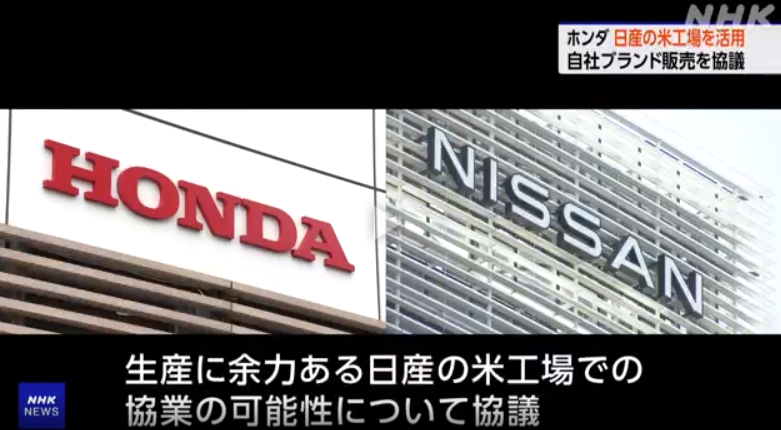
Core Viewpoint - Nissan and Honda are in discussions to utilize Nissan's underutilized production capacity in the U.S. to manufacture pickup trucks for Honda, aiming to enhance operational efficiency and mitigate the impact of tariffs on their businesses [1][3][4]. Group 1: Collaboration and Production Capacity - Nissan is exploring the possibility of producing large vehicles for Honda at its Canton, Mississippi plant, which currently has a low utilization rate of 57% for 2024 [3][6]. - The collaboration could benefit both companies, as Nissan seeks to improve factory utilization while Honda aims to expand its product lineup in North America [3][4]. Group 2: Tariff Implications - The U.S. is Japan's largest automotive export market, accounting for 30% of total exports, making tariffs a significant concern for Japanese automakers [5]. - Honda anticipates a 70% drop in net profit for the fiscal year 2025, largely due to the impact of tariffs, while Nissan expects a loss of 450 billion yen from the same tariff policies [5][6]. Group 3: Financial Challenges - Nissan is facing severe financial difficulties, reporting a net loss of 670.9 billion yen for the fiscal year 2024, with significant debt obligations approaching maturity [6]. - The company is undergoing a restructuring process, including plans to lay off 20,000 employees and close seven factories, while also seeking to improve cash flow by negotiating payment extensions with suppliers [6].
日产或在美国为本田生产汽车
日经中文网· 2025-07-14 03:12
Core Viewpoint - Nissan and Honda are discussing collaboration to utilize Nissan's underutilized factories in the U.S. to produce vehicles for Honda, aiming to mitigate the impact of U.S. auto tariffs on Japanese automakers [1][2]. Group 1: Collaboration and Production - Nissan has begun negotiations with Honda to supply vehicles from its U.S. factories, particularly focusing on producing pickup trucks at the Canton plant in Mississippi [1][2]. - The collaboration is seen as a strategic move to increase local production and reduce the high import ratios of Japanese vehicles in the U.S., which are 47% for Nissan and 32% for Honda [2][3]. - Both companies face significant profit declines due to U.S. auto tariffs, with Honda projected to lose 650 billion yen and Nissan up to 450 billion yen in the fiscal year ending March 2026 [2]. Group 2: Market Conditions and Challenges - The Canton plant's utilization rate is projected to be only 57% in 2024, significantly below the breakeven point of around 80%, indicating a need for increased production to improve profitability [3]. - The U.S. government's strong stance on tariffs, including a 25% tariff set to take effect in April, adds pressure on Japanese automakers to enhance local production [3]. Group 3: Negotiation Dynamics - Previous discussions aimed at forming a global automotive alliance between Nissan and Honda collapsed due to disagreements, but both companies are now focusing on cooperation to rebuild their relationship [4]. - Following a management change at Nissan in April, regular discussions between the executives of both companies have resumed, although they have denied immediate plans to restart formal merger talks [4].
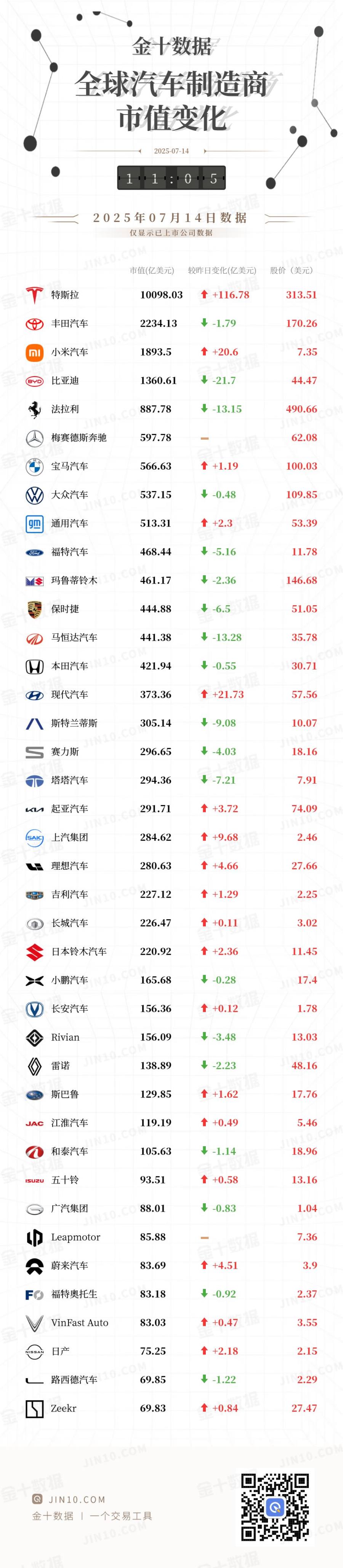
金十图示:2025年07月14日(周一)全球汽车制造商市值变化
news flash· 2025-07-14 03:08
Group 1 - BYD reported a value of 1360.61 with a decrease of 21.7% [2] - Ferrari's value is 887.78, showing a decrease of 13.15% [2] - Mercedes-Benz has a value of 597.78, with no percentage change reported [2] - BMW's value increased by 1.19% to 566.63 [2] Group 2 - Volkswagen's value is 537.15, reflecting a decrease of 0.48% [3] - General Motors reported a value of 513.31, with an increase of 2.3% [3] - Ford's value decreased by 5.16% to 468.44 [3] - Maruti Suzuki's value is 461.17, showing a decrease of 2.36% [3] - Porsche's value decreased by 6.5% to 444.88 [3] - Mahindra Automotive's value is 441.38, with a decrease of 13.28% [3] - Honda's value is 421.94, reflecting a slight decrease of 0.55% [3] - Hyundai's value increased by 21.73% to 373.36 [3] - Stellantis reported a value of 305.14, with a decrease of 9.08% [3] - Seres' value is 296.65, showing a decrease of 4.03% [3] - Tata Motors reported a value of 294.36, with a decrease of 7.21% [3] - Kia's value increased by 3.72% to 291.71 [3] - SAIC Motor's value is 284.62, reflecting an increase of 9.68% [3] - Li Auto's value is 280.63, with an increase of 4.66% [3] - Geely's value is 227.12, reflecting an increase of 1.29% [3] - Great Wall Motors reported a value of 226.47, with a slight increase of 0.11% [3] - Suzuki Japan's value is 220.92, showing an increase of 2.36% [3] - Xpeng's value is 165.68, reflecting a decrease of 0.28% [3] Group 3 - Changan Automobile's value is 156.36, with a slight increase of 0.12% [4] - Rivian's value is 156.09, showing a decrease of 3.48% [4] - Renault's value is 138.89, reflecting a decrease of 2.23% [4] - Subaru's value is 129.85, with an increase of 1.62% [4] - JAC's value is 119.19, with an increase of 0.49% [4] - Hozon Auto's value is 105.63, showing a decrease of 1.14% [4] - Isuzu's value is 93.51, with an increase of 0.58% [4] - GAC Group's value is 88.01, reflecting a decrease of 0.83% [4] - Leapmotor's value is 85.88, with no percentage change reported [4] - Weimi Auto's value is 83.69, showing an increase of 4.51% [4] - Ford Otosan's value is 83.18, reflecting a decrease of 0.92% [4] - VinFast Auto's value is 83.03, with an increase of 0.47% [4] - Nissan's value is 75.25, reflecting an increase of 2.18% [4] - Lucid Motors' value is 69.85, showing a decrease of 1.22% [4] - Zeekr's value is 69.83, with an increase of 0.84% [4]