Honda Motor(HMC)

Search documents
关税降至15% 美日贸易协议达成
Bei Jing Shang Bao· 2025-07-23 14:45
Group 1: Trade Agreement Overview - The United States and Japan reached a trade agreement before August 1, significantly reducing U.S. tariffs on Japanese automobiles and industrial goods from 25% to 15% in exchange for Japan's commitment to invest $550 billion in the U.S. and open its markets for automobiles, rice, and other products [2][3] - The agreement is seen as a short-term benefit for Japan, as it avoids higher tariffs that could severely impact its automotive industry, which is a key sector for the Japanese economy [3][4] Group 2: Economic Impact - Following the announcement of the trade agreement, Japan's stock market surged, with the Nikkei 225 index rising by 3.51% and the TOPIX index increasing by 3.18%, particularly benefiting the automotive sector [5] - Japanese government bond yields rose across the board, reflecting concerns over Japan's fiscal outlook and the potential for increased government spending following the recent elections [6][7] Group 3: Political Context - The political landscape in Japan remains uncertain, with Prime Minister Shigeru Ishiba facing pressure to resign after the ruling coalition lost its majority in the recent elections, which could lead to increased market volatility [6][8] - Analysts suggest that the election results may have significant implications for Japan's macroeconomic policies, including fiscal strategy and the direction of the Bank of Japan's monetary policy [9]


突然!暴涨1400点!
中国基金报· 2025-07-23 07:56
Group 1 - A-shares experienced volatility, briefly surpassing 3600 points before retreating, with mixed performance across major indices [12][13] - The market saw 1271 stocks rise, with 56 hitting the daily limit up, while 4027 stocks declined [14][15] - The construction and cement sectors showed divergence, with companies like China Power Construction and Huaxin Cement hitting the daily limit up, while most stocks retreated [16] Group 2 - Japanese stock market surged over 1400 points, driven by a trade agreement between the US and Japan, particularly benefiting the automotive sector [4][10] - Major Japanese automakers saw significant stock price increases, with Honda up over 11%, Toyota nearly 15%, and Mazda soaring over 17% [7] - The agreement reduced tariffs from 25% to 15%, providing short-term confidence to the market despite ongoing challenges from competition [10][11]

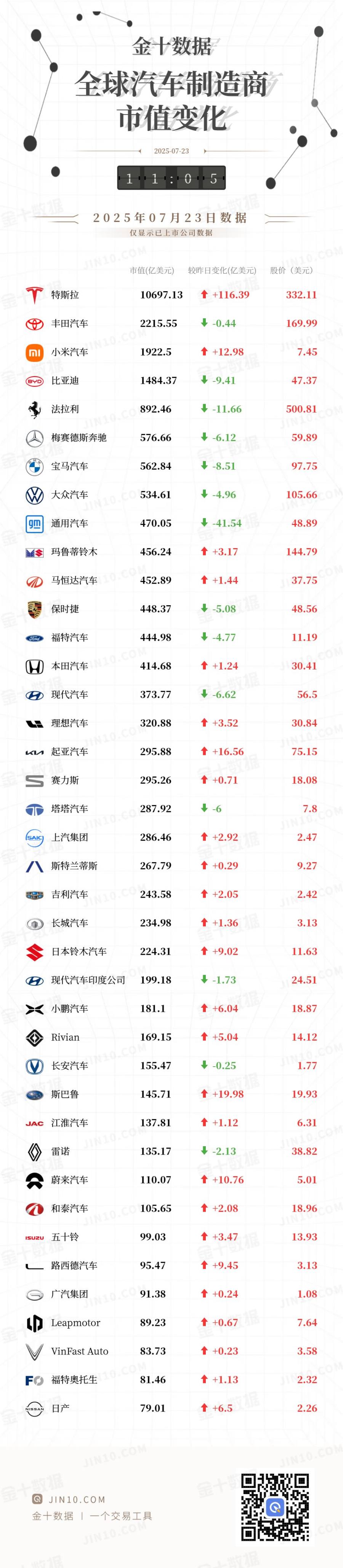
金十图示:2025年07月23日(周三)全球汽车制造商市值变化
news flash· 2025-07-23 03:07
Core Insights - The article presents the market capitalization changes of global automotive manufacturers as of July 23, 2025, highlighting significant fluctuations in values among various companies [1]. Group 1: Market Capitalization Changes - Volkswagen's market capitalization is reported at $534.61 billion, experiencing a decrease of $4.96 billion [3]. - General Motors shows a market cap of $470.05 billion, with a notable increase of $41.54 billion [3]. - Maruti Suzuki's market value stands at $456.24 billion, reflecting an increase of $3.17 billion [3]. - Mahindra & Mahindra has a market cap of $452.89 billion, with a slight increase of $1.44 billion [3]. - Porsche's market capitalization is $448.37 billion, down by $5.08 billion [3]. - Ford's market value is $444.98 billion, decreasing by $4.77 billion [3]. - Honda's market cap is $414.68 billion, with an increase of $1.24 billion [3]. - Hyundai's market capitalization is $373.77 billion, down by $6.62 billion [3]. - Li Auto's market value is $320.88 billion, reflecting an increase of $3.52 billion [3]. - Kia's market cap is $295.88 billion, with a significant increase of $16.56 billion [3]. - SAIC Motor's market capitalization is $286.46 billion, up by $2.92 billion [3]. - Geely's market value stands at $243.58 billion, with an increase of $2.05 billion [3]. - Great Wall Motors has a market cap of $234.98 billion, reflecting an increase of $1.36 billion [3]. Group 2: Emerging Players - Xpeng Motors has a market capitalization of $181.1 billion [4]. - Rivian's market value is reported at $169.15 billion, with an increase of $5.04 billion [4]. - NIO's market cap stands at $110.07 billion, reflecting an increase of $10.76 billion [4]. - Leapmotor's market value is $89.23 billion, with a slight increase of $0.67 billion [4]. - VinFast Auto has a market capitalization of $83.73 billion, showing a minor increase of $0.23 billion [4].






刚刚!日股跳涨,突破40000点整数关
Zheng Quan Shi Bao· 2025-07-23 01:49
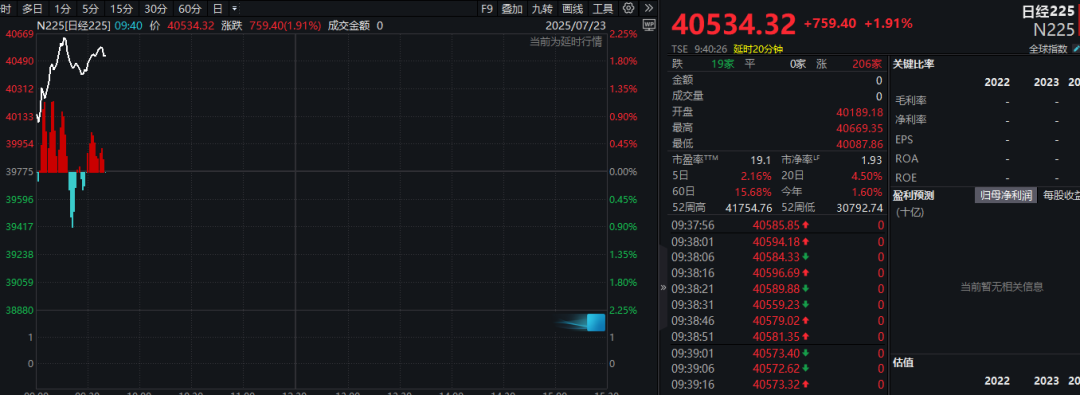
Group 1 - The US and Japan have reached a trade agreement, reducing the reciprocal tariff rate from 25% to 15%, with Japan committing to invest $550 billion and open its agricultural market, including rice [1] - Following the announcement, the Japanese stock market experienced a significant surge, with the Nikkei 225 index surpassing the 40,000-point mark, showing an intraday increase of over 2% [2] - The Tokyo Stock Exchange index also saw a notable rise, breaking the 2,900-point threshold with an increase exceeding 2.4% [4] Group 2 - Japanese automotive stocks were the highlight of the market surge, with Mazda's stock rising over 17%, Subaru's over 14%, Toyota's over 10%, Honda's over 9%, and Nissan's over 9% [5] - The automotive sector is crucial to Japan's economy, and the previous announcement of a 25% tariff on Japanese automotive exports had been a significant point of contention in US-Japan trade negotiations [5]
刚刚!日股跳涨,突破40000点整数关!
证券时报· 2025-07-23 01:28
Core Viewpoint - The article discusses the recent trade agreement between the United States and Japan, which includes a reduction in tariffs and significant Japanese investment in the U.S. [1] Group 1: Trade Agreement Impact - The U.S. and Japan have reached a trade agreement that lowers the reciprocal tariff rate from 25% to 15% [1] - Japan is set to invest $550 billion in the U.S. and will open its market for rice and other agricultural products [1] Group 2: Market Reaction - Following the announcement, the Japanese stock market experienced a significant surge, with the Nikkei 225 index surpassing the 40,000-point mark, showing an intraday increase of over 2% [2][4] - Major automotive stocks in Japan saw substantial gains, with companies like Mazda, Subaru, Toyota, Honda, and Nissan reporting increases of over 9% to 17% [10] Group 3: Sector Performance - The automotive sector was highlighted as a key driver of the market rally, with collective gains among major car manufacturers [9][10] - Other large companies in Japan, including TDK, Yamaha, and Panasonic, also saw their stock prices rise significantly [6]

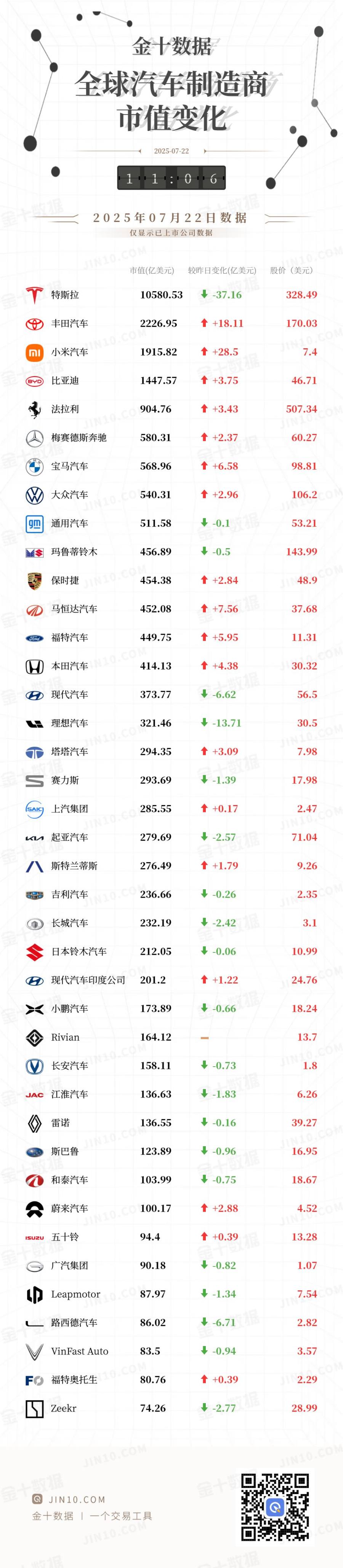
金十图示:2025年07月22日(周二)全球汽车制造商市值变化
news flash· 2025-07-22 03:12
Group 1 - The article presents the market capitalization changes of global automotive manufacturers as of July 22, 2025, highlighting significant fluctuations in their valuations [1][3][4] - Volkswagen leads with a market cap of $540.31 billion, showing an increase of 2.96% [3] - General Motors follows with a market cap of $511.58 billion, experiencing a slight decrease of 0.1% [3] - Other notable manufacturers include Maruti Suzuki at $456.89 billion, Porsche at $454.38 billion, and Mahindra & Mahindra at $452.08 billion, all showing varying percentage changes [3] Group 2 - The data indicates that Ford's market cap is $449.75 billion, reflecting a 5.95% increase [3] - Honda's market cap stands at $414.13 billion, with a 4.38% increase [3] - Hyundai's market cap is reported at $373.77 billion, showing a decrease of 6.62% [3] - Li Auto's market cap is $321.46 billion, with a significant drop of 13.71% [3] Group 3 - The article also lists other manufacturers such as Tata Motors at $294.35 billion and SAIC Motor at $285.55 billion, both showing slight increases [3] - Kia's market cap is $279.69 billion, reflecting a decrease of 2.57% [3] - The report includes smaller manufacturers like Xpeng Motors at $173.89 billion and Rivian at $164.12 billion, with no percentage changes reported [4]

日本专家刚算了一笔账,特朗普把问题闹大了,石破茂抓住美方软肋
Sou Hu Cai Jing· 2025-07-19 10:05
Group 1 - Trump's announcement to increase tariffs on almost all Japanese goods from 10% to 25% starting August 1 has significant implications for Japanese exporters [1][3] - Japanese automobile exports to the U.S. saw a dramatic decline of 26.7% in June, with companies like Toyota and Honda facing pressure to raise prices, resulting in a profit reduction of 30% [1][3] - The increase in tariffs could lead to a loss of $3,125 in profit per vehicle for Japanese automakers, potentially causing Japan's GDP to decline by 0.2%, which is substantial given the previous year's growth of only 0.1% [3][6] Group 2 - Analysts predict that if Japanese companies attempt to pass on tariff costs to U.S. consumers, sales could drop by 8% to 26%, further squeezing profits by 6% to 59% [6] - The appreciation of the yen exacerbates the situation, with every 1 yen increase resulting in a loss of 50 billion yen for Toyota [6] - Japanese officials, including Prime Minister Shigeru Ishiba, have taken a firm stance against U.S. demands, emphasizing the importance of protecting key industries such as agriculture and automotive [6][9] Group 3 - Japan's reliance on the U.S. market is significant, with Japanese cars accounting for one-third of the U.S. automotive market, indicating that a withdrawal could lead to higher prices for American consumers [8][9] - Japan has potential countermeasures, including selling off U.S. Treasury bonds and accelerating free trade talks with China and South Korea [9]
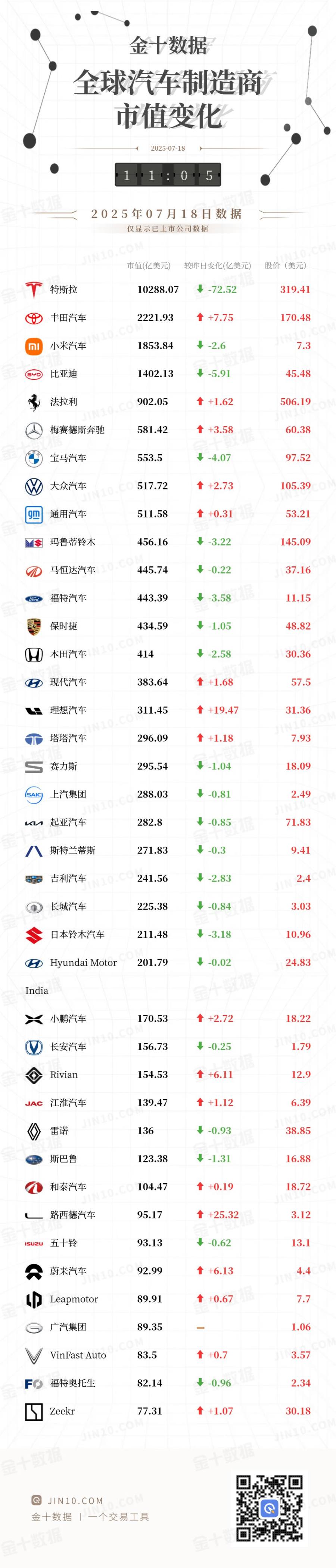
金十图示:2025年07月18日(周五)全球汽车制造商市值变化
news flash· 2025-07-18 03:12
Group 1 - The global automotive manufacturers' market capitalization has shown significant changes as of July 18, 2025, with Volkswagen leading at $517.72 billion, reflecting an increase of 2.73% [1][3] - General Motors follows closely with a market cap of $511.58 billion, up by 0.31% [1][3] - Notable declines were observed in companies like Maruti Suzuki and Ford, with market caps of $456.16 billion (down 3.22%) and $443.39 billion (down 3.58%) respectively [1][3] Group 2 - Chinese electric vehicle manufacturer Li Auto has seen a substantial increase in market capitalization, reaching $311.45 billion, up by 19.47% [1][4] - Rivian also experienced growth, with a market cap of $154.53 billion, increasing by 6.11% [1][4] - NIO's market cap stands at $92.99 billion, reflecting a rise of 6.13% [1][4]





暂停研发电动汽车后,本田为何急于投资汽车芯片开发商?
Zhong Guo Qi Che Bao Wang· 2025-07-17 07:57
Group 1 - Honda has decided to halt the development of new electric vehicles, which is surprising given the competitive landscape where rivals like Volkswagen, Toyota, and Nissan are advancing their electric solutions [3][4] - The decision to stop electric vehicle development may be influenced by the recent termination of the $7,500 electric vehicle tax credit in the U.S., prompting Honda to adopt a strategy of timely loss mitigation [3][4] - Honda's previous collaboration with Sony to form a new mobility company has not yielded significant results, with reported operational losses of 52 billion yen (approximately 2.6 billion RMB) [4] Group 2 - Honda is preparing to invest in the Japanese chip manufacturer Rapidus to secure a domestic supply of chips for its next-generation vehicles, with the investment expected to reach several billion yen [5][6] - The partnership with Rapidus aims to ensure a stable supply of automotive chips and is part of a broader strategy to reduce chip procurement costs by 20% and overall electric drive system costs by 30% [7][8] - The investment in chip development reflects a shift in the automotive industry towards high-value chip production, as traditional automakers evolve from hardware integrators to collaborative developers of software and hardware [7][8] Group 3 - Honda's decision to pause electric vehicle development while investing in automotive chips is seen as a cost-reduction and efficiency-enhancing move, aiming to maintain cash flow and build future competitiveness [7][8] - The investment in Rapidus signifies a strategic shift towards "technological sovereignty," moving from reliance on external supply chains to controlling the production of critical automotive chips [8] - Honda's actions may provide insights for traditional automakers navigating the crossroads of electrification and intelligent technology in the global automotive industry [8]

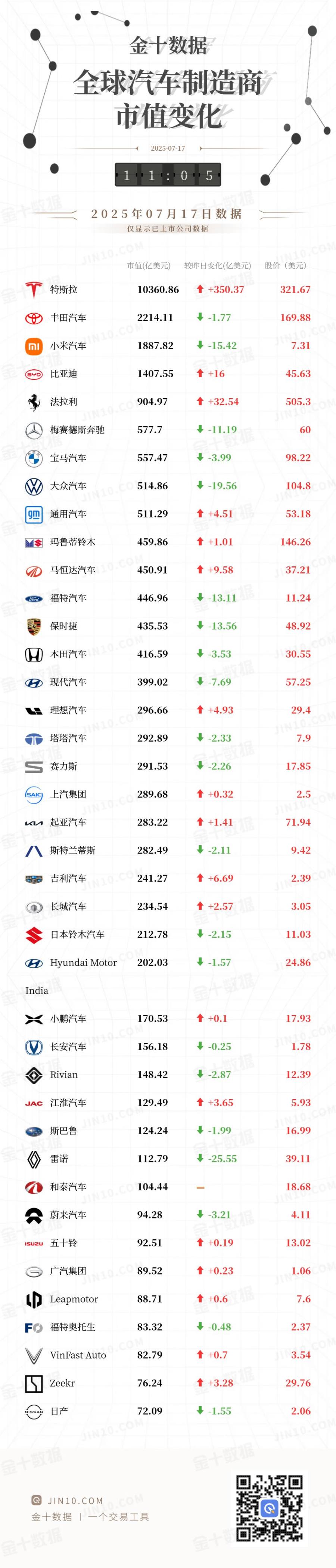
金十图示:2025年07月17日(周四)全球汽车制造商市值变化
news flash· 2025-07-17 03:07
Group 1 - The market capitalization changes of global automotive manufacturers as of July 17, 2025, show significant fluctuations among major players [1][3]. - Volkswagen's market value decreased by 19.56 billion, while General Motors saw an increase of 4.51 billion [3]. - Notable increases in market value were observed for Mahindra & Mahindra (+9.58 billion) and Geely (+6.69 billion) [3]. Group 2 - The data indicates that companies like Rivian and NIO experienced declines in market value, with Rivian down by 2.87 billion and NIO down by 3.21 billion [4]. - Xpeng Motors and Leapmotor showed slight increases in their market values, with Xpeng up by 0.1 billion and Leapmotor up by 0.6 billion [4]. - The overall trends reflect a competitive landscape with varying performance metrics across different automotive manufacturers [4].