
ING Groep(ING)

Search documents
每日投行/机构观点梳理(2025-07-07)
Jin Shi Shu Ju· 2025-07-07 08:31
Group 1: OPEC+ Production and Oil Price Forecasts - Goldman Sachs expects OPEC+ member countries to increase oil production by 550,000 barrels per day in September, fully canceling the voluntary reduction of 2.2 million barrels per day [1] - Goldman Sachs maintains its Brent crude oil price forecast at $59 per barrel for Q4 2025, citing supply shortfalls and reduced idle capacity as key factors [2] - UBS analysts indicate that OPEC+'s unexpected production increase reinforces expectations for further declines in oil prices, predicting Brent crude could drop to $60 per barrel by year-end [8] Group 2: Currency and Trade Policy Implications - UBS analysts warn that if the U.S. reinstates higher tariffs without a trade agreement, the dollar may weaken against major currencies [3] - Targeted tariffs by the U.S. could support the dollar in the short term, as they may strengthen the dollar against specific countries while weakening it against broader tariffs [4] - The impact of further tariff delays on the dollar remains uncertain, with potential for initial support if high tariffs are avoided [5] Group 3: Economic Indicators and Market Sentiment - Deutsche Bank analysts note that gold prices are primarily supported by the instability of U.S. policies, which erodes investor confidence in U.S. assets [6] - Citic Securities reports that the current market environment resembles late 2014, with signs of recovery in investor sentiment and potential catalysts for market movement [11] - Citic Securities highlights that the "Big and Beautiful" Act may negatively impact U.S. healthcare and renewable energy sectors while benefiting technology and manufacturing industries [12]



荷兰国际:对欧元走强的担忧似乎过头了
news flash· 2025-07-03 08:15
Core Viewpoint - Concerns regarding the strengthening of the euro appear to be overstated, as it is beneficial for the Eurozone economy [1] Group 1: Economic Impact - The strengthening euro is expected to lower import prices and reduce inflation, which could be a concern for European Central Bank officials [1] - However, the Eurozone should capitalize on this "global euro moment," as previously praised by the ECB President [1] Group 2: Investment Implications - Reallocating global investment portfolios to the Eurozone will likely benefit the borrowing costs for the private sector [1]
ING逆势看涨美元:关税或令美国通胀反弹 兑欧元与日元均将升4%
智通财经网· 2025-07-03 01:41
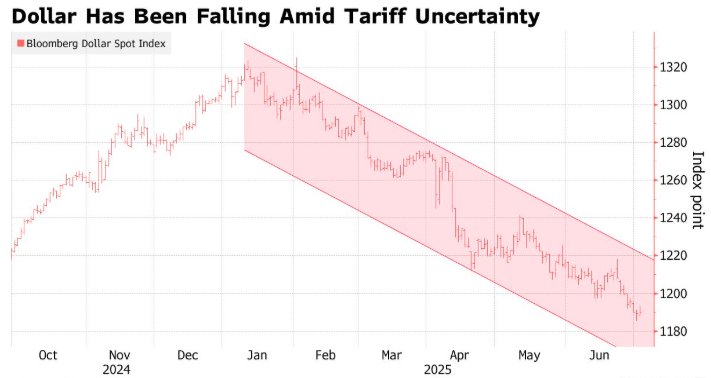
Group 1 - The core viewpoint is that due to tariffs leading to increased inflation, the US dollar is expected to rise in the coming months, contrary to its recent downward trend [1][6] - Chris Turner from ING predicts that the dollar may temporarily escape its decline starting in August, as trade tariffs will accelerate consumer price growth, limiting the Federal Reserve's ability to cut interest rates [1][6] - The euro is expected to briefly retreat to the range of 1.13 to 1.15 against the dollar, while the dollar to yen exchange rate is projected to return to the range of 145 to 150, indicating a decline of about 4% for both currencies [1][6] Group 2 - The market anticipates at least two interest rate cuts by the Federal Reserve this year, each by 25 basis points, with the first cut expected in September [6] - Turner forecasts that the US inflation rate will rise from 2.4% in May to approximately 4% by August or September, with a median forecast of 3.1% for the third quarter and 3.3% for the last three months of the year [6] - The dollar index has fallen over 9% since 2025, reflecting increased bearish bets on the dollar's future performance [6] Group 3 - The labor market is identified as a key factor influencing the dollar's outlook, with a low unemployment rate suggesting a peak in bearish sentiment towards the dollar [7] - If the labor market begins to deteriorate, market sentiment may shift towards a more negative outlook for the dollar [7]

荷兰国际:周四的非农数据或为美指提供支撑
news flash· 2025-06-30 12:54
Core Viewpoint - The upcoming U.S. economic data, particularly the non-farm payroll report, may provide short-term support for the dollar index, limiting its decline amid concerns over interest rate cuts [1] Economic Data Impact - The dollar index (DXY) fell to a three-year low due to worries about interest rate cuts [1] - Francesco Pesole from ING suggests that the non-farm employment report could indicate a gradual slowdown in job growth, but not enough to significantly increase bets on a rate cut in July [1] - There is an expectation that inflation may rise in the coming months, which could further support the dollar [1]
荷兰国际:美元风险平衡偏向进一步下跌
news flash· 2025-06-27 11:32
Core Viewpoint - The risk balance indicates that the US dollar may continue to decline, influenced by upcoming economic indicators and Federal Reserve communications [1] Group 1: Economic Indicators - The upcoming release of the US core personal consumption expenditure price index is expected to impact the dollar's performance, with any reading below a month-on-month increase of 0.1% likely to negatively affect the dollar [1] Group 2: Federal Reserve Communications - Market participants are closely monitoring speeches from Federal Reserve officials, including Kashkari, Williams, and Harker, for signals regarding potential interest rate cuts [1] Group 3: Trade Dynamics - Developments in US tariff policies may also trigger a new round of declines for the dollar, adding to the existing pressures [1]
Australia Retail Banking Competitor Benchmarking Report 2025: ANZ Leads with Nearly 75% of Its Customers Holding Three or More Products, While ING Lags in Credit Card Penetration
GlobeNewswire News Room· 2025-06-23 14:32
Core Insights - The Australian retail banking sector is experiencing significant changes driven by digital-first banking, enhanced customer engagement, and competitive product offerings [2] - The Big Four banks (ANZ, Westpac, NAB, and CommBank) maintain a dominant position, while smaller banks are gaining market share through niche, customer-centric services [2] Group 1: Market Analysis - The report benchmarks the largest retail banks in Australia based on financial performance and customer satisfaction metrics [1] - It analyzes market share changes, customer relationship depth, consumer pain points, and key metrics such as Net Promoter Score (NPS), cross-selling, and digital satisfaction [1] Group 2: Key Metrics - ANZ leads with nearly 75% of its customers holding three or more products, indicating strong cross-selling capabilities [6] - ING excels in digital banking usage, with 93% of its customers being digitally active, while it lags in credit card penetration, being 31 percentage points below the average [6] - CommBank retains the highest proportion of customers from childhood, showcasing strong customer loyalty [6] Group 3: Customer Insights - Bendigo and Adelaide Bank has the highest customer acquisitions in the past year, despite struggling with overall performance [6] - The report aims to identify which banks are succeeding or failing across various metrics, including profitability and customer satisfaction [6] Group 4: Actionable Recommendations - The report outlines actionable steps for Australian banks to address their major shortcomings and improve their market position [6]


荷兰国际:若英国数据提振降息押注,英镑将下跌
news flash· 2025-06-20 09:25
Group 1 - The core viewpoint is that the British pound may weaken if upcoming UK data is disappointing, despite the Bank of England's gradual rate cut approach [1] - Analysts at ING expect two more rate cuts from the Bank of England this year, with market expectations potentially adjusting for more cuts if data is weak [1] - The recent decision by the Bank of England to maintain interest rates with a 6-3 vote indicates a slightly dovish stance, reinforcing expectations for a rate cut in August [1] Group 2 - ING forecasts that the EUR/GBP exchange rate may rise to around 0.8600 in the near term [1]
荷兰国际:英国央行缺乏前瞻指引,市场紧盯细节预测降息时机
news flash· 2025-06-19 12:03
Core Viewpoint - The lack of forward guidance from the Bank of England is causing the market to closely scrutinize details to assess the timing of potential interest rate cuts [1] Group 1: Economic Performance - The past month has been particularly poor for the UK, with various indicators underperforming expectations [1] - Inflation has come in slightly below expectations, and economic growth remains weak [1] Group 2: Market Reactions - The yield curve has shown little change, as it largely reflects market expectations of maintaining interest rates at one meeting and a potential cut at the next [1]
Why ING Groep (ING) is a Great Dividend Stock Right Now
ZACKS· 2025-06-16 16:51
Company Overview - ING Groep is headquartered in Amsterdam and operates in the Finance sector, with a stock price change of 32.74% since the beginning of the year [3] - The company currently pays a dividend of $0.68 per share, resulting in a dividend yield of 6.55%, significantly higher than the Banks - Foreign industry's yield of 3.39% and the S&P 500's yield of 1.57% [3] Dividend Performance - The annualized dividend of ING Groep is $1.36, reflecting a 33.7% increase from the previous year [4] - Over the past 5 years, ING Groep has increased its dividend three times year-over-year, with an average annual increase of 45.79% [4] - The current payout ratio is 31%, indicating that the company paid out 31% of its trailing 12-month earnings per share as dividends [4] Earnings Growth - Earnings growth for ING Groep appears solid, with the Zacks Consensus Estimate for 2025 projected at $2.24 per share, representing a year-over-year growth rate of 4.67% [5] Investment Considerations - Dividends are favored by investors for various reasons, including tax advantages and risk reduction in portfolios, although not all companies provide quarterly payouts [6] - High-growth firms or tech start-ups typically do not offer dividends, while larger, established companies are often viewed as better dividend options [7] - ING Groep is considered a compelling investment opportunity due to its strong dividend profile and current Zacks Rank of 3 (Hold) [7]

欧洲银行“画风突变” 摒弃“军火钱”顾虑转投国防热潮
智通财经网· 2025-06-12 12:41
Core Viewpoint - European banks are shifting their stance towards collaboration with defense manufacturers, moving from a previous reluctance to a proactive engagement in financing defense projects, reflecting a broader trend of rearmament in response to geopolitical threats [1][2][3] Group 1: Shift in Banking Policies - Major European banks, including BNP Paribas, Commerzbank, Deutsche Bank, and Societe Generale, are now emphasizing their partnerships with defense companies, marking a significant change from their previous focus on sustainability [1][3] - Deutsche Bank announced a €1 billion ($1.2 billion) financing initiative for defense-related enterprises, highlighting its commitment to enhancing European security [1] - ING's CEO indicated a fundamental shift in mindset regarding credit applications from defense industries, signaling a welcoming approach [2] Group 2: Government-Driven Initiatives - The rearmament plans in Europe are primarily government-led, necessitating strong relationships between banks and national governments [5] - The European Banking Federation has established a special task force to facilitate collaboration between banks and defense companies, indicating a coordinated effort to support the defense sector [5] - The European Commission is preparing proposals to address various challenges faced by the defense industry, including financing issues [5] Group 3: Financial Opportunities and Challenges - European banks are expected to benefit from the anticipated surge in defense spending, with significant investments planned for military equipment and infrastructure [3][6] - While large defense companies typically have access to financing, smaller firms often face challenges, creating opportunities for banks to provide support through guarantees and trade financing [6] - The asset management divisions of banks are also entering the defense sector, potentially introducing hundreds of billions of euros into defense projects [6] Group 4: Future Outlook - The extent of profits that banks can derive from the expected defense boom remains uncertain, with many initiatives still in the planning stages [6] - The European defense sector is viewed as a high-quality business opportunity, with substantial funds anticipated to flow into it [7]

