
Intel(INTC)

Search documents
Intel price target raised to $54 from $46 at Northland
Yahoo Finance· 2026-01-24 13:45
Northland raised the firm’s price target on Intel (INTC) to $54 from $46 and keeps an Outperform rating on the shares after the company reported non-GAAP EPS upside in Q4, but gave downbeat Q1 guidance due to internal capacity constraints. While the process remains disappointing, Intel is a U.S. strategic asset and “too critical to fail,” says the analyst, who adds that guidance is “very likely to be conservative.” Claim 50% Off TipRanks Premium Published first on TheFly – the ultimate source for real-ti ...

Jim Cramer on Intel: “If You Give Up on It, I Think You’re Making a Big Mistake”
Yahoo Finance· 2026-01-24 11:37
Group 1 - Intel Corporation (NASDAQ: INTC) is experiencing significant demand, with a stock increase of 40% this year, indicating strong market interest despite recent earnings that were below expectations [1] - Under CEO Lip-Bu Tan's leadership, Intel is regaining its position as a leading semiconductor manufacturer in the U.S., although the competitive landscape may impact its earnings potential [2] - There is a suggestion that while Intel has potential, certain AI stocks may offer better upside potential and lower downside risk, indicating a shift in investment focus within the tech sector [2]
Global Markets Grapple with Geopolitical Escalations, Tech Investments, and Economic Protectionism
Stock Market News· 2026-01-24 09:38
Geopolitical Tensions - Russia launched a significant strike on Ukrainian drone sites and energy facilities, utilizing over 370 drones and 21 missiles, primarily targeting Kyiv's energy infrastructure, resulting in one fatality and two injuries [2] - Russian forces reportedly took control of Starytsya in Ukraine's Kharkiv region, although confirmed advances were not made on January 23 [3] Semiconductor Industry - Intel (INTC) is facing challenges despite significant investments from Nvidia ($5 billion), SoftBank ($2 billion), and the U.S. government ($8.9 billion converted to equity), which had previously boosted investor confidence [4] - Intel's shares fell 12-14% after forecasting first-quarter revenue and profit below market estimates, citing struggles to meet the booming demand for server chips used in AI data centers, leading to a net loss of $600 million in Q4 [5] AI Sector - Google (GOOGL) made a strategic investment in Japanese AI startup Sakana AI, valued at approximately $2.6 billion, to enhance the reach of its Gemini chatbot in Japan [6][7] - The partnership will leverage Alphabet's language models to improve product reliability and expand into critical sectors, including government agencies, with existing contracts with major Japanese financial institutions [8] Healthcare Sector - Buyout firms are exploring bids for Spire Healthcare (SPI), a UK private hospital operator, amid shareholder pressure, particularly from activist trust Achilles, who believe the company is undervalued [9][10] - Spire's market capitalization is around £672 million to £820 million, while its real estate assets are valued at over £1.4 billion, prompting a review of options to maximize shareholder value [10] Economic Outlook - ECB's Bundesbank President Joachim Nagel warned about the need for Europe to protect key industries against China and commented on the potential negative impact of U.S. tariffs on consumers [11][12] - Nagel expects modest growth in the German economy in Q1 2026, with inflation stabilizing at 2%, and anticipates increased government spending on defense and infrastructure to boost the economy later in 2026 and into 2027 [12]



华尔街集体看多半导体设备!
是说芯语· 2026-01-24 08:19
Core Viewpoint - The global semiconductor industry is expected to experience stronger demand, particularly driven by the AI computing infrastructure and a "super cycle" in semiconductor equipment manufacturing, benefiting companies involved in AI chips and DRAM/NAND storage expansion [1][3]. Semiconductor Equipment Sector - KeyBanc Capital Markets highlights that semiconductor equipment manufacturers will be the largest beneficiaries of the AI chip and storage capacity expansion trends [1]. - Citigroup predicts a "Phase 2 bull market" for the semiconductor equipment sector, suggesting a shift from valuation recovery to sustained profit growth, with leading companies like ASML, Lam Research, and Applied Materials being key players [3]. - The semiconductor equipment sector is expected to see significant growth due to the ongoing demand for AI computing and storage solutions, with a focus on advanced manufacturing processes [4][5]. AI Infrastructure Investment - The construction of large-scale AI data centers by tech giants like Microsoft, Google, and Meta is accelerating the expansion of advanced AI chip production and storage capacity [4]. - The global AI infrastructure investment wave is projected to reach $3 trillion to $4 trillion by 2030, indicating that the current phase is just the beginning [5]. - The semiconductor market is expected to grow significantly, with a forecasted value of $772.2 billion in 2025 and $975.5 billion in 2026, driven by strong demand for AI GPUs and storage systems [6][9]. Market Dynamics - The demand for DRAM/NAND storage chips is surging, with prices increasing due to the heightened importance of these products in AI training and inference systems [10]. - TSMC reported a record gross margin exceeding 60% and raised its 2026 revenue growth forecast to nearly 30%, indicating strong demand for AI-related chip manufacturing [10][11]. - The semiconductor investment chain driven by AI demand is expected to lead to increased capital expenditures (capex) from major manufacturers like SK Hynix, Samsung, and Intel [12][13]. Company-Specific Insights - KeyBanc maintains an "overweight" rating on AEI Industries, citing its strong position in the data center sector and potential for revenue growth in semiconductor manufacturing equipment [14]. - Applied Materials is recognized for its diverse product offerings across various semiconductor manufacturing processes, with expectations for significant revenue growth in the coming years [15][16]. - MKS Instruments is positioned to benefit from the ongoing demand for advanced packaging and semiconductor manufacturing technologies, with a focus on maintaining a strong market share in NAND and advanced packaging sectors [18].


算力即国力:CPU 海外迎涨价,产业趋势有望传导
Changjiang Securities· 2026-01-24 07:46
Investment Rating - The report maintains a "Positive" investment rating for the industry [8] Core Insights - Intel, a leader in the global CPU market, has secured a significant contract worth up to $151 billion, which is nearly three times its projected revenue for 2024, indicating a strong demand outlook [2][11] - The supply chain dynamics are a crucial factor driving CPU price increases, with a tight supply situation exacerbated by high demand from major cloud service providers [11] - The AI era is expected to amplify the demand for CPUs, with new applications and technologies potentially widening the supply-demand gap [11] Summary by Sections Event Description - Intel's stock price increased by 33.59% from December 24, 2025, to January 20, 2026, while Nvidia's stock decreased by 5.89% during the same period [5] - On January 20, 2026, Intel announced it won a significant contract with the U.S. Department of Defense, which could contribute to its revenue growth [5] Market Dynamics - The CPU market is experiencing a supply crunch, with major players like AMD and Intel having sold out their server CPU capacities for the year due to high demand [11] - Both companies are planning to raise server CPU prices by 10-15% to address the supply-demand imbalance [11] Future Outlook - The report recommends focusing on the domestic CPU industry, particularly highlighting the potential for domestic manufacturers to gain market share as overseas prices rise [11] - The report emphasizes the long-term growth potential of the CPU market driven by AI applications, suggesting that companies like Haiguang Information could see significant performance improvements [11]

Analyst sends blunt 3-word warning on Intel stock after earnings
Yahoo Finance· 2026-01-24 04:33
Core Viewpoint - Intel's stock experienced a significant decline of 17% on January 23 due to weaker-than-expected guidance for the current quarter, despite beating fourth-quarter earnings expectations [1][2]. Financial Performance - In Q4 2025, Intel reported adjusted earnings of 15 cents per share, surpassing Wall Street's forecast of 8 cents, with revenue reaching $13.7 billion, exceeding the estimate of $13.4 billion [1]. - For the current quarter, Intel anticipates revenue between $11.7 billion and $12.7 billion, with breakeven adjusted earnings, falling short of consensus forecasts of 5 cents per share on $12.51 billion in revenue [2]. Stock Performance and Market Sentiment - Over the past 12 months, Intel's shares have more than doubled, with a year-to-date increase of 22% as of January 23, significantly outperforming the S&P 500's 1% gain [3]. - The recent stock pullback has led investors to question whether it represents a buying opportunity or a warning sign [3]. Management and Strategic Changes - Intel's stock suffered in 2024 due to management errors and an outdated AI strategy, resulting in layoffs. CEO Lip-Bu Tan, who took over in March 2025, has implemented major changes to revitalize the company, including cost-cutting and leadership restructuring [4]. Government and Strategic Partnerships - The U.S. government has become Intel's largest shareholder after investing $8.9 billion last year, while Nvidia is also a significant shareholder following a $5 billion investment. Both companies are collaborating on custom data center CPUs [5]. Product Development and Challenges - Intel's stock rose 11% on January 21, driven by optimism regarding new server chips and the overall sentiment in the AI sector. The company has begun shipping its new "Panther Lake" PC chips, utilizing its 18A manufacturing technology [6]. - However, yields from the 18A technology remain uncertain, with only a small percentage of chips meeting quality standards. CEO Tan noted that yields are improving by 7% to 8% per month [7]. Analyst Insights - Analyst Matt Bryson from Wedbush maintained a neutral rating and a $30 price target for Intel, citing supply constraints and expected declines in first-quarter sales due to depleted excess inventory [9]. - Bryson expressed concerns about early-stage yields from the 18A process, which may limit output and pressure margins. He noted that Intel's stock price reflects more progress than the company has achieved [10][11].
苹果App Store搜索结果将加更多广告/马斯克:特斯拉FSD最快下月国内获批/曝Kimi新模型即将发布
Sou Hu Cai Jing· 2026-01-24 04:17
Group 1: Apple App Store Advertising Expansion - Apple will introduce more advertising placements in App Store search results starting March 3, 2024, with a global rollout planned by the end of March [3][4] - The new ad placements will appear in various locations within search results, expanding beyond the current top promotional spots [3] - Approximately 65% of app downloads occur after a search, indicating the importance of search in app discovery [3] Group 2: Xiaomi SU7 Pre-Sales - Xiaomi's new SU7 model has received nearly 100,000 pre-orders within 15 days of its launch on January 7, 2024, despite a price increase of 14,000 yuan [6][7] - The vehicle is expected to launch in April 2024, with a production capacity adjustment to prioritize the SU7 and the upcoming YU7 model [6][7] - Xiaomi aims to deliver 550,000 vehicles in 2024, up from 411,800 in the previous year [7] Group 3: Apple Executive Restructuring - Craig Federighi has taken over Apple's AI department, while John Ternus's role has expanded, positioning him as a potential successor to CEO Tim Cook [10][11] - Federighi's leadership is expected to focus on enhancing Siri and optimizing AI models, while Ternus will oversee the integration of design and hardware [10][12] - This restructuring reflects Apple's strategy to prioritize productization and cost control in AI development [12] Group 4: Intel Stock Performance and Valuation Concerns - Intel's stock price has doubled over five months but recently fell due to concerns over its high valuation compared to its fundamentals [13][15] - Analysts note that Intel's projected revenue growth is only about 2.8% for the year, contrasting with TSMC's expected growth of nearly 30% [17][21] - Despite a strong fourth-quarter revenue of $13.7 billion, Intel's first-quarter guidance fell short of market expectations [19][20] Group 5: Anthropic's Margin Forecast Adjustment - Anthropic has lowered its 2025 gross margin forecast to 40%, citing higher-than-expected inference costs [25][26] - The company anticipates significant revenue growth, projecting $4.5 billion in 2025, up from $381 million in 2024 [26][28] - Anthropic is in discussions for over $10 billion in new funding, with a pre-funding valuation of approximately $350 billion [28] Group 6: Kimi Model Valuation Increase - The valuation of Moonlight's Kimi model has risen to $4.8 billion ahead of its new version release [29][31] - The company claims to have achieved significant performance metrics with limited resources, indicating a competitive edge in AI model development [31][32] Group 7: AI in Healthcare - AI is positioned as a key technology to address healthcare accessibility issues, according to Chinese academician Zhong Nanshan [35][36] - The integration of AI in healthcare aims to enhance efficiency and resource distribution, particularly in rural areas [35][36] Group 8: Samsung Exynos 2600 Performance - Samsung's Exynos 2600 chip has shown competitive performance, nearing that of Qualcomm's Snapdragon 8 Elite Gen 5 in benchmarks [57] - The Exynos 2600 is based on a 2nm process and features a custom GPU architecture, promising significant improvements in performance [57]


PC CPU市场格局,生变
半导体行业观察· 2026-01-24 02:39
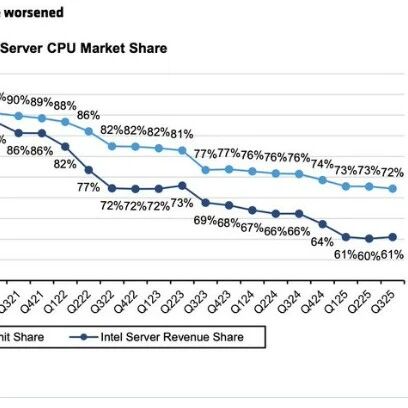
Core Viewpoint - Intel's market share has significantly declined from approximately 90% to 60% over the past eight years, primarily due to competition from AMD and Apple's transition to self-designed Arm architecture processors [1][3]. Market Share Analysis - AMD has steadily been gaining CPU market share, with recent analyses indicating that Apple's notebook CPU sales are now nearly on par with Intel's, each holding about 20% of the market [3]. - Since 2018, AMD and Apple have collectively reduced Intel's market share by over 20% in both the desktop and notebook CPU markets [3]. - Prior to 2018, Intel dominated the desktop CPU market with around 90% share and over 80% in the notebook CPU market; currently, it retains about 60% in both segments [3]. Competitive Landscape - AMD's fourth-generation Zen processors have accelerated its market share growth, while Intel's consumer-grade CPUs have stagnated due to stability issues and a lack of effective response to AMD's 3D V-Cache technology [11]. - AMD's CPUs now account for over 40% of Steam users, indicating strong adoption among gamers [11]. - Apple's M series processors have maintained a stable 10% share in the desktop market since their launch in 2022, reflecting a shift among users favoring Mac computers over Intel models [11]. Future Outlook - Intel's recent launch of the Core Ultra 3 series processors aims to counter the increasing competition from AMD's Ryzen AI 400 series and Apple's M5 processors [12]. - The impact of emerging players like Qualcomm and NVIDIA in the Arm CPU market is anticipated, with Qualcomm set to release a series of Arm-based Windows laptop processors in 2024 [12].

英特尔,有望拿下苹果芯片订单
半导体行业观察· 2026-01-24 02:39
Core Viewpoint - Intel is expected to secure Apple as a major client for its upcoming foundry business, driven by the steady advancement of its next-generation manufacturing processes [1][3]. Group 1: Intel's Manufacturing Process - Intel has released its advanced 14A process node's 0.5 Process Design Kit (PDK), with expectations that clients will officially adopt this technology between the second half of 2026 and the first half of 2027 [3]. - The analyst Jeff Pu anticipates a sufficient external customer reserve for the 14A process, listing potential partners such as Apple, Nvidia, and AMD [3]. - Intel's execution capabilities have improved, laying the groundwork for potential orders, including non-Pro series iPhone chips by 2028 [3]. Group 2: Current Focus and Future Prospects - Before the launch of the 14A process, Intel is focusing on its 18A process, which is showing steady yield improvements, expected to approach 70% by Q1 2026 [3]. - Other analysts, including Ming-Chi Kuo, have reported that Intel may begin delivering low-end M-series chips for Apple using the 18A process as early as 2027 [3]. - Apple is reportedly seeking to diversify its supply chain to mitigate geopolitical risks and control rising costs, making Intel a potential second supplier alongside TSMC [3].
Dow ends lower after topsy-turvy week, as Intel's outlook weighs on market sentiment
The Economic Times· 2026-01-24 02:06
Market Overview - All three Wall Street benchmarks experienced a rebound in the past two sessions after a sharp selloff triggered by U.S. President Donald Trump's tariff threats against European allies [1][12] - On Friday, the Dow Jones Industrial Average fell by 285.30 points, or 0.58%, closing at 49,098.71, while the S&P 500 edged up by 2.26 points, or 0.03%, to 6,915.61 [1][12] - Despite the limited pullback, the S&P 500 was down by 0.36% for the week, the Dow lower by 0.53%, and the Nasdaq slipped by 0.06% [1][12] Investor Sentiment - Investors remain confident in the robustness of the American economy despite geopolitical-induced volatility [2][12] - Jason Blackwell, chief investment strategist at Focus Partners Wealth, expressed a positive outlook for corporate earnings and the economy, while acknowledging potential volatility due to upcoming midterm elections in 2026 [4][5] Corporate Earnings and Market Dynamics - Intel's shares dropped by 17% after the company forecasted quarterly revenue and profit below market estimates, indicating struggles to meet demand for server chips used in AI data centers [6][12] - The technology and semiconductor sectors are under scrutiny as many companies are trading at high valuations, with 2026 seen as a critical year for AI-related revenue growth [7][8][12] - Upcoming earnings reports from major companies, referred to as the "Magnificent Seven," including Apple, Tesla, and Microsoft, are anticipated to be pivotal for investor sentiment [9][12] Sector Performance - Of the S&P sub-sectors, seven ended positively, with materials leading with a 0.9% increase [10][12] - The energy index rose by 0.6% on Friday, marking its third consecutive record closing high, and has advanced by 10.1% so far in 2026, making it the top-performing sub-index for the week [10][12] - Trading volume on U.S. exchanges reached 17.34 billion shares on Friday, slightly above the 17.07 billion average over the last 20 trading days [10][12]

