
JP MORGAN CHASE(JPM)

Search documents
报道:摩根大通近期冻结多家稳定币初创企业账户
Xin Lang Cai Jing· 2025-12-28 11:36
Core Viewpoint - JPMorgan has frozen accounts of at least two rapidly growing stablecoin startups, highlighting the risks associated with cryptocurrency transactions for banks, which must adhere to compliance requirements such as "Know Your Customer" and source of funds checks [1][2]. Group 1: Account Freezing - The two frozen startups are Blindpay and Kontigo, both backed by venture capital firm Y Combinator, focusing primarily on the Latin American market [1][2]. - These startups have established business relationships with JPMorgan through digital payment company Checkbook [1][2]. Group 2: Legal Risks - The operations of these startups in Venezuela and other regions, which are affected by sanctions or other restrictions, pose potential legal risks for JPMorgan [1][2]. - JPMorgan stated that the decision to freeze the accounts is unrelated to the nature of the startups' businesses [1][2]. Group 3: JPMorgan's Position - A spokesperson for JPMorgan emphasized that the matter is not connected to the stablecoin companies themselves, as the bank provides services to stablecoin issuers and collaborates with related businesses [1][2]. - Recently, JPMorgan assisted a stablecoin issuer in completing a public listing [1][2].

JPMorgan's Top 3 Stocks to Crush the Market in 2026
247Wallst· 2025-12-27 13:02
Core Viewpoint - JPMorgan has identified 47 top stock picks for 2026 that are expected to outperform the market significantly [1] Group 1 - The list includes stocks that analysts believe will "crush the market" in 2026 [1] - The selection reflects JPMorgan's strategic insights into market trends and potential high-growth sectors [1] - Analysts have conducted thorough research to identify these stocks based on various performance metrics [1]



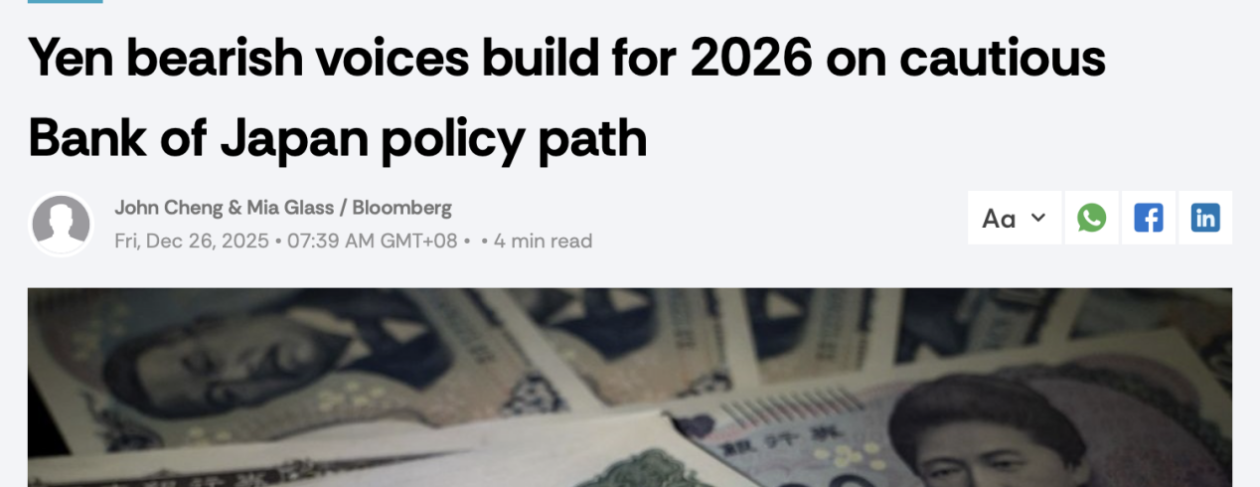
多家国际投行唱空日元 预测明年底或跌破160关口
Huan Qiu Wang· 2025-12-27 01:07
Core Viewpoint - The outlook for the Japanese yen is increasingly pessimistic, with major global investment banks predicting a potential depreciation to 160 yen per dollar or lower by next year due to various economic pressures [1][3]. Group 1: Economic Factors Impacting the Yen - The Bank of Japan's slow interest rate hikes, ongoing capital outflows, and inflation risks driven by fiscal policies are seen as core factors suppressing the yen [3][4]. - Despite a nearly 10% decline in the US dollar index this year, the yen has only slightly rebounded by 0.5%, indicating its weakness [3]. - Market expectations suggest that the next interest rate hike by the Bank of Japan may not be fully priced in until September next year, adding to the uncertainty surrounding the yen [4]. Group 2: Predictions from Analysts - Analysts from JPMorgan and BNP Paribas expect the yen to weaken further, with JPMorgan's Junya Tanase predicting a target of 164 yen per dollar by the end of 2026 [3][5]. - BNP Paribas's Parisha Saimbi anticipates that the macro environment will favor risk appetite, leading to a forecast of 160 yen per dollar by the end of 2026 [4]. Group 3: Capital Outflows and Market Sentiment - There is a notable trend of Japanese retail investors favoring overseas assets, with net purchases through investment trusts at near ten-year highs, which may continue until 2026 [4]. - Corporate capital outflows are also significant, with Japanese companies engaging in high levels of foreign acquisitions this year [4]. - The sentiment in the market remains tense, with speculative pressures on the yen leading to concerns about potential government intervention to stabilize the currency [5].

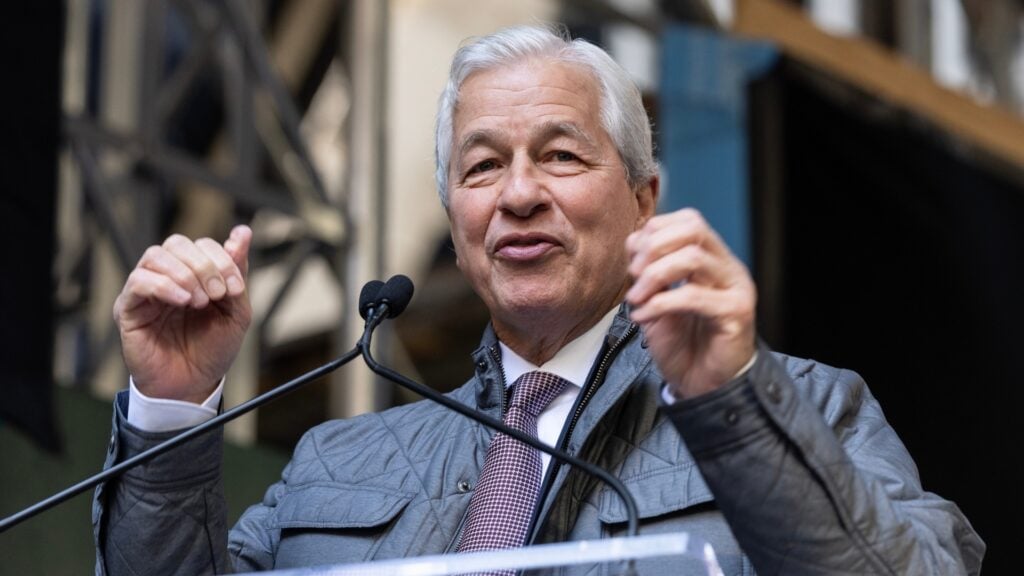
In January, Jamie Dimon Said Bitcoin Is A 'Ponzi'—But Look At JPMorgan's Crypto Moves Now
Benzinga· 2025-12-26 19:53
Core Viewpoint - JPMorgan Chase & Co. continues to expand its blockchain initiatives while CEO Jamie Dimon maintains a skeptical view of Bitcoin, emphasizing its lack of intrinsic value and associating it with illicit activities [1][2]. Group 1: Dimon's Stance on Bitcoin - In 2025, Dimon reiterated his skepticism towards Bitcoin, stating it has no intrinsic value and linking it to negative activities such as sex trafficking and money laundering [2]. - Dimon compared Bitcoin ownership to smoking, indicating that while JPMorgan allows clients to buy digital assets, the bank will not provide custody services for them [2][4]. Group 2: JPMorgan's Blockchain Initiatives - JPMorgan executed an aggressive blockchain expansion strategy, launching the My OnChain Net Yield Fund (MONY) with an initial investment of $100 million, marking its first tokenized money-market fund on the Ethereum blockchain [3]. - The bank is considering offering cryptocurrency trading services to institutional clients, including spot and derivatives, a significant shift from previous policies [4]. Group 3: Institutional Buildout and Market Trends - Throughout 2025, JPMorgan accelerated its institutional buildout, announcing plans to allow Bitcoin and Ethereum as collateral for secured loans and launching JPM Coin for instant money transfers on Coinbase's Base blockchain [5]. - The tokenized treasury market reached approximately $7.3 billion in 2025, reflecting a 256% year-over-year increase, with BlackRock's BUIDL fund leading the space with around $1.8 billion in assets [6]. Group 4: Evolving Views on Blockchain - Despite his criticism of Bitcoin, Dimon's perspective on blockchain technology has softened, acknowledging its legitimacy and potential for widespread adoption [7]. - Dimon differentiates between Bitcoin, which he considers speculative, and blockchain infrastructure, which he views as transformative for institutional finance [8].
受监管放松推动,今年美国六大银行市值增加6000亿美元
Ge Long Hui A P P· 2025-12-26 15:21
Core Viewpoint - The article highlights that the six largest banks in the U.S. are projected to gain a combined market value of $600 billion by 2025, driven by regulatory rollbacks under the Trump administration and a recovery in investment banking [1] Group 1: Market Value Growth - The combined market value of the six largest U.S. banks—JPMorgan Chase, Bank of America, Citigroup, Wells Fargo, Goldman Sachs, and Morgan Stanley—rose to $2.37 trillion as of Tuesday's close, up from $1.77 trillion at the end of last year [1]


摩根大通:预测2026年底日元兑美元汇率为164
Sou Hu Cai Jing· 2025-12-26 13:46
本文由 AI算法生成,仅作参考,不涉投资建议,使用风险自担 【12月26日摩根大通策略师悲观预测日元兑美元汇率】12月26日,摩根大通首席日本外汇策略师Junya Tanase称,日元基本面相当疲软,明年改观不大。他预测2026年底日元兑美元汇率为164,此为华尔街 一众策略师中最悲观的预测。他还指出,明年周期性因素或进一步打压日元,限制日本央行收紧货币政 策的影响,且市场已开始将其他地区利率上行预测纳入定价。 ...
9 Top ETFs for Income Investors That Stood Out in 2025
Youtube· 2025-12-26 10:00
Group 1: Dividend ETFs - The discussion highlights the appeal of dividend ETFs for income investors, focusing on their risk-reward profiles and exposure to factors like value, quality, and low volatility [2][4] - Four dividend ETFs received top ratings from Morning Star, including Vanguard's Dividend Appreciation ETF (VIG) and its international counterpart (VIGI), which emphasize companies with a long track record of increasing dividend payments [7][8] - The Vanguard High Dividend Yield ETF targets companies with above-average dividend payouts while maintaining a diversified portfolio, balancing yield and risk [10][12] Group 2: Bond ETFs - Bond ETFs are experiencing significant inflows, with approximately one trillion dollars invested in ETFs this year, of which 30-33% is directed towards bond ETFs [15][16] - Core bond ETFs, such as Vanguard Total Bond Market ETF (BND) and iShares Core US Aggregate Bond ETF (AG), are recommended for their low volatility and broad exposure to the bond market [22] - Fidelity Total Bond ETF (FBND) is highlighted as a top pick in the Core Plus category, offering higher yield with slightly increased risk [27] Group 3: Covered Call ETFs - Covered call ETFs are gaining popularity due to their attractive yields, which are often higher than those of traditional dividend or bond funds [41][42] - The JP Morgan Equity Premium Income ETF (JEPPY) is noted for its competitive expense ratio and effective management strategy, making it a solid choice among covered call ETFs [51][52] - Investors should be aware of the trade-offs associated with covered call strategies, including potential caps on long-term growth in exchange for immediate income [49][50]

美国各大银行首席执行官谈人工智能对员工规模的影响
Xin Lang Cai Jing· 2025-12-26 09:20
Core Viewpoint - The CEOs of major U.S. banks are optimistic about the transformative efficiency changes that artificial intelligence (AI) can bring to the industry, but there are concerns about potential job reductions for bank employees [1][16]. Group 1: Statements from JPMorgan Chase - Jamie Dimon, CEO of JPMorgan Chase, stated that job cuts are inevitable due to the AI wave, emphasizing that AI will eliminate certain positions [3][17]. - Dimon mentioned that AI could serve as a "work assistant" and take over tedious tasks, potentially leading to job losses [3][17]. - In the short term, if AI implementation goes smoothly, JPMorgan Chase's employee count may remain stable or even slightly increase [3][17]. - The core goal of JPMorgan Chase's AI strategy is to enhance operational efficiency, with expectations of a 40% to 50% increase in productivity in the operations department over the next five years [4][19]. - The company is focusing on controlling hiring and shifting towards efficiency improvements [5][19]. Group 2: Statements from Goldman Sachs - David Solomon, CEO of Goldman Sachs, indicated that AI will be a key driver for efficiency improvements, which may lead to a slowdown in hiring and the streamlining of certain roles [6][20]. - Solomon believes that while AI will reduce manpower in some areas, it will also allow the firm to focus on attracting high-value talent for customer service [7][21]. - Goldman Sachs expects to see employee growth by the end of 2025, despite the current focus on optimizing recruitment structures [6][20]. Group 3: Statements from Citigroup - Jane Fraser, CEO of Citigroup, expressed that AI is expected to significantly enhance work efficiency in the short term and reshape all business segments in the long term [9][24]. - Fraser reported that AI has already led to over 1 million automated code reviews this year, saving approximately 100,000 hours of work per week [10][25]. - She acknowledged concerns that AI might initially compress job positions before the industry realizes its benefits, noting that the current AI penetration rate is only 10% [10][25][11][26]. Group 4: Statements from Wells Fargo - Charles Scharf, CEO of Wells Fargo, indicated that the bank's workforce has already decreased by nearly 25% since he took over in 2019, and this trend is likely to continue [12][27]. - Scharf emphasized that the potential of AI is undeniable and that many in the industry are aware that it will lead to job reductions [13][28]. - He noted that AI tools have improved the efficiency of engineers by 30% to 35%, allowing the bank to accomplish more with fewer employees [13][28]. Group 5: Statements from Bank of America - Brian Moynihan, CEO of Bank of America, stated that the implementation of AI has already led to reductions in workforce in certain departments [14][29]. - The bank's strategy focuses on employee training to prepare them for roles that AI cannot replace, emphasizing the importance of skill development [15][30]. - Moynihan highlighted that the bank's digital interactions reached 1.4 billion in November, which has saved approximately 11,000 full-time equivalent positions [15][30].
“AI裁员潮”即将到来!华尔街大行掌门人坦承,岗位削减不可避免
智通财经网· 2025-12-26 09:08
Core Insights - The discussion around artificial intelligence (AI) by CEOs of major banks indicates a significant shift in the financial industry, with predictions that generative AI will enhance or replace human jobs, impacting nearly 200 million employees in the banking sector [1] Group 1: CEO Perspectives on AI and Employment - Jamie Dimon, CEO of JPMorgan Chase, openly acknowledges that AI will eliminate jobs, stating that people should not avoid this reality. He emphasizes that AI will change job roles and improve efficiency, potentially stabilizing or even increasing the workforce if managed well [2] - Mary Erdoes, President of JPMorgan Chase, predicts a 40% to 50% productivity increase in operational departments over the next five years, but clarifies that this will not lead to mass layoffs, rather a slowdown in net workforce growth [3] - David Solomon, CEO of Goldman Sachs, indicates that AI will drive efficiency improvements, leading to slower hiring and job reductions. He believes that while some roles may be significantly reduced, the economy will adapt and create new jobs [5][6] Group 2: Company Strategies and AI Implementation - Goldman Sachs is focusing on controlling workforce growth and enhancing efficiency through AI, with a goal to find the best team structure and agility. The company expects to increase its total employee count by the end of 2025, despite slowing hiring [5] - Jane Fraser, CEO of Citigroup, highlights that generative AI will greatly enhance productivity in the short term and could fundamentally change various banking functions in the long term. She notes that AI-driven automation has already saved approximately 100,000 work hours weekly [6][7] - Charlie Scharf, CEO of Wells Fargo, acknowledges that the bank has reduced its workforce by nearly a quarter since 2019 and anticipates this trend will continue, emphasizing that AI will create significant opportunities for efficiency [8] Group 3: Training and Workforce Adaptation - Brian Moynihan, CEO of Bank of America, recognizes that while AI has led to some departmental reductions, the focus is on retraining employees for roles that AI cannot replace. The bank is prioritizing multi-dimensional training to adapt to the changing landscape [9]
日元没有“速效药”!日本央行渐进紧缩难逆转结构性颓势 华尔街唱空声浪高涨
Zhi Tong Cai Jing· 2025-12-26 02:06
Core Viewpoint - The recent interest rate hike by the Bank of Japan has failed to provide sustained support for the yen, leading to increased bearish sentiment towards the currency, with predictions of further depreciation against the dollar by 2026 [1][2]. Group 1: Economic Factors - Analysts from major financial institutions, including JPMorgan and BNP Paribas, predict that the yen could weaken to 160 yen per dollar or lower by the end of 2026 due to persistent factors such as significant US-Japan interest rate differentials, negative real interest rates, and ongoing capital outflows [1][2]. - The yen has seen a slight increase of less than 1% against the dollar this year after four consecutive years of decline, but expectations for a reversal driven by the Bank of Japan's rate hikes and potential Fed rate cuts have not materialized [1][2]. - The return of arbitrage trading, where investors borrow low-yielding yen to invest in higher-yielding currencies, is creating additional headwinds for the yen [2]. Group 2: Market Sentiment - Market sentiment remains cautious, with the overnight index swap indicating that the next rate hike by the Bank of Japan is not fully priced in, expected at the earliest in September [2]. - The ongoing high inflation in Japan, which exceeds the Bank of Japan's 2% target, continues to exert pressure on Japanese government bonds [2]. - Japanese retail investors are showing a strong preference for overseas assets, with net purchases through investment trusts hovering around 9.4 trillion yen (approximately 60 billion USD), a ten-year high, which is likely to persist and further suppress the yen [3]. Group 3: Long-term Predictions - Some analysts, including those from Goldman Sachs, believe that the yen may eventually strengthen to 100 yen per dollar over the next decade, although they acknowledge the presence of multiple short-term negative factors [4]. - Concerns about intervention risks are rising as the yen approaches levels that previously prompted official action, but experts suggest that intervention alone may not be sufficient to reverse the yen's downward trend [4][5].