JP MORGAN CHASE(JPM)

Search documents
日元没有“速效药”!日本央行渐进紧缩难逆转结构性颓势 华尔街唱空声浪高涨
Zhi Tong Cai Jing· 2025-12-26 02:06
Core Viewpoint - The recent interest rate hike by the Bank of Japan has failed to provide sustained support for the yen, leading to increased bearish sentiment towards the currency, with predictions of further depreciation against the dollar by 2026 [1][2]. Group 1: Economic Factors - Analysts from major financial institutions, including JPMorgan and BNP Paribas, predict that the yen could weaken to 160 yen per dollar or lower by the end of 2026 due to persistent factors such as significant US-Japan interest rate differentials, negative real interest rates, and ongoing capital outflows [1][2]. - The yen has seen a slight increase of less than 1% against the dollar this year after four consecutive years of decline, but expectations for a reversal driven by the Bank of Japan's rate hikes and potential Fed rate cuts have not materialized [1][2]. - The return of arbitrage trading, where investors borrow low-yielding yen to invest in higher-yielding currencies, is creating additional headwinds for the yen [2]. Group 2: Market Sentiment - Market sentiment remains cautious, with the overnight index swap indicating that the next rate hike by the Bank of Japan is not fully priced in, expected at the earliest in September [2]. - The ongoing high inflation in Japan, which exceeds the Bank of Japan's 2% target, continues to exert pressure on Japanese government bonds [2]. - Japanese retail investors are showing a strong preference for overseas assets, with net purchases through investment trusts hovering around 9.4 trillion yen (approximately 60 billion USD), a ten-year high, which is likely to persist and further suppress the yen [3]. Group 3: Long-term Predictions - Some analysts, including those from Goldman Sachs, believe that the yen may eventually strengthen to 100 yen per dollar over the next decade, although they acknowledge the presence of multiple short-term negative factors [4]. - Concerns about intervention risks are rising as the yen approaches levels that previously prompted official action, but experts suggest that intervention alone may not be sufficient to reverse the yen's downward trend [4][5].


2026年全球市场怎么走?摩根大通眼中的资产大洗牌
Jin Shi Shu Ju· 2025-12-25 07:44
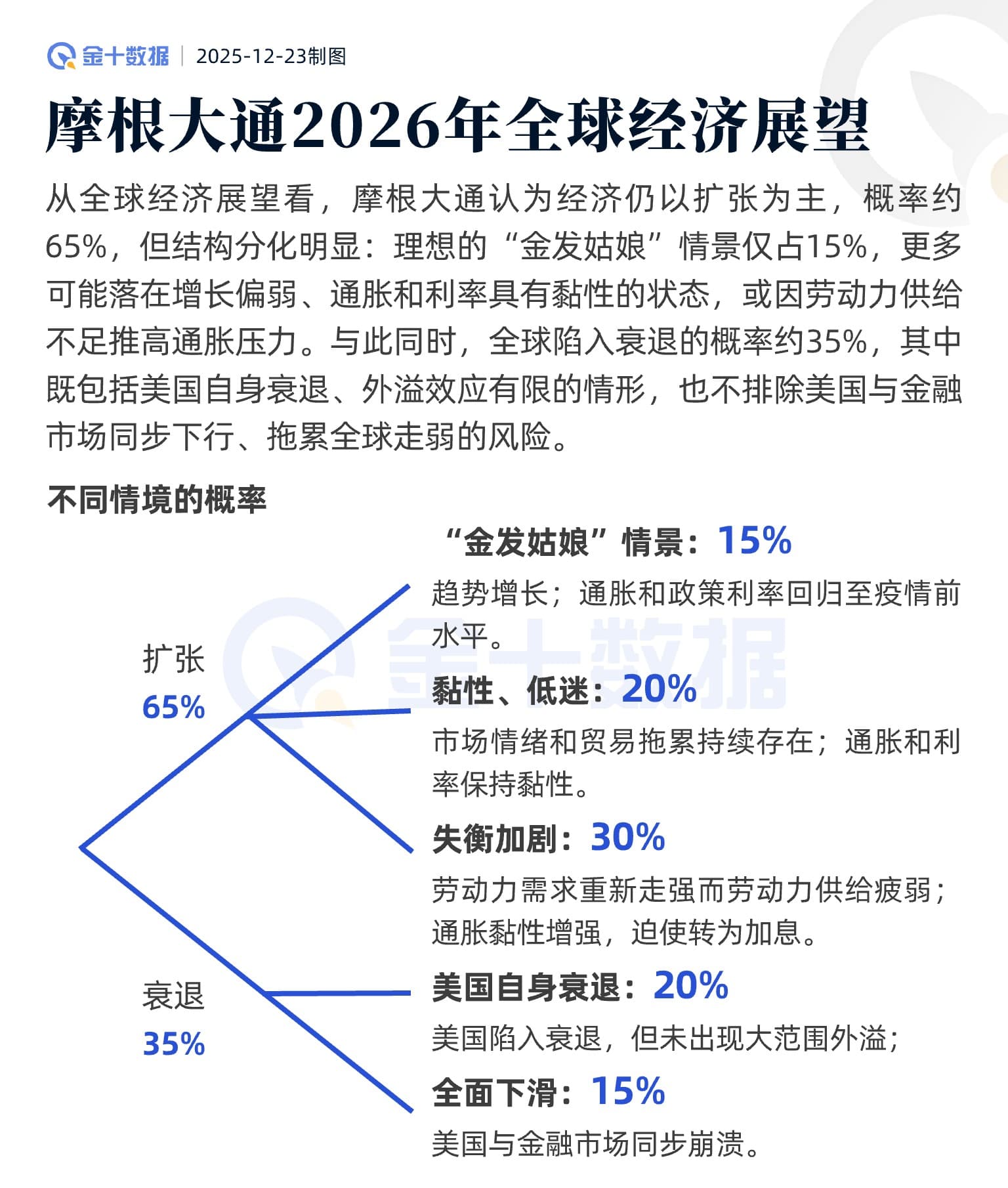
Global Market Outlook - The global market in 2026 is characterized by a blend of resilience and risks, influenced by divergent monetary policies, the acceleration of AI, and structural market differentiation [1][2] - Morgan Stanley anticipates that fiscal stimulus and robust corporate and household balance sheets will support continued global growth, despite weakening corporate confidence and a slowing labor market [1][2] Stock Market - Morgan Stanley holds a positive outlook for the global stock market in 2026, expecting double-digit gains in both developed and emerging markets driven by strong earnings growth, declining interest rates, and the ongoing rise of AI [7] - The AI-driven supercycle is expected to propel record capital expenditures and rapid earnings expansion across various sectors, creating both winners and losers [7] - The S&P 500 index is projected to see a 13%-15% super trend earnings growth over the next two years due to the AI supercycle [7] Economic Outlook - The global economy is at a critical juncture, with structural imbalances emerging as demand shifts towards technology capital expenditures and employment growth stagnates [12] - Morgan Stanley estimates a 35% probability of recession in the U.S. and globally in 2026, although fiscal stimulus is expected to boost GDP growth in the first half of 2026 [12][13] Interest Rate Market Predictions - Morgan Stanley predicts that most developed markets will see economic growth at or above potential levels in 2026, with inflation continuing to decline but remaining sticky in some economies [14] - The U.S. Federal Reserve is expected to lower interest rates by 50 basis points, while the Bank of Japan may raise rates by 50 basis points [14] Commodity Predictions - Global oil demand is expected to increase by 900,000 barrels per day in 2026, with supply growth anticipated to outpace demand growth significantly [17] - Morgan Stanley maintains a Brent crude oil price forecast of $58 per barrel for 2026, with gold prices projected to rise to $5,000 per ounce by the fourth quarter of 2026 [17][19]

多家机构预期:2026年金价继续上涨
Sou Hu Cai Jing· 2025-12-25 06:58
Group 1 - The core viewpoint of the articles indicates a sustained trend in using gold to hedge against risks associated with dollar-denominated assets, with expectations for gold prices to rise further by 2026 [1] - Analysts from Schroders highlight that the U.S. is facing "policy uncertainty, fiscal fragility, and increasing investor doubts about the long-term role of U.S. Treasuries and the dollar," making gold a preferred choice for asset diversification due to its safe-haven properties and low correlation with traditional assets [1] - Goldman Sachs predicts that by the end of 2026, gold prices will reach approximately $4,900 per ounce, driven by strong structural demand from central bank purchases and cyclical support from potential Federal Reserve rate cuts [1] - JPMorgan forecasts that gold prices could rise to $5,055 per ounce by Q4 2026, with potential further increases up to $6,000 per ounce, emphasizing a clear long-term trend of gold allocation by official reserves and investors [1] - Forbes notes that global trade tensions initiated by the U.S., the rise of "de-dollarization" transactions to avoid dollar depreciation, increased demand for gold from private investors and cryptocurrency funds, and ongoing central bank purchases are significant drivers for the upward movement in gold prices [1] Group 2 - Reuters reports that the U.S. dollar index has declined by 9% since the beginning of 2025, potentially marking its worst annual performance in eight years [2] - The market widely anticipates that the new Federal Reserve chair may lean towards a dovish monetary policy stance, which could further weaken the dollar and reduce the attractiveness of dollar-denominated assets for investors [2]
多家机构预期2026年美元资产吸引力减弱 金价继续上涨
Xin Hua Wang· 2025-12-25 06:40
Group 1 - The core viewpoint of the articles indicates a sustained trend in using gold to hedge against risks associated with dollar-denominated assets, with expectations for gold prices to rise further by 2026 [1] - Analysts from Schroders highlight that the U.S. is facing "policy uncertainty, fiscal fragility, and increasing investor doubts about the long-term role of U.S. Treasuries and the dollar," making gold a preferred choice for asset diversification due to its safe-haven properties and low correlation with traditional assets [1] - Goldman Sachs projects that by the end of 2026, gold prices could reach approximately $4,900 per ounce, driven by strong structural demand from central bank purchases and cyclical support from potential Federal Reserve rate cuts [1] - JPMorgan forecasts that gold prices may rise to $5,055 per ounce by the fourth quarter of 2026, with potential further increases up to $6,000 per ounce, emphasizing a clear long-term trend of gold allocation by official reserves and investors [1] - Forbes notes that global trade tensions initiated by the U.S., the rise of "de-dollarization" transactions to avoid dollar depreciation, increased demand for gold from private investors and cryptocurrency funds, and ongoing central bank purchases are significant drivers for the upward movement of gold prices [1] Group 2 - Reuters reports that the U.S. dollar index has declined by 9% since the beginning of 2025, potentially marking its worst annual performance in eight years [2] - The market widely anticipates that the new Federal Reserve chairman may lean towards a dovish monetary policy stance, which could further weaken the dollar and reduce the attractiveness of dollar-denominated assets for investors [2]

全球数据_中国关税后的出口多元化程度超预期-GDW Asia_ China‘s post-tariff export diversification is broader than presumed
2025-12-25 02:41
Summary of Key Points from J.P. Morgan's Global Data Watch: Asia Industry Overview - **Industry**: Chinese Export Market - **Context**: Analysis of China's export diversification post-US tariffs Core Insights 1. **Export Growth**: Despite US tariffs averaging ~32%, China's goods exports grew by 5% in 2025, consistent with the previous year's growth [1][11] 2. **Redirection of Exports**: China's direct export share to the US decreased by one-third in 2025, from 15% to 10%, leading to a redirection of exports to other markets [1][11] 3. **Broader Diversification**: The decline in US export share was offset by increases in market share across Africa, Asia, and Europe, indicating a broader diversification than previously assumed [1][11] 4. **Impact on Domestic Manufacturing**: Increased Chinese exports are creating pressures on local manufacturing sectors in Asia, evidenced by rising trade barriers on Chinese imports [1][11] 5. **ASEAN Economies**: ASEAN countries, due to strong economic ties with China, are unlikely to push back against increased Chinese imports despite the pressures on their manufacturing bases [1][11] Additional Important Points 1. **Economic Ties**: The strong economic connections between ASEAN economies and China as a source of foreign direct investment (FDI) and as an export market are highlighted [1][11] 2. **Trade Barriers**: The increase in trade barriers on Chinese imports suggests a growing concern among Asian countries regarding the impact of Chinese exports on their local industries [1][11] 3. **Long-term Trends**: The increase in exports to Asia reflects a secular rise over the last decade, with shipments to Asia now making up almost a third of China's export basket [1][11] Economic Forecasts 1. **China's GDP Forecast**: The 4Q GDP forecast for China is maintained at 3.0% quarter-on-quarter seasonally adjusted annual rate (saar) or 4.2% year-on-year (yoy) for 2025, with net exports contributing 1.4 percentage points [11][12] 2. **Fiscal Spending**: Year-to-date fiscal deposits are elevated at 2.04 trillion yuan, indicating weak fiscal spending, which may lead to higher unused funds carrying over into the next year [12][11] This summary encapsulates the key insights and implications regarding China's export dynamics and its impact on regional economies, particularly in the context of ongoing trade tensions and economic forecasts.
国际银行巨头大力扩张贵金属交易业务
Qi Huo Ri Bao· 2025-12-24 22:59
Group 1 - The core viewpoint of the articles highlights the significant increase in gold and silver prices, prompting major international banks to expand their precious metals trading and logistics capabilities to capitalize on the opportunity [1][2] - The international spot gold price surpassed $4500 per ounce on October 24, marking a historic high, and the precious metals trading revenue for 12 leading banks reached approximately $1.4 billion in the first nine months of this year [1] - The year 2025 is projected to be the second most profitable year for gold trading on record, following 2020, indicating a strong market interest in precious metals [1] - Major banks, including Societe Generale, Morgan Stanley, and Mitsui, have expanded their precious metals teams this year, reflecting a renewed interest in the sector [1] - The perception of owning vaults has shifted from being seen as a dull and low-profit business to a lucrative opportunity, with some banks, including Citigroup, considering opening vaults [1] Group 2 - JPMorgan Chase's relocation of its precious metals trading department to Singapore has shocked the industry, indicating a broader shift in international finance where Asian markets are increasingly challenging Western dominance [2] - Gold has significantly outperformed Bitcoin this year, with gold prices rising by 70% in USD terms, while Bitcoin has seen a decline of 6% [2] - The divergence in the performance of gold and Bitcoin became evident in October, when Bitcoin experienced a rapid sell-off and failed to rebound, leading to a loss of over $1 trillion in the entire cryptocurrency market within six weeks [2]
S&P 500 Hits All-Time Highs On Christmas Eve, VIX Drops To One-Year Low - Apple (NASDAQ:AAPL)
Benzinga· 2025-12-24 16:35
Market Performance - The S&P 500 reached a new record, climbing past 6,920 points with a year-to-date gain of 17% [1] - Other major indices also saw modest gains, indicating a potential fifth consecutive session of increases as the year ends [2] - The CBOE Volatility Index (VIX) fell to 13.7, the lowest level since mid-December 2024, reflecting reduced market anxiety [2] Notable Stock Movements - Top gainers in the S&P 500 included Sandisk Corp. and Nike Inc., both rising approximately 5% [2] - Nike shares increased following Apple CEO Tim Cook's purchase of 50,000 shares at $58.97 each [3] - Micron Technology extended its post-earnings rally to 27% over the past five sessions, gaining an additional 4% [3] Banking Sector Highlights - Major banks like Citigroup, J.P. Morgan Chase, Wells Fargo, and Bank of America reached record levels, with Citigroup marking its sixteenth gain in the past seventeen sessions [3][4] Precious Metals and Crypto Markets - Precious metals experienced a pause in their rally, with gold slipping 0.4% after reaching an intraday high of $4,525 per ounce, and silver falling 0.8% after hitting $72.69 [4] - In the crypto market, Bitcoin decreased by 0.9% to around $87,000, marking a 7% decline year-to-date [5] ETF Performance - The Vanguard S&P 500 ETF rose 0.2% to $633.80, while the SPDR Dow Jones Industrial Average ETF gained 0.4% to $486.07 [7]



Is JPMorgan Stock a Buy for 2026 as it Hits an All-Time High?
ZACKS· 2025-12-24 14:56
Core Insights - JPMorgan's shares reached an all-time high of $327.78, driven by optimism regarding the easing rate cycle, stronger U.S. GDP growth, and potential entry into the crypto trading business [1][10] Performance Comparison - Over the past six months, JPMorgan shares have increased by 14.8%, while the S&P Index gained 15.7%. In comparison, Bank of America and Citigroup saw increases of 19.5% and 44.5%, respectively [2] Valuation Metrics - JPMorgan's stock trades at a price-to-tangible book (P/TB) ratio of 3.27X, above the industry average of 3.20X. Bank of America and Citigroup have P/TB ratios of 2.04X and 1.30X, respectively [5] - The Value Score of F indicates that JPMorgan's stock is not considered cheap, suggesting a stretched valuation [5] Business Model Resilience - JPMorgan operates across multiple segments, including consumer banking, commercial banking, investment banking, and wealth management, providing diverse revenue streams that enhance its resilience [11] - The bank benefits from a stable deposit base, with a loans-to-deposit ratio of 56% as of September 30, 2025, allowing for low-cost funding [12] - Approximately 45% of total net revenues come from fee-based income, which enhances stability and reduces reliance on interest-rate dynamics [13] Growth Strategy - JPMorgan is expanding its branch network, opening nearly 150 branches in 2024 and planning to add 500 more by 2027 to strengthen its competitive edge [14] - The bank has consistently delivered industry-leading returns through disciplined risk management and a focus on high-quality lending [15] Profitability Expectations - Despite expected pressure on net interest income (NII) due to declining rates, JPMorgan anticipates NII to be nearly $92.2 billion in 2025 and $95 billion in 2026 [16] - Non-interest income streams from trading, investment banking, payments, and wealth management provide additional earnings stability [17] Leadership and Execution - Under Jamie Dimon's leadership, JPMorgan has emphasized conservatism and capital strength, enabling it to outperform competitors during crises [18] - The bank's strong balance sheet includes total debt of $496.6 billion and cash and deposits of $303.4 billion as of September 30, 2025 [19] Shareholder Returns - JPMorgan has increased its quarterly dividend by 7% to $1.50 per share and authorized a new share repurchase program worth $50 billion [20] - The bank has raised dividends six times in the last five years, with an annualized growth rate of 8.94% [21] Earnings Estimates - The Zacks Consensus Estimate for JPMorgan's earnings in 2025 is $20.32, with a slight decline to $21.03 for 2026, indicating elevated non-interest expense expectations [25] - The consensus for revenue growth suggests increases of 2.8% in 2025 and 3.9% in 2026 [25] Investment Consideration - Despite its premium valuation, JPMorgan's size, diversification, and track record make it a reasonable core holding for a multi-year horizon [29]

JPMorgan Mulls Entering Crypto Trading Business: What Does This Mean?
ZACKS· 2025-12-24 14:01
Key Takeaways JPMorgan is considering offering crypto trading, including spot and derivatives, to its institutional clients.JPM sees easing regulation and rising institutional demand as banks gain room to offer crypto services rules.JPMorgan's entry could add liquidity, improve execution and tighten spreads while intensifying competition.Earlier this month, when the Office of the Comptroller of the Currency ("OCC") issued new guidance allowing banks to act as crypto brokers, it was only a matter of time bef ...

JPMorgan Considers Offering Bitcoin and Crypto Trading Services
Crowdfund Insider· 2025-12-24 13:56
JPMorgan Chase & Co. (NYSE:JPM), the largest U.S. bank in terms of assets and scope of operations, is assessing the potential to provide cryptocurrency trading services to its institutional clients. This move involves evaluating spot and derivatives products for assets like Bitcoin (BTC) and Ethereum (ETH), according to sources familiar with the discussions.The bank’s markets division is reportedly examining how to broaden its digital asset offerings amid rising demand from hedge funds, asset managers, and ...