
Moody’s(MCO)

Search documents
意大利有望迎穆迪23年来首次上调评级
Ge Long Hui A P P· 2025-11-20 07:13
Core Viewpoint - Moody's is set to review Italy's credit rating, with the possibility of an upgrade for the first time in nearly 25 years, reflecting increasing market confidence in the country's public finances [1] Group 1: Credit Rating Review - Moody's will conduct a credit rating review for Italy on Friday, potentially leading to an upgrade [1] - The last upgrade occurred in May 2002 when Moody's adjusted Italy's rating from Aa3 to Aa2, and since then, there has been no increase [1] - Italy's current rating remains at "Baa3," the lowest tier of investment grade, which has not changed since the downgrade in October 2018 [1] Group 2: Economic Indicators - In May, Moody's raised Italy's rating outlook from "stable" to "positive," while maintaining the "Baa3" rating, citing stronger-than-expected fiscal performance and a stabilizing political environment [1] - The Meloni government has revised the 2025 budget deficit target down to 3% of GDP, ahead of the EU's deadline [1] Group 3: Market Sentiment - Unicredit Bank noted that a potential rating upgrade would further confirm the positive trend in Italy's overall credit assessment [1] - Among major rating agencies, Moody's remains the most cautious regarding Italy's credit outlook [1]

Moody's Stock: Is Wall Street Bullish or Bearish?
Yahoo Finance· 2025-11-19 12:46
Core Insights - Moody's Corporation (MCO) has a market cap of $83.9 billion and operates through two segments: Moody's Analytics and Moody's Investors Service, providing credit ratings, data, analytics, and SaaS-based risk-management solutions [1] Stock Performance - Over the past 52 weeks, MCO shares have underperformed the broader market, declining slightly while the S&P 500 Index increased by 12.3% [2] - Year-to-date, MCO shares are also down compared to the S&P 500's 12.5% gain [2] - MCO shares have lagged behind the Financial Select Sector SPDR Fund's 2.7% rise over the same period [3] Financial Performance - Moody's reported Q3 2025 adjusted EPS of $3.92 and revenue of $2.01 billion, exceeding expectations [4] - The company raised its full-year outlook for adjusted EPS to between $14.50 and $14.75, projecting high-single-digit revenue growth [4] - The ratings business saw an 11% revenue increase, driven by strong bond issuance and tight credit spreads [4] Analyst Expectations - For the fiscal year ending December 2025, analysts expect Moody's adjusted EPS to grow by 17.4% year-over-year to $14.64 [5] - Moody's has a promising earnings surprise history, beating consensus estimates in the last four quarters [5] - Among 23 analysts covering the stock, the consensus rating is a "Moderate Buy," with 11 "Strong Buy" ratings, one "Moderate Buy," and 11 "Holds" [5] Price Target - Mizuho analyst Sean Kennedy raised Moody's price target to $550 while maintaining a "Neutral" rating [6] - The mean price target of $539 represents a 14.6% premium to MCO's current price levels [6] - The highest price target of $620 suggests a potential upside of 31.9% [6]
Moody's Corporation (MCO) Presents at J.P. Morgan 2025 Ultimate Services Investor Conference Transcript
Seeking Alpha· 2025-11-18 20:49
Core Insights - The discussion highlights a positive trend in issuance and ratings revenues, which have exceeded initial expectations for the year [2] Group 1 - The expectations for issuance and ratings revenues were initially modest at the beginning of the year [2] - As the year progressed, the actual issuance has shown robust growth, indicating a significant upside compared to initial forecasts [2]



Moody’s (NYSE:MCO) 2025 Conference Transcript
2025-11-18 19:22
Summary of Moody's Conference Call Company Overview - **Company**: Moody's Corporation (NYSE: MCO) - **Event**: Info Services Track of the Ultimate Service Investor Conference - **Date**: November 18, 2025 Key Points Industry Insights - **M&A Activity**: There has been a significant increase in M&A activity in the second half of the year, contrary to initial expectations. This includes both strategic and sponsor-backed M&A, which positively impacts issuance volumes [7][10] - **Economic Growth**: Economic growth has slowed but remains better than market expectations, contributing to a favorable environment for debt issuance [7][8] - **Default Rates**: Default rates are slightly above long-term averages but have been decreasing, which is conducive for issuance [8] - **Issuance Trends**: The strongest issuance has been in the corporate segment, particularly in investment-grade and leveraged finance [8] Financial Performance - **Revenue Growth**: Moody's anticipates medium-term organic revenue growth targets of high single digits to low double digits, with a focus on areas with strong growth potential [18][19] - **Refinancing Needs**: A significant amount of debt issued over the past five years will need refinancing, which supports future issuance [11][12] AI and Technology - **AI Opportunities**: The company views AI as a significant opportunity to monetize proprietary data and analytics, enhancing customer engagement and expanding use cases [20][21][26] - **Digital Fulfillment**: Moody's is developing a digital fulfillment model to better serve customers and monetize content across various platforms [30][31] Market Dynamics - **Investor Sentiment**: There is growing interest among investors regarding the credit quality of private credit funds, indicating a shift in focus towards understanding credit risk [48][59] - **Partnership with MSCI**: The collaboration aims to provide Moody's modeled credit ratings to investors in private credit, enhancing their understanding of credit risk [49][50] Challenges and Considerations - **Two-Speed Economy**: The U.S. economy is experiencing a two-speed dynamic, with disparities in growth across different sectors, particularly between the AI-driven economy and traditional sectors [15] - **Structured Finance Outlook**: There has been a modest reduction in the outlook for structured finance and public category issuance, attributed to slower growth in consumer finance [14][15] Strategic Focus - **Investment Areas**: Moody's plans to invest in segments with the strongest growth potential, including banking, lending, and insurance [19][38] - **Proprietary Data Utilization**: The company emphasizes the value of its proprietary data in various applications, including risk assessment and credit modeling [37][40] Conclusion - Moody's is positioned to leverage its proprietary data and analytics capabilities to navigate the evolving market landscape, particularly in the context of increasing M&A activity and the integration of AI technologies. The focus on understanding credit risk in private credit markets presents a significant opportunity for growth and engagement with investors [58][59]
The Best Warren Buffett Stocks to Buy With $2,500 Right Now
Yahoo Finance· 2025-11-17 13:10
Group 1: Warren Buffett and Berkshire Hathaway - Warren Buffett has delivered compound annual returns of nearly 20% for Berkshire Hathaway since becoming CEO in 1965, with an investment of $100 growing to over $5.5 million today [1] - Buffett is stepping down as CEO at the end of this year, leaving behind a unique legacy [2] Group 2: Visa - Visa holds a leading market position in the global digital payments landscape, with total payment volume exceeding $14.2 trillion last year, outpacing competitors like Mastercard and American Express [4] - Visa benefits from strong network effects, collecting small fees on transactions without significant capital expenditures, resulting in high profit margins [5] - The company is well-positioned to benefit from rising digital transaction volumes, which increase during economic growth and inflationary periods, ensuring continued shareholder rewards [6] Group 3: Moody's - Moody's operates as one of the largest credit rating agencies in the U.S., controlling 80% of the overall credit ratings market in a duopoly with S&P Global, while Fitch Ratings holds a 12.5% share [9]

伯克希尔最新调仓动向曝光!首次建仓谷歌母公司
Ge Long Hui· 2025-11-15 03:41
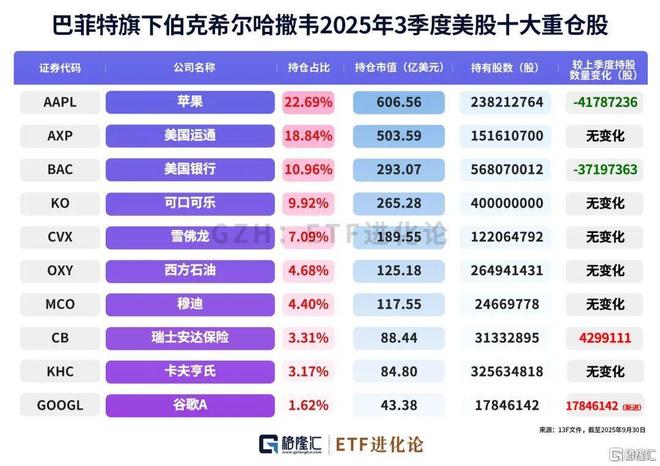
Group 1 - Berkshire Hathaway's latest investment strategy reveals a total of 41 stocks held in the U.S. market, with a combined market value of $267 billion as of the end of Q3 [1] - In Q3, Berkshire purchased 17.85 million shares of Alphabet, with a holding value of approximately $4.34 billion, making it the 10th largest position in the portfolio [1] - Berkshire has reduced its stake in Apple by selling 41.79 million shares in Q3, more than doubling the amount sold compared to Q2, yet still holds over 238 million shares valued at approximately $60.66 billion, maintaining Apple as its largest holding [1][2] Group 2 - The top ten holdings of Berkshire Hathaway account for 87% of its portfolio, including Apple, American Express, Bank of America, Coca-Cola, Chevron, Occidental Petroleum, Moody's, Chubb, Kraft Heinz, and Alphabet [2][3] - Chubb is the only stock among the top ten that saw an increase in holdings, with an additional 4.29 million shares acquired, raising its holding percentage to 3.31% [3] Group 3 - Warren Buffett's annual letter to shareholders reflects on his life and investment philosophy, emphasizing the importance of kindness and philanthropy, while also announcing plans to convert more Berkshire A shares into B shares for charitable donations [4][5] - Buffett reassures shareholders of his confidence in the U.S. economy and Berkshire's resilience, stating that volatility is not risk, but panic is [5]




Top Wide-Moat Stocks to Invest in for Long-Term Wealth and Stability
ZACKS· 2025-11-12 16:26
Core Concept - The article discusses the concept of "wide moats," which refers to companies with durable competitive advantages that protect them from rivals and support lasting profitability [1][3]. Group 1: Companies with Wide Moats - Lam Research Corporation (LRCX), ASML Holding N.V. (ASML), NVIDIA Corporation (NVDA), and Moody's Corporation (MCO) are highlighted as examples of companies with wide economic moats [2]. - These companies operate in industries with significant barriers to entry, which help safeguard their market positions and promote consistent revenue growth [2][3]. Group 2: Competitive Advantages - Firms with wide economic moats benefit from brand power, cost efficiency, network effects, regulatory protection, and economies of scale, making it difficult for newcomers to capture market share [3]. - Such companies typically maintain robust pricing power, steady profit margins, and ample capacity to reinvest in growth, reinforcing their long-term dominance [3][4]. Group 3: Investment Appeal - Investing in wide-moat companies is appealing due to their ability to generate stable, long-term returns, especially during economic slowdowns and market volatility [4][5]. - These firms tend to produce reliable cash flows, weather market fluctuations effectively, and reward shareholders through consistent dividends and stock price appreciation [5]. Group 4: Lam Research Corporation - Lam Research specializes in wafer fabrication equipment, particularly in etch and deposition technologies critical to semiconductor manufacturing, benefiting from deep expertise and long-term customer relationships [7]. - The company is positioned to capitalize on the growing semiconductor memory market driven by advancements in AI, machine learning, and cloud computing, leading to increased demand for memory chips [8][9]. Group 5: ASML Holding N.V. - ASML is a vital supplier to the semiconductor industry, holding a near-monopoly on extreme ultraviolet (EUV) lithography, essential for producing advanced chips at 3nm and below [10][11]. - The company's High-NA EUV technology is critical for future chip manufacturing, with sustained demand expected as chipmakers ramp up production of smaller, more powerful chips [12][13]. Group 6: NVIDIA Corporation - NVIDIA leads in graphics processing units (GPUs) and AI, with a technological moat that ensures its competitive edge through substantial R&D investment and a strong software ecosystem [14]. - The company is expanding its market presence in enterprise AI and data centers, driven by increasing demand for GPUs as businesses shift towards cloud solutions [15][16][17]. Group 7: Moody's Corporation - Moody's is a leader in credit ratings and analytics, benefiting from regulatory reliance on its ratings and a strong reputation, creating high barriers for new entrants [18]. - The company is pursuing growth through strategic acquisitions, diversifying its revenue streams and enhancing its presence in various markets, including banking and insurance [19][21].



穆迪:韩国央行或推迟降息至2026年一季度
Xin Hua Cai Jing· 2025-11-12 05:46
Core Viewpoint - Moody's indicates that the Bank of Korea may delay its next interest rate cut to the first quarter of 2026 due to high household debt, rising housing prices, and resilient economic data [1][2]. Economic Indicators - Recent inflation rebound and better-than-expected GDP growth in the third quarter suggest that the Bank of Korea does not have an urgent need to further ease monetary policy [1]. - The unemployment rate in South Korea was 2.6% in October, showing stability in the labor market, while manufacturing employment has recently started to recover after four months of decline [1]. Monetary Policy Outlook - The last monetary policy meeting of the Bank of Korea for this year is scheduled for November 27, with market attention on whether another rate cut will occur [1]. - The current seven-day repurchase rate is maintained at 2.5%, with four rate cuts implemented since October 2024, but the easing was paused starting July 2025 [1]. Risks to Financial Stability - High levels of household debt and real estate prices remain significant risks to South Korea's financial stability, despite government measures to restrict housing credit [1]. - The policy stance remains cautious regarding further easing, as there is concern that it could exacerbate asset bubbles, particularly in the Greater Seoul area [1].
NYSE Content Advisory: Pre-Market Update + S&P 500 Hits 6,900 for First Time
The Manila Times· 2025-10-29 13:28
Market Overview - The S&P 500 index reached an intraday record above 6,900 for the first time, marking a significant milestone in the market [2][3] - Major averages posted record closes for two consecutive days, indicating strong market performance [3] Economic Indicators - Investors are awaiting the Federal Reserve's decision on interest rates, with expectations for a second consecutive cut [3] - The Fed's announcement is scheduled for 2 PM ET, followed by a press conference with Fed Chair Powell at 2:30 PM ET [3] Corporate Earnings - The earnings season is in full swing, with five companies from the "Magnificent 7" set to release quarterly figures in the next two days [3] - Notable companies reporting today include Microsoft, Alphabet, and Meta, which are key players in the tech sector [3] Company Developments - AI-writing assistant Grammarly has announced a rebranding, changing its name to Superhuman to unify its various platforms under one brand [3]




瑞穗上调穆迪目标价至550美元
Ge Long Hui A P P· 2025-10-29 08:12
Group 1 - Mizuho raised Moody's target price from $539 to $550 while maintaining a "Neutral" rating [1]