
MNSO(MNSO)

Search documents
名创优品新设跨境电商公司;横琴消费连续六个月增长丨横琴财报
2 1 Shi Ji Jing Ji Bao Dao· 2025-09-05 13:14
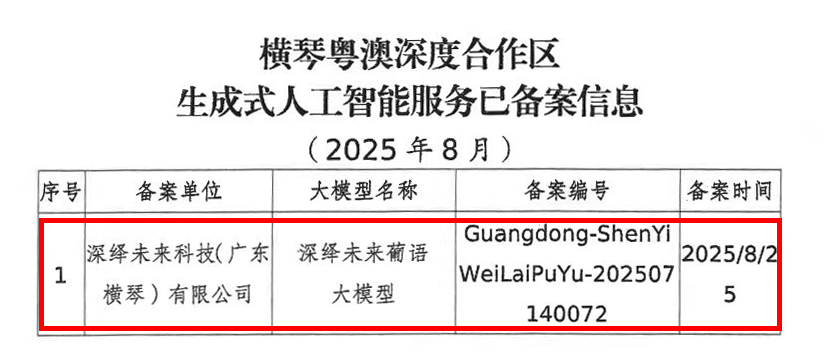
Group 1: New Developments in AI and E-commerce - Deep Future Technology (Guangdong Hengqin) Co., Ltd. has successfully registered its "Deep Future Portuguese Large Model" with the National Internet Information Office, marking it as the first large model aimed at Portuguese-speaking markets to receive national approval [1] - The model targets over 300 million people in Portuguese-speaking countries and regions, and it is the first large model to "go overseas" after passing the compliance guidance center in the Hengqin Guangdong-Macao Deep Cooperation Zone [1] - Miniso has established a new cross-border e-commerce company in Hengqin with a registered capital of 500,000 yuan, expanding its operational scope to include software sales and blockchain technology services [3] Group 2: Economic Performance in Hengqin - From January to July 2025, the total retail sales of consumer goods in Hengqin reached 3.11 billion yuan, reflecting a year-on-year growth of 51.3%, with online retail sales increasing by 105.1% [7] - Industrial investment in Hengqin grew by 162.3% during the same period, with imports and exports totaling 26.39 billion yuan, a significant increase of 106.0% year-on-year [8] - The cumulative cross-border RMB settlement amount in Hengqin reached 63.6 billion yuan in July 2025, with a total of 475.3 billion yuan settled from January to July [5]

名创优品,距离泡泡玛特还有多远?
格隆汇APP· 2025-09-05 13:11
Core Viewpoint - The article discusses the contrasting performance of Pop Mart and Miniso in the new consumption sector, highlighting Pop Mart's strong growth driven by its IP strategy, while Miniso faces challenges in its business model transformation [2][12][25]. Group 1: Pop Mart's Performance - Since August, Pop Mart's stock price has increased by 37%, with a market capitalization exceeding 400 billion yuan [3]. - Pop Mart's recent mini LABUBU release sold 300,000 units in just one minute, showcasing its strong consumer demand [4]. - In the first half of 2025, Pop Mart achieved revenue of 13.876 billion yuan, 1.5 times that of Miniso, with a year-on-year growth of 204.4% [27]. Group 2: Miniso's Challenges - Miniso's stock has experienced significant volatility, with a 20% drop following its 2024 annual performance release and a subsequent rise of over 20% after its 2025 first-half results [7][8]. - For the first half of 2025, Miniso reported revenue of 9.393 billion yuan, a year-on-year increase of 21.1%, but its net profit decreased by nearly 20% [14]. - Miniso's market capitalization is still below 60 billion HKD, with a valuation of only 22 times earnings, indicating a lack of investor enthusiasm [10]. Group 3: IP Strategy Comparison - The disparity between Pop Mart and Miniso largely stems from their approaches to IP. Pop Mart has successfully integrated IP into its business model, while Miniso struggles to replicate this success [12][40]. - In the first half of 2025, Pop Mart's gross margin was 70.3%, significantly higher than Miniso's 44.3% [28]. - Pop Mart's revenue from self-developed products accounted for 99.1%, with 88.1% coming from artist IP, indicating a strong reliance on proprietary IP for revenue generation [29]. Group 4: Miniso's Growth Strategy - Miniso has expanded its overseas presence significantly, opening 554 new stores in international markets, nearly three times the number of new stores opened in mainland China [16][18]. - Despite the rapid expansion, Miniso faces high operational costs in overseas markets, leading to low same-store sales growth rates [20][21]. - The company is exploring ways to leverage IP to enhance its store offerings and drive growth, but it remains to be seen if it can effectively transform its business model [25][54]. Group 5: Future Outlook - The article suggests that Miniso's future growth may depend on its ability to develop and leverage its own IP, which could enhance its product offerings and market position [54][60]. - As the global market for Chinese cultural products expands, there is potential for significant growth in the IP economy, which could benefit companies like Miniso if they adapt successfully [60].


名创优品新设跨境电商公司;横琴消费连续六个月增长丨横琴财报⑪
2 1 Shi Ji Jing Ji Bao Dao· 2025-09-05 13:09
Group 1: AI and Technology Developments - Shenyi Future Technology's "Portuguese Large Model" has received national registration, marking it as the first large model targeting Portuguese-speaking countries to be registered in China [1] - The model aims to serve a market of over 300 million people in Portuguese-speaking regions, highlighting its international expansion strategy [1] - The establishment of the "Large Model Compliance Guidance Center" in Hengqin has facilitated the compliance process for AI companies, reducing barriers to entry [1] Group 2: Cross-Border E-commerce and Retail Growth - Miniso has established a cross-border e-commerce company in Hengqin with a registered capital of 500,000 yuan, expanding its operational scope [2] - As of December 31, 2024, Miniso Group plans to have 7,780 global stores, with a net increase of 1,219 stores, exceeding its opening targets [2] - Hengqin's social retail sales reached 3.11 billion yuan in the first seven months of 2025, showing a year-on-year growth of 51.3% [4] - The region's import and export total reached 26.39 billion yuan in the same period, reflecting a significant year-on-year increase of 106% [4] Group 3: Financial Sector Developments - By the end of July 2025, there were 622 financial enterprises in Hengqin, with 81 licensed financial institutions and 42 local financial organizations [3] - The cumulative cross-border RMB settlement amount reached 63.6 billion yuan in July 2025, with a total of 475.3 billion yuan settled from January to July [3] - The region has seen a significant increase in the number of Australian-funded entities, with 7,461 registered by the end of July 2025, marking a 15.7% year-on-year growth [5] Group 4: Infrastructure and Policy Initiatives - Hengqin is promoting cross-border e-commerce industry support applications, with a submission deadline of September 15, 2025 [7] - New regulations effective from September 1, 2025, will support the development of a digital trade hub in Hengqin, facilitating cross-border data flow and processing [7] - The region has seen 69.85 million people pass through its border since September 2021, indicating robust cross-border movement [6]
“有点钱,但不多,不急花”:2025上半年消费者现状
Hu Xiu· 2025-09-05 06:26
Group 1: Consumer Market Overview - The overall vitality of the consumer market is improving, with a 5% year-on-year increase in retail sales of consumer goods in the first half of the year, reaching 24.55 trillion yuan [1][2] - The contribution rate of final consumption expenditure to GDP growth is 52%, indicating that consumer spending is a key driver of economic growth [1][2] - The core CPI has shown a continuous upward trend, indicating a recovery in domestic demand [1][2] Group 2: Emotional Consumption Trends - Emotional consumption has become a significant trend, with the emotional consumption market expected to exceed 2 trillion yuan by 2025, growing at a compound annual growth rate of 12% since 2013 [4][11] - Companies like Pop Mart have seen substantial revenue growth from emotional products, with LABUBU generating 4.81 billion yuan in revenue in the first half of the year, contributing to Pop Mart's total revenue of 13.88 billion yuan, a 204.4% increase year-on-year [7][5] - Other companies in the emotional consumption space, such as MINISO, are also adapting their strategies to capture this market, with their sub-brand TOP TOY achieving 740 million yuan in revenue, a 73% increase [8] Group 3: Traditional Consumption Decline - Traditional consumption categories, particularly in the liquor and high-end tea sectors, are experiencing declines, with many companies reporting negative growth in revenue and profit [10][12] - The white liquor industry saw a 5% decrease in revenue and a 7.5% drop in net profit in the second quarter of 2025, with only a few companies maintaining positive growth [10] - The high-end tea market is also struggling, with companies like Tianfu Tea reporting a 17.1% decline in revenue [10] Group 4: Impact of Economic Conditions on Consumer Behavior - Economic uncertainties have led to a cautious consumer sentiment, with many individuals opting for cost-effective options and prioritizing emotional value in their purchases [12][13] - The trend of "old consumption" is fading, as younger consumers focus on personal satisfaction rather than social status, leading to a shift in spending patterns [9][11] - The overall consumer sentiment is reflected in the decline of high-end dining and entertainment, with many consumers opting for more affordable alternatives [17][18] Group 5: Investment and Housing Market Dynamics - The real estate market is facing challenges, with a 11.2% decline in real estate development investment in the first half of 2025, and a 3.5% drop in new housing sales [25][26] - Consumer confidence in real estate has diminished, leading to a decrease in housing purchases and a shift towards investments in stocks and gold [27][29] - The stock market has seen increased activity, with A-shares and Hong Kong stocks experiencing good liquidity, indicating a shift in investment preferences among consumers [27][29]



名创优品偷师泡泡玛特,谁更懂年轻人的钱包?
Hu Xiu· 2025-09-05 03:05
Core Viewpoint - Miniso is transforming into an IP derivative product collection store, actively learning from Pop Mart, aiming to shift from a ten-yuan store to a trendy "IP paradise" for young consumers [1] Group 1: Company Strategy - Miniso is attempting to pivot its business model by focusing on IP (intellectual property) products, which are becoming increasingly popular among young consumers in China [1] - The company is inspired by Pop Mart's success in the IP toy market and is looking to replicate that model to enhance its brand appeal [1] Group 2: Industry Trends - The trend of IP toys is emerging as a new source of national pride in China, indicating a cultural shift from mere manufacturing to cultural output [1] - The popularity of trendy IP products among the youth suggests a growing market opportunity for companies that can effectively tap into this consumer sentiment [1]
热门中概股美股盘前多数下跌,知乎涨超2%
Jing Ji Guan Cha Wang· 2025-09-03 15:01
Core Viewpoint - The majority of popular Chinese concept stocks in the US market are experiencing declines, with notable drops in several key companies [1] Group 1: Stock Performance - Xiaopeng Motors, Li Auto, and NIO have all fallen by over 2% [1] - Alibaba, JD.com, iQIYI, and Miniso have seen declines exceeding 1% [1] - Zhihu has increased by over 2%, while Douyu has risen by over 1% [1]


名创优品(09896) - 截至2025年8月31日止月份之股份发行人的证券变动月报表
2025-09-03 08:31
股份發行人及根據《上市規則》第十九B章上市的香港預託證券發行人的證券變動月報表 截至月份: 2025年8月31日 狀態: 新提交 致:香港交易及結算所有限公司 公司名稱: 名創優品集團控股有限公司 呈交日期: 2025年9月3日 I. 法定/註冊股本變動 | 1. 股份分類 | 普通股 | 股份類別 | 不適用 | | 於香港聯交所上市 (註1) | | | 是 | | | --- | --- | --- | --- | --- | --- | --- | --- | --- | --- | | 證券代號 (如上市) | 09896 | 說明 | | | | | | | | | | | 法定/註冊股份數目 | | | 面值 | | | 法定/註冊股本 | | | 上月底結存 | | | 10,000,000,000 | USD | | 0.00001 | USD | | 100,000 | | 增加 / 減少 (-) | | | 0 | | | | USD | | 0 | | 本月底結存 | | | 10,000,000,000 | USD | | 0.00001 | USD | | 100,000 | 本月 ...
中国企业出海浪潮中,飞书如何成为全球化“神队友”?
Sou Hu Cai Jing· 2025-09-02 11:08
Core Insights - Miniso, a Chinese trendy retail brand, has successfully attracted consumers with its plush toy series at its Paris flagship store in July 2024, highlighting a surge in consumer interest [1] - The company has expanded its operations to 112 countries and regions, facing challenges in maintaining efficient operations in international markets [1] - Miniso's global journey reflects the current trend of Chinese brands focusing on systematic and refined global operations rather than mere product exports [1] Group 1 - Miniso utilizes advanced digital tools to monitor global sales data, consumer feedback, and supply chain stability in real-time from its headquarters in Guangzhou [1] - The introduction of Feishu, a global integrated collaboration platform, has enhanced operational efficiency and communication across different time zones and languages [2] - The "Overseas Store Assistant" application built on Feishu's low-code platform has standardized operations and improved cross-time zone collaboration for Miniso's global stores [3] Group 2 - In the Indonesian market, Miniso leveraged Feishu's multi-dimensional table feature to digitize its store expansion process, achieving a 50% increase in development efficiency compared to traditional methods [3] - Challenges such as language barriers and cross-time zone collaboration consume significant resources for companies expanding internationally, as noted by Feishu's Chief Commercial Officer [3] - Cultural integration is emphasized as a "soft power" for Chinese companies, with brands like Bawang Tea Ji using Feishu to promote understanding of Chinese tea culture among global employees [5] Group 3 - Feishu respects cultural diversity in its product design, supporting multi-skin tone emoji options and avoiding potentially misinterpreted symbols [5] - The platform provides stable and efficient foundational services while also offering customizable solutions for specific business scenarios [5] - J&T Express, a global logistics service provider, has implemented Feishu for unified collaboration across 12 countries, achieving online coordination for 80,000 employees in just 40 working days [5][6] Group 4 - The ongoing trend of Chinese companies expanding internationally is supported by Feishu, which is transforming its accumulated experiences into a toolkit for more outbound enterprises [6] - Feishu's collaboration with outbound companies is creating new narratives on a global scale [6]
一边关店,一边押注“25元店”,无印良品被名创优品拖下水?
3 6 Ke· 2025-09-02 10:42
Core Viewpoint - MUJI is experiencing a wave of store closures in China, with a total of 17 stores expected to close by May 2025, marking a historical high for the company in this market. Despite the closures, MUJI plans to open approximately 40 new stores annually, indicating a strategic shift in its operations [1][7][10]. Group 1: Store Closures - Multiple MUJI stores in key urban areas, including Beijing and Jinan, are closing due to decreased foot traffic influenced by newer shopping centers nearby [2][1]. - The closures are part of a broader strategy to enhance operational efficiency by evaluating the performance of underperforming stores [1][2]. Group 2: New Store Strategy - MUJI has introduced a new store format called "MUJI 500," focusing on lower-priced items, with around 70% of products priced at approximately 25 RMB (500 yen) [4][5]. - The new stores will avoid high-rent core shopping areas, opting instead for locations near subway stations and community hubs, with store sizes around 200 square meters [5][6]. Group 3: Cost Reduction Measures - The "MUJI 500" stores will feature a localized supply chain, with nearly half of the products manufactured in China, significantly reducing logistics costs [6][10]. - The product strategy will focus on existing low-cost items rather than introducing new products, thereby minimizing design and trial costs [6][10]. Group 4: Market Positioning and Competition - MUJI's pricing strategy in China has historically been higher than in Japan, with some products priced 50% to 100% more, influenced by taxes and logistics [7][10]. - The competitive landscape includes brands like Miniso, which has a significantly larger store count and offers lower-priced products, prompting MUJI to adjust its strategy [8][10]. Group 5: Consumer Behavior Trends - The shift in consumer preferences towards value and cost-effectiveness is evident, as younger consumers increasingly seek products that offer better price-performance ratios [12]. - The changing market dynamics reflect a broader trend where consumers are less willing to pay premium prices for brands, favoring essential value instead [12].

淡马锡押注TOP TOY估值达百亿港元 潮玩赛道迎来双雄争霸
Xin Lang Zheng Quan· 2025-09-02 10:31
Core Viewpoint - The global潮玩 (trendy toy) market is undergoing a significant restructuring, with companies like TOP TOY and泡泡玛特 (Pop Mart) showing remarkable growth, indicating a rapid expansion phase in China's潮玩 industry [1][2][3] Group 1: Company Performance - TOP TOY reported a revenue of 400 million yuan in Q2 2025, marking an impressive year-on-year increase of 87.0%, significantly surpassing the industry average growth rate [2] -泡泡玛特's Labubu IP generated 34.7% of its revenue in the first half of 2025, with a staggering year-on-year growth of 726.6% [2] -泡泡玛特 achieved a gross margin of 70.3%, well above the traditional toy companies' range of 20-30%, due to premium pricing and exclusive strategies [2] Group 2: Market Expansion - TOP TOY has expanded its store count to 293, with 283 located in mainland China, and achieved a total GMV of 1.05 billion yuan in the first half of 2025 [2] -泡泡玛特's overseas revenue surged by 440%, accounting for 40% of its total revenue, with the U.S. and European markets experiencing a growth rate of 480% [2][3] Group 3: Strategic Investments -淡马锡's investment in TOP TOY reflects a long-term investment perspective, recognizing the potential of the Chinese潮玩 market and the global expansion capabilities of名创优品 (Miniso) [3] -名创优品's total revenue reached 4.97 billion yuan in Q2 2025, with a year-on-year growth of 23.1%, and overseas revenue making up 42.6% of its total income [3] Group 4: Future Trends -泡泡玛特 aims to increase its overseas revenue share to 65% by 2027, while also diversifying into new business areas such as theme parks and animation content [6][7] -名创优品 plans to promote 100 Chinese IPs globally, enhancing its brand presence and cultural export [6][7]