
名创优品商品

Search documents
在县城,「月薪三千」属于高工资
36氪· 2026-03-02 13:50
Core Insights - The article emphasizes the importance of understanding county-level cities in China, as they represent the living conditions and economic realities of the majority of the population, which is often overlooked by those living in first and second-tier cities [5][7][8]. Group 1: Economic Conditions in County Cities - By the end of 2025, China's urban population is projected to reach 953 million, with an urbanization rate of 67.89%, indicating that over two-thirds of the population lives in towns, primarily in lesser-known third and fourth-tier cities [5]. - In many county cities, the average disposable income is below 36,000 yuan, with monthly salaries often around 3,000 yuan, which is considered a competitive income in these areas [11][15]. - Job opportunities in county cities often reflect outdated salary structures, with positions such as cashiers and security guards earning between 1,800 to 2,500 yuan per month [13][15]. Group 2: Social Dynamics and Consumer Behavior - The article discusses how the perception of income differs between urban and county settings, where a salary of 3,000 yuan can signify a promotion in a county but is viewed as low income in larger cities [12][20]. - The cost of living in county cities is significantly lower, allowing residents to manage on lower incomes compared to their urban counterparts, where 2,000 yuan may not suffice for basic living expenses [19][20]. - The article highlights the psychological aspects of spending, where individuals in stable jobs (especially in the public sector) feel more secure in their financial situations, leading to more confident spending behaviors [34][37]. Group 3: The Role of Government Jobs - Government jobs in county cities provide significant economic advantages, with salaries often exceeding 4,000 yuan per month, which is substantially higher than the average income in these areas [31]. - The article illustrates how obtaining a government position can enhance one's social standing and marriage prospects, as it is seen as a ticket to a more stable and prosperous life [32][33]. - The dual-income structure of families where both partners work in government positions creates a buffer against economic uncertainties, contributing to a more relaxed lifestyle [53]. Group 4: Consumer Market Dynamics - The consumer market in county cities is characterized by a clear structure, where government employees are the primary consumers, while the larger population remains cautious about spending due to economic uncertainties [60]. - New brands entering county markets often face challenges; those with lower price points succeed, while those attempting to replicate urban quality standards may struggle to survive [59][60]. - Understanding the distinct consumer behavior and economic conditions in county cities is crucial for businesses aiming to penetrate these markets effectively [61].


年味拉满!中国品牌刷屏泰国街头
Guo Ji Jin Rong Bao· 2026-02-25 11:43
Core Viewpoint - Thailand has become a top destination for Chinese tourists during the Spring Festival, showcasing not only its welcoming atmosphere but also the integration of Chinese brands into local culture and commerce [1][2]. Group 1: Tourism and Cultural Integration - The Spring Festival celebrations in Chiang Mai included traditional decorations and activities, making it a festive experience for both locals and tourists [1]. - Chinese brands such as Ora, BYD, and Nezha have established a presence in Thailand, indicating a successful integration into the local market beyond just catering to Chinese consumers [2]. Group 2: Beverage and Food Industry Expansion - The hot climate and favorable economic conditions in Thailand have facilitated the expansion of new tea beverage brands, with several stores like Mixue and Nayuki opening in key locations [3][4]. - Nayuki has adapted its product offerings to local tastes, with a focus on combining beverages with baked goods, which has been well-received by local consumers [5]. - Haidilao has successfully attracted both Chinese and Korean tourists, offering a unique dining experience that incorporates local flavors while maintaining its core offerings [6][8]. Group 3: Retail and Brand Localization - Retail brands like Miniso and Pop Mart are rapidly expanding in Thailand, becoming recognizable symbols for both local youth and Chinese tourists [8][9]. - Pop Mart has tailored its products to include local cultural elements, enhancing its appeal in the Southeast Asian market [8].
美股异动|名创优品盘前涨2.2% 持续回购+被列为摩通马年内需首选股
Ge Long Hui· 2026-01-21 09:49
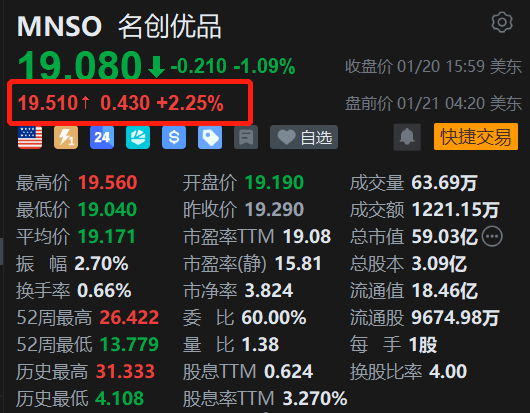
Group 1 - Miniso (MNSO.US) shares rose by 2.2% to $19.51 in pre-market trading [1] - The company announced a share buyback of 51,300 shares at a total cost of $245,900, with a buyback price range of $4.7625 to $4.875 per share, scheduled for January 20, 2026 [1] - JPMorgan's latest report identified Miniso as a preferred stock in the consumer discretionary sector, alongside other companies such as Lao Pu Gold, Gu Ming, Yum China, and Pop Mart [1] Group 2 - The closing price of Miniso on January 20 was $19.08, with a decrease of $0.21 or 1.09% [2] - The pre-market price on January 21 was $19.51, reflecting an increase of $0.43 or 2.25% [2] - The total market capitalization of Miniso is approximately $5.903 billion, with a total share count of 309 million [2]
16元盒饭自助杀疯了,这届打工人彻底不装了
虎嗅APP· 2026-01-18 03:27
Core Viewpoint - The article discusses the shift in consumer preferences in the Chinese dining industry, highlighting the rise of affordable self-service meals and the decline of high-end dining experiences, reflecting a broader trend towards value for money and practicality in consumer behavior [4][10]. Group 1: Rise of Affordable Dining - The emergence of "box lunch self-service" meals priced under 20 yuan has become a popular choice among workers, serving as a "lifeline" for many [5][12]. - By May 2025, the number of self-service restaurants in China is projected to reach 66,000, with a net increase of over 10,000 locations compared to the previous year, driven primarily by affordable fast-casual dining options [5]. - The appeal of these self-service meals lies in their variety, affordability, and the ability to satisfy hunger without breaking the bank, contrasting sharply with the struggles of high-end dining establishments [9][15]. Group 2: Decline of High-End Dining - High-end restaurants are facing significant challenges, with notable closures including Opera BOMBANA and L'Atelier 18, indicating a downturn in the luxury dining sector [6][7]. - The closure of establishments like the Michelin-starred Ultraviolet by Paul Pairet, which charged 6,800 yuan per meal, underscores the shift in consumer spending away from luxury dining experiences [7]. Group 3: Changing Consumer Behavior - The trend towards value-driven dining reflects a broader change in consumer attitudes, with a focus on practicality and cost-effectiveness becoming paramount [10][18]. - The rise of brands like Mixue Ice City and the popularity of low-cost meal options illustrate a market shift where consumers prioritize affordability over brand prestige [19][22]. - Data indicates that while the Engel coefficient for Chinese households is decreasing, indicating a rise in living standards, consumer spending is becoming more cautious and value-oriented [19][22]. Group 4: Generational Shifts in Consumption - The Z generation, characterized by their strong sense of national identity and skepticism towards brand premiums, is driving a new wave of consumption focused on cost-effectiveness [28][30]. - Over 85% of the Z generation prioritize value for money, leading to a culture where frugality is celebrated and luxury is scrutinized [28][30]. - This generation's consumption patterns reflect a strategic retreat from traditional markers of success, opting instead for practical spending in the face of economic pressures [30][34]. Group 5: The Complexity of Modern Consumption - The article posits that the current consumer landscape is marked by a duality of frugality and indulgence, where consumers are both budget-conscious and willing to splurge on experiences that matter to them [41][42]. - The popularity of affordable self-service meals serves as a reflection of a broader societal trend towards finding balance between survival and dignity in consumption choices [36][40].

任泽平年度演讲:中国经济十大预测2025
泽平宏观· 2026-01-17 02:42
Core Viewpoint - The article presents ten major predictions for the Chinese economy in 2025, emphasizing the emergence of a new cycle and era, the global interest rate reduction, the fourth technological revolution, and the importance of adapting to new trends and opportunities in various sectors [2][3][4][5][6][7][8][9][10][11]. Group 1: New Economic Cycle and Global Trends - A new economic cycle and era are emerging, encouraging adaptation to new trends and opportunities [2][3]. - The global economy is entering a new interest rate reduction cycle, with significant implications for monetary policy and economic growth [3][40]. - The return of Trump to the White House (Trump 2.0) is expected to create uncertainties, including inflation and trade tensions, impacting global economic dynamics [3][42][44]. Group 2: Technological Revolution - The fourth technological revolution is underway, with breakthroughs in artificial intelligence, renewable energy, commercial aerospace, low-altitude economy, and biomanufacturing [4][55][57]. - AI is expected to experience explosive growth, with applications in image recognition, humanoid robots, AI assistants, and consumer electronics [6][11]. - The low-altitude economy is gaining traction, with potential applications in logistics and urban management, creating a multi-trillion market [8][59]. Group 3: Economic Policies and Domestic Growth - China is initiating macroeconomic easing to boost confidence and economic growth, focusing on new infrastructure and productivity [5][73]. - The government is implementing policies to stabilize the real estate market and promote consumption, with a focus on enhancing the business environment for private enterprises [78][87]. - The emphasis on new infrastructure includes advancements in new energy systems, digital economy, and artificial intelligence, positioning China for future growth [81][84]. Group 4: Globalization and Market Expansion - Chinese enterprises are shifting from export to global expansion, tapping into larger international markets [6][92]. - The rise of successful Chinese companies in overseas markets, such as SHEIN and TikTok, illustrates the potential for growth beyond domestic borders [96][111]. - Southeast Asia is identified as a key target for Chinese companies due to its growing market and favorable conditions for investment [101]. Group 5: Aging Population and Consumer Trends - The aging population presents opportunities in the silver economy, emphasizing the need for policies to boost birth rates and early childhood development [11]. - Consumer behavior is shifting towards interest-based spending, with cultural consumption and local trends gaining popularity among younger demographics [9][30].



【“打通全国统一大市场堵点卡点”热点问题探析⑦】破局“内卷” 开拓蓝海
Jing Ji Ri Bao· 2025-12-14 22:51
Core Viewpoint - The article highlights the detrimental effects of "involution" competition across various industries, leading to price wars, reduced profit margins, and increased quality and safety risks. It emphasizes the need for a unified national market to promote high-quality development in enterprises and industries [1][3][7]. Group 1: Industry Challenges - The washing detergent industry is facing severe competition from low-quality products with less than 5% active ingredient content, which are capturing market share through low pricing, putting quality products at a disadvantage [1]. - "Involution" competition is characterized by irrational competition due to market mechanism failures, where companies resort to price wars instead of leveraging differentiation or technological advantages, resulting in "increased production without increased revenue" [2]. - Various industries, including steel, photovoltaics, automotive, and catering, are experiencing similar challenges due to intense price competition, leading to a consensus among over 20 industry associations to advocate for "anti-involution" measures [3]. Group 2: Solutions and Strategies - To enhance market efficiency, it is essential to eliminate barriers to fair competition, which is a key aspect of building a unified national market. This will help stabilize the commercial ecosystem and address supply-demand imbalances [3]. - Companies are encouraged to abandon the outdated "scale-first" mentality and focus on creating value through quality products and strong brands. For instance, China Resources Beer closed 40 factories and reduced over 5 million tons of redundant capacity to focus on value creation [3]. - Innovation is crucial for traditional manufacturing to break free from path dependence and scale bottlenecks. Companies like Weiqiao Venture Group are collaborating with research institutions and adopting new technologies to transform their business models [4]. Group 3: Brand and Market Positioning - In a market characterized by information asymmetry, low-quality products often mislead consumers, necessitating a shift towards rebuilding trust in "quality for price" mechanisms and enhancing user experience and brand value [5]. - The home appliance industry has maintained a relatively rational approach due to years of system development, with a shift in market power from companies to consumers, who now seek personalized and emotionally resonant experiences [5]. - Companies like Hisense are witnessing a reversal in consumer behavior, with domestic brands gaining recognition for quality, indicating a shift towards "Chinese manufacturing" being associated with technological premium [5]. Group 4: Global Expansion - The construction of a unified national market is not a closed "internal cycle" but an open market that encourages both domestic and international engagement. Companies are urged to expand globally to alleviate domestic competition pressures and enhance competitiveness [6]. - Jack Technology has entered a global leadership phase, establishing production bases tailored to regional markets, while Miniso emphasizes cultural integration in its global strategy, showcasing the importance of local insights in international expansion [6]. Group 5: Future Outlook - Building a unified national market aims to create fairer, more efficient, and more valuable competition. Companies must focus on innovation, brand strength, and global presence to escape internal strife and contribute to China's high-quality economic development [7].


名创优品三季度营收猛增28% 全球化与IP战略驱动业绩新高
Xin Lang Zheng Quan· 2025-11-27 10:58
Core Insights - MINISO Group reported a record high total revenue of 5.8 billion yuan for Q3 2025, marking a 28% year-on-year increase, driven by strong performance in its main brand and the TOP TOY brand [1][2] - The company achieved a significant growth in its global store network, surpassing 8,000 stores, with a focus on international expansion [1][3] Revenue Growth Analysis - The revenue growth rate of 28% in Q3 2025 is an improvement from 19% in the previous quarter, indicating sustained growth momentum [2] - Gross profit reached 2.59 billion yuan, also up 28% year-on-year, with a stable gross margin of 44.7% [2] - Revenue from the main brand in mainland China was 2.91 billion yuan, a 19% increase, while overseas revenue was 2.31 billion yuan, growing by 28% [2] - TOP TOY brand revenue surged by 111% to 570 million yuan, highlighting the potential of the trendy toy market [2] Profitability Insights - Adjusted net profit for Q3 was 770 million yuan, a 12% increase, with an adjusted net profit margin of 13.2% [2] - However, the company's net profit decreased by 31.64% to 443 million yuan, primarily due to rising operational costs associated with rapid expansion [2] Global Expansion Strategy - As of September 30, 2025, MINISO had 7,831 stores globally, with 4,407 in China and 3,424 overseas, reflecting a strategic focus on international markets [3] - The U.S. market showed remarkable performance with a 65% year-on-year revenue increase and over 100% growth in new memberships [3] - The company is transitioning to a "big store" growth model, with the MINISO LAND concept being implemented in major cities [3] Same-Store Sales Performance - Same-store sales achieved mid-single-digit growth in Q3, with double-digit growth recorded in October, indicating improved operational quality [4] IP Strategy and Innovation - MINISO's growth is supported by a dual IP strategy, combining self-owned IP and international licensed IP, enhancing its position in the IP operation field [5][6] - The company has signed 16 trendy toy artist IPs and launched an innovative artist IP area in Guangzhou, generating significant sales in a short period [5] - Collaboration with Disney on the "Zootopia" franchise has led to successful product launches, enhancing brand visibility and sales [6] Future Outlook - The company aims to become a global leader in IP operations, with the recent opening of MINISO LAND in Bangkok marking a significant step in brand value enhancement [6]
名创优品(09896):Q3收入增速超预期,同店表现显著提升
CMS· 2025-11-24 10:05
Investment Rating - The report maintains a "Strong Buy" rating for the company [3][6] Core Insights - The company reported Q3 revenue of 5.8 billion (+28.2% YoY) and adjusted net profit of 770 million (+11.7% YoY), with a net profit margin of 13.2% (-2.0 percentage points) [1][6] - Domestic revenue for the company's brand reached 2.91 billion (+19.3% YoY), while overseas revenue was 2.31 billion (+27.7% YoY). TOPTOY revenue surged to 570 million (+111.4% YoY) [1][6] - The company has a robust "1+3" moat strategy, combining a Chinese supply chain, global IP, global design, and global channels, which supports its domestic expansion and high growth in overseas markets [1][6] Financial Performance - The company expects significant revenue growth, with projected revenues of 13.84 billion, 16.99 billion, 21.21 billion, 25.13 billion, and 29.27 billion for 2023 to 2027, respectively, reflecting growth rates of 39%, 23%, 25%, 18%, and 17% [2][7] - Adjusted net profit is projected to grow from 2.39 billion in 2023 to 4.34 billion in 2027, with corresponding growth rates of 101%, 13%, 10%, 23%, and 18% [2][7] - The company’s earnings per share (EPS) is expected to increase from 1.90 in 2023 to 3.45 in 2027 [2][7] Domestic Market Performance - In Q3, the domestic brand revenue was 2.91 billion, with same-store sales showing high single-digit growth. The company anticipates low double-digit growth in same-store sales for Q4 [1][6] - The company added 102 new stores in Q3, bringing the total to 4,407 stores [1][6] International Market Performance - The overseas brand revenue reached 2.31 billion, with same-store sales showing low single-digit growth. The U.S. market saw revenue growth exceeding 65% [1][6] - The company opened 117 new stores overseas in Q3, with a total of 3,424 stores by the end of the quarter [1][6] TOPTOY Performance - TOPTOY brand revenue reached 570 million in Q3, with a same-store sales growth in the mid-single digits and a net increase of 14 stores, totaling 307 stores [1][6]
中银国际:降名创优品(09896)目标价至46.1港元 料核心业务第四季再改善
智通财经网· 2025-11-24 08:50
Core Viewpoint - The market's concerns regarding Miniso's core business are considered excessive, presenting a potential buying opportunity, especially if the negative factors surrounding the acquisition of Yonghui Supermarket ease [1] Financial Projections - After adjusting forecasts for 2026, the target price for H-shares is reduced from HKD 48.4 to HKD 46.1, while the target price for US shares is lowered from USD 24.8 to USD 23.6, reflecting a 19 times adjusted earnings per share (EPS) for 2025 and 29 times and 18 times for the next two years [1] - Adjusted EPS forecasts for fiscal years 2025 to 2027 are increased by 4%, decreased by 6%, and decreased by 7%, respectively, while reported EPS forecasts are cut by 35%, 22%, and 20% [1] Business Strategy and Growth Potential - Despite mixed performance in Q3, the company is believed to be on the right track to achieve stronger organic growth through its robust IP strategy, aiming to capture more market share globally [1] - The anticipated share buyback plan is expected to support the stock price and mitigate some of the negative impact from the acquisition of Yonghui Supermarket [1]
细分赛道显复苏迹象,高端消费和新零售优成长
GOLDEN SUN SECURITIES· 2025-11-23 11:53
Investment Rating - The report maintains an "Increase" rating for the industry [6] Core Viewpoints - The report indicates signs of recovery in the retail sector, particularly in high-end consumption and new retail, supported by recent quarterly performance disclosures from consumer companies [1] - The recovery is attributed to both low base effects from the previous year and the resilience of specific market segments, suggesting a strengthening foundation for domestic consumption [1] Summary by Sections Brand Performance - Richemont Group reported a 14% revenue increase in Q3 2025, with a 7% growth in mainland China, driven primarily by jewelry sales [2] - Burberry's same-store sales turned positive for the first time since 2024, with a 3% increase in China, benefiting from a low base effect [2] Property Performance - Swire Properties reported retail sales growth of 41.9% in Shanghai and 7.8% in Beijing for the first three quarters of 2025, indicating improving retail performance [3] - China Resources Land's total contract sales in October 2025 were approximately 15.2 billion yuan, a decrease of 51%, but recurring income showed a 3% increase [3] New Retail Developments - Walmart's Q3 2026 revenue reached $179.5 billion, a 5.8% year-on-year increase, with a 21.8% growth in China and a 32% increase in e-commerce sales [4] - Miniso reported a 28% revenue growth in Q3 2025, with a net profit increase of 12% and a total of 8,138 stores globally [5] Industry Trends - The retail index showed a decline of 7.24% recently, underperforming the Shanghai Composite Index by 3.34 percentage points [14] - The report highlights the importance of new consumption trends and the potential for growth in sectors like duty-free shopping and cross-border e-commerce [10] Company Dynamics - Yum China announced a new strategic plan aiming for significant growth in store numbers and profitability over the next three years [21] - Huitongda Network plans to acquire a 57% stake in Cognition Boundary, enhancing its market position [21] Industry Developments - Good Sale has introduced coffee sales in select stores, maintaining a low-price strategy [23] - JD's discount supermarket is set to open a new location, expanding its market coverage [23] - Hema's new discount community supermarket model is entering the Guangdong market, indicating strategic expansion [24]