Morgan Stanley(MS)

Search documents
大摩闭门会最新分享:市场过热了吗?
Xin Lang Cai Jing· 2026-01-20 12:26
炒股就看金麒麟分析师研报,权威,专业,及时,全面,助您挖掘潜力主题机会! 来源:六里投资报 相关的行业ETF瞬间膨胀几十倍到 500亿、千亿的规模。 根据大摩独有的情绪指数显示,1月6日已超过78的警戒线, 上周,更是迅速上窜至93的高位,明显提示了短期过热迹象。 这种现象引发了管理层关注,并迅速采取了一定的冷却措施。 邢自强认为,这些措施旨在适度降温、防范市场过热,而非打压市场, 目的是引导市场走向一个长期跟基本面相匹配、能够被夯实的制度性慢牛。 此外,摩根士丹利中国首席策略师 Laura补充指出, 1月19日,摩根士丹利中国首席经济学家邢自强,在每周的闭门会中,围绕开年以来的"开门红"现象、 以及近期部分板块情绪过热出现的调整,分享了最新的观点。 他指出,年初以来亚洲股市普遍上涨,背后有几方面因素驱动; 而近期个别科技概念,在短短两三周之内引发大量的资金流入, 本轮市场资金主要来源于债市、存款、保险资金及外资流入,并非是融资融券等杠杆资金。 虽然短期有情绪过热迹象,但从整体来看, 在全球股市范围内,无论是A股还是港股,远远没有到过热,或者吸引了重大炒作资金量的程度。 展望未来,全球资金分散化的配置趋势持续 ...



Morgan Stanley (MS)’s CEO is Doing a Great Job, Says Jim Cramer
Yahoo Finance· 2026-01-20 11:01
We recently published 15 Fresh Stocks Jim Cramer Discussed. Morgan Stanley (NYSE:MS) is one of the stocks Jim Cramer discussed. Morgan Stanley (NYSE:MS) is one of the largest investment banks in the world. The shares are up by 37% over the past year and by 3.9% year-to-date. Keefe Bruyette raised the share price target to $210 from $202 in January and kept an Outperform rating on the shares in January. The shift came after Morgan Stanley (NYSE:MS)’s fourth quarter earnings report, which saw the bank post ...
华尔街对黄金的看法
Jin Tou Wang· 2026-01-20 09:27
Group 1 - Citigroup predicts a bullish scenario where gold could reach $5,000 within three months, with a potential test of $4,700-$4,750 this week due to trade tensions from Trump's tariff policies and a surge in investments into gold ETFs for hedging, leading to localized shortages in physical gold [1] - JPMorgan anticipates a strong market this week with a target of $4,750, and if stabilized, a push towards $5,000 next month, driven by a 26% probability of a Fed rate cut in March, declining 10-year Treasury yields, and an average monthly gold purchase of 70 tons by emerging market central banks, providing a "safety cushion" for gold prices [1] - Goldman Sachs expects a potential pullback this week with a buying range of $4,600-$4,650, maintaining a year-end target of $4,900, while expressing concerns over profit-taking by hedge funds that may lead to increased short-term volatility despite a long-term bullish outlook [1] Group 2 - Morgan Stanley adopts a conservative stance, projecting a trading range of $4,620-$4,690 this week, emphasizing that central bank gold purchases provide strong support, and highlighting the acceleration of de-dollarization in emerging markets, suggesting that buying gold is not merely for hedging but a strategic move against dollar dominance, with this trend expected to continue at least until Q3 [1] - Current data indicates that while U.S. employment and inflation are slowing, some sectors are improving under the potential influence of Fed rate cuts, leading to a cautious but optimistic outlook for gold prices in the medium to long term, supported by increased allocations from institutional investors amid rising geopolitical risks [3] - The market is likely to be influenced more by U.S. economic data affecting Fed policy expectations and geopolitical disturbances, with a general view that short-term news impact is diminishing, maintaining a strong oscillating trend for gold prices, while suggesting holding long positions above the 20-day moving average and selling out-of-the-money put options to capture time value [3]


Evercore ISI上调摩根士丹利目标价至215美元
Ge Long Hui· 2026-01-20 09:00
Core Viewpoint - Evercore ISI has raised Morgan Stanley's target price from $200 to $215 while maintaining an "Outperform" rating [1] Group 1 - The target price adjustment reflects a positive outlook on Morgan Stanley's performance in the market [1] - The "Outperform" rating indicates confidence in Morgan Stanley's ability to exceed market expectations [1]
Best Momentum Stock to Buy for January 19th
ZACKS· 2026-01-19 16:01
Core Insights - Three stocks with strong momentum and buy rankings are highlighted for investors: RF Industries, Morgan Stanley, and First Horizon Group 1: RF Industries (RFIL) - RF Industries is engaged in the design, manufacture, and distribution of coaxial connectors for radio communications and other applications [1] - The company has a Zacks Rank of 1 (Strong Buy) and a 22.9% increase in the Zacks Consensus Estimate for current year earnings over the last 60 days [1] - RF Industries' shares gained 14.5% over the last three months, outperforming the S&P 500's gain of 3% [2] - The company possesses a Momentum Score of A [2] Group 2: Morgan Stanley (MS) - Morgan Stanley is a leading financial services holding company serving a diverse clientele, including corporations and governments [2] - The company has a Zacks Rank of 1 and a 4.4% increase in the Zacks Consensus Estimate for current year earnings over the last 60 days [2] - Morgan Stanley's shares gained 17.4% over the last three months, also outperforming the S&P 500's gain of 3% [3] - The company possesses a Momentum Score of A [3] Group 3: First Horizon (FHN) - First Horizon offers a range of financial services, including regional banking, mortgage lending, and wealth management [4] - The company has a Zacks Rank of 1 and a 6.7% increase in the Zacks Consensus Estimate for current year earnings over the last 60 days [4] - First Horizon's shares gained 18.2% over the last three months, significantly outperforming the S&P 500's gain of 3% [5] - The company possesses a Momentum Score of A [5]



美国经济生产率激增,驱动因素却是“未解之谜”
财富FORTUNE· 2026-01-19 13:12
Group 1 - The core viewpoint of the article highlights the surprising efficiency of the U.S. economy in producing goods and services, providing a buffer for policymakers while raising questions about the underlying drivers of this productivity surge [2][4]. - Morgan Stanley reported a significant increase in non-farm productivity, with an annualized growth rate of 4.9% in Q3, marking a substantial rise from the average of 1.9% over the previous four quarters [2]. - The report suggests that the current productivity increase is largely cyclical, and the true drivers behind this acceleration remain a mystery [2]. Group 2 - The labor market in the U.S. has been characterized by "low hiring, low layoffs," with net job additions nearly at zero over the past five months, averaging only 44,000 new jobs per month, the lowest since 2020 [5]. - Despite reduced hiring, productivity has surged, supported by wealthier households maintaining demand, with consumer spending unexpectedly rising by 3.5% in Q3, primarily driven by service consumption [5]. - The article notes a shift in consumer behavior, with high-income households (earning over $150,000) accounting for 43% of new car purchases, up from 30% five years ago, while lower-income households (earning under $75,000) saw their share drop from 35% to 25% [5]. Group 3 - The rise of artificial intelligence is often seen as a potential factor for productivity improvement, but the report emphasizes cyclical factors instead, indicating that companies are not widely replacing human labor with AI but are correcting previous overhiring [6]. - The surge in productivity has direct implications for monetary policy, reducing the urgency for the Federal Reserve to cut interest rates, with revised predictions pushing the expected rate cuts to June and September [6]. - The report concludes that as long as the unemployment rate remains stable, the Federal Reserve can accept a slowdown in job growth [6].

特朗普的新目标?继军工和房地产商之后,华尔街巨头或面临回购禁令
Hua Er Jie Jian Wen· 2026-01-19 13:05
Core Viewpoint - The Trump administration is shifting focus from the defense and real estate sectors to broader economic areas, increasing regulatory pressure on major U.S. banks, raising concerns among investors about potential restrictions on capital return plans [1][2]. Group 1: Regulatory Pressure on Banks - Major banks may become the next target for regulatory actions following Trump's pressure on defense contractors and homebuilders to limit stock buybacks, leading to heightened concerns about policy risks for bank stocks [1][2]. - The government's direct intervention tools over the banking sector are more pronounced compared to other industries, as banks' dividend payments and stock buyback capabilities are already constrained by regulatory limits and capital adequacy requirements [1][5]. - The potential restriction on buybacks could directly impact investor return expectations, as buybacks are a key reason many investors favor bank stocks due to their ability to return capital and support share prices [1][6]. Group 2: Historical Context and Precedents - The significant scale of stock buybacks by major banks, totaling over $500 billion in the past decade, makes them susceptible to populist policies, with political pressure mounting against such capital return behaviors [3]. - Trump's recent actions demonstrate a willingness and capability to intervene in corporate capital allocation, as seen with his executive order prohibiting defense contractors from paying dividends or repurchasing stock until they meet production standards [4]. - Similar pressures are being applied to the real estate sector, with scrutiny on homebuilders' buyback activities amid record profits, indicating a broader trend of regulatory tightening across industries [4]. Group 3: Federal Reserve's Role and Uncertainty - The Federal Reserve's regulatory authority over major banks provides Trump with a significant leverage point to disrupt capital plans, as banks' ability to pay dividends and conduct buybacks is contingent on regulatory capital rules [5][6]. - Trump's disregard for the independence of the Federal Reserve could enhance his influence over regulatory policies, potentially leading to shifts in the regulatory landscape that could affect banks' capital return strategies [6]. - Historical data shows that banks like Goldman Sachs and Morgan Stanley have achieved annualized returns of 22% from stock buybacks over the past decade, but these past performance metrics are now facing unprecedented policy challenges due to potential regulatory changes [6].


Goldman’s $4.3 Bn Equities Record Signals the Dealmaking Boom Is Just Starting
Investing· 2026-01-19 06:00
Group 1 - The article provides a market analysis focusing on Goldman Sachs Group Inc and Morgan Stanley, highlighting their performance and strategic positioning in the investment banking sector [1] Group 2 - Goldman Sachs has shown resilience in its investment banking operations, adapting to market changes and maintaining a competitive edge [1] - Morgan Stanley is noted for its strong wealth management division, which has contributed significantly to its overall revenue growth [1]

投资者报告- 新年行情之后的走势展望-Investor Presentation-What's Next After New Year Rally
2026-01-19 02:32
Summary of Key Points from the Conference Call Industry Overview - The conference call primarily discusses the **China-Japan trade relations** and the **Chinese economy**, focusing on fiscal measures and export dynamics [1][4][29]. Core Insights and Arguments - **Fiscal and Quasi-fiscal Measures**: The People's Bank of China (PBoC) is implementing fiscal measures to stimulate the economy, including a **25 basis points rate cut** on structural monetary policy tools and a **RMB 1.9 trillion** new relending quota aimed at technology and small firms [7][5]. - **Export Performance**: Exports are showing resilience, particularly in higher value-added and capital-intensive products. Exports to non-US economies are improving, while exports to the US are stabilizing at lower levels, with the US accounting for **11%** of China's total exports [8][10][11]. - **Private Demand Weakness**: There is a noted weakness in private demand, with sequentially weaker M1 growth and ongoing household deleveraging. New household loans have also decreased significantly [13][14][15]. - **Deposit Migration**: There is a trend of deposit migration from term deposits to onshore equity mutual funds, with AUM rising notably to approximately **RMB 30 trillion** in December [16][17][20]. - **RMB Forecasts**: The RMB forecasts have been revised upwards due to mark-to-market adjustments and strong export performance, although a soft domestic economy continues to exert pressure on capital flows [22][24][26]. Additional Important Content - **China-Japan Relations**: The call indicates that while escalation in trade tensions is possible, it is likely to be capped by supply chain interdependence. The licensing process for dual-use items is highlighted, with a standard application time of about **two months** [28][29]. - **Export Control Risks**: There are potential risks associated with China's tightening of export controls on Japan, particularly in sectors where China has a trade deficit with Japan [30][31][32]. - **Economic Indicators**: The call includes various economic indicators, such as the M1 growth rate and the maturity structure of existing term deposits, which are critical for understanding the current economic landscape [14][18][19]. This summary encapsulates the key points discussed in the conference call, providing insights into the current state of the Chinese economy and its trade relations with Japan.
2025年香港IPO中介机构排行榜
Sou Hu Cai Jing· 2026-01-17 14:33
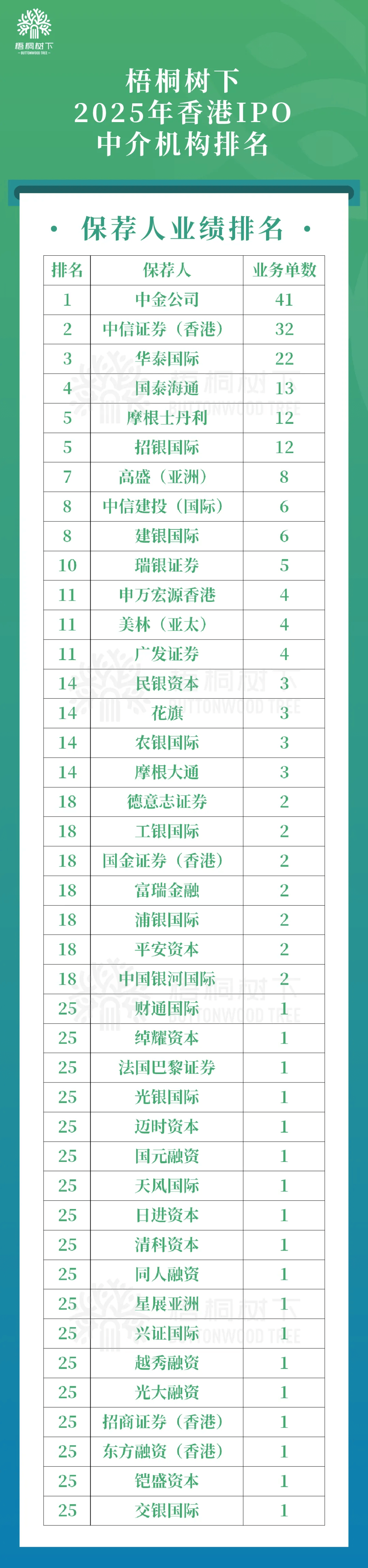
Group 1: IPO Overview - In 2025, a total of 119 companies listed on the Hong Kong Stock Exchange, with 114 through IPOs and 5 through other methods [1] - The IPO intermediaries included 42 brokerage firms, 39 Hong Kong legal advisors, 33 Chinese legal advisors, and 9 accounting firms [1] Group 2: Sponsor Performance Rankings - The top five sponsors for the 114 Hong Kong IPOs were: 1. CICC with 41 deals 2. CITIC Securities (Hong Kong) with 32 deals 3. Huatai International with 22 deals 4. Guotai Junan with 13 deals 5. Morgan Stanley and China Merchants International, both with 12 deals [2][3] Group 3: Hong Kong Legal Advisors Rankings - The leading Hong Kong legal advisors for the IPOs were: 1. Davis Polk and Highbury with 16 deals each 2. K&L Gates with 9 deals 3. Several firms including Farrer & Co, King & Wood Mallesons, and others with 5 deals each [7][8] Group 4: Chinese Legal Advisors Rankings - The top Chinese legal advisors for the IPOs were: 1. Tongshang with 19 deals 2. Jingtian & Gongcheng with 17 deals 3. Zhong Lun with 10 deals [10][11] Group 5: Accounting Firms Rankings - The leading accounting firms for the IPOs were: 1. Ernst & Young with 41 deals 2. KPMG with 25 deals 3. Deloitte with 21 deals 4. PwC with 13 deals [14][15]