Morgan Stanley(MS)

Search documents
摩根士丹利:全球宏观策略-关税关键节点
摩根· 2025-07-01 02:24
Investment Rating - The report maintains a bullish outlook on U.S. Treasuries (USTs) and a bearish stance on the U.S. Dollar (USD) [1] Core Insights - Tariffs are significant, with U.S. government revenue from tariffs annualizing over 1% of U.S. GDP, indicating that they do not represent a zero-sum game [1] - U.S. importers paid tariffs equivalent to 65% of corporate income taxes in 2024, and these tariffs represented 15% of non-financial corporate profits after tax in Q1 2025 [10][11] - If corporations absorbed all tariff expenses, profit margins would have fallen to 11.7% from 13.8%, below the 15-year moving average of 12.2% [10][26] Summary by Sections Tariff Impact - U.S. importers' tariff payments in June annualized to $327 billion, or 1.1% of Q1 2025 nominal GDP [12][16] - The analysis suggests that tariffs act as a significant tax burden on corporations, impacting profit margins and overall economic growth [11][29] Corporate Profit Margins - In Q1 2025, non-financial corporations reported $2.127 trillion in profit after tax, with profit margins sitting at 13.8% [22] - The report highlights that if tariffs were fully absorbed, profit margins would drop significantly, indicating potential economic stress [26][34] Economic Outlook - The report suggests that the economic backdrop is skewed to the downside, with airline passenger traffic slowing and potential impacts from tariffs expected to manifest in inflation data [30] - The recommendation is to stay long U.S. Treasuries and short the USD, reflecting a cautious economic outlook [1][30]

摩根士丹利:中国经济-财政发力强劲,出口动能趋缓
摩根· 2025-07-01 02:24
Investment Rating - The report does not explicitly state an investment rating for the industry Core Insights - The manufacturing PMI for June increased by 0.2 percentage points month-on-month to 49.7, slightly surpassing consensus expectations of 49.6, driven by strong fiscal front-loading [7] - Export momentum is weakening, with the new export order index rising only 0.2 percentage points month-on-month, remaining significantly below pre-tariff levels, indicating a potential end to strong US-bound shipping [3][4] - Real GDP growth is expected to decline from 5% year-on-year in Q2 to 4.5% in Q3 due to fading export front-loading and muted stimulus measures anticipated from the government [4][7] Summary by Sections Manufacturing Sector - The June manufacturing PMI rose to 49.7, supported by stronger new orders and production, particularly in consumer goods and base materials [2][7] - The construction PMI also saw a notable increase of 1.8 percentage points month-on-month to 52.8, reflecting ongoing fiscal support for infrastructure spending [2] Export Dynamics - The new export orders index showed a slight increase but remains low compared to historical levels, suggesting a slowdown in export activities [3][4] - Container throughput has weakened, indicating a broader decline in export volumes to various destinations [3] Economic Outlook - The report anticipates a decrease in real GDP growth to 4.5% year-on-year in Q3, influenced by the diminishing impact of export front-loading and a lack of significant new fiscal stimulus [4][7] - A modest supplementary fiscal stimulus of Rmb0.5-1 trillion is expected to be introduced by the government in late Q3 or early Q4 if economic data continues to show weakness [4]
摩根士丹利:中国经济-二季度表现稳健,增长动能趋缓,秋季或推刺激政策
摩根· 2025-07-01 02:24
Investment Rating - The report indicates a solid investment outlook for the China economy, with expectations of a supplementary budget of Rmb0.5-1 trillion in response to weaker data in the coming months [3]. Core Insights - The report highlights a robust performance in Q2 2025, but notes a softening momentum, suggesting that a fall stimulus is likely to be implemented [2][3]. - Structural reforms are deemed essential for sustained economic reflation, with a focus on social welfare reform, debt restructuring, and improving fiscal governance [3]. - Retail sales have remained strong, particularly in the auto and home appliance sectors, although there are concerns about subdued sales in other consumer goods categories [5][7]. - Exports are expected to slow further, despite a rebound in US-bound shipping, indicating potential challenges in international trade [10][12]. - The housing market is experiencing a downturn, with secondary home sales weakening and local government financing pressures increasing [15][20]. Summary by Sections Economic Performance - Q2 2025 data shows solid economic performance, but momentum is softening, leading to expectations of a fall stimulus [2][3]. - Retail sales in June were strong, driven by front-loaded demand in the auto and home appliance sectors [5]. Policy Outlook - The report anticipates a supplementary budget of Rmb0.5-1 trillion to address weaker economic data in the upcoming months [3]. - Structural reforms are necessary for sustained reflation, focusing on social welfare, debt restructuring, and fiscal governance [3]. Trade and Exports - Exports are likely to slow further, with June showing a decline despite a rebound in US-bound shipping [10][12]. - Container throughput at major ports has slipped sharply, indicating challenges in trade logistics [11]. Housing Market - The housing market is under pressure, with secondary home sales weakening and local government financing facing challenges [15][20]. - Major tax revenues and land sales have underperformed, contributing to fiscal pressures [20]. Construction Activity - Weak construction activities are indicated by subdued demand for rebar and cement, suggesting a slowdown in overall construction [21][23]. RMB Internationalization - The report discusses the roadmap for RMB cross-border settlement and highlights the importance of stablecoins in reinforcing dollar dominance in the near term [27][28].
KVB plus:美股3个月狂飙近24%,大摩放话,今年下半年还能涨
Sou Hu Cai Jing· 2025-07-01 01:29
Core Viewpoint - The U.S. stock market is experiencing a significant rally, with the S&P 500 index rising nearly 24% since mid-April, prompting discussions about the sustainability of this bull market [1] Group 1: Corporate Earnings Improvement - The primary driver for the continued rise in U.S. stocks is the improvement in corporate earnings, with recent upward revisions in earnings forecasts for S&P 500 constituents [3] - The breadth of earnings improvement is expanding beyond just technology giants, as indicated by the ERB indicator, which has rebounded from -25% in mid-April to -5% currently [3] - Historical data suggests that such turning points often signal a strong return outlook for the market, with large-cap quality stocks benefiting first, followed by small-cap and lower-quality stocks [3] Group 2: Federal Reserve Monetary Policy Expectations - A shift in expectations regarding Federal Reserve monetary policy is the second catalyst supporting the rise in U.S. stocks, with predictions of up to seven interest rate cuts by 2026 [4] - The market tends to react proactively to anticipated changes in monetary policy rather than waiting for explicit signals [4] - While there are risks associated with rising unemployment potentially disrupting market optimism, this scenario is not included in Morgan Stanley's baseline forecast [4] Group 3: Market Resilience to External Shocks - The strong resilience of the U.S. stock market in absorbing external shocks is the third pillar supporting its future performance, mirroring historical trends following geopolitical conflicts [5] - The easing tensions between Iran and Israel and the subsequent decline in international oil prices have reduced energy cost threats to the economic cycle [5] - The potential removal of "retaliatory tariffs" from tax reform legislation is expected to boost market confidence, alongside a decrease in the yield premium on U.S. Treasuries, indicating alleviated concerns about U.S. fiscal health [5] - Morgan Stanley maintains a target of 6,500 points for the S&P 500 index over the next 12 months, provided that the 10-year Treasury yield remains below 4.5% [5]


高盛改口:美联储提前在9月启动降息,今年恐连砍3刀
Jin Shi Shu Ju· 2025-07-01 01:01
Group 1 - Goldman Sachs has adjusted its forecast for the Federal Reserve's interest rate cuts, now expecting a cut in September instead of December, citing weaker-than-expected inflation impacts from tariffs [1] - The Goldman Sachs economic research team, led by Chief Economist Jan Hatzius, believes the probability of a September rate cut is slightly above 50%, influenced by factors such as weaker tariff effects and a softening labor market [1] - Goldman Sachs predicts rate cuts of 25 basis points in September, October, and December, lowering the terminal rate expectation from 3.5%-3.75% to 3%-3.25% [1] Group 2 - Morgan Stanley disagrees with Goldman Sachs, stating that the likelihood of the Federal Reserve cutting rates in the near term remains low, despite market expectations increasing for a September cut [1] - Morgan Stanley analysts believe that most Federal Reserve officials support a cautious stance and are unlikely to quickly endorse rate cuts, anticipating a relatively stable upcoming employment report [1] - Chicago Fed President Goolsbee expressed skepticism about the possibility of a 1970s-style stagflation occurring in the current economic environment, given the current unemployment and inflation rates [2] Group 3 - Atlanta Fed President Bostic expects one rate cut in 2025 and three cuts in the following year, indicating a patient approach to maintaining current rates due to a stable labor market [3] - Bostic noted that the full impact of Trump's trade tariffs on the economy has yet to be felt, suggesting that price impacts are more a matter of timing than certainty [2]

摩根士丹利:全球宏观展望-外国投资者是否在逃离美国资产?
摩根· 2025-07-01 00:40
Investment Rating - The report recommends an overweight position in US equities, suggesting they remain attractive compared to the rest of the world [9]. Core Insights - There is a narrative questioning whether foreign investors are fleeing US assets, driven by uncertainties in trade and tariff policies. However, data indicates that while foreign investors have slowed their pace of buying US stocks, they have not significantly reallocated away from them [2][4]. - US risky and risk-free assets are viewed as attractive, with a recommendation for an equal-weight position in global equities while overweighting US equities due to better earnings revision breadth in the US compared to other regions [9]. - The report highlights persistent weakness in the US dollar over the next 12 months, driven by a convergence of US rates and growth to peers, alongside elevated policy uncertainty [10]. Summary by Sections - **Investment Flows**: International investors have been net buyers of US equities post-Liberation Day, but the buying pace has slowed compared to 2024, although it remains higher than in 2021-2023. US investors, in contrast, have been net sellers, reallocating away from US equities [3][4]. - **Bond Funds**: Net inflows to US bond funds have been positive but slower than the previous year. Foreign investors have remained net buyers of US bonds, indicating no significant outflows from US bonds [5][8]. - **Regional Allocation**: The weight of US equities in global equity funds has decreased, reflecting a market correction rather than net outflows. This change aligns with the overall market cap of US equities shrinking as a share of the global equity benchmark index [4].
摩根士丹利:关注经济数据,而非美国股市
摩根· 2025-07-01 00:40
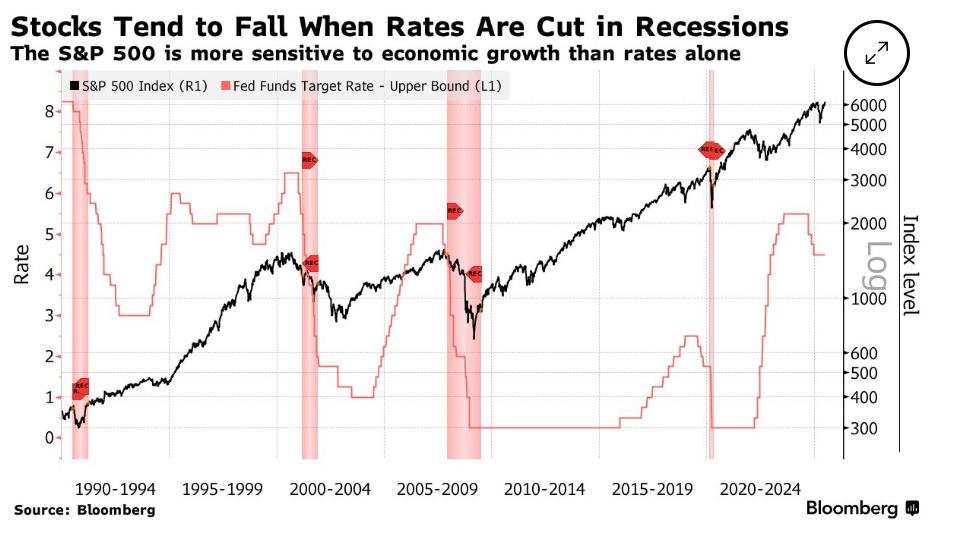
Investment Rating - The report suggests a long position in UST duration at the 5-year key rate and recommends maintaining long positions in UST 3s30s and term SOFR 1y1y vs. 5y5y steepeners ahead of potential range breakouts post-month-end [6][10][41]. Core Insights - The report emphasizes that the performance of the S&P 500 Index often does not accurately predict economic recessions, with historical data showing that in 27% of NBER-declared recessions, the S&P 500 peaked in or after the month the recession began [6][21]. - It highlights the importance of upcoming US labor market data, particularly the May JOLTS and June employment reports, which could significantly influence the yield curve and Treasury yields [18][32]. - The report notes a significant decrease in the US Treasury's cash flow deficit over the past three months, attributed to higher tax revenues, tariff revenues, and reduced government spending [19][29]. Summary by Sections Economic Data and Market Performance - The report argues that investors should focus on economic data rather than the stock market, as historical trends indicate that equity performance often misleads regarding impending recessions [9][11]. - It points out that the S&P 500 Index's performance leading up to recessions has often been misleading, with many instances where the index was near its peak when recessions began [15][21]. Labor Market Insights - The upcoming labor market data is critical, with expectations for total payroll growth of 140,000, which aligns with recent trends but contrasts with rising unemployment claims [32][36]. - The report suggests that the labor market data could catalyze a repricing of risks in the US rates market, particularly if the data indicates downside risks [30][41]. Treasury Financing Needs - The report discusses the US Treasury's financing needs, noting a significant reduction in the cash flow deficit, which fell to $111 billion over a recent 63-day period, down 75% from the previous year [29][30]. - It highlights that tariff revenues have played a significant role in reducing the cash flow deficit, with annualized tariff revenue reaching $323.9 billion, or 1.1% of nominal GDP, a notable increase from historical averages [25][26].
7月1日电,摩根士丹利表示,布伦特原油价格有望在明年初回落至每桶约60美元左右。
news flash· 2025-06-30 21:17
Core Viewpoint - Morgan Stanley predicts that Brent crude oil prices are expected to decline to around $60 per barrel by early next year [1] Group 1 - The forecast indicates a significant drop in oil prices, suggesting potential changes in the energy market dynamics [1]
摩根大通警告:美联储“错误降息”将至 美国股债汇恐迎巨震!
Jin Shi Shu Ju· 2025-06-30 12:00
Group 1 - The market's expectation for a Federal Reserve rate cut is increasing, but JPMorgan's London strategy team warns that the underlying reasons for the cut may not be favorable for the stock market, potentially leading to a "wrong type of easing" and triggering market repercussions [1] - JPMorgan strategists identified three possible scenarios for rate cuts: 1) a cut due to significant economic activity slowdown, 2) a resilient economic growth scenario with controlled inflation, and 3) a cut despite some inflation pressure, possibly influenced by the U.S. government [1] - The strategists predict a combination of the first and third scenarios, where economic activity slows but inflation rises, which could lead to investor disappointment [1] Group 2 - Historically, emerging market stocks tend to perform well when the Federal Reserve loosens monetary policy, and JPMorgan has reaffirmed its bullish stance on this sector after a cautious period [2] - In a rate cut environment, sectors such as consumer staples, healthcare, and technology typically perform better, while industrials and financials may lag [2] - Despite the S&P 500 reaching new highs, its year-to-date gain of 5% is significantly lower than the 21% increase of European stocks [2]

美股新高但多空对峙激烈:小摩看空非农就业数据 大摩坚信降息预期延续牛市
智通财经网· 2025-06-30 11:33
Group 1 - JPMorgan's strategy team indicates that the cooling labor market in the U.S. may exert a greater suppressive effect on the stock market than the potential boost from Federal Reserve rate cuts [1] - The team, led by Chief Strategist Mislav Matejka, believes that the weakening macro environment supporting U.S. equities is diminishing, and that the negative impact of a weak labor market on investor confidence will be more significant than the positive effects of monetary easing [1] - The report emphasizes that the adverse effects of a weak labor market will dominate over the positive push from the Fed's loosening of monetary policy [1] Group 2 - In contrast, Morgan Stanley's strategy team, led by Michael Wilson, suggests that the market may begin to rebound before the anticipated rate cuts are realized [3] - Morgan Stanley economists predict that the Fed will implement a total of seven rate cuts by 2026, which will provide crucial support for the stock market in the second half of this year [3] - The differing views between the two investment banks reflect a divide in assessing the turning point of the U.S. economy, with JPMorgan focusing on the negative chain reaction from a deteriorating labor market and Morgan Stanley emphasizing the driving effect of policy shifts on valuation expansion [3]