Microsoft(MSFT)

Search documents
抗争起效,AI大厂终于不再“白嫖”维基百科
3 6 Ke· 2026-01-21 12:21
AI大厂终于意识到继续与内容平台对抗是条不归路。 就在全球最知名的百科全书网站维基百科(Wikipedia)庆祝25周年之际,负责运营维基百科的维基媒 体基金会方面宣布,亚马逊、Meta、微软、Mistral AI以及Perplexity等多家AI大厂加入"维基媒体企业合 作伙伴计划"(Wikimedia Enterprise)。 因此也就意味着,这些厂商将付费获取维基百科的"企业级数据访问权",以获取这家百科全书网站的实 时数据。而维基媒体企业合作伙伴计划则会根据他们的特定需求,对维基百科海量的文章数据进行结构 化处理,使其更易于模型训练和商业用途。对此维基媒体基金会表示,来自亚马逊、微软等厂商的授权 费用将直接用于支持该非营利组织的长期运营。 简而言之,维基百科将旗下的数据资产整理成AI更易懂的形式,以方便AI厂商即拿即用。 比如在金融大模型中,交易金额、交易时间、交易类型等结构化的交易记录,就可以作为模型的输入特 征,帮助AI学习和识别风险模式,从而提升输出结果的稳定性。不仅如此,结构化数据与知识图谱之 间存在天然的协同关系,通过将两者结合,AI大模型就可以更准确地理解数据的上下文和语义。 而维基百科之 ...


氪星晚报|联想集团与英伟达联合推出“联想人工智能云超级工厂”;OpenAI与盖茨基金会将向非洲医疗人工智能领域投资5000万美元;我国去年电影全产业链产值超8100亿元
3 6 Ke· 2026-01-21 11:32
36氪获悉,联想集团与英伟达近日共同宣布,两家公司将进一步深化在人工智能基础设施领域的合作, 联合推出"联想人工智能云超级工厂"。同时,联想中国正式发布了"联想AI工厂"整体解决方案,旨在帮 助企业数据中心从传统"算力中心"向高效"AI工厂"的智能化转型,助力其全栈AI技术在中国的应用实践 与全面落地。 OpenAI:推出用户年龄预测功能,以保护未成年用户 美东时间周二,OpenAI表示,已在其ChatGPT消费者计划中推出一款年龄预测模型,以帮助该公司识别 属于18岁以下用户的账户。近几个月来,OpenAI已推出多项新的安全功能,以应对有关其如何保护用 户(尤其是未成年人用户)的日益严格的审查。OpenAI表示,如果其年龄预测模型显示用户未满18 岁,ChatGPT将自动启用保护措施,减少展示"敏感内容"。如果已成年用户的年龄被错误判定为未满18 岁,他们将能够使用身份验证服务Persona来恢复完全访问权限。(智通财经) 大公司: 日本最大核电站重启 当地时间1月21日,日本东京电力公司重启柏崎刈羽核电站6号机组。日本最大核电站——柏崎刈羽核电 站由东京电力公司运营,2011年"3·11"东日本大地震后一 ...


Bubble or Boom? Answer Depends on AI Adoption, Microsoft CEO Says
Yahoo Finance· 2026-01-21 11:30
He’s not saying it is a bubble, but Microsoft CEO Satya Nadella knows what one would look like. Speaking at the World Economic Forum in Davos, Switzerland, on Tuesday, the Microsoft CEO said whether there’s an AI bubble depends on one not-so-surprising factor: adoption rates. “For this not to be a bubble by definition, it requires that the benefits of this are much more evenly spread” beyond just AI firms and the tech industry, Nadella said. Early indications suggest the industry may have its work (human, ...
Fortune and Korn Ferry Reveal the Fortune World's Most Admired Companies™ 2026 List
Prnewswire· 2026-01-21 11:01
Core Insights - Apple has maintained its position as the top company on Fortune's World's Most Admired Companies (WMAC) list for the 19th consecutive year, reflecting its strong corporate reputation and management practices [1][2] - The list, created in partnership with Korn Ferry, is based on a poll of over 3,000 executives, directors, and analysts, highlighting the importance of innovation and effective management in corporate reputation [2][10] Company Rankings - The top five companies in the WMAC list for 2026 are Apple, Microsoft, Amazon, NVIDIA, and JPMorgan Chase, recognized for their financial stability, innovation, and respected leadership [3][9] - Notable companies that dropped off the list include Target, PepsiCo, Novo Nordisk, and Adobe, indicating shifts in corporate reputation and performance [5] Industry Highlights - The WMAC list features 324 companies across 22 countries, with a significant representation from the U.S. (235 companies), Europe (58), and the Asia/Pacific region (28) [5] - In specific industries, Whirlpool and MetLife made notable comebacks, ranking first in home equipment and furnishings and life and health insurance, respectively [6] - First-time winners in their categories include L'Oréal in soaps and cosmetics and GE Aerospace in aerospace and defense, showcasing the dynamic nature of corporate competition [7] Female Leadership - The list includes 35 female-led companies, representing 10% of the total, with several leaders also recognized in Fortune's Most Powerful Women in Business list [8]


Anthropic CEO Predicts AI Models Will Replace Software Engineers In 6-12 Months: 'I Don't Write Any Code Anymore' - Microsoft (NASDAQ:MSFT)
Benzinga· 2026-01-21 10:32
Core Insights - Dario Amodei, CEO of Anthropic, predicts that AI models could soon take over most tasks currently performed by software engineers within the next six to twelve months [1][3] - Engineers at Anthropic have already ceased manual coding, relying instead on AI models to write code, which they then edit [2][3] Group 1: Automation in Software Engineering - Amodei states that the transition to AI-driven coding is imminent, with engineers at Anthropic no longer writing code manually [2][3] - The development of AI models capable of coding is creating a self-improvement loop, accelerating the creation of next-generation models [3][4] Group 2: Industry Trends and Implications - The trend of automating software engineering tasks aligns with broader advancements in AI and automation technologies, as seen with companies like Microsoft implementing AI tools [5] - Concerns have been raised regarding job displacement, with AI researcher Geoffrey Hinton warning that AI could replace millions of jobs by 2026 [6]

美股大型科技股盘前小幅上涨




Ge Long Hui A P P· 2026-01-21 09:21
格隆汇1月21日丨伟达涨1%,特斯拉涨0.8%,Meta、亚马逊涨0.4%,微软涨0.2%,苹果涨0.1%。 ...
微软打包收购OpenAI?就差一点
3 6 Ke· 2026-01-21 08:56
Core Viewpoint - The article discusses the dramatic internal conflict at OpenAI, particularly the removal and subsequent reinstatement of CEO Sam Altman, highlighting Microsoft's strategic involvement and the competitive landscape surrounding OpenAI. Group 1: OpenAI's Internal Conflict - OpenAI experienced a rapid internal upheaval, leading to the unexpected firing of CEO Sam Altman, followed by employee pressure on the board for his reinstatement [3][11] - Microsoft played a crucial role in this situation, offering a $25 billion guarantee to OpenAI employees to prevent them from leaving for competitors like Google or Amazon [3][9] - The board's decision to remove Altman was met with significant backlash from nearly 800 OpenAI employees, who threatened to resign if he was not reinstated [11][12] Group 2: Microsoft's Strategic Moves - Microsoft quickly established a new subsidiary named "Microsoft RAI, Inc." to potentially absorb OpenAI employees, completing all legal paperwork within a day [8][9] - The urgency of Microsoft's actions was driven by the fear of losing talent to competitors during OpenAI's internal turmoil [9][11] - Microsoft’s CEO Satya Nadella actively supported Altman's return and was involved in discussions about the new board composition at OpenAI [15][12] Group 3: Historical Context of Microsoft and OpenAI - Initially, OpenAI partnered with Amazon, but Microsoft later became a significant investor, providing $1 billion in exchange for exclusive cloud computing rights [16][20] - The relationship between Microsoft and OpenAI has been complex, with Microsoft expressing doubts about OpenAI's commercial viability in the past [3][20] - OpenAI's transition to a capped-profit model allowed it to attract further investment from Microsoft, which has since become a major player in the AI landscape [20][22] Group 4: Future Directions and Challenges - OpenAI is shifting towards a more independent operational model, signing a $38 billion infrastructure deal with Amazon to reduce reliance on Microsoft [25][27] - The company is also facing legal challenges from Elon Musk, who claims that OpenAI has strayed from its original non-profit mission [27][29] - OpenAI's CFO is leading efforts to diversify its partnerships and avoid dependency on any single cloud service provider, aiming to establish itself as a leader in the AI industry [31]

A Once-in-a-Decade Investment Opportunity: 3 Quantum Computing Stocks to Buy and Hold
The Motley Fool· 2026-01-21 08:45
Core Viewpoint - The current decade presents a once-in-a-decade investment opportunity in generative AI and quantum computing, with specific stocks in quantum computing being highlighted as potential long-term investments [2]. Group 1: Alphabet - Alphabet has significantly benefited from the rise of mobile phones and social media, with its Google Cloud division experiencing substantial growth due to the shift to cloud computing and the rise of generative AI [3]. - The Google Quantum AI unit achieved quantum supremacy in October 2019, marking a significant milestone in quantum computing [4]. - In 2023, Google Quantum AI demonstrated the first logical qubit prototype, indicating progress in reducing quantum computing errors and increasing qubit numbers [5]. - Predictions suggest that Google Quantum AI will build a large, error-corrected quantum computer with at least 1 million qubits in the coming years [6]. Group 2: Microsoft - Microsoft shares similarities with Alphabet, being a technology giant and a top-tier cloud service provider, benefiting from generative AI [7]. - The company has developed a unique approach to quantum processing, distinguishing it from competitors [7]. - In February 2025, Microsoft introduced the Majorana 1 quantum chip, utilizing a topological superconductor, which could potentially allow for over 1 million qubits on a single chip [9]. - If successful, Microsoft's topoconductor technology could position the company as a leading player in the quantum computing industry for the next decade [10]. Group 3: IonQ - IonQ currently has a market cap of approximately $18 billion, making it a smaller player compared to Alphabet and Microsoft [11]. - The company employs a trapped-ion architecture for quantum computing, which aims to reduce quantum errors and enhance qubit coherence [12]. - IonQ is also developing quantum networking, sensing, and security solutions, positioning itself as a unique quantum platform company [14]. - Despite being riskier and currently unprofitable, IonQ could offer greater long-term returns if its R&D efforts succeed [15].




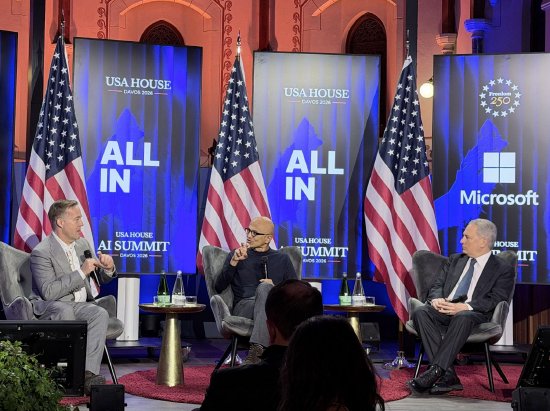
直击达沃斯|微软CEO纳德拉:AI时代的核心不是“单一模型”,而是“模型编排与算力工厂”
Xin Lang Cai Jing· 2026-01-21 08:36
Core Insights - The main strategic focus for Microsoft in the AI era is not on having a single foundational model, but rather on computational infrastructure, model orchestration capabilities, and deep embedding of enterprise knowledge [1][11]. Group 1: AI Strategy - One of Microsoft's core AI strategies is to develop Azure into a large-scale "Token factory" to meet the exponentially growing computational demands of AI applications [3][13]. - Microsoft emphasizes the need for cloud service providers to build heterogeneous infrastructure clusters and enhance utilization through software to lower total cost of ownership (TCO) [3][5]. - Nadella asserts that future AI applications will not rely on a single model; instead, enterprises will use multiple models and orchestrate them for various tasks [3][16]. Group 2: Model Ecosystem - The competition between open-source and closed-source models is likened to the evolution of the database market, suggesting a diverse model ecosystem will emerge, featuring both types of models [3][6]. - The true competitive advantage lies in a company's ability to embed its tacit knowledge into its controllable model weights [3][18]. - Nadella predicts that the number of models will be equivalent to the number of companies in the world, reflecting the transition from a knowledge economy to an AI economy [3][19]. Group 3: Local Computing - Microsoft has developed models that can run locally on Windows desktops, utilizing NPU and GPU resources, indicating a resurgence of high-performance workstations [3][21]. - The desktop computing form factor is regaining strategic value in the AI era, which aligns with Microsoft's inherent advantages in the desktop ecosystem [3][21].