Nissan Motor(NSANY)

Search documents
欧洲跨国巨头大手笔收购印度整车工厂,背后究竟有何深意?
Zhong Guo Qi Che Bao Wang· 2025-08-04 02:56
Core Insights - Renault announced the acquisition of Nissan's remaining 51% stake in the Chennai joint venture, making it the sole owner of the facility [2][3] - The acquisition signifies a strategic shift for Renault, allowing for independent operations and decision-making without the constraints of a joint venture [5][6] Company Strategy - The Chennai plant has produced over 2.8 million vehicles since its inception, with 43% (approximately 1.2 million) exported to over 100 countries, highlighting its manufacturing capabilities [3][4] - Renault aims to leverage the Chennai facility as a global production hub for right-hand drive vehicles, targeting markets in Australia, South Africa, and Southeast Asia [7] Market Positioning - The transition to full ownership allows Renault to respond more swiftly to market demands, particularly in the growing Southeast Asian market for small SUVs [6] - Renault expects to reduce production costs by 15%-20% due to India's lower labor costs, enhancing competitiveness in price-sensitive markets [6] Industry Impact - The acquisition is seen as a pivotal move in the global automotive landscape, potentially influencing other automakers to reconsider their strategies in emerging markets [8][10] - The shift in production capacity from traditional markets to emerging markets like India and Southeast Asia reflects a broader trend in the automotive industry [9][10] Future Outlook - By 2027, Renault anticipates that the Chennai plant's export volume could exceed 800,000 units, contributing 12% to the group's global output [7] - The acquisition is expected to inspire new investment models in emerging markets, combining technology transfer with local production and global export [8][9]



大众造增程车,丰田建电池厂,合资车企正在上演“生存式进化”
Hua Xia Shi Bao· 2025-08-01 10:41
Core Insights - The Chinese automotive market is undergoing a silent transformation, with joint venture automakers rebounding after three years of declining market share, showing a significant recovery in the first half of 2025 [2][3] - The resurgence of joint venture brands is attributed to their strategic restructuring and adaptation to market trends, including deep operations in the fuel vehicle market and localization of new energy technologies [2][4] Joint Venture Recovery - In the first half of 2025, major joint venture automakers reported impressive sales figures, with FAW-Volkswagen achieving a cumulative sales of 436,100 units, a 3.5% year-on-year increase, and FAW Toyota seeing a 16% increase with 377,800 units sold [3] - The strong performance of fuel vehicles has been a key driver of this recovery, with models like the Volkswagen Sagitar and Magotan showing significant sales growth [3][4] Pricing Strategy - The adjustment of pricing strategies has been crucial for the recovery of the fuel vehicle market, with average promotional discounts for joint venture fuel vehicles reaching 23.1% in June 2025, nearly doubling from 13% in 2023 [4] - Many joint venture automakers have adopted a "one price" strategy, enhancing product competitiveness and reshaping consumer preferences [4] Channel Optimization - The optimization of distribution channels has injected strong momentum into terminal sales, with FAW-Volkswagen focusing on dealer return on investment and prioritizing channel health in its strategic agenda [4] - FAW Toyota's direct sales model for the Corolla has alleviated pricing competition among dealers while enhancing service quality [4] Localization and R&D - Joint venture automakers are restructuring their competitiveness through deep localization strategies, with a focus on local R&D and decision-making processes [6][8] - The shift towards local teams leading product development is evident, with new models like Nissan's N7 being entirely developed by Chinese teams [6] Dynamic Technology Adjustments - The ability to dynamically adjust technology routes is a significant aspect of the transformation, with Volkswagen's recent embrace of range-extended technology marking a notable shift in strategy [7] - The market is witnessing a surge in range-extended vehicle sales, with a 78.7% year-on-year increase in 2024, indicating a growing acceptance of this technology [7] Electric Vehicle Surge - Joint venture automakers are preparing for a wave of electric vehicle launches, leveraging local technology platforms to regain market influence [8][9] - Major brands are collaborating with Chinese tech companies to enhance their smart driving systems, ensuring competitiveness in the electric vehicle market [9] Conclusion - The rebound of joint venture automakers is not coincidental; it reflects a survival evolution in the Chinese market, where local technology and consumer demands are reshaping the automotive landscape [10]



雷诺将收购日产在印度金奈合资工厂的剩余股权
3 6 Ke· 2025-08-01 08:00
雷诺8月1日宣布,将收购日产在印度金奈(Chennai)合资工厂剩余的51%股权,成为该工厂 的唯一所有者。为了领导这一新阶段的发展,公司任命Stéphane Deblaise为雷诺集团印度首席执 行官,自2025年9月1日起生效。(界面) ...
巨亏55亿,日产坠落:裁员2万人,关闭全球7家工厂
2 1 Shi Ji Jing Ji Bao Dao· 2025-08-01 06:55
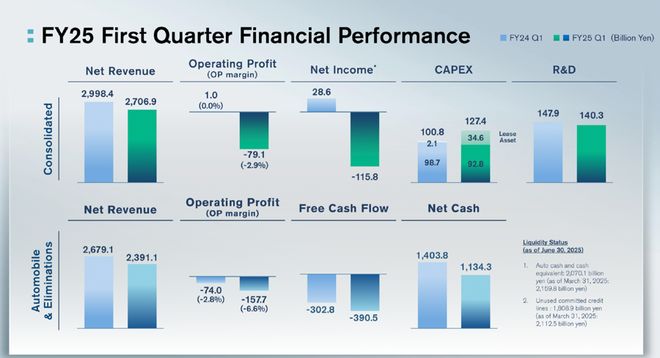
Core Viewpoint - Nissan is facing significant financial challenges, reporting a net loss of 115.76 billion yen (approximately 5.5 billion RMB) in Q1 of FY2025, marking a shift from a profit of 28.56 billion yen in the same period last year, primarily due to currency fluctuations and U.S. tariff policies [1][8][20]. Financial Performance - Nissan's net sales for Q1 FY2025 were 2.7 trillion yen, a decrease of 9.7% year-on-year [1]. - The company reported an operating loss of 79.1 billion yen, compared to an operating profit of 9.95 billion yen in the previous year [1]. - Global retail sales fell to 707,000 units, down 10.1% year-on-year, with a notable 27.5% decline in the Chinese market [8][12]. Market Challenges - The decline in sales is attributed to intense competition in the Chinese market and a shrinking non-luxury joint venture segment, exacerbated by escalating price wars [8]. - Nissan has struggled to capitalize on the hybrid demand in the U.S. market, leading to decreased sales and revenue [12]. Strategic Responses - In response to the financial crisis, Nissan has initiated a revival plan called "Re:Nissan," which includes cost optimization measures such as laying off 20,000 employees and closing seven factories globally [17][19]. - The company plans to invest 100 billion yen in R&D for new energy vehicles and aims to launch 10 new models in China by 2027 [15][19]. Future Outlook - Nissan has not disclosed a profit forecast for FY2025 but anticipates further losses in the first half, with an expected operating loss of up to 180 billion yen [17]. - The company projects a 2.9% decline in global sales for FY2025, primarily due to an 18.2% expected drop in the Chinese market [17]. - Nissan's leadership emphasizes the urgency of the revival plan to ensure a sustainable and profitable future [20].
巨亏55亿,日产坠落:裁员2万人,关闭全球7家工厂
21世纪经济报道· 2025-08-01 06:38
Core Viewpoint - Nissan Motor Co. has reported significant financial losses, marking a continued decline in performance due to adverse market conditions and strategic missteps, particularly in the Chinese market [1][7][19]. Financial Performance - In Q1 of FY2025 (April 1, 2025 - June 30, 2025), Nissan's net sales amounted to 2.7 trillion yen, a year-on-year decrease of 9.7% [1]. - The company recorded a net loss of 115.76 billion yen (approximately 5.5 billion RMB), a stark contrast to a net profit of 28.56 billion yen in the same period last year [1]. - Operating losses reached 79.1 billion yen, also a shift from profitability in the previous year [1]. Sales and Market Performance - Global retail sales for Nissan fell to 707,000 units in Q1 FY2025, a decline of 10.1% year-on-year [7]. - The Chinese market saw a particularly steep drop in sales, down 27.5%, attributed to intense competition and a shrinking market for non-luxury joint venture brands [7][11]. - Nissan's sales in Asia dropped nearly 30%, with the region contributing only 5% to global sales [11]. Strategic Responses - Following the collapse of merger talks with Honda, Nissan has initiated a self-rescue plan, which includes laying off 20,000 employees and closing seven factories globally [6][15]. - The company plans to invest 100 billion yen in R&D for electric vehicles in the Chinese market and aims to launch 10 new energy models by 2027 [12][14]. - Nissan's restructuring plan, "Re:Nissan," focuses on cost optimization, including a target to save 500 billion yen in costs by FY2026 [17][18]. Future Outlook - Nissan has not disclosed profit forecasts for FY2025 but anticipates further losses, with operating losses potentially reaching 180 billion yen in the first half of FY2025 [16]. - The company expects a 2.9% decline in global sales to 3.25 million units, primarily due to an 18.2% drop in the Chinese market [17]. - Nissan is enhancing its collaboration with Dongfeng in China and exploring partnerships with other companies to strengthen its market position [18][19].

2025 FIRST HALF RESULTS : MOBILIZE FINANCIAL SERVICES DELIVERS SOLID GROWTH
Globenewswire· 2025-07-31 18:45
Core Insights - Mobilize Financial Services achieved a 3.8% increase in new financing in the first half of 2025 compared to the same period in 2024, reflecting strong commercial dynamics and growth in vehicle registrations [1][8] - The pre-tax profit rose by 9.7%, indicating the effectiveness of the company's strategy and commitment to sustainable mobility [2][15] - The penetration rate for electric vehicles reached 43.9%, a significant increase of 6.5 points compared to other motorization types [7][9] Commercial Performance - A total of 632,994 contracts were financed in the first half of 2025, showing a slight increase of 0.8% from the previous year [7][10] - The financing activity for used vehicles saw a minor decline of 0.4%, with 153,759 contracts financed [10] - Mobilize Lease&Co financed 120,039 operational leasing contracts, achieving a fleet under management of 655,000 vehicles, a growth of 4% [11] Financial Performance - The Net Banking Income (NBI) reached 1,132 million euros, up 5.3% year-on-year, driven by improved financial margins and increased outstanding loans [13] - Operating costs amounted to 389 million euros, reflecting a stable operating expense ratio of 1.33% relative to Average Productive Assets [14] - The Average Performing Assets (APAs) grew to 58.9 billion euros, a 7.3% increase compared to the same period in 2024 [12] Market Context - The automotive market experienced a slight growth of 0.7%, with Renault Group, Nissan, and Mitsubishi selling 1.19 million vehicles, a 2.3% increase from the first half of 2024 [8] - The overall penetration rate for financing stood at 39.6%, a slight decrease of 0.4 points compared to the previous year [9] Financing Strategy - The company raised 1.3 billion euros in the bond market during the first half of 2025, enhancing the maturity profile of subordinated debt [15] - In the securitization market, 624 million euros in automobile loan-backed securities were placed, with extensions on revolving periods for certain transactions [16] - The savings collection activity reached 30.5 billion euros, representing 49.1% of net assets, highlighting the diversification of financing sources [17][23]

预期亏损扩大,日产复苏计划“刻不容缓”
2 1 Shi Ji Jing Ji Bao Dao· 2025-07-31 14:37
Core Viewpoint - Nissan has reported significant financial losses for the first quarter of the 2025 fiscal year, attributing these losses to currency fluctuations and U.S. tariff policies, alongside a decline in global sales, particularly in the Chinese market [1][3][11]. Financial Performance - Nissan's net sales for the first quarter amounted to 2.7 trillion yen, a year-on-year decrease of 9.7% [1]. - The company recorded a net loss of 115.76 billion yen, a shift from a net profit of 28.56 billion yen in the same period last year [1]. - Operating losses reached 79.1 billion yen, compared to an operating income of 9.95 billion yen in the previous year [1]. Sales and Market Performance - Global retail sales for Nissan fell to 707,000 units, a decline of 10.1% year-on-year [3]. - In the Chinese market, Nissan's sales dropped by 27.5%, highlighting intense competition and a shrinking non-luxury joint venture segment [3]. - The U.S. market remains Nissan's largest, contributing 1.08 trillion yen, but saw a year-on-year decline of 10.23% [6]. Regional Sales Breakdown - Sales in Asia, including China, saw the largest decline, with net sales of 135.6 billion yen, down nearly 30% [7]. - The company plans to integrate powertrain production capacity and export models manufactured in China to overseas markets [7]. Electric Vehicle Strategy - Nissan has launched its first self-developed pure electric model, the N7, in China, with a total of over 10,000 units delivered within a month and a half of its launch [8]. - The company aims to introduce 10 new electric models in China by summer 2027, expanding its product offerings across various vehicle types [8]. Cost-Cutting and Restructuring Plans - Nissan has initiated a revival plan named "Re:Nissan," which includes cost optimization measures such as laying off 20,000 employees and closing seven global factories [9][10]. - The company expects to save 500 billion yen in costs by the 2026 fiscal year [9]. - Specific factory closures include the Civac plant in Mexico and the shutdown of the Oppama plant in Japan by the 2027 fiscal year [10]. Future Outlook - Nissan has not disclosed profit forecasts for the 2025 fiscal year but anticipates further losses, with operating losses potentially reaching 180 billion yen and net sales of 5.5 trillion yen for the first half [8]. - The company projects a 2.9% decline in global sales to 3.25 million units, primarily due to an expected 18.2% drop in the Chinese market [8].
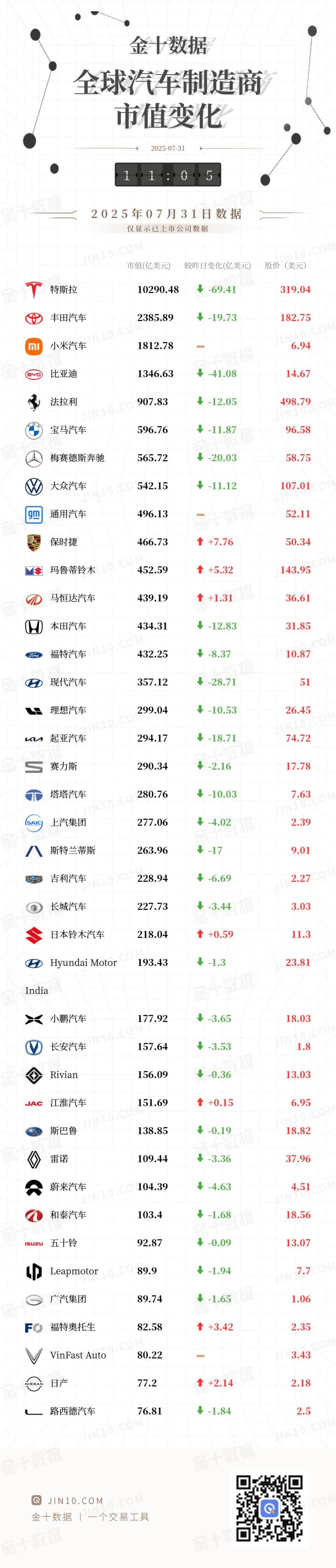
金十图示:2025年07月31日(周四)全球汽车制造商市值变化
news flash· 2025-07-31 03:08
金十图示:2025年07月31日(周四)全球汽车制造商市值变化 量十数据 | והו | 小米汽车 | 1812.78 | | 6.94 | | --- | --- | --- | --- | --- | | (BHD) | 比亚迪 | 1346.63 | + -41.08 | 14.67 | | ર | 法拉利 | 907.83 | + -12.05 | 498.79 | | (1) | 宝马汽车 | 596.76 | + -11.87 | 96.58 | | | 梅赛德斯奔驰 | 565.72 | + -20.03 | 58.75 | | 人》 大众汽车 | 542.15 | + -11.12 | 107.01 | | --- | --- | --- | --- | | 通用汽车 | 496.13 | | 52.11 | | 保时捷 | 466.73 | 1 +7.76 | 50.34 | | > 玛鲁蒂铃木 | 452.59 | 1 +5.32 | 143.95 | | 马恒达汽车 | 439.19 | 1 +1.31 | 36.61 | | 本田汽车 1-0 | 434.31 | + -12.83 | ...




日产警告:转型与关税阻力下亏损将进一步扩大
Zhong Guo Qi Che Bao Wang· 2025-07-31 00:54
日产汽车公司预测,4月至9月期间的营业亏损将达1800亿日元,并暂未公布截至2026年3月的财年 业绩指引。该公司首席执行官伊万・埃斯皮诺萨表示,日产正处于转型计划的初期阶段,计划裁员2万 人,并将生产基地从17个缩减至10个。日产面临美国总统唐纳德・特朗普贸易战带来的阻力,预计关税 将造成3000亿日元的损失。行业研究高级汽车分析师吉田辰雄称,该公司缺乏足够的产品实力、品牌影 响力和销售能力。 ...
5年首次第一财季亏损,日产汽车预警:下一季度不会有所好转
Di Yi Cai Jing· 2025-07-30 22:34
Group 1 - Nissan is facing a continuous loss crisis, reporting a net sales revenue of 2.7 trillion yen for the first quarter of fiscal year 2025, a decrease of 9.7% year-on-year, with a global retail sales volume of 707,000 units, down 10.1% [2] - The company has adjusted its half-year forecast, expecting a net sales revenue of 5.50 trillion yen and a loss of 180 billion yen, indicating no improvement in sales and profits for the second quarter [2] - Despite the short-term pessimism, Nissan maintains its full-year sales revenue forecast at 12.50 trillion yen [2] Group 2 - Nissan plans to reduce global production capacity by 20% by fiscal year 2026, aiming to consolidate its production facilities [2] - The company will integrate production from the CIVAC plant into the Aguascalientes facility in Mexico, with the CIVAC plant set to cease operations by the end of fiscal year 2025 [3] - Nissan's production in Japan will also be consolidated, with the Yokosuka plant scheduled to end vehicle production by the end of fiscal year 2027 [3] Group 3 - In the Chinese market, Nissan plans to cut its production capacity from 1.5 million units to 1 million units, with the Wuhan Yunfeng plant already sold to Dongfeng's electric vehicle subsidiary, Lantu [4] - Nissan's ranking in the Fortune Global 500 has dropped from 136 to 150 [5]