Qualcomm(QCOM)

Search documents
美股异动 | 芯片制造商股价上涨 英特尔(INTC.US)涨超4%
智通财经网· 2025-08-22 14:30
Core Viewpoint - The Federal Reserve Chairman Jerome Powell hinted at easing monetary policy, leading to a rise in semiconductor manufacturers' stock prices [1] Group 1: Stock Performance - Nvidia (NVDA.US) increased by over 1% [1] - Intel (INTC.US) rose by over 4% [1] - Qualcomm (QCOM.US) gained over 3.2% [1] - Broadcom (AVGO.US) saw an increase of over 2.3% [1] - Navitas Semiconductor (NVTS.US) surged by over 3.5% [1] - Micron Technology (MU.US) climbed by over 3% [1]


一颗芯片,颠覆智驾江湖
半导体芯闻· 2025-08-22 11:28
Core Viewpoint - The emergence of Momenta's self-developed driving chip marks a significant shift in the domestic intelligent driving industry, transitioning from a software-only company to a full-stack supplier, posing new competitive challenges to existing players in the market [1][2][20]. Company Overview - Momenta, established in 2016, focuses on high-performance intelligent driving solutions, targeting both L2 and L4 markets, and has partnerships with major global automakers, including SAIC, BYD, and Toyota [2][3]. - The company holds the largest market share in urban NOA technology at 60.1%, with cumulative sales of 114,000 vehicles equipped with its technology [3][19]. Self-Developed Chip Significance - Momenta's self-developed chip is positioned for the mid-range market, offering cost advantages and compatibility with existing products, which enhances its competitive edge [6][19]. - The strategy of "downward integration" is expected to create stronger competitive barriers and higher value capture capabilities for the company [6][10]. Impact on Competitors - The introduction of Momenta's chip poses significant challenges to NVIDIA and Qualcomm, as it allows automakers to transition smoothly from their solutions, increasing competitive pressure on these established players [8][10]. - Domestic chip manufacturers like Horizon Robotics and Black Sesame are also facing heightened competition, as Momenta's software expertise may overshadow their advantages [10][11]. Implications for Automakers - Automakers are reevaluating the necessity and cost-effectiveness of in-house chip development in light of Momenta's competitive offerings, particularly for resource-constrained new entrants [12][14]. - The shift towards Momenta's integrated solutions may lead to a reassessment of self-research strategies among automakers, balancing differentiation with cost advantages [15][21]. Strategic Challenges Ahead - Momenta faces challenges in achieving large-scale production and meeting stringent automotive safety standards, which are critical for its long-term success [20][21]. - The competitive landscape is expected to intensify as established players like NVIDIA and Qualcomm may respond with price cuts or enhanced technology to counter Momenta's market entry [20][21].


烧钱热!135亿美元,涌入AI初创公司
Sou Hu Cai Jing· 2025-08-22 11:14
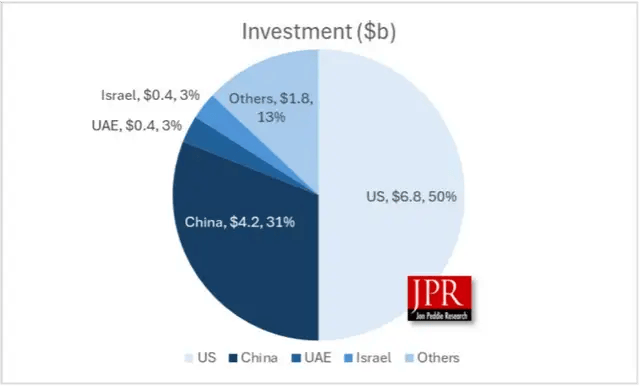
Group 1 - The core investment in AI processors is significantly higher among public companies compared to startups, with public companies spending 600 billion USD on R&D, which is 444% more than the 13.5 billion USD raised by 96 startups [1][3] - The current AI investment landscape is reminiscent of the internet bubble era, with major players like Nvidia drawing competitors globally, while China builds its ecosystem amid US restrictions [1][3] - Only the US and China have made substantial investments in AI processors, with the majority of startup funding coming from the US, totaling 13.5 billion USD in recent years [1][3] Group 2 - Concerns are rising about a potential AI bubble similar to the internet bubble of the late 1990s, as many companies attempt to replicate the success of Nvidia, which dominates the AI processor market [3][4] - The success of startups in the AI sector depends on their ability to remain agile and focus on niche markets, but the competition is fierce with 121 companies targeting similar goals, leading to a high likelihood of failure [4][5] - Global AI startups have raised an impressive 122 billion USD in venture capital this year, with the US accounting for 85.5% of this total, indicating a robust investment trend in the AI sector [5][8] Group 3 - The second quarter of this year saw global AI startup funding reach 50 billion USD, nearly half of the total venture capital investment of 101.5 billion USD during the same period [5][8] - Despite a slight decrease from the previous quarter's record peak of 73.1 billion USD, AI-related investments remain at historically high levels, with a year-on-year growth of 7.28% from 2023 to 2024 [8]

高通庄思民解读6G:AI原生的6G设计赋能全新服务,迈向AI互联未来
Huan Qiu Wang· 2025-08-22 07:47
Core Insights - The widespread application of 5G technology is significantly transforming communication and societal operations, while the development of 6G is actively underway globally [1] - Qualcomm, as a leading company in communication technology, is at the forefront of industry development through its technological advancements and strategic initiatives [1] Group 1: 6G Development Path - The development path for 6G is clear within the 3GPP global standardization framework, with Release 20 establishing formal technical research projects [2] - Release 21 will initiate the standardization of the first version of 6G, laying the groundwork for its deployment by 2030 [2] - Qualcomm aims to incorporate important optimization technologies into the 6G system, focusing on physical layer communication enhancements [2] Group 2: AI Integration and System Design - 6G is designed for the AI era, integrating new applications and edge AI scenarios into communication systems [3] - AI will be deeply embedded in the 6G system, not only enhancing performance but also supporting new AI-driven services [3] - The design of 6G will require balancing compatibility with existing systems while achieving significant advancements [3][4] Group 3: Industry Impact and Future Vision - Qualcomm's innovations are driving the digital and intelligent transformation across various industries, including smart homes, industrial applications, and automotive solutions [6] - There is a global recognition of the profound impact of AI and communication technology on economic development and connectivity [6] - The future envisions a highly interconnected world with new applications in virtual reality, IoT, humanoid robots, and autonomous vehicles [7]

Momenta自研芯片,打响智驾芯片淘汰赛
半导体行业观察· 2025-08-22 01:17
Core Viewpoint - The emergence of Momenta's self-developed driving chip marks a significant shift in the domestic intelligent driving industry, transitioning from a software-only company to a full-stack supplier, which introduces new competition and challenges for existing players in the market [2][3][27]. Group 1: Company Overview - Momenta, established in 2016, focuses on high-performance intelligent driving solutions, targeting both L2 and L4 markets, and has established partnerships with numerous leading automotive manufacturers globally, including SAIC, BYD, and Toyota [3][4]. - As of now, Momenta holds the highest number of high-level intelligent driving projects and partnerships among suppliers, with a cumulative sales volume of 114,000 vehicles equipped with its city NOA technology, leading the industry [4][26]. Group 2: Market Impact - Momenta's self-developed chip primarily targets the mid-range market, maintaining compatibility with existing mainstream products while offering cost advantages, which could enhance its competitive edge and operational efficiency [8][10]. - The entry of Momenta into chip development poses significant challenges to established players like NVIDIA and Qualcomm, as it allows for seamless transitions for automotive manufacturers from existing solutions to Momenta's offerings, potentially disrupting their market positions [12][14]. Group 3: Competitive Landscape - The competition landscape is shifting, with traditional chip manufacturers like Horizon and Black Sesame facing increased pressure from Momenta's integrated software and hardware solutions, which could undermine their market differentiation [14][15]. - Emerging chip companies, such as Weijing, Aixin Yuanzhi, and Xingchen, may find their market space further constricted as Momenta leverages its software expertise to optimize hardware solutions, creating a significant competitive barrier [15][28]. Group 4: Automotive Manufacturers' Strategies - Automotive manufacturers that have invested heavily in self-developed chips, like Xiaopeng and Li Auto, may need to reassess the value of their investments in light of Momenta's cost-effective and technologically superior solutions [18][20]. - The shift towards Momenta's offerings may prompt a reevaluation of self-development strategies among car manufacturers, potentially leading to a focus on key components rather than full in-house development [21][22]. Group 5: Industry Trends - The trend of software companies integrating hardware solutions is gaining momentum, as evidenced by Momenta's successful transition, which may influence other players in the industry to adapt their business models accordingly [23][25]. - The competitive dynamics in the intelligent driving sector are evolving, with companies needing to balance differentiation and cost-effectiveness in their strategies to remain viable in a rapidly changing market [28].

ASTS vs. QCOM: Which Connectivity Stock Has Better Growth Potential?
ZACKS· 2025-08-21 15:11
Core Insights - AST SpaceMobile and Qualcomm are key players in the mobile connectivity sector, with AST SpaceMobile focusing on a global cellular broadband network in space and Qualcomm providing high-performance chip designs for various applications [1][2] AST SpaceMobile - AST SpaceMobile has launched its first five commercial satellites, known as Bluebird, which feature the largest commercial communications arrays at 693 square feet, providing non-continuous service across the U.S. with over 5,600 cells in the low-band spectrum [4] - The company plans to deploy 45 to 60 additional satellites by Q1 2026 and holds a patent portfolio of over 3,650 patents related to direct-to-cell satellite technology [4] - Partnerships with major carriers like AT&T and Verizon aim to enhance cellular coverage and eliminate dead zones in the U.S. [5] - AST SpaceMobile anticipates a staggering 1261% sales growth for 2025, although it faces challenges from macroeconomic conditions and competition from companies like SpaceX's Starlink [8][6] Qualcomm - Qualcomm is positioned for long-term revenue growth, driven by strong 5G adoption and a diversified revenue stream, with projected sales growth of 12.3% and EPS growth of 15.9% for 2025 [9][12] - The company has expanded its Snapdragon portfolio with new gaming chipsets and is focusing on AI integration across its product lines [9][10] - Qualcomm's operations in the automotive sector are also growing, with advancements in connected vehicles and digital cockpit solutions [10] - Despite facing competition from Intel in the AI PC market and challenges in the premium smartphone segment, Qualcomm's EPS estimates have been trending upward [11][12] Comparative Analysis - AST SpaceMobile has outperformed Qualcomm in price performance over the past year, gaining 32% compared to Qualcomm's decline of 8% [14] - From a valuation perspective, Qualcomm's shares trade at a price/sales ratio of 3.75, significantly lower than AST SpaceMobile's 67.77, indicating a more attractive valuation for Qualcomm [15] - Long-term earnings growth expectations are 26.1% for AST SpaceMobile versus 7.1% for Qualcomm, suggesting that AST SpaceMobile may be a better investment option despite its less favorable valuation metrics [20]


Qualcomm: Diversification Helps, But Apple Headwind Still Looms
Seeking Alpha· 2025-08-21 12:45
Group 1 - The article discusses the challenges faced by Qualcomm Incorporated, particularly the impact of losing revenue from Apple as it plans to develop its own technology [1] - The author emphasizes the importance of diversification for Qualcomm while acknowledging the potential revenue loss from Apple [1] - The author's background includes experience in technology investment, with a focus on semiconductors, robotics, and energy sectors [1] Group 2 - The article does not provide specific financial data or performance metrics related to Qualcomm or the semiconductor industry [2]


高通发布第二代骁龙W5+与W5平台 率先支持NB-NTN卫星通信
Huan Qiu Wang· 2025-08-21 03:38
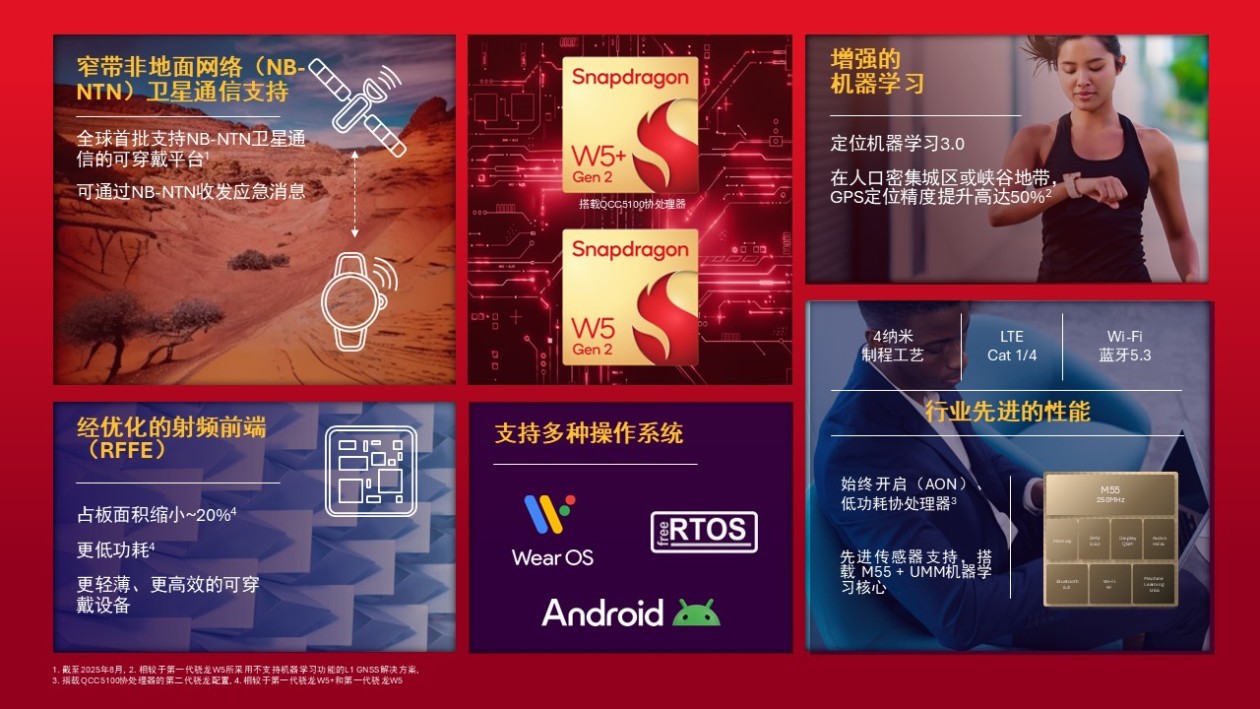
Core Insights - Qualcomm has launched the second-generation Snapdragon W5+ and W5 wearable platforms, enhancing connectivity, energy efficiency, product design, and positioning capabilities [1][3] - The platform utilizes Skylo's Narrowband Non-Terrestrial Network (NB-NTN) technology, enabling satellite communication for wearable devices, allowing for two-way emergency message transmission in remote areas without cellular coverage [1][3] Group 1: Product Features - The second-generation Snapdragon W5+ and W5 platforms are built on a 4nm system-on-chip (SoC) architecture, offering two versions: W5+ with a low-power co-processor and W5 without [1] - Key enhancements include a 50% improvement in GPS positioning accuracy and a 20% reduction in the size of the optimized radio frequency front-end (RFFE), contributing to lighter devices and extended battery life [1][3] Group 2: Industry Impact - The new platform positions Wear OS as the first operating system integrated with NB-NTN, enhancing communication reliability and user safety through satellite technology [3] - The Pixel Watch 4, as the first smartwatch supporting emergency satellite communication, leverages the second-generation Snapdragon W5 platform and Wear OS 6 for improved performance, energy efficiency, and connectivity [3] Group 3: Strategic Partnerships - The collaboration with Skylo expands satellite connectivity technology from smartphones, vehicles, and IoT to wearable devices, promoting functional upgrades in wearables while ensuring device miniaturization and battery life [3] - The SOS feature of the Pixel Watch is subject to regional limitations and offers two years of free usage upon activation, with potential data sharing with Google, emergency services, and satellite service providers [3]
凌晨,美联储发布!



Zheng Quan Shi Bao· 2025-08-21 00:11
科技股连续第二日遭到抛售 科技股连续第二个交易日遭到抛售,投资者正在评估好坏参半的零售商业绩报告。 当地时间8月20日,美股三大指数收盘涨跌不一,标普500指数连续第四个交易日下跌。 投资者正在评估好坏参半的零售商业绩报告。美联储会议纪要显示内部分歧,大多数FOMC(联邦公开 市场委员会)委员认为通胀风险甚于就业担忧,特朗普关税政策是核心议题。 道指涨16.04点,涨幅为0.04%,报44938.31点;纳指跌142.10点,跌幅为0.67%,报21172.86点;标普 500指数跌15.59点,跌幅为0.24%,报6395.78点。 周三投资者迎来多家零售商的财报。塔吉特股价暴跌,此前该零售商报告销售额再度下滑。公司同时宣 布首席执行官布莱恩·康奈尔(Brian Cornell)将于2026年2月份离职。 家装零售商劳氏公司宣布盈利超预期。 这些数据发布之前,家得宝公布财报后股价跃升,并助力周二道指勉强实现小幅上涨并创下盘中纪录。 但由于科技股下跌,标普500指数和纳指周二均收跌。 科技股周二普跌,投资者削减科技巨头仓位,原因是担忧标普500指数近期创纪录的反弹过快过猛,且 过度依赖少数成长股。 虽然科技股 ...
刚刚,全线崩跌!发生了什么?
券商中国· 2025-08-19 23:33
Core Viewpoint - The article discusses the recent significant sell-off in the U.S. tech stock market, highlighting concerns among traders about a potential repeat of the severe sell-off experienced in April. It emphasizes the growing interest in purchasing "disaster puts" as a hedge against further declines in major tech stocks, which have seen substantial gains since April [1][2][4]. Group 1: Market Trends - Major tech stocks in the U.S. experienced a sharp decline, with companies like Micron Technology dropping over 6%, Oracle and AMD falling over 5%, and others like Nvidia and TSMC ADR decreasing over 3% [1]. - The Nasdaq Composite Index fell by 1.46%, while the S&P 500 Index decreased by 0.59% [1]. - Since April 8, the "Big Seven" tech stocks have surged nearly 50%, raising concerns about potential triggers for a downturn [4]. Group 2: Trader Sentiment - Wall Street traders are increasingly purchasing "disaster puts" for the Invesco QQQ Trust Series 1 ETF, indicating heightened anxiety about market declines [2][3]. - The cost of hedging against significant market drops is nearing a three-year high, reflecting traders' fears of a repeat of the April sell-off [2]. Group 3: Economic Indicators - Goldman Sachs economists warn that the slowdown in the U.S. job market is not over and may worsen, with employment growth estimates falling below the necessary levels to maintain full employment [6][7]. - The firm predicts three rate cuts by the Federal Reserve this year, with potential further cuts in 2026 if hiring remains weak [7]. Group 4: Political Context - Former President Trump criticized Goldman Sachs for its pessimistic economic forecasts, particularly regarding tariffs and their impact on consumers [8].