Qualcomm(QCOM)

Search documents
买出来的芯片帝国?
半导体行业观察· 2025-06-14 03:09
Group 1 - Qualcomm has built a semiconductor empire through strategic acquisitions, combining technology and patents to dominate various sectors including mobile, automotive, IoT, and AI edge computing [1] - The acquisition of Adreno, a GPU division from ATI, marked a significant turning point for Qualcomm, allowing it to enhance mobile graphics processing capabilities [4][5] - Adreno has evolved from a small team to a leading graphics processing engine, supporting billions of mobile devices and integrating advanced technologies like machine learning and AR/VR applications [6] Group 2 - The release of Apple's M1 chip in 2020 posed a significant challenge to Qualcomm, prompting the company to rethink its reliance on Arm's public core architecture [8][9] - Qualcomm's acquisition of Nuvia for $1.3 billion aimed to bolster its CPU design capabilities, leveraging Nuvia's expertise in high-performance, low-power processors [10][11] - The integration of Nuvia's technology into Qualcomm's CPU design strategy has led to the development of the Oryon CPU core, marking Qualcomm's entry into self-developed CPU architecture [13][14] Group 3 - The acquisition of Atheros for $3.1 billion allowed Qualcomm to enhance its wireless communication capabilities, integrating Wi-Fi and Bluetooth technologies into its mobile solutions [21][22] - Atheros' technology has been pivotal in establishing Qualcomm's dominance in the wireless connectivity market, enabling seamless integration of multiple connection technologies [25][24] - Qualcomm's strategy of deep integration post-acquisition has resulted in a comprehensive communication solution that supports a wide range of devices and applications [23] Group 4 - The acquisition of Autotalks has enabled Qualcomm to enhance its V2X communication capabilities, crucial for the development of smart transportation systems [27][28] - This acquisition allows Qualcomm to integrate V2X technology into its Snapdragon Ride platform, improving the stability and synergy of automotive systems [28] - Qualcomm's strategic moves in V2X technology position it as a leader in the future of intelligent transportation networks [28] Group 5 - Qualcomm's acquisition of Alphawave Semi's SerDes assets reflects its commitment to enhancing high-speed interconnect capabilities, essential for AI and data center applications [29][30] - The integration of SerDes technology is critical for Qualcomm's future in AI and communication systems, enabling efficient data transfer across various platforms [31] - This strategic acquisition positions Qualcomm as a key player in the evolving landscape of high-performance computing and modular chip architectures [31] Group 6 - Qualcomm's success is attributed to its ability to integrate acquired technologies into a cohesive ecosystem, transforming from a chip manufacturer to a comprehensive communication solutions provider [32] - The company's strategic acquisitions have laid the foundation for its semiconductor empire, demonstrating the importance of both capital and technology in achieving industry leadership [32]



数据总结2024全球半导体产业园
半导体行业观察· 2025-06-14 03:09
Core Insights - The semiconductor industry is a cornerstone of modern technology and industry, significantly impacting economic, technological, and political domains [1] - Semiconductor advancements drive economic growth, with every $1 of semiconductor output generating over $10 in downstream economic benefits [1] - The industry is crucial for technological revolutions, powering key components in computers, smartphones, and communication devices [1] - Geopolitically, semiconductors are tools for power, with the U.S. implementing measures to maintain dominance in the global semiconductor value chain [1] Industry Overview - The semiconductor industry encompasses a complex ecosystem including EDA & IP, design companies, wafer foundries, packaging and testing, and equipment materials [2] EDA & IP - EDA (Electronic Design Automation) is essential for integrated circuit design, with a projected global market size of approximately $15 billion in 2024, supporting a semiconductor industry worth over $600 billion [3] - IP (Intellectual Property) includes pre-designed circuit modules, with a market size of $7.8 billion in 2024, where processor IP accounts for 47% [3] Market Growth - The global semiconductor market is expected to reach $655.9 billion in 2024, a 21% increase from 2023, driven by AI infrastructure and storage chip demand [5] Fabless Companies - Fabless companies focus on chip design and IP development, outsourcing manufacturing to foundries, with a projected market size of $215 billion in 2024, accounting for 32.9% of the IC industry [6] - Key global fabless companies include NVIDIA, Qualcomm, Broadcom, AMD, and MediaTek, with revenues of $124.3 billion, $34.9 billion, $30.6 billion, $25.8 billion, and $16.5 billion respectively in 2024 [8] Foundry Sector - Foundries specialize in chip manufacturing, with the top five global foundries including TSMC, Samsung, SMIC, UMC, and GlobalFoundries, generating revenues of $106.8 billion, $21.2 billion, $8 billion, $7.6 billion, and $6.75 billion respectively in 2024 [12] Packaging & Testing - The packaging and testing segment is crucial for ensuring chip reliability, with top companies like ASE, Amkor, JCET, TFMC, and PTI generating revenues of $18.54 billion, $6.32 billion, $5 billion, $3.32 billion, and $2.28 billion respectively in 2024 [16] Equipment & Materials - Semiconductor equipment and materials are foundational to the industry, with a global equipment market size exceeding $250 billion in 2024, and materials accounting for approximately 32.9% of the market [19] - Leading equipment companies include ASML, Applied Materials, Lam Research, Tokyo Electron, and KLA, with revenues of $30.5 billion, $26.5 billion, $17 billion, $12 billion, and $10.9 billion respectively in 2024 [20]


买出来的芯片帝国?
半导体行业观察· 2025-06-14 03:05
Group 1: Qualcomm's Strategic Acquisitions - Qualcomm has built a semiconductor empire through targeted acquisitions, combining technology and patents to dominate various sectors including mobile, automotive, IoT, and AI edge computing [1][4][33] - The acquisition of Adreno, a GPU division from ATI, allowed Qualcomm to enhance its mobile graphics capabilities, integrating it into the Snapdragon SoC platform, which improved performance and power management [5][6][4] - The purchase of Nuvia for $1.3 billion was a strategic move to develop proprietary CPU cores, aiming to compete with Apple's M-series chips and enhance Qualcomm's position in high-performance computing [10][11][12] Group 2: Atheros and Connectivity Solutions - The acquisition of Atheros for $3.1 billion enabled Qualcomm to strengthen its position in wireless communication technologies, integrating Wi-Fi and Bluetooth capabilities into its mobile solutions [21][22][24] - Atheros' expertise in RF design and signal processing has been crucial for Qualcomm to provide comprehensive connectivity solutions across various devices, enhancing performance and reducing power consumption [20][23][24] - The integration of Atheros' technology has allowed Qualcomm to dominate the mobile connectivity market, with its solutions being widely adopted in Android devices and IoT applications [24][25] Group 3: V2X and Automotive Innovations - Qualcomm's acquisition of Autotalks enhances its V2X communication capabilities, crucial for the development of smart transportation systems and autonomous driving technologies [27][28] - The integration of V2X technology into Qualcomm's Snapdragon Ride platform signifies a strategic move towards creating a comprehensive automotive ecosystem that includes smart cockpit and autonomous driving solutions [27][28] - This acquisition positions Qualcomm as a key player in the future of intelligent transportation, enabling vehicles to communicate with each other and infrastructure for improved safety and efficiency [26][28] Group 4: SerDes Technology and Data Interconnects - Qualcomm's acquisition of Alphawave Semi's SerDes assets addresses the critical need for high-speed data interconnects in AI, edge computing, and data centers [29][30] - The SerDes technology is essential for enhancing data transmission capabilities within SoCs, particularly as the industry shifts towards Chiplet architectures [30][31] - This strategic move allows Qualcomm to strengthen its position in the evolving landscape of AI and communication systems, ensuring efficient data flow across various platforms [30][31] Group 5: Overall Strategy and Future Outlook - Qualcomm's approach to building its capabilities through acquisitions reflects a broader strategy of integrating diverse technologies into a cohesive platform, enhancing its competitive edge in the semiconductor industry [33][34] - The company's ability to internalize and innovate upon acquired technologies has been pivotal in establishing its dominance across multiple sectors, from mobile devices to automotive solutions [33][34] - Qualcomm's narrative illustrates a successful model of leveraging acquisitions not just for immediate gains, but for long-term strategic positioning in the rapidly evolving tech landscape [33][34]

数据总结2024全球半导体产业园
半导体行业观察· 2025-06-14 03:05
Core Insights - The semiconductor industry is a cornerstone of modern technology and industry, significantly impacting economic, technological, and political domains [1][2]. Economic Impact - Semiconductors are central to the information industry and are strongly correlated with global GDP growth, with every $1 of semiconductor output generating over $10 in downstream economic benefits [2]. - The industry has seen substantial revenue growth, driving economic progress and creating vast employment opportunities [2]. Technological Significance - Semiconductors are the driving force behind the information technology revolution, essential for key components like CPUs, GPUs, and communication devices [2]. - They enhance production efficiency and intelligence across various sectors, including industrial automation, energy, and automotive [2]. Political Dynamics - The semiconductor sector has become a critical tool in geopolitical strategies, with the U.S. implementing measures like the CHIPS and Science Act and export controls to maintain its dominance in the global semiconductor value chain [2]. - These actions have led to shifts in the global semiconductor supply chain and prompted other nations to intensify their focus on semiconductor development [2]. Industry Structure - The semiconductor industry operates as a complex ecosystem, including EDA & IP, design companies, wafer foundries, packaging and testing, and equipment materials [3][4]. - EDA (Electronic Design Automation) is projected to reach a market size of approximately $15 billion in 2024, supporting a semiconductor industry worth over $600 billion [4]. - The global semiconductor market is expected to grow to $655.9 billion in 2024, a 21% increase from 2023, with AI infrastructure and storage chip demand driving this growth [6]. Fabless Companies - Fabless companies focus on chip design and IP development while outsourcing manufacturing to foundries, significantly reducing capital investment and allowing for rapid market response [9][10]. - The global fabless market is projected to reach $215 billion in 2024, accounting for 32.9% of total IC industry revenue [9]. Foundry Operations - Foundries specialize in the physical production of chips, significantly lowering industry entry barriers and fostering global innovation [13][14]. - TSMC is the leading foundry with projected revenues of $106.8 billion in 2024, followed by Samsung and SMIC [16][19]. Packaging and Testing - The packaging and testing segment is crucial for ensuring chip reliability and performance, with major players like ASE and Amkor leading the market [20][21]. Equipment and Materials - Semiconductor equipment and materials are foundational to the industry, with a global equipment market size exceeding $250 billion in 2024 [22][24]. - The top equipment companies include ASML, Applied Materials, and Lam Research, with ASML being the sole supplier of EUV lithography machines for advanced processes [24].
一群硬科技投资人、产业人,又要组团去德国
芯世相· 2025-06-13 10:30
Core Viewpoint - The article emphasizes the importance of exploring overseas markets for the chip industry, particularly in Europe, as a strategy for industry upgrade and sustained growth amidst intense domestic competition and technological innovation [3]. Group 1: Overview of the European Market Exploration - The chip industry is increasingly focusing on overseas markets, with "going abroad" seen as a new option for growth [3]. - A business investigation trip to Germany is planned from September 4 to September 14, focusing on two major global exhibitions: IFA and IAA [3][4]. - The IFA exhibition, one of the largest international consumer electronics shows, attracted over 1,800 exhibitors and more than 210,000 visitors from 138 countries in its last edition [4]. - The IAA exhibition, a key event in the global automotive industry, had 750 exhibitors from 38 countries and over 500,000 visitors in its previous edition [4]. Group 2: Activities and Itinerary - The trip includes visits to five major German cities: Berlin, Leipzig, Dresden, Stuttgart, and Munich, each representing significant industrial characteristics [7]. - Activities will include industry salons, company visits, and tours of leading universities, aimed at deepening understanding of local market needs and trends [4][6][7]. - The itinerary features visits to notable companies such as GlobalFoundries and Mercedes-Benz, as well as academic institutions like the Technical University of Munich [19][20][21][22]. Group 3: Networking and Resource Linking - The trip aims to facilitate connections among participants, local exhibitors, and industry professionals through deep-dive salons and networking events [6][13]. - Previous trips have successfully established communication bridges among key industry players, enhancing collaboration opportunities [6][10].

Is Now The Time To Buy Qualcomm Stock?
Forbes· 2025-06-13 10:05
Core Viewpoint - Qualcomm's stock has shown moderate performance with a year-to-date increase of approximately 3% amid U.S.-China trade uncertainties, but the company reported strong Q2 FY'25 results, with revenue up 15% year-over-year to $10.84 billion and earnings per share at $2.85, driven by a rebound in the smartphone market [2][3] Revenue Growth - Qualcomm's revenue has grown at an average rate of 5.3% over the past three years, slightly below the S&P 500's 5.5% growth [5] - In the last 12 months, Qualcomm's revenue increased by 12.1%, from $36 billion to $42 billion, compared to the S&P 500's 5.5% growth [5] - Quarterly revenues rose by 17.5% to $11 billion from $9.4 billion a year prior, outperforming the S&P 500's 4.8% improvement [5] Profitability Metrics - Qualcomm has a price-to-sales (P/S) ratio of 4.2, compared to 3.0 for the S&P 500 [7] - The company's price-to-free cash flow (P/FCF) ratio is 12.4, while the S&P 500 stands at 20.5 [7] - Qualcomm's price-to-earnings (P/E) ratio is 16.2, significantly lower than the S&P 500's 26.4 [7] - The operating margin for Qualcomm is 26.4%, compared to 13.2% for the S&P 500, indicating strong profitability [8] Financial Stability - Qualcomm's debt is $15 billion, with a market capitalization of $176 billion, resulting in a debt-to-equity ratio of 8.5%, lower than the S&P 500's 19.9% [10] - Cash and cash equivalents amount to $14 billion out of $55 billion in total assets, leading to a cash-to-assets ratio of 25.7%, compared to 13.8% for the S&P 500 [10] Downturn Resilience - Qualcomm's stock has shown slightly better performance than the S&P 500 during recent downturns, including a 45.1% decline during the inflation shock of 2022, compared to a 25.4% decline for the S&P 500 [12] - The stock fully recovered to its pre-crisis peak by May 2024 and has since risen to around $160 [12] - Historical performance during the COVID-19 pandemic and the global financial crisis also indicates resilience, with Qualcomm recovering fully from significant declines [12][13] Overall Assessment - Qualcomm's operational performance and financial standing are assessed as very strong across key metrics, making the stock appealing at its current valuation [3][15]

高通24亿美元收购Alphawave:押注AI算力互联,剑指数据中心千亿蓝海
Xin Lang Zheng Quan· 2025-06-13 08:27
Core Viewpoint - The global semiconductor industry is witnessing a significant transaction as Qualcomm announces its acquisition of UK semiconductor IP company Alphawave for approximately $2.4 billion, marking a 96% premium and a strategic move into AI computing and data center sectors [1] Group 1: Alphawave Overview - Alphawave, established in 2017, specializes in high-speed interconnect IP licensing and custom chip design, focusing on SerDes technology with transmission rates from 112Gbps to 224Gbps [2] - In 2024, Alphawave ranked fourth in the global IP market with revenues of $270 million, a year-on-year growth of 25.6%, capturing a market share of 3.2% [2] - The company has seen a 44% year-on-year increase in order volume in Q4 2024, reaching $185.7 million, with total bookings exceeding $515 million for the year [2] Group 2: Qualcomm's Strategic Shift - Qualcomm reported revenues of $35.82 billion for fiscal year 2023, but the slowdown in the smartphone market has prompted the company to seek new growth avenues [3] - The acquisition of Alphawave is viewed as a critical step for Qualcomm's return to the data center market, following its previous exit in 2017 due to weak ARM ecosystem and competitive pressures [3] - By integrating Alphawave's high-speed interconnect IP, Qualcomm aims to enhance data transmission efficiency between chips and reduce AI computing deployment costs, particularly in the UCIe small chip interconnect domain [3] Group 3: Strategic Synergies and Market Potential - Analysts from JPMorgan highlight that Alphawave's IP assets complement Qualcomm's existing technology, facilitating entry into high-growth areas such as data centers and AI chips [4] - According to IDC, the global data center market is projected to exceed $108.62 billion in 2024, with a year-on-year growth of 14.9%, and is expected to reach $163.25 billion by 2027, maintaining an average annual growth rate of over 10% from 2025 to 2027 [4] - AI-related demand is anticipated to contribute over 60% of the new market growth, becoming a core driver of industry expansion [4] Group 4: Industry Impact and Future Outlook - Qualcomm's acquisition of Alphawave poses a direct challenge to custom chip giants like Broadcom and Marvell, indicating an escalation in competition within the AI computing interconnect space [5] - The collaboration with Middle Eastern clients such as Saudi Arabia's HUMAIN may enable Qualcomm to capture global AI computing demand benefits through a "chip-application" closed loop [5] - This $2.4 billion investment is expected to reshape the competitive landscape of global AI computing infrastructure [6]
全球IC设计top10榜单,最新出炉
半导体芯闻· 2025-06-12 10:07
Core Insights - The semiconductor chip demand is expected to exceed previous seasonal levels due to changes in international circumstances and the construction of AI data centers, leading to a strong performance in the IC design industry [3][4]. Group 1: Industry Performance - The top ten fabless IC design companies achieved a combined revenue of approximately $77.4 billion in Q1 2025, marking a 6% quarter-over-quarter increase and a 44% year-over-year increase [4][5]. - NVIDIA led the revenue rankings with $42.4 billion in Q1 2025, reflecting a 12% quarter-over-quarter increase and a 72% year-over-year increase [4][5]. - Qualcomm's revenue for Q1 2025 was approximately $9.5 billion, down 6% from the previous quarter, impacted by seasonal declines and increased competition from Apple's in-house chips [6][7]. Group 2: Company-Specific Developments - AMD reported Q1 2025 revenue of nearly $7.4 billion, a 3% decrease from the previous quarter but a 36% increase year-over-year, with plans to ramp up production of the new MI350 platform [5][6]. - Broadcom achieved a record semiconductor revenue of $8.3 billion in Q1 2025, a 15% year-over-year increase, driven by AI server ecosystem expansion [5][6]. - Marvell's revenue reached approximately $1.9 billion in Q1 2025, a 9% quarter-over-quarter increase, supported by strong demand for AI server-related products [6][7]. Group 3: Emerging Trends - Realtek's revenue increased by 31% to over $1.1 billion in Q1 2025, driven by inventory increases from PC clients and rising demand for Wi-Fi 7 [7]. - MediaTek's revenue grew to approximately $4.7 billion in Q1 2025, benefiting from increased demand for its mobile chipsets in mainland China [6][7]. - OmniVision's revenue slightly decreased by 2% to $732 million in Q1 2025, but the company made significant progress in image sensors and automotive electronics [7].



巨额资金涌入!估值洼地+政治经济稳定 英国并购市场迎爆发日
Zhi Tong Cai Jing· 2025-06-12 08:30
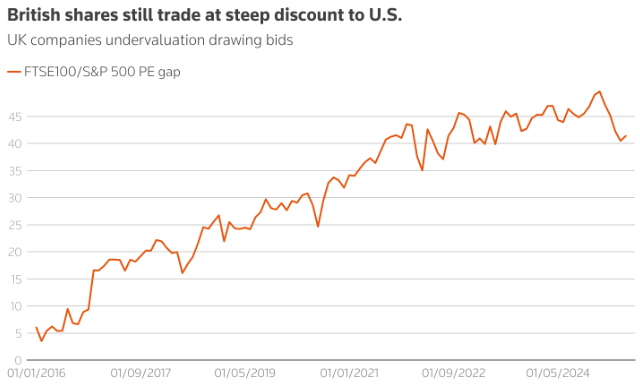
Core Insights - Over $10 billion in merger and acquisition funds were invested in UK companies on a single day, marking the most active trading day of the year, indicating a resurgence in interest in the UK market due to low valuations and relative stability [1] - A total of 30 UK companies have accepted acquisition offers this year, with valuations exceeding £1 million ($1.3544 million), compared to 26 companies during the same period last year [2] - The total announced transaction value so far this year is £24 billion, down from £36 billion in the same period last year, largely due to the absence of large-scale deals [2] Group 1: Market Dynamics - The UK market has become more attractive for acquisitions due to significant outflows of capital, leading to lower valuations compared to similar companies listed in other European or US exchanges [2] - The gap between the FTSE 100 index and the S&P 500 index reached approximately 49.5% in January, currently narrowing to about 41% [2] - The relative stability of the UK economy and political environment is drawing bidders, with analysts noting that acquiring UK companies may pose less risk than acquiring US companies [4] Group 2: Economic and Political Stability - The UK has achieved trade agreements that signal openness to business, and the absence of upcoming elections ensures political stability for the next four years [5] - Analysts suggest that the strength of the pound has not deterred investment, with global investors eager to buy before inflation rises further [5] - The largest acquisition deals announced this week include Advent's £3.7 billion bid for Spectris and Qualcomm's £1.8 billion bid for Alphawave, with expectations of more deals to follow [5] Group 3: Sector Activity - The technology and real estate sectors are currently the most active in terms of transactions, showing resilience against recent market volatility [6] - Key fundamentals are seen as favorable for driving transactions, with improved balance sheets for UK companies contributing to this trend [6]
研报 | 受AI强劲需求驱动,2025年第一季全球前十大IC设计厂营收季增6%
TrendForce集邦· 2025-06-12 07:29
Core Insights - The semiconductor chip demand has exceeded typical seasonal levels due to changes in international circumstances and the construction of AI data centers, leading to a strong performance in the IC design industry in Q1 2025 [1] Group 1: Industry Performance - The top ten fabless IC design companies reported a combined revenue of approximately $77.4 billion in Q1 2025, marking a quarter-over-quarter increase of about 6% and a year-over-year increase of 44% [2] - NVIDIA maintained its position as the top revenue earner with $42.4 billion in Q1 2025, reflecting a 12% quarter-over-quarter increase and a 72% year-over-year increase [4] - Broadcom achieved a record high semiconductor revenue of $8.3 billion in Q1 2025, representing a 15% year-over-year growth [5] Group 2: Company-Specific Developments - AMD's revenue in Q1 2025 was approximately $7.4 billion, a 3% decrease from the previous quarter but a 36% increase compared to the same period in 2024 [4] - Qualcomm's revenue for Q1 2025 was around $9.5 billion, down 6% quarter-over-quarter due to seasonal factors and increased competition from Apple's in-house chips [6] - Marvell's revenue reached nearly $1.9 billion in Q1 2025, a 9% increase from the previous quarter, driven by strong demand for AI server-related products [6] Group 3: Emerging Trends - The AI data center sector is significantly impacting revenue growth, with companies like NVIDIA and Broadcom expanding their offerings in AI networking solutions [5] - Realtek reported a remarkable 31% quarter-over-quarter revenue increase to over $1.06 billion, driven by increased inventory from PC clients and rising demand for Wi-Fi 7 and automotive Ethernet [6] - Chipmakers are actively seeking growth opportunities in emerging fields such as AI smartphones and automotive applications to counteract seasonal declines [6]