Qualcomm(QCOM)

Search documents
“十五五”系列研究之二:加速中国经济动力变革的十五大产业赛道
Tebon Securities· 2025-11-14 13:46
Group 1: Semiconductor Industry - The semiconductor industry is undergoing a transformation driven by accelerated technological iteration, supply chain restructuring, and deepening domestic substitution, with advanced process nodes becoming a core growth driver[17] - In Q2 2025, TSMC's revenue reached $30.239 billion, with advanced process nodes (3nm, 5nm, 7nm) contributing 24%, 36%, and 14% respectively to its revenue structure[18] - By 2024, China's semiconductor sales are projected to be $182.1 billion, accounting for 29.52% of global sales, while its wafer demand is only 5%, indicating a significant gap in domestic chip design capabilities[30] Group 2: AI Infrastructure and Applications - The AI industry is transitioning into a dual-phase of infrastructure development and deep industry integration, with domestic AI chip production and commercialization being key investment themes[39] - The demand for AI servers is expected to surge, driven by the need for robust computing power, which will enhance the domestic AI infrastructure[7] - AI is anticipated to become a foundational productivity driver in the economy, with significant potential for explosive applications in various sectors[39] Group 3: Nuclear Energy and New Energy Storage - Nuclear power is positioned as a clean and stable energy source, crucial for achieving dual carbon goals, with the industry entering a golden development period focusing on third-generation technology and breakthroughs in fourth-generation technology[7] - New energy storage technologies are rapidly advancing, with installed capacity expected to double under strong policy support, leading to a diversified technological landscape[7] Group 4: Emerging Industries - The commercial aerospace sector is transitioning from state-led initiatives to large-scale commercialization, with significant growth in low-orbit satellite demand and the development of reusable rocket technologies[7] - The pet economy is evolving into a mature market, with a notable shift towards high-end products and domestic brands gaining market share through online channels[8] - The CXO industry is entering a new growth cycle, with China holding nearly 30% of the global market share, driven by innovation in drug development despite geopolitical challenges[8]




高通芯片,不得不用?
半导体芯闻· 2025-11-14 11:09
Core Insights - Samsung is expected to use Snapdragon 8 Elite Gen 5 in 75% of its Galaxy S26 models, with the Galaxy S26 Ultra exclusively featuring this Qualcomm flagship SoC in all markets [2] - Samsung's chip expenditure reached approximately $9 billion in 2023, driven by rising costs from Qualcomm's next-generation processes and self-developed CPU cores [2] - The price of Snapdragon 8 Elite Gen 5 is around $280 per unit, leading Samsung to increase the price of Galaxy S26 Ultra, as Exynos 2600 will only cover the remaining models [2] Group 1 - Samsung's continued procurement of Qualcomm chips is influenced by a contractual obligation that could incur significant penalties if terminated early [3] - The low yield of Exynos 2600 complicates Samsung's situation, making its reliance on Qualcomm a "double-edged sword" [3] - Qualcomm's aggressive business strategy has drawn criticism for being "greedy," as it charges high fees for 5G modem licenses and related patent royalties, pushing companies like Apple to develop their own chips [3] Group 2 - Apple's licensing agreement with Qualcomm for modems is set to expire in March 2027, suggesting that Samsung may have a similar long-term agreement [4] - The reality is that Samsung's self-sufficiency in chip production is not its strong suit, allowing companies like Qualcomm to expand their influence [4]



高通推出跃龙IQ-X系列处理器 赋能工业PC与边缘智能升级
Huan Qiu Wang· 2025-11-14 10:14
【环球网科技综合报道】高通于日前正式发布高通跃龙IQ-X系列处理器,聚焦可编程逻辑控制器(PLC)、高级人机界面 (HMI)、边缘控制器等工业核心设备,为工业PC与边缘智能场景提供适配严苛环境的计算解决方案。该系列凭借加固封 装设计、丰富外设支持及高能效优势,助力工业设备灵活部署与多媒体功能拓展。 高通技术公司汽车、工业及嵌入式物联网事业群总经理Nakul Duggal称,高通跃龙IQ-X系列将Qualcomm Oryon CPU的计算 性能引入工业PC领域,有助于提升工厂车间边缘控制器的运行能力与响应速度,同时为OEM厂商和ODM厂商搭建高效开 发平台,降低设计复杂性,缩短产品上市周期。 据悉,目前,研华、康佳特、新汉、瑞传科技、SECO赛柯和Tria等OEM厂商已确定采用该平台,相关商用终端预计在未来 数月内正式推出,为工厂自动化、机器人、智能边缘系统等领域注入技术动力。(心月) 针对现代工业领域的核心需求,高通跃龙IQ-X系列在多方面形成技术支撑。该系列搭载基于4纳米制程工艺定制的 Qualcomm Oryon CPU,提供8至12个高性能内核的可扩展配置,AI性能表现出色,同时支持-40℃至105℃的 ...

阿里已秘密启动“千问”项目;两家国产GPU公司IPO迎新动向
2 1 Shi Ji Jing Ji Bao Dao· 2025-11-14 02:54
Group 1 - Tencent responded to rumors about a 15% fee agreement with Apple for mini-games, stating that their relationship is strong and progress is optimistic [2] - Alibaba has secretly launched the "Qianwen" project to develop a personal AI assistant app, aiming to compete with ChatGPT and leveraging its Qwen model [3] - Baidu's founder, Li Yanhong, highlighted the transition of AI technology from "intelligent emergence" to "effect emergence," emphasizing the practical applications and value creation in the AI industry [4] Group 2 - Didi announced a strategic partnership with the Abu Dhabi Investment Office to expand its autonomous driving operations in the Middle East [5] - Xiaomi and Tencent have partnered to enable developers to distribute AI agents through Xiaomi's app store, enhancing accessibility for users [6] - Apple clarified its recent restrictions on authorized dealers in China, aimed at preventing unauthorized sales across regions [7] Group 3 - Yuzhu Technology launched a comprehensive training solution for humanoid robots, featuring a high-performance robot and data collection tools [8] - Alibaba Cloud's Baolian announced a price reduction for its Tongyi Qianwen 3-Max model, effective November 13, 2025 [9] - China has completed the first phase of 6G technology trials, establishing over 300 key technology reserves [10] Group 4 - Qualcomm introduced its first industrial-grade PC processor, the Longwing IQ-X series, designed for smart manufacturing applications [12] - Moer Thread plans to go public on the STAR Market, with an initial public offering of 70 million shares [13][14] - Muxi Integrated Circuit's IPO registration has been approved, focusing on high-performance GPU chips and AI applications [15] Group 5 - Haige Communication's subsidiary plans to raise up to 800 million yuan by introducing strategic investors to support its business development [17] - Daming City announced plans to acquire a 19.43% stake in Baicai Bang for 694 million yuan, focusing on 4G/5G/6G communication solutions [18] - Tencent reported a 15% year-on-year revenue increase to 192.87 billion yuan in Q3 2025, with net profit rising 18% to 70.55 billion yuan [19] Group 6 - SMIC reported a 9.9% year-on-year revenue increase to 17.162 billion yuan in Q3 2025, with a net profit growth of 43.1% [20] - JD Group's Q3 revenue reached 299.1 billion yuan, a 14.9% increase, with new business revenue growing 214% year-on-year [22] - Baidu launched its upgraded multi-modal AI assistant, Super Baidu, enhancing its capabilities in visual understanding and reasoning [23] Group 7 - DJI released the Osmo Action 6, its first action camera with a variable aperture, designed for improved performance in various lighting conditions [24]


智能早报丨美股科技股全线下跌,英伟达跌约3.6%
Guan Cha Zhe Wang· 2025-11-14 02:40
Market Performance - US stock markets experienced a significant decline, with the Dow Jones Industrial Average falling by 1.65%, the S&P 500 down by 1.66%, and the Nasdaq Composite dropping by 2.29% [1] - The Nasdaq Golden Dragon Index, which tracks Chinese companies listed in the US, also fell by 1.59% after initially showing strength [1] - The Magnificent 7 index, which includes major tech stocks, decreased by 2.26%, closing at 203.76 points [1] Individual Stock Movements - Tesla saw a sharp decline of 6.64%, while Nvidia dropped by 3.58% and Alphabet's Google A shares fell by 2.84% [1] - Other notable declines included AMD down by 4.22%, and TSMC down by 2.90% [1] - In contrast, Eli Lilly rose by 0.50% and Berkshire Hathaway's Class B shares increased by 2.13% [1] Broader Tech Sector Trends - The "super" market cap tech stock index fell by 2.88%, closing at 394.92 points [1] - Other tech companies such as Oracle, Broadcom, Qualcomm, Adobe, Salesforce, and Netflix also experienced declines, with Oracle down by 4.15% and Broadcom down by 4.29% [1]




Quantum Computing Stocks: AMD, Qualcomm, IonQ Invest In Startup
Investors· 2025-11-13 16:45
Core Insights - The quantum computing sector is experiencing significant investment activity, with Classiq raising over $200 million in a recent funding round, supported by major players like AMD and Qualcomm [1][2] - Quantum Computing's Q3 earnings report is anticipated, with notable revenue growth reported by IonQ and D-Wave, while Rigetti's revenue has declined [9][10] - The U.S. government is considering equity stakes in quantum companies, which may impact investor sentiment [3][4] Investment Activity - Classiq has announced a new funding round totaling "tens of millions of dollars," bringing its total funding to over $200 million [2] - The Trump administration is reportedly contemplating taking equity stakes in both public and private quantum companies [2][3] - DARPA has selected 11 firms for the Quantum Benchmarking Initiative, aimed at developing practical quantum computing solutions [4][5] Company Performance - IonQ's Q3 revenue surged to $39.9 million, up from $12.4 million year-over-year, while D-Wave's revenue increased to $3.7 million from $1.9 million [9] - Rigetti's revenue fell to $1.9 million from $2.4 million in the same period last year [9] - D-Wave's stock has risen 178% in 2025, while IonQ and Rigetti have seen increases of 10% and 66%, respectively [10] Technological Developments - IBM is advancing its quantum computing technology with new devices, including Nighthawk and Loon, aiming for a fault-tolerant quantum computer by 2029 [7][8] - The second stage of DARPA's Quantum Benchmarking Initiative focuses on validating utility-scale quantum architectures [5]




Qualcomm vs. Nvidia and AMD: The Next Big AI Stock?
ZACKS· 2025-11-13 16:21
Core Insights - Qualcomm is entering the AI chip market with its AI 200 and AI 250 chips, aiming to carve out a niche in the AI inference segment, which is currently dominated by Nvidia and AMD [1][5] - The new chips are designed for low-power, high-efficiency performance, making them suitable for real-time AI workloads across various applications, including smartphones and IoT systems [2][6] - Qualcomm's strategy focuses on efficiency and total cost of ownership, addressing the industry's challenges related to energy consumption and infrastructure costs [6][9] Company Positioning - Qualcomm has historically been viewed as a stable but unexciting performer in the semiconductor industry, with a lower relative valuation due to its association with mature mobile markets [3][10] - The launch of the AI chips could signify a turning point, potentially transforming Qualcomm into a dynamic player in the AI hardware space [3][11] - The company is leveraging its expertise in mobile computing to extend its capabilities from smartphones to data centers and edge environments, creating a unified architecture [8][9] Market Opportunity - Qualcomm's AI 200 and AI 250 chips are engineered for high-density inference workloads, supporting significant memory and bandwidth improvements compared to current GPUs [7] - The AI market is expected to see substantial growth, and Qualcomm's focus on cost and efficiency positions it well to benefit from this expansion [9][20] - Current earnings forecasts suggest modest growth, but the potential upside from the AI segment remains untapped, indicating a significant opportunity for future expansion [12][13] Stock Performance - Qualcomm shares are currently trading at a valuation of 17.7x forward earnings, which is below the industry average, suggesting that the market has not fully priced in the potential of its AI initiatives [13] - Following the announcement of its AI strategy, Qualcomm's stock experienced an initial surge of over 11%, indicating strong investor interest [15][17] - The stock has shown resilience and technical strength, breaking out from a bullish pattern, which may signal further upward movement [17][19]

高通:首席财务官会议凸显其作为低成本人工智能投资标的的定位
2025-11-13 11:52
Summary of Qualcomm's Investor Meetings Company Overview - **Company**: Qualcomm - **Industry**: IT Hardware / Telecom & Networking Equipment Key Points and Arguments Growth Opportunities - Qualcomm has achieved over **20% CAGR** in Automotive and IoT over the last **5 years** [1][3] - The company is well-positioned to benefit from the proliferation of AI across various end-markets and an emerging datacenter market opportunity [1][3] - Qualcomm is considered potentially the least expensive AI semiconductor company for investors, especially given the strong performance of AI-related companies over the past **18 months** [1][3] Datacenter Strategy - Qualcomm's datacenter strategy focuses on addressing power and memory challenges, leveraging its performance-per-watt advantage from edge devices [3][4] - The company anticipates datacenter revenues to ramp up starting in **FY27**, initially from AI accelerators/NPUs (AI200 and AI250), with CPU revenues expected in **FY28** [3][4][5] - Qualcomm is engaging with hyperscalers for both CPU and NPU opportunities, with initial deployments expected to begin in **late 2026** [3][4] AI Integration Across Markets - Qualcomm identifies three key landscapes for AI integration: 1. **Personal AI**: Wearables and devices evolving into personal assistants 2. **Physical AI**: Automotive applications, including ADAS and robotics 3. **Industrial AI**: Utilizing data from edge devices for actionable intelligence [5][6] Market Expansion - In the PC market, Qualcomm aims for a **12% global market share** to achieve a **$4 billion** revenue target by **FY29**, currently tracking at **~10%** market share in the US and Western Europe [5][6] - The automotive sector is seeing better-than-expected design wins, particularly in connectivity and ADAS, with significant opportunities from the ADAS stack [5][6] - The XR market is shifting towards AI smart glasses and other independent devices, with potential to exceed the previously set **$2 billion** target for **FY29** [5][6] Smartphone Market Dynamics - The premium segment of the smartphone market is expanding, with Qualcomm expecting robust growth in non-Apple smartphone revenues [6][7] - The company sees limited impact from commodity inflation on its specific content drivers, as smartphone OEMs manage these challenges based on past experiences [6][7] Additional Important Insights - Qualcomm's management emphasized the importance of memory bandwidth as AI becomes more prevalent, which could have implications beyond the datacenter into edge computing [5][6] - The company is optimistic about the incremental revenue opportunities from its automotive ADAS stack, which is not fully reflected in long-term forecasts [5][6] This summary encapsulates Qualcomm's strategic positioning and growth prospects as discussed in the investor meetings, highlighting the company's focus on AI integration, datacenter opportunities, and market expansion across various sectors.
Counterpoint:先进制程将在2025年占据近50%的智能手机SoC出货量
智通财经网· 2025-11-13 01:53
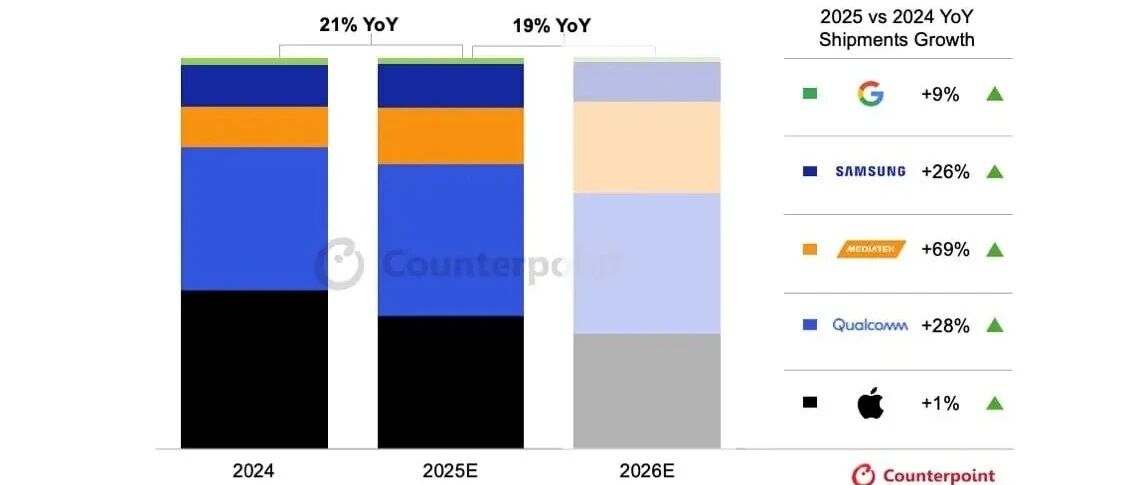
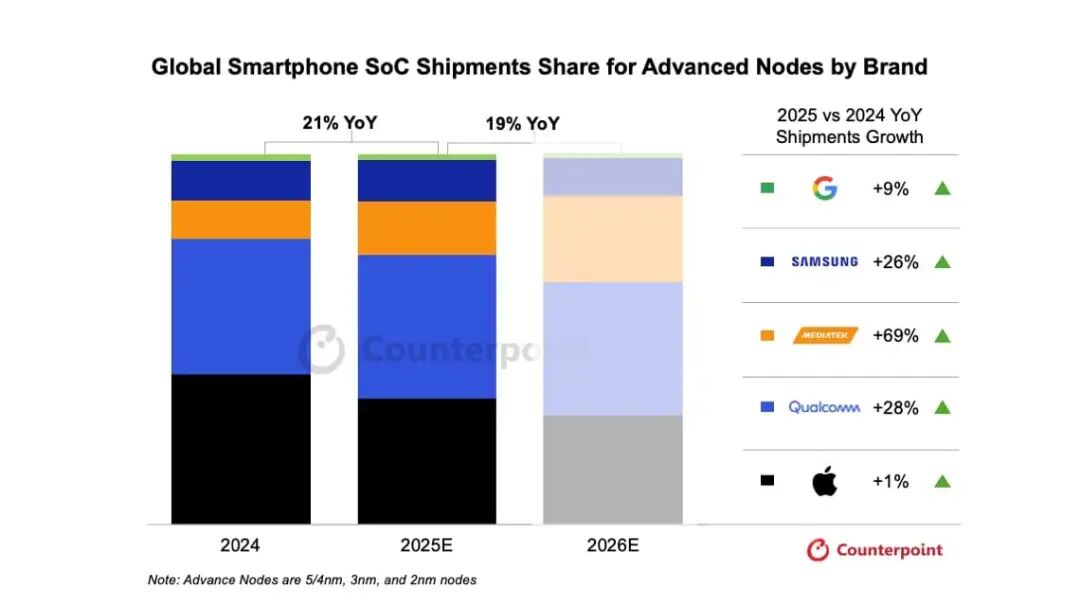
Core Insights - The report from Counterpoint indicates that advanced process nodes (5/4/3/2nm) will account for nearly 50% of smartphone SoC shipments by 2025, driven by a shift from mature nodes to advanced nodes across various price segments [1][4] - This transition enhances performance and energy efficiency, enabling stronger GenAI capabilities, improved gaming performance, and better thermal management in devices [1] - The revenue from advanced process chips is expected to exceed 80% of total smartphone SoC revenue by 2025, reflecting a rise in semiconductor content and average selling price (ASP) [1][5] Company Insights - Qualcomm is projected to benefit the most from the transition to advanced processes, expected to capture nearly 40% of the shipment share in 2025 with a 28% year-on-year growth, surpassing Apple [4] - MediaTek is also anticipated to see a 69% year-on-year increase in advanced process shipments by 2025, driven by the migration of mid-range products to 5/4nm [4] - TSMC is expected to maintain its leadership in advanced process SoC manufacturing, with a projected 27% year-on-year growth in shipments by 2025, capturing over 75% of the advanced process smartphone SoC shipment share [5] Market Outlook - By 2026, advanced processes are expected to account for 60% of total smartphone SoC shipments, primarily due to the accelerated migration of mid-range models to 5/4nm [5] - The mass production of 2nm processes and the continued ramp-up of 3nm processes will further accelerate the penetration of advanced processes in the market [5]
智能手机 AP-SoC 出货量在 2025 年达成先进制程 51% 的里程碑;高通将处于领先地位
Counterpoint Research· 2025-11-13 01:34
Core Insights - The article discusses the significant shift towards advanced process nodes (5/4/3/2nm) in smartphone SoC shipments, predicting that by 2025, these advanced nodes will account for 50% of total smartphone SoC shipments, up from 43% in 2024 [4][5]. Advanced Process Node Transition - The transition to advanced process nodes is accelerating, enhancing performance and energy efficiency across various smartphone price segments, leading to improved GenAI capabilities, gaming performance, and thermal management [5]. - The revenue from advanced process chips is expected to exceed 80% of total smartphone SoC revenue by 2025, driven by increased semiconductor content and average selling price (ASP) growth [5][8]. Key Players and Market Dynamics - Qualcomm is projected to lead the advanced process transition, capturing nearly 40% of the market share in 2025 with a 28% year-over-year growth, surpassing Apple [6][8]. - MediaTek is also expected to see a 69% increase in advanced process shipments in 2025, benefiting from its mid-range product migration to 5/4nm [6][8]. Manufacturing Landscape - TSMC is anticipated to remain the leading foundry for advanced process smartphone SoCs, with a projected 27% year-over-year growth in shipments by 2025, holding over 75% of the advanced process market share [9]. - The introduction of 2nm process technology is expected in 2026, with major players like MediaTek, Qualcomm, Apple, and Samsung launching flagship SoCs based on this technology [8][10]. Market Outlook - By 2026, the share of advanced process nodes in total smartphone SoC shipments is expected to rise to 60%, driven by the migration of mid-range models and the continued ramp-up of 3nm production [10].