Siemens(SIEGY)

Search documents
20年“零增长”的企业,靠什么创造价值?
3 6 Ke· 2025-06-10 01:24
Core Insights - Many companies face challenges in achieving revenue growth due to factors such as slowing globalization, aging populations, and increased scrutiny on consumption, leading to the question of how to create lasting value without relying on growth [1] Group 1: Characteristics of Stable Companies - A study of over 10,000 companies in North America, Europe, and Japan identified 172 stable companies with nearly zero revenue growth, which provided returns similar to market averages but with 12% lower volatility [3] - These stable companies have a significantly lower likelihood of experiencing severe value collapse, with a 50% lower chance of a 90% or more decline in market value compared to ordinary companies [3] - The average age of these stable companies is approximately 100 years, nearly double that of S&P 500 constituents, and one-third of them outperformed the market in total shareholder return (TSR) [3] Group 2: Strategies for Value Creation - Stable companies employ four distinct strategies to achieve superior performance without growth: 1. **Service Focus: Asset-Light Strategy** - These companies maximize value from existing customer relationships by shifting from physical products to asset-light services, resulting in an average EBIT margin increase of 8 percentage points and a 9% annual TSR [4][5] 2. **Premium Route: Margin Strategy** - Companies adopting a high-end approach increased their gross margins by an average of 12 percentage points over 20 years, achieving a 9% annual TSR through margin expansion and strong cash flow [6][7] 3. **Internal Integration: Balance Sheet Strategy** - By vertically integrating, these companies doubled their asset base and increased gross margins by 8 percentage points, achieving a 9% annual TSR with a cash flow contribution of 5% [8][9] 4. **Shareholder Returns: Dividend Strategy** - Stable companies prioritize returning cash to shareholders through predictable dividends, resulting in lower volatility and an average annual TSR of 12% [10] Group 3: Talent and Innovation Challenges - Companies pursuing low-growth strategies may struggle to attract and retain top talent due to limited opportunities for advancement, necessitating a deliberate talent strategy [12] - Some stable companies invest in long-term plans and partnerships to attract talent, such as targeted recruitment and collaborations with educational institutions [12][13] - Maintaining an innovative culture is crucial, with many stable companies focusing on incremental improvements rather than disruptive innovation, which can foster creativity under resource constraints [14]


2025汉诺威十大工业物联技术风向:生成式AI全面融入,代理型AI初露头角
3 6 Ke· 2025-06-06 11:49
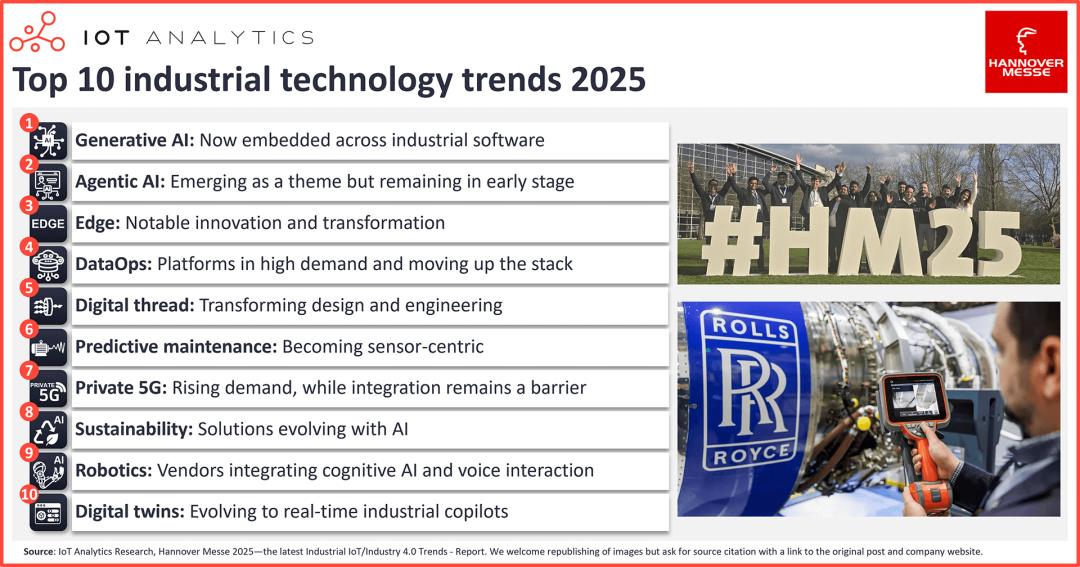
Core Insights - The 2025 Hannover Messe showcased the ongoing transformation in the industrial sector driven by artificial intelligence, particularly generative AI, although no groundbreaking technologies were introduced [1] - The report by IoT Analytics highlighted that generative AI has become an integral part of industrial software, moving beyond being a buzzword to a common feature in major industrial software products [3][4] - Agentic AI is emerging as the next significant trend in the industry, although it remains in its early stages of development [7][9] Trend Summaries Trend 1: Generative AI Fully Integrated into Industrial Software - Generative AI has transitioned from a focus on coding to being embedded across industrial software, with major software vendors showcasing integrated functionalities [3] - Leading companies like Siemens and ABB have developed various industrial assistants that leverage generative AI for tasks such as design, planning, and operational support [4][6] Trend 2: Emergence of Agentic AI - Agentic AI is viewed as a significant future opportunity, with many vendors promoting its capabilities, although practical applications are still limited [7][9] - Companies are exploring multi-agent frameworks, but these remain in early exploratory phases without substantial real-world validation [8] Trend 3: Significant Innovations in Edge Computing - Edge computing is evolving to integrate AI technology stacks, enhancing local processing capabilities and responsiveness [10] - Companies like Bosch Rexroth are demonstrating platforms that support AI model deployment at the edge, optimizing for specific industrial scenarios [10][11] Trend 4: Growing Demand for DataOps Platforms - DataOps is becoming essential for managing the increasing volume of data in industrial settings, with platforms expanding their capabilities to support AI lifecycle management [13][14] - Companies are focusing on data governance to ensure compliance with regulations like GDPR, enhancing data observability and tracking [14] Trend 5: AI-Driven Digital Threads Transforming Design and Engineering - Digital threads are reshaping engineering processes by ensuring data continuity throughout the product lifecycle, as demonstrated by Siemens' new solutions [17] - Autodesk's Project Bernini showcases how generative AI can enhance early design processes, promoting a multi-modal design approach [17] Trend 6: Sensorization of Predictive Maintenance - Predictive maintenance solutions are increasingly integrating custom hardware with analytics models, focusing on sensor quality and system compatibility [18][19] - New solutions are extending predictive maintenance capabilities to previously overlooked asset categories, enhancing monitoring and fault detection [18] Trend 7: Rising Demand for Private 5G Networks - The demand for private 5G networks is growing, particularly in the US and Asia, but integration with existing infrastructure remains a significant challenge [21][22] - Companies are developing solutions that combine generative AI, edge computing, and private 5G for real-time industrial safety and asset monitoring [22] Trend 8: Sustainable Solutions Enhanced by AI - AI is improving carbon emissions tracking and compliance efficiency, with various applications being upgraded to enhance data visibility and accuracy [23] - Collaborative efforts, such as those between Microsoft and Accenture, are optimizing compliance processes through AI integration [23] Trend 9: Cognitive Capabilities Empowering Robotics - Robotics manufacturers are incorporating cognitive AI and voice interaction features, allowing users to control robots through voice commands [24] - This trend aims to enhance flexibility and reduce the need for specialized skills in manufacturing and logistics [24] Trend 10: Digital Twins Evolving into Real-Time Industrial Co-Pilots - Digital twins are transitioning from static models to dynamic tools that assist in operations, training, and quality control [25] - Companies like EDAG Engineering and Siemens are showcasing how AI-driven digital twins can optimize processes and enhance training efficiency [25]
西门子发布了一则声明,确认限制中国EDA使用
是说芯语· 2025-06-05 23:53
是说芯语,欢迎关注分享 加入"中国IC独角兽联盟",请点击进入 投稿 、 商务合作 请微信 dolphinjetta 针对 美国商务部工业和安全局要求断供中国EDA软件供应的要求, 西门子在昨日发布了一则 声明 : " 5月23日 ,美国商务部工业和安全局通知Siemens Industry Software Inc.,对向中国客户 和全球中国军事产品终端用户出口电子设计自动化(EDA)软件和技术采取新的控制措施。 在我们 应对这些新出口管制的复杂性并评估对我们的业务和客户的影响时,我们限制了对出口管制分类编 号(ECCN)3D991 和3E991下的软件和技术的访问 。 150多年来,西门子一直为中国客户提供支持,并分别与美国和中国的利益相关者合作,以减 轻这些新限制的影响。西门子将继续为世界各地的员工和客户提供支持,他们正在使用我们的技术 来改变日常生活。 " ...

西门子“Realize LIVE”活动透视:AI+工业软件新征程,持续推进一站式AI解决方案
3 6 Ke· 2025-06-03 19:25
Core Insights - Siemens is focusing on digital transformation in manufacturing, emphasizing the integration of AI and digital technologies to enhance operational efficiency and competitiveness [3][4][5] Group 1: Event Overview - The Realize Live Americas 2025 conference hosted over 2,500 Siemens customers, partners, and industry experts to discuss best practices and insights in industrial digitalization [3] - Tony Hemmelgarn, CEO of Siemens Digital Industries Software, highlighted the ongoing evolution of the Siemens Xcelerator platform, which aims to provide comprehensive digital transformation solutions [3][4] Group 2: Technological Advancements - The Xcelerator platform integrates software, hardware, and services to help businesses become truly digital enterprises, improving manufacturing agility and operational efficiency [3][4] - AI capabilities are being integrated into Siemens' Teamcenter software for automatic problem detection and into Simcenter products to reduce engineering computation time [3][4] Group 3: Strategic Acquisitions - Siemens strengthened its digital twin capabilities through the acquisition of Altair, enhancing its ability to model and simulate physical systems in a virtual environment [4][5] - The integration of Altair's technology allows Siemens to offer advanced high-performance computing solutions, balancing workloads between GPU and CPU [4] Group 4: Product Lifecycle Management - Siemens' Teamcenter, a core product lifecycle management (PLM) solution, has seen a performance improvement of 20 times over the past 18 to 24 months, incorporating AI for intelligent lifecycle management [5] - The introduction of independent release processes and enterprise-level change functions enables simultaneous management of multiple product changes with complete traceability [5] Group 5: Case Study - Workhorse, an electric vehicle manufacturer, successfully utilized Siemens Xcelerator for comprehensive digital transformation, developing high-quality electric trucks in a short timeframe [6][8] - The deployment of NX and Teamcenter X PLM software allowed Workhorse to complete the full development process of its next-generation electric vehicle in just 22 months [8]

美国全面断供EDA,谁影响最大?谁却没影响?
是说芯语· 2025-06-02 09:19
其实,老美拿着EDA搞事情,已经很多年了,之前是点对点,针对特定的国内单位和公司。 比如说,2018年, 美国 禁止 中兴 使用EDA工具。再比如, 2019年,华为海思 被列入实 体清单后,被迫切断与美国EDA公司的合作。这次就明确了针对全部中国客户。 以下文章来源于龙科多 ,作者龙科多 龙科多 . 深度科技观察,聚焦半导体、操作系统等底层技术。内容全平台发布。 今天聊聊最新的美国EDA禁令。龙科多认为,美国此举基本无法起到多少制裁作用, 利好国 产EDA发展 。但这个事,还是值得具体说道说道。 最近,《纽约时报》 等多个外媒称,美国商务部已向包括Cadence、新思科技和西门子等全 球领先的EDA公司发出通知,要求停止向中国供应EDA技术。 Cadence、新思科技 都是美国公司,西门子是德国公司。消息一出,国内还是非常关注。有 一些人士认为不大可能,认为报道不准确。 不过,外媒陆续报道 ,上述三家EDA公司都对外发布公告,表示收到了美方的通知。这下, 基本做实了。 EAD工具,主要是用于 半导体制造测试的设计和验证,以及监控性能和质量。 如果再细分, 包括 模拟IC设计与验证、数字IC设计与验证,晶圆制 ...




EDA被禁,商务部强硬回应
半导体行业观察· 2025-06-02 02:28
Core Viewpoint - The article discusses the ongoing tensions between the U.S. and China regarding trade agreements, specifically highlighting China's firm stance against U.S. accusations of violating the Geneva Economic and Trade Talks consensus [1][2]. Group 1: U.S.-China Trade Relations - The Chinese Ministry of Commerce firmly rejected U.S. claims of violations, asserting that China has adhered to the consensus reached in the joint statement following the Geneva talks [1]. - Following the Geneva talks, the U.S. has implemented several discriminatory measures against China, including AI chip export controls and restrictions on sales of chip design software [1][2]. - The article emphasizes the importance of the joint statement as a significant achievement based on mutual respect and equal negotiation, urging the U.S. to correct its erroneous actions [2]. Group 2: Impact on Semiconductor Companies - Major EDA companies like Synopsys, Cadence, and Siemens EDA have received notifications regarding new U.S. export restrictions, prompting Synopsys to suspend its financial forecasts for the upcoming fiscal year [2][3]. - Cadence described the new regulations as "very complex" and is currently seeking clarification while assessing the impact on its business [3]. - Siemens EDA is also collaborating with global clients to mitigate the effects of the new restrictions [3].

特朗普政府已要求美国半导体软件设计公司停止向中国出售服务
news flash· 2025-05-29 03:51
Core Viewpoint - The Trump administration has requested American semiconductor software design companies to cease providing services to China, marking a significant move to curb China's ability to develop advanced AI chips [1] Group 1: Government Actions - The U.S. Department of Commerce has instructed electronic design automation (EDA) companies, including Cadence, Synopsys, and Siemens EDA, to stop supplying technology to China [1] - The directive was communicated through letters sent to these companies, although it remains unclear if all U.S. EDA firms received such letters [1] Group 2: Industry Impact - This action represents a major new initiative by the U.S. government aimed at limiting China's advancements in the semiconductor sector, particularly in the development of cutting-edge artificial intelligence chips [1]
突发!传西门子EDA(原Mentor)暂停对中国大陆支持
是说芯语· 2025-05-28 07:06
Core Viewpoint - Siemens' EDA division may suspend support and services for mainland China due to a notification from the U.S. Department of Commerce's Bureau of Industry and Security (BIS), which requires Siemens to "decouple" from its customers in China [1] Group 1: Impact on the Semiconductor Industry - The potential suspension of EDA tools from Siemens, along with Synopsys and Cadence's cautious stance, poses a significant challenge for Chinese companies reliant on imported EDA tools for chip design [1] - Lack of necessary technical support could hinder R&D progress, impacting the entire semiconductor supply chain [1] - The situation is being closely monitored by both Chinese and international industries for its potential ripple effects on the global semiconductor supply chain [1] Group 2: Response and Adaptation - In response to this uncertainty, the Chinese government and domestic companies are accelerating efforts towards independent innovation and technological self-sufficiency to reduce sensitivity and dependence on external changes [1][2]

一家工厂的一线员工何以创造90%的AI应用?| 走进标杆工厂
吴晓波频道· 2025-05-26 17:02
Core Viewpoint - Siemens Chengdu Digital Factory exemplifies the application of "Industry 4.0" and has achieved significant improvements in production efficiency and cost reduction through digital transformation, with a 2.3 times increase in efficiency and nearly 50% reduction in manufacturing costs over 12 years [3][6][8]. Group 1: Factory Overview - The Chengdu factory covers an area of 35,300 square meters, with over 14,000 square meters dedicated to production [3]. - The factory's design incorporates a four-story layout, with the first floor for logistics and production support, and the upper floors for office space [3][6]. - The factory has been recognized as a "Global Digital Lighthouse Factory" and a "Sustainable Lighthouse Factory," highlighting its advanced status in digital manufacturing [7]. Group 2: Digital Transformation and Automation - The factory utilizes a fully automated production line, capable of producing up to 80,000 products daily, with over 3,500 product types [10]. - Automation has optimized labor allocation, reducing the number of frontline workers to approximately 150, while enhancing the skill levels of remaining employees [19]. - Data collection is highly efficient, with 160,000 data points collected every 100 seconds, generating data equivalent to the daily mobile traffic of a city with 200,000 residents [10]. Group 3: AI and Innovation - AI is seen as a transformative force in industrial intelligence, with Siemens focusing on integrating digital and physical worlds [11]. - The concept of "digital twin" is employed to create real-time digital representations of physical entities, enhancing planning and operational efficiency [11][12]. - The factory encourages innovation through its "Idea Works" space, where employees can experiment with AI applications, resulting in 90% of AI solutions being developed by frontline workers [20]. Group 4: Human Capital and Future Outlook - The factory's workforce has grown from over 300 to 900 employees, with a significant shift towards higher-skilled roles, indicating a need for advanced capabilities in the AI era [19]. - The emphasis is on the importance of human creativity and innovation in the age of AI, with a belief that those who can leverage AI will thrive [21]. - The collaboration between Siemens and Chinese manufacturing highlights the potential for mutual growth and innovation in the global industrial landscape [24].
融资需求火爆 欧洲债券发行规模以创纪录速度突破1万亿欧元
智通财经网· 2025-05-21 02:45
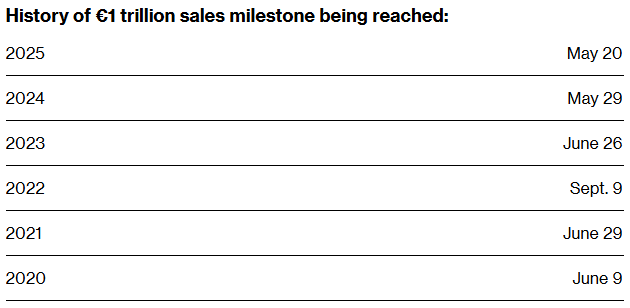
智通财经APP获悉,今年欧洲各地银行家安排的债券销售以有史以来最快的速度超过了1万亿欧元(1.13 万亿美元),即使特朗普政府全面征收关税一度引发市场短暂关闭。 Del Canto补充道:"如果你看看市场如何吸收交易、超额认购的程度以及二级市场的收紧程度,你就会 发现这一切都表明市场运作良好。" 根据Bloomberg的数据和分析,本月投资者认购的债券数量已达到可售债券数量的3.69倍。 据一位知情人士透露,周二至少有26家借款人在欧洲公开银团债券市场发行债券,其中包括诺和诺德。 今年全球债券销售持续飙升,即便上个月美国宣布的关税举措震动了全球市场,导致债券市场暂时停 摆。自那以来,债券销售出现反弹,尽管在穆迪下调美国政府信用评级后,一些美国借款人选择推迟计 划中的交易。 欧洲债券发行量达到1万亿欧元里程碑的时间表 | 2025 | May 20 | | --- | --- | | 2024 | May 29 | | 2023 | June 26 | | 2022 | Sept. 9 | | 2021 | June 29 | | 2020 | June 9 | 三菱日联金融集团欧洲、中东和非洲资本市场联席主管 ...