Toyota(TM)

Search documents
全固态电池,这次真有重大进展
3 6 Ke· 2025-10-11 02:47
Core Insights - Recent breakthroughs in solid-state battery technology have been reported by multiple Chinese research teams, focusing on overcoming the "solid-solid interface" challenge, which is a significant barrier to commercialization [2][4][5] - The introduction of Dynamic Adaptive Interface (DAI) technology allows solid-state batteries to maintain stable cycling even under low or zero external pressure, achieving over 70% capacity retention after 300 cycles [2][5] - The advancements in solid-state batteries are still in the research phase, with experts estimating a potential timeline of 5 to 8 years for mass production, suggesting that large-scale commercialization may not occur until around 2030 [4][5] Research Breakthroughs - The research led by Huang Xuejie’s team at the Chinese Academy of Sciences has made significant progress in addressing the solid-solid interface issue, which has been a major challenge for solid-state lithium batteries [2][7] - Another team from the Institute of Metal Research has innovated at the molecular level to reduce interface impedance and enhance ion transport efficiency, with their findings published in Advanced Materials [2][16] - Tsinghua University’s team has developed a new fluorinated polymer electrolyte that significantly increases energy density, achieving 604 Wh/kg and 1027 Wh/L, nearly double that of current liquid electrolyte lithium batteries [14][16] Industry Implications - Despite the promising research, experts caution that the transition from laboratory breakthroughs to commercial applications remains a lengthy process, with significant challenges in manufacturing and cost still to be addressed [4][21] - Toyota, a leading player in the solid-state battery space, has set ambitious timelines for mass production, aiming for 2027-2028, while also investing heavily in partnerships and production facilities [18][21] - The solid-state battery technology race is ongoing, with various companies exploring different approaches, but the consensus is that solid-state batteries may only find niche applications in high-end markets, rather than becoming mainstream [21][23]


丰田上市改良版bZ4X,续航日本国内厂商最长
日经中文网· 2025-10-10 07:09
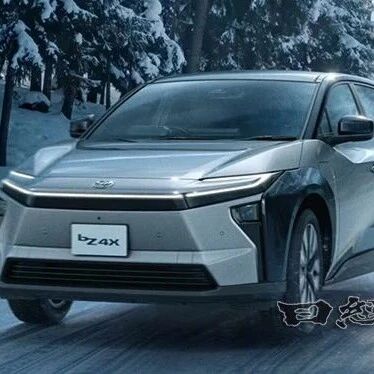
Core Viewpoint - Toyota has improved the range of its electric vehicle "bZ4X" by 25%, reaching a maximum of 746 kilometers, making it the longest range among domestic EVs in Japan [2][4]. Group 1: Vehicle Improvements - The range increase is achieved by enhancing the total battery capacity and reducing energy loss in the "e-Axle" drive system [2][4]. - The bZ4X can now travel from Tokyo to Aomori or Okayama on a full charge [4]. - Acceleration performance has been enhanced, with the time to accelerate from 0 to 100 km/h reduced to 5.1 seconds, a decrease of 1.8 seconds [5]. Group 2: Charging Enhancements - Improvements have been made for charging in cold climates, including a preheating function for the battery, allowing charging in temperatures as low as -10 degrees Celsius within 28 minutes [4]. - Toyota will sell its first home charger with an output power of 6 kW, which is double that of other brands, capable of storing enough energy for a 300 km range in 8 hours [5]. - A new charging service called "TEEMO" will be launched, allowing users to access chargers at Toyota dealerships with a pay-per-use model, benefiting both Toyota and other brand EV users [5].
异动盘点1010|泡泡玛特涨超2%,黄金股集体低开;法拉利跌近15%,百事可乐涨超4%
贝塔投资智库· 2025-10-10 04:33
Group 1: Hong Kong Stocks - Nocera Biotech (09969) fell over 8% after announcing a licensing collaboration with Zenas for three self-immune pipeline products [1] - Pop Mart (09992) rose over 2% as new products sold out immediately, with Morgan Stanley optimistic about the company's sales momentum [1] - Bluec (00325) increased over 8% after launching new "building block cars" and "building block figures" at the WF2025 exhibition [1] - Huaxin Cement (06655) rose over 7% after announcing a name change to "Huaxin Building Materials" and a restricted stock incentive plan [1] - Mixue Group (02097) gained over 5% after announcing an investment of nearly 300 million in the fresh beer industry, potentially opening up long-term growth opportunities [1] - CATL (03750) dropped nearly 6% as the cornerstone lock-up period is set to expire on the 19th of next month, with both Morgan Stanley and others downgrading the company's H-share rating [1] - Dazhong Public Utilities (01635) rose over 9%, stating that its operations are normal and previously mentioned its stake in Shenzhen Capital Group [1] - Jinli Permanent Magnet (06680) increased nearly 1%, forecasting a year-on-year increase of 157%-179% in net profit attributable to shareholders for the first three quarters [1] Group 2: Gold Stocks - Gold stocks opened lower collectively, with China Gold International (02099) down over 7%, Zijin Mining International (02259) down over 1%, Shandong Gold (01787) down over 6%, and Chifeng Jilong Gold Mining (06693) down over 6% due to easing geopolitical tensions leading to a pullback in precious metals [2] Group 3: US Stocks - AMBO Education (AMBO.US) surged 61.06% after announcing the launch of a real-time translation platform, WeSpeak, for enterprises [3] - CenturyLink (VNET.US) fell 3.13% as Goldman Sachs included it in a "strong buy" list for the Asia-Pacific region [3] - UiPath (PATH.US) rose 18.81% after announcing multiple collaborations with major tech companies like NVIDIA, OpenAI, Google, Microsoft, and Snowflake [3] - Tuniu (TOUR.US) decreased by 0.51%, despite a double-digit increase in user travel during this year's "Double Festival" holiday compared to last year [3] - Tesla (TSLA.US) fell 0.72% after reports that production of its humanoid robot, Optimus, has been paused [3] - Toyota (TM.US) dropped 2.97% after a recall of over 390,000 vehicles in the US due to software errors [3] - Lloyds Bank (LYG.US) decreased by 3.67% as it may need to increase provisions following a compensation plan for mis-sold auto loans [3] - Ferrari (RACE.US) fell 14.99%, reaching a six-month low as long-term profit guidance fell below expectations [4] - TSMC (TSM.US) decreased by 1.52%, projecting a consolidated revenue of approximately NT$330.98 billion for September 2025, a 1.4% decrease quarter-on-quarter but a 31.4% increase year-on-year [4] - PepsiCo (PEP.US) rose 4.23% with Q3 net revenue increasing by 2.7% to $23.94 billion, and core EPS of $2.29, both exceeding expectations [4]



日经BP精选:中国EV在泰国受挫,丰田以最低价HV发起反击
日经中文网· 2025-10-10 03:27
"我们确信可以推出超越泰国消费者期待的车型",正如丰田泰国法人社长山下典昭在曼谷 发布会上显示出的自信,这款车型的开局良好。相关人士透露,在 YARIS ATIV 混动版发售 后的 8 月底,在泰国举行的展会上获得了超出预期的订单。 日经BP成立于1969年4月, 隶属于日本经济新闻社集团。作为日本领先的B2B媒体公司,我们聚焦"经营 管理"、"专业技术"及"生活时尚"三大主要领域,满足客户多元化的需求。 本文的3个要点 丰田 8 月下旬在泰国推出了小型轿车" YARIS ATIV "的混合动力版( HV )。年内将以 71.9 万泰铢(约合人民币 16 万元)的限定价格销售,比此前投放泰国市场的 HV 之中最便 宜的小型 SUV " YARIS Cross "便宜约 1 成。 编者荐语: 日经中文网"开设了"日经BP精选"栏目。日经BP是日本经济新闻社媒体集团的一员,成立于1969年。作 为日本领先的B2B媒体公司,聚焦经营管理、专业技术及生活时尚三大主要领域。敬请读者关注。 以下文章来源于日经BP ,作者日经BP 日经BP . 阅读更多内容请点击下方"阅读原文" (本文由日经BP提供) 1. 丰田在泰国推 ...

固态电池消息撩人:两个来自中国,一个来自日本
汽车商业评论· 2025-10-09 23:08
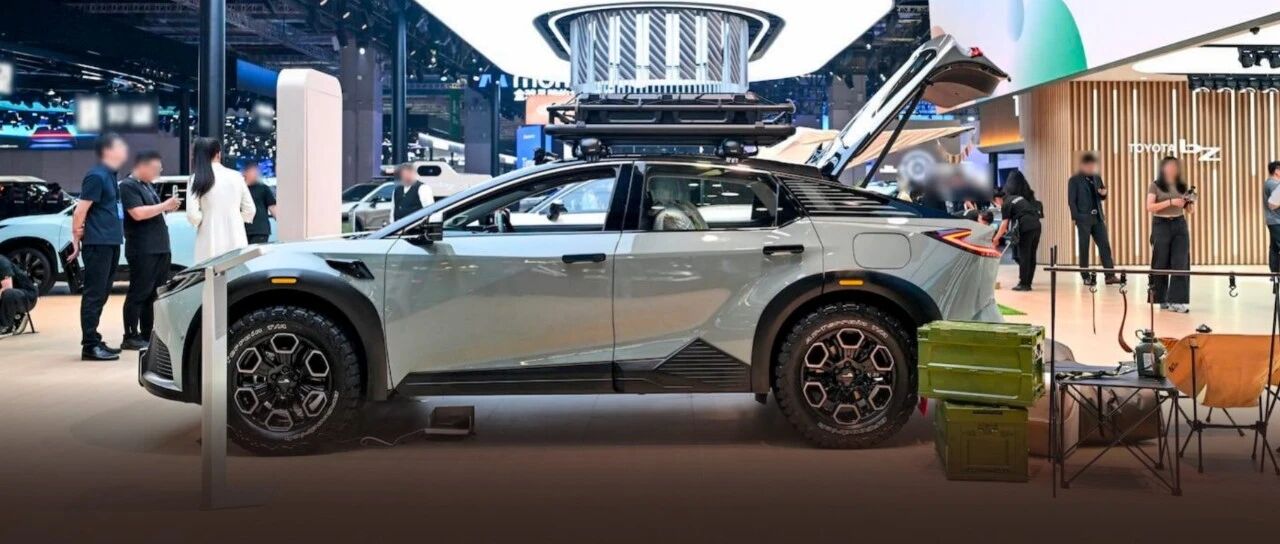
Core Insights - Recent advancements in solid-state battery technology have emerged, with significant breakthroughs reported from Chinese research teams and a collaborative effort from Japanese companies [3][5][8] Group 1: Chinese Research Breakthroughs - The Chinese Academy of Sciences' research team has developed a new type of material that integrates ion conduction and electrochemical activity, achieving a significant increase in ion transport efficiency and a 86% improvement in energy density when used in composite cathodes [7] - Another team led by Huang Xuejie has introduced an anion regulation technology that enhances the interface stability between the electrolyte and lithium electrode, resulting in a prototype battery that maintains performance over hundreds of cycles [7] Group 2: Japanese Industry Response - Toyota and Sumitomo Metal Mining have announced a partnership to develop and produce cathode materials for solid-state batteries aimed at electric vehicles, marking a strategic shift in Sumitomo's battery materials business [8] - Toyota aims to launch electric vehicles equipped with solid-state batteries by 2027-2028, indicating a strong commitment to advancing solid-state technology [8][11] Group 3: Industry Challenges and Comparisons - The transition to solid-state batteries faces significant challenges, including low ionic conductivity of solid electrolytes, high material costs, and complex manufacturing processes that hinder large-scale production [19][20] - Current lithium-ion battery technologies, such as lithium iron phosphate (LFP) and high manganese batteries, continue to dominate the market due to their improved energy density and cost-effectiveness, suggesting that solid-state batteries may initially be limited to high-end applications [22][23]
从日本车企定价看美国通胀的“隐退”与“回涌”
Hu Xiu· 2025-10-09 12:35
Core Viewpoint - The article discusses how Japanese automakers have responded to increased tariffs imposed by the Trump administration by collectively lowering prices instead of passing costs onto consumers, creating an unexpected buffer against inflation in the U.S. market [1][3][4]. Group 1: Japanese Automakers' Pricing Strategy - Following the announcement of a 25% tariff on imported vehicles, Japanese automakers adopted a "price reduction" strategy to maintain market share in the U.S. [3][5]. - The price index for cars exported to North America dropped by 19.4% year-on-year, indicating a significant reduction aimed at stabilizing prices in the U.S. market [5][6]. - Despite a decline in profits, Japanese manufacturers managed to maintain a 1.3% increase in sales revenue, demonstrating the effectiveness of their pricing strategy [6]. Group 2: Impact of Tariffs on Inflation - The collective price reductions by Japanese automakers have contributed to a decrease in the Personal Consumption Expenditures (PCE) index for imported vehicles, which fell by 0.52% in May, marking the largest drop in nearly a year [16][17]. - However, the overall impact on U.S. inflation has been limited, as the weight of Japanese cars in the PCE index is relatively small, accounting for only about 0.5% [17][19]. - The strong U.S. market has allowed for a "neutralization" effect on inflation, where competitive pressures have absorbed tariff impacts without significantly raising consumer prices [14][19]. Group 3: Broader Global Manufacturing Trends - Other countries, including South Korea and Germany, have also seen similar price reductions in key export sectors, indicating a widespread response to U.S. tariffs [4][19]. - The phenomenon of "price elasticity" in the U.S. market has forced foreign manufacturers to absorb costs rather than pass them on to consumers, creating a temporary buffer against inflation [12][20]. - The overall trend suggests that the competitive landscape in the U.S. has led to a collective effort among global manufacturers to mitigate inflationary pressures through price adjustments [20][39]. Group 4: Future Implications for Inflation - As Japanese automakers begin to raise prices in response to profit pressures, the previous buffer against inflation may diminish, potentially leading to renewed inflationary pressures in the U.S. [22][28]. - The combination of rising import prices and the depletion of existing inventory is expected to contribute to an upward trend in inflation indicators [34][39]. - The ongoing monetary policy changes, including potential interest rate cuts, may further complicate the inflation landscape, suggesting a challenging environment for both manufacturers and consumers [38][39].


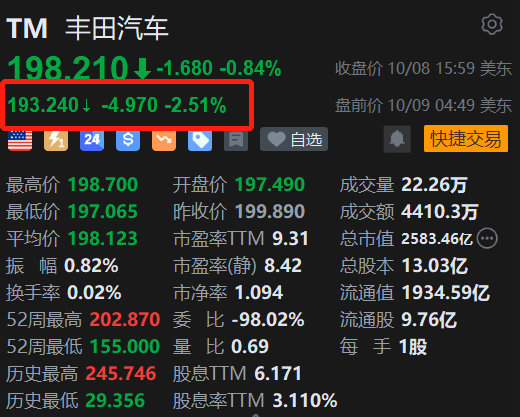
美股异动|丰田汽车盘前跌2.5% 由于软件错误在美国召回超39万辆汽车
Ge Long Hui· 2025-10-09 09:01
Core Viewpoint - Toyota Motor Corporation (TM.US) shares fell by 2.5% in pre-market trading due to a recall announcement related to a software error that affects vehicle safety [1] Group 1: Recall Details - The U.S. National Highway Traffic Safety Administration reported that a software error may cause the vehicle to shift into reverse unexpectedly or fail to display the rearview camera image, posing a safety risk [1] - A total of 393,838 vehicles are being recalled, including certain 2022-2025 Tundra, Tundra Hybrid, and 2023-2025 Sequoia Hybrid models [1] - Dealers will provide free software upgrades to rectify the issue for the recalled vehicles [1]
丰田加码固态电池:2027年至2028年间推出搭载全固态电池的纯电动汽车
Shang Hai Zheng Quan Bao· 2025-10-09 00:02
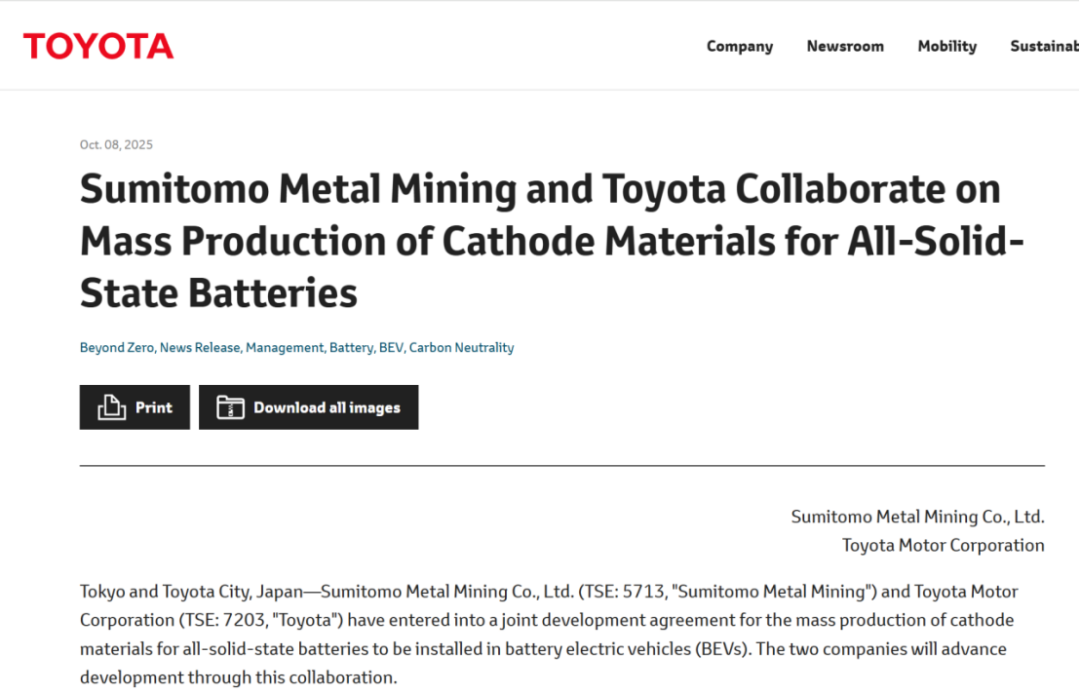
Core Points - Toyota Motor Corporation has announced a collaboration with Sumitomo Metal Mining Co., Ltd. to mass-produce cathode materials for solid-state batteries intended for battery electric vehicles (BEVs) [1][3] - The partnership aims to advance the research and development process, with plans to launch BEVs equipped with solid-state batteries between 2027 and 2028 [1][5] Group 1: Solid-State Battery Technology - Solid-state batteries consist of a cathode, an anode, and a solid electrolyte, offering advantages such as smaller size, higher output power, and longer lifespan compared to traditional liquid electrolyte batteries [3] - The application of solid-state batteries in BEVs is expected to enhance driving range, reduce charging time, and improve output power [3][5] Group 2: Research and Development Collaboration - Since around 2021, Sumitomo Metal Mining and Toyota have been conducting joint research on cathode materials for solid-state batteries, focusing on overcoming degradation issues during charge-discharge cycles [3][5] - The collaboration has led to the development of a new "high-durability cathode material" using Sumitomo's unique powder synthesis technology [3][5] Group 3: Future Goals and Strategic Importance - Both companies will continue to collaborate on improving the performance, quality, safety, and cost-effectiveness of solid-state battery cathode materials [5] - The goal is to be the first globally to implement solid-state batteries in BEVs, which is seen as a potential game-changer for the automotive industry and a contribution to achieving a carbon-neutral society [5] Group 4: Multi-Path Strategy - Toyota's Executive Vice President Hiroki Nakajima emphasized that solid-state batteries are a key pillar of the company's "multi-path strategy," which aims to provide suitable vehicle models based on the energy structure of different regions [6][8] - The development of solid-state batteries is intended to address critical challenges in BEVs, such as charging time and driving range [6][8]
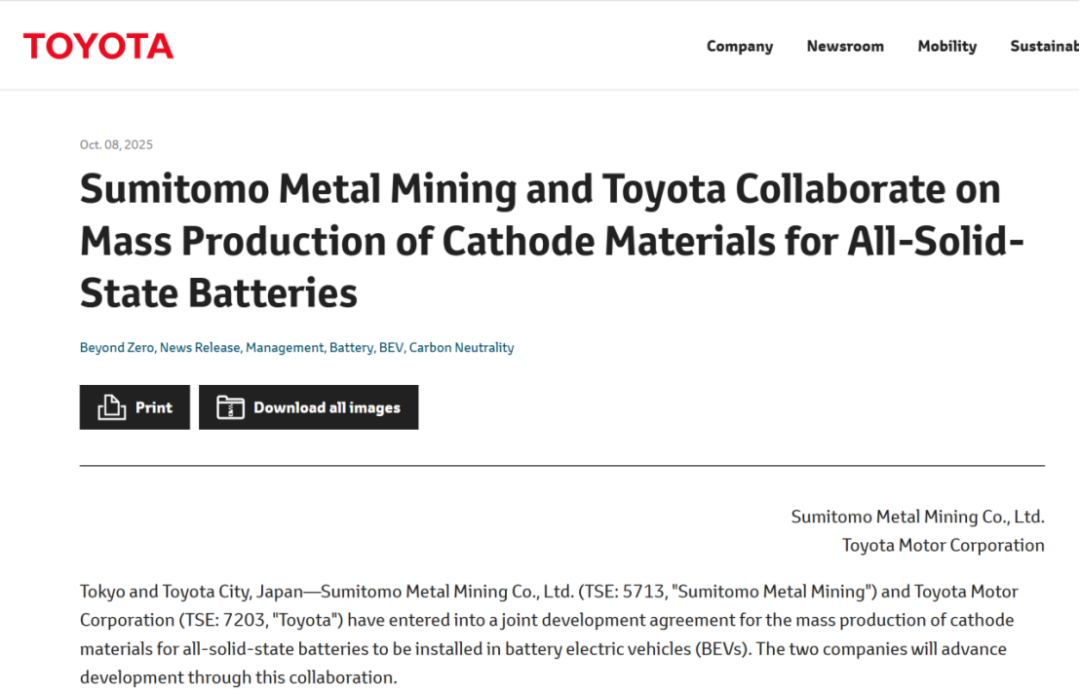
Toyota And Sumitomo Team Up On Next-Gen EV Batteries - Sumitomo Metal Mining (OTC:SMMYY), Toyota Motor (NYSE:TM)
Benzinga· 2025-10-08 16:50
Core Insights - Sumitomo Metal Mining Co., Ltd. and Toyota Motor Corporation have signed a joint development agreement to mass-produce cathode materials for all-solid-state batteries aimed at battery electric vehicles [1][3] - The collaboration is focused on industrializing next-generation cells that offer higher output, longer life, and faster charging times [1][4] Group 1: Technology and Development - All-solid-state batteries utilize a solid electrolyte instead of liquid solutions, allowing for tighter packaging, enhanced safety, and quicker charging for battery electric vehicles [2] - The initial market launch of battery electric vehicles using this technology is targeted for 2027–2028 [3] - Joint research has been ongoing since 2021 to tackle cathode degradation during charge-discharge cycles [3] Group 2: Material and Production - Sumitomo Metal Mining aims to leverage its proprietary powder synthesis methods to develop a highly durable cathode material suitable for solid-state architectures [3][4] - The companies plan to enhance performance, quality, and safety while reducing production costs [5] - The roadmap includes scaling materials and processes to support battery electric vehicle applications as the technology transitions from pilot lines to commercial volumes [5] Group 3: Market Impact and Goals - The development of higher power density and improved longevity in batteries could extend driving range and reduce charging time, addressing key challenges for broader electric vehicle adoption [4] - This initiative is framed as a significant step towards the practical use of all-solid-state batteries in battery electric vehicles, supporting the automotive industry's transition and long-term carbon-neutrality objectives [4]
丰田加码固态电池
Shang Hai Zheng Quan Bao· 2025-10-08 15:43
Core Insights - Toyota Motor Corporation has announced a collaboration with Sumitomo Metal Mining Co., Ltd. to develop mass production of cathode materials for solid-state batteries intended for battery electric vehicles (BEVs) [1][3] - The company plans to launch BEVs equipped with solid-state batteries between 2027 and 2028 [1][3] Group 1: Solid-State Battery Technology - Solid-state batteries consist of a cathode, an anode, and a solid electrolyte, offering advantages over traditional liquid electrolyte batteries, such as smaller size, higher output power, and longer lifespan [3] - The application of solid-state batteries in BEVs is expected to enhance driving range, reduce charging time, and improve output power [3][5] Group 2: Research and Development Collaboration - Since around 2021, Sumitomo Metal Mining and Toyota have been jointly researching cathode materials for solid-state batteries, focusing on overcoming degradation issues during charge-discharge cycles [3][5] - The collaboration has led to the development of a new "high-durability cathode material" using Sumitomo's unique powder synthesis technology [3][5] Group 3: Future Goals and Strategic Importance - Both companies aim to enhance the performance, quality, safety, and reduce production costs of solid-state battery cathode materials [5] - The goal is to be the first globally to implement solid-state batteries in BEVs, which is believed to significantly impact the automotive industry and contribute to a carbon-neutral society [5] Group 4: Corporate Strategy - Toyota's Executive Vice President Hiroki Nakajima emphasized that solid-state batteries are a key pillar of the company's "multi-path strategy," which aims to provide suitable vehicle types based on regional energy structures [6][8] - The development of solid-state batteries is seen as a solution to critical challenges in BEVs, such as charging time and driving range [6][8]