TME(TME)

Search documents
豪掷200亿收购喜马拉雅,腾讯音乐“钞能力”买出未来?
3 6 Ke· 2025-06-11 12:09
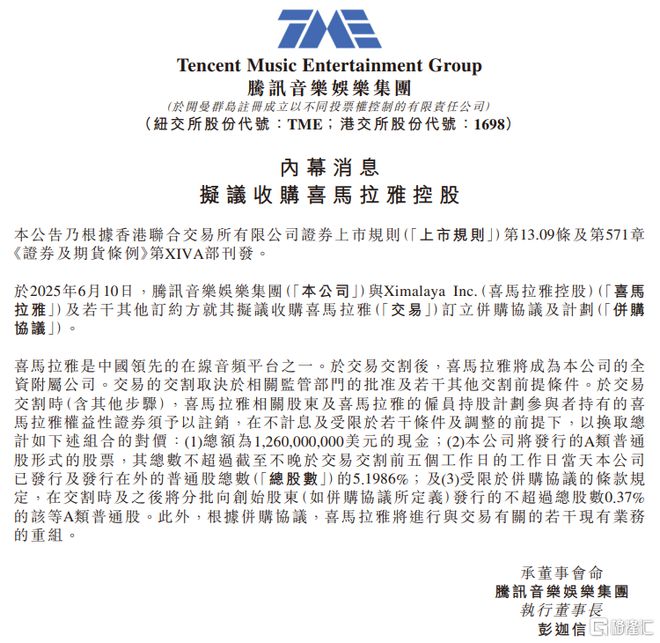
Core Viewpoint - Tencent Music has signed an acquisition agreement to purchase Ximalaya for approximately $1.26 billion in cash and stock, totaling an estimated $2.85 billion, which has sparked discussions about the valuation and future of both companies [1][2][3]. Summary by Sections Acquisition Details - Tencent Music will pay $1.26 billion in cash and up to 5.1986% of its Class A common stock, along with an additional 0.37% of Class A common stock for Ximalaya's founding shareholders [1]. - The total estimated acquisition cost is around $2.85 billion, equivalent to approximately 20 billion RMB [1]. Financial Performance of Ximalaya - Ximalaya has faced significant financial challenges, with cumulative losses exceeding 10 billion RMB and only achieving a profit of 224 million RMB in 2023 [1][3]. - The company's revenue for 2021, 2022, and 2023 was reported at 5.86 billion RMB, 6.06 billion RMB, and 6.16 billion RMB, respectively, with adjusted net profits of -718 million RMB, -296 million RMB, and 224 million RMB [3][4]. Market Position and User Metrics - Ximalaya has over 300 million monthly active users, but its growth rate has slowed significantly, with a 4.1% increase in 2023 compared to 7.2% in 2021 and 8.6% in 2022 [3][4]. - The platform's paid user rate decreased from 13.3% in 2021 to 11.9% in 2023, indicating a decline in user engagement [3][4]. Strategic Implications for Tencent Music - The acquisition is seen as a strategic move for Tencent Music to enhance its market position in the audio sector, complementing its existing services [5][9]. - Tencent Music has been actively expanding its audio business, having previously acquired Lazy Listening for 2.7 billion RMB, indicating a trend of growth through acquisitions [6][10]. Competitive Landscape - The online audio market in China is highly competitive, with major players like ByteDance and NetEase also vying for market share [5][12]. - Tencent Music's recent financial reports show a decline in active users, highlighting the need for new growth strategies amidst increasing competition [12][13].

腾讯音乐买了喜马拉雅,谁赚了?谁亏了?
3 6 Ke· 2025-06-11 11:23
Core Viewpoint - The acquisition of Ximalaya by Tencent Music for approximately $28.4 billion marks a significant shift in the long audio industry, with both companies seeking to fulfill their strategic needs through this transaction [1][6][9]. Group 1: Acquisition Details - Tencent Music announced a deal to acquire Ximalaya for $12.6 billion in cash and up to 5.1986% of its Class A common stock, along with additional stock for Ximalaya's founding shareholders [1]. - The total transaction cost is estimated at around $28.4 billion, which includes the value of the stock and cash [1][2]. - The acquisition price represents a significant decrease compared to Ximalaya's previous valuations, which were as high as $50 billion [7][8]. Group 2: Ximalaya's Challenges - Ximalaya has faced multiple challenges in its attempts to go public, including failed IPO attempts and continuous financial losses, with net losses reported from 2018 to 2021 [3][4]. - The company managed to achieve profitability in 2023 primarily through cost-cutting measures rather than revenue growth, leading to a significant decline in revenue growth rate from 43.7% to 1.7% [4][5]. - Ximalaya's revenue model has been heavily reliant on subscriptions, which accounted for 51.1% of total revenue in 2021, but it has struggled to diversify its monetization strategies [15][16]. Group 3: Tencent Music's Position - Tencent Music has shown strong performance in the capital market, with a gross margin increase from 40.9% to 44.1% year-on-year [5]. - The acquisition of Ximalaya is seen as a strategic move to enhance Tencent Music's content ecosystem and address competitive pressures from ByteDance and other players in the audio market [6][9]. - Tencent Music's cash reserves, amounting to $5.19 billion, will be impacted by this acquisition, although the mixed payment method aims to mitigate immediate cash flow concerns [8][9]. Group 4: Strategic Implications - The merger of the largest music streaming platform and the largest online audio platform in China is expected to attract regulatory scrutiny due to potential market dominance [11][13]. - Ximalaya's extensive user base of approximately 300 million MAU and its rich content library present significant strategic value for Tencent Music, potentially enhancing user engagement and monetization opportunities [10][9]. - The integration process will require careful management to maintain Ximalaya's brand and operational independence while leveraging Tencent's resources for growth [11][12].
喜马拉雅“上岸”,应该感谢字节
虎嗅APP· 2025-06-11 10:39
Core Viewpoint - The acquisition of Ximalaya by Tencent Music Entertainment Group (TME) for approximately $2.847 billion is seen as a strategic move to enhance TME's audio ecosystem and address the challenges faced by Ximalaya in a competitive market [3][4][10]. Group 1: Acquisition Details - TME announced a merger agreement with Ximalaya, valuing the company at about $2.847 billion, which includes $1.26 billion in cash and $1.587 billion in equity [3]. - If the acquisition is completed, Ximalaya will operate as a wholly-owned subsidiary of TME while maintaining its independent operations [3]. - Ximalaya's valuation peaked at $4.3 billion, but due to multiple failed IPO attempts, it is now being sold at a significantly lower price [4][10]. Group 2: Market Dynamics - The market has shifted from a focus on growth through losses to prioritizing profitability, making it difficult for Ximalaya to secure new financing [4]. - The rise of ByteDance's products, such as Tomato Novel and Tomato Listening, has intensified competition in the audio sector, further eroding Ximalaya's market share [7][8]. - Ximalaya's advertising revenue has declined from 14.88 billion yuan in 2021 to 14.23 billion yuan in 2023, with its revenue share also decreasing [7][9]. Group 3: Financial Performance - Ximalaya's revenue for 2021-2023 was 58.57 billion yuan, 60.61 billion yuan, and 61.63 billion yuan, with growth rates plummeting from 43.7% to 1.7% [9]. - The company reported a net profit of 3.736 billion yuan in 2023, indicating a shift towards profitability after years of losses [10]. - Cumulative losses from 2018 to 2022 reached 3.166 billion yuan, highlighting the financial struggles faced by Ximalaya [8]. Group 4: Business Model and Strategy - Ximalaya's revenue model heavily relies on membership and advertising, lacking high-margin business support [16]. - The company has been slow to adapt to the podcasting trend, only recently prioritizing it as a key growth area despite earlier attempts to establish a podcast channel [18][19]. - Internal governance issues, such as the dual leadership structure, have hindered decision-making and execution within the company [22].


腾讯音乐收购喜马拉雅,音频市场该如何迎接市场变局
Qi Lu Wan Bao Wang· 2025-06-11 10:35
Group 1 - Tencent Music Entertainment Group announced the acquisition of Himalaya for $1.26 billion (approximately RMB 9.06 billion) in cash and stock, marking a significant move in the long audio sector [1] - Himalaya has 303 million monthly active users, accounting for 25% of China's online audio market, making it a crucial addition to Tencent Music's user base [3] - The acquisition aims to enhance Tencent Music's ecosystem by integrating music, audiobooks, and podcasts, thereby strengthening its competitive position against ByteDance's audio offerings [3][8] Group 2 - The online audio industry in China has been experiencing rapid growth, with Tencent Music and NetEase Cloud Music holding nearly 90% of the market share [2] - The user engagement in music apps is facing challenges, with a decline in average daily usage time, indicating a shift in consumer behavior towards video content [4][8] - The acquisition is seen as a strategic move for Himalaya, which has struggled with multiple failed IPO attempts, providing it with a stable investment partner in Tencent Music [3][8]

300亿龙头,打折卖了
创业邦· 2025-06-11 10:12
Core Viewpoint - The acquisition of Himalaya by Tencent Music Entertainment Group for $1.26 billion is seen as a strategic move to enhance Tencent's audio business and boost its stock price, while Himalaya aims to maintain its independent operations and brand identity post-acquisition [2][5][19]. Group 1: Acquisition Details - Tencent Music announced the acquisition of Himalaya, the largest online audio company in China, for a total transaction value exceeding $2.73 billion (approximately 20 billion RMB) [2]. - Following the acquisition, Himalaya will operate as a wholly-owned subsidiary of Tencent Music, with no changes to its core team or strategic direction [2][3]. - The acquisition is expected to significantly impact Tencent Music's stock price and expand its business portfolio [5]. Group 2: Himalaya's Business Performance - Himalaya has been profitable for nine consecutive quarters since 2023, with a revenue of 6.16 billion RMB in 2023, but its revenue growth rate has slowed dramatically from an average compound growth rate of 47% from 2019 to 2021 to around 5% from 2021 to 2023 [3][14]. - The company has reduced its workforce from 4,342 employees at the end of 2021 to 2,637 by April 2025, indicating a significant cost-cutting strategy [4]. - Himalaya's revenue sources include advertising, membership, knowledge payment, and audio live streaming, with a focus on audiobooks, children's content, and podcasts [14]. Group 3: Market Position and Competition - Himalaya holds the largest market share in China's online audio sector, with approximately 60% of mobile listening time and over 300 million monthly active users [7]. - The company faces intense competition from short video platforms, web novel platforms, and emerging audio apps, which are capturing user attention and market share [15][17]. - Despite its leading position, Himalaya's growth is challenged by the saturation of the online audio market and the rise of alternative content platforms [14][17]. Group 4: Investment and Valuation - Prior to the acquisition, Himalaya's valuation had reached over 30 billion RMB, but the latest transaction suggests a decrease in its valuation to two-thirds of its previous estimate [12]. - The company has undergone multiple rounds of investment, raising nearly 10 billion RMB from various investors, including Tencent and Xiaomi [8][11].

喜马拉雅200亿卖身腾讯音乐,已是最好的结局
36氪· 2025-06-11 09:43
Core Viewpoint - The acquisition of Ximalaya by Tencent Music marks a significant shift in the audio industry, reflecting both the challenges faced by Ximalaya and Tencent Music's strategic move to consolidate its position in the long audio market [4][12]. Acquisition Details - Tencent Music announced a deal to acquire Ximalaya for approximately $1.26 billion in cash and up to 5.1986% of Class A common stock, bringing the total acquisition cost to nearly $2.9 billion, or around 20 billion RMB [4][8]. - The acquisition is subject to regulatory approvals, including antitrust reviews by the State Administration for Market Regulation [4][5]. Financial Performance of Ximalaya - Ximalaya reported a net profit of 224 million RMB in 2023, marking its first profitable year after years of losses totaling 3.166 billion RMB from 2018 to 2022 [9][10]. - Revenue growth has stagnated, with figures of 5.856 billion RMB in 2021, 6.061 billion RMB in 2022, and 6.163 billion RMB in 2023, reflecting growth rates of 43.7%, 3.5%, and 1.7% respectively [10]. Market Context - The online audio market in China grew from 2.54 billion RMB in 2016 to 27.24 billion RMB in 2020, with a compound annual growth rate of 69.5% [8]. - Ximalaya's user base peaked at over 600 million in 2019, with monthly active users exceeding 200 million [8]. Strategic Implications for Tencent Music - The acquisition allows Tencent Music to enhance its content ecosystem, gaining access to Ximalaya's 300 million monthly active users and a diverse range of audio content, including podcasts and audiobooks [12][13]. - Tencent Music's previous attempts to compete with Ximalaya through aggressive marketing and talent acquisition did not yield the desired results, prompting this acquisition as a more effective strategy [12][13]. Challenges Faced by Ximalaya - Ximalaya's struggles included a series of unsuccessful IPO attempts and a management structure that may have contributed to strategic misalignment [11][13]. - The rise of short video platforms has intensified competition, further complicating Ximalaya's market position [13][14].

腾讯音乐买下喜马拉雅,但字节还在猛攻一切丨南财号联播
2 1 Shi Ji Jing Ji Bao Dao· 2025-06-11 09:36
Group 1 - Pang Donglai estimates a net profit of approximately 1.5 billion yuan for 2025, with over 8,000 employees earning an average after-tax monthly income of 9,000 yuan [1] - As of June 9, 2025, Pang Donglai Group's total sales have exceeded 10.6 billion yuan [1] - The A-share market saw the Shanghai Composite Index rise above 3,400 points, with significant gains in rare earth and automotive parts sectors [1] Group 2 - Tencent Music announced the acquisition of Ximalaya for approximately $12.6 billion in cash and stock, totaling around $27-28 billion [2] - Ximalaya's decision to sell follows multiple unsuccessful attempts to go public, indicating a search for stability [2] - The audio streaming industry is becoming increasingly competitive, with ByteDance aggressively expanding its market presence [2] Group 3 - 52TOYS has submitted its prospectus for an IPO in Hong Kong, aiming to capitalize on the popularity of collectible toys [3] - The company has secured new financing from various institutions, positioning itself among the top three IP toy companies in China by GMV [3] - The success of Pop Mart, driven by its LABUBU IP, sets a high benchmark for 52TOYS in the collectible toy market [3] Group 4 - The AI wave is rapidly reshaping the business landscape, with significant reductions in computing costs and an explosion of application scenarios [4] - Investors are keenly observing industry trends to identify potential opportunities in AI applications and hardware integration [4] - The focus for investment in the latter half of 2025 is expected to be on AI applications and their combination with hardware [4]

云姨夜话|“耳朵经济”迎新“声”,腾讯音乐喜马拉雅走到这一步
Qi Lu Wan Bao· 2025-06-11 08:44
Group 1 - Tencent Music plans to acquire 100% of Himalaya's shares, marking a significant move in the online audio industry as Himalaya has struggled to go public despite multiple attempts [2][3] - The online audio market in China is projected to reach a scale of 123.6 billion yuan by 2027, with a compound annual growth rate of 19.3% [2] - Himalaya's revenue sources include subscriptions, advertising, and live broadcasts, with subscription revenue being the mainstay of its business [3] Group 2 - Himalaya has undergone several rounds of financing, with notable investors including Tencent and Xiaomi, but has faced challenges in its pursuit of an IPO [3] - The company has reduced its workforce by 39% from 2021 to 2023, indicating operational challenges [3] - The podcasting trend is gaining traction in the financial sector, with over 20 public funds launching dedicated podcast channels to engage audiences [4]

腾讯音乐豪掷205亿“收编”喜马拉雅!音频江湖要变天?
Jin Rong Jie· 2025-06-11 07:54
Core Viewpoint - Tencent Music has announced a plan to fully acquire China's largest online audio platform, Ximalaya, for a total cash consideration of $1.26 billion, alongside stock options, bringing the total deal value to approximately $2.86 billion, equivalent to about 20.5 billion RMB [2][4]. Group 1: Acquisition Details - The acquisition agreement includes a cash payment of $1.26 billion and the issuance of Tencent Music's Class A ordinary shares, amounting to a stake of approximately 5.5686% in Tencent Music for Ximalaya's shareholders [2][3]. - The total consideration for the transaction is approximately $2.86 billion, which translates to around 20.5 billion RMB [4]. - The deal is subject to regulatory approvals and other closing conditions [2]. Group 2: Strategic Implications - Tencent Music aims to strengthen its position in the audio economy by acquiring Ximalaya, which will help build a competitive moat against rivals like ByteDance [7]. - The acquisition allows Tencent Music to enhance its long audio content strategy, as it has been relatively weak in this area, while Ximalaya is the largest online audio platform in China with a rich content ecosystem [7][10]. - Ximalaya holds a 25% market share in China's online audio industry, significantly higher than its closest competitor at 13% [8]. Group 3: Financial Performance and Challenges - Ximalaya has faced challenges in its IPO attempts, with failed listings in both the US and Hong Kong, leading to a decline in its valuation from $4.3 billion in 2021 to under $3 billion in this deal [11][12]. - The company's revenue growth has stagnated, with revenues increasing from 5.857 billion RMB in 2021 to 6.163 billion RMB in 2023, reflecting a slowdown in growth rate from approximately 3.5% to 1.7% [11]. - Ximalaya's adjusted net profit improved to 224 million RMB in 2023 after losses in previous years, attributed to cost-cutting measures and operational efficiency [11]. Group 4: Market Dynamics - The online audio market is highly competitive, with platforms like NetEase Cloud Music and short video platforms posing significant challenges to Tencent Music [6][9]. - The user overlap between Ximalaya and Tencent Music is relatively low, which may provide opportunities for cross-promotion and user base expansion post-acquisition [11]. - The integration of Ximalaya into Tencent Music's ecosystem is expected to create synergies and enhance the overall content offering, potentially leading to a stronger competitive position against rivals [9][12].
4次上市未果,曾估值300亿,喜马拉雅“卖身”!
Ge Long Hui· 2025-06-11 07:25
Core Insights - The leading online audio platform, Ximalaya, has been acquired by Tencent Music Entertainment Group for a total consideration of approximately $1.29 billion, which includes $1.26 billion in cash and about 5.57% equity [1][2] Company Overview - Ximalaya was founded in 2012 and has become a well-known online audio platform over its 13 years of operation [4] - The company has attempted to go public four times but has not succeeded, with its valuation previously reaching as high as $30 billion [4][7] Financial Performance - Ximalaya has undergone 12 rounds of financing, raising nearly $15 billion, with a peak valuation of $4.3 billion in 2020 [6] - The company reported cumulative losses of approximately $4.8 billion from 2018 to 2022, with losses decreasing to $296 million in 2022 [8][9] - In 2023, Ximalaya achieved a net profit of $5.3 billion, primarily through cost-cutting measures, including a significant reduction in workforce by 39.26% [9] User Engagement and Revenue Growth - Revenue growth has slowed significantly, with revenue increasing from $8.4 billion in 2021 to $8.6 billion in 2023, reflecting a growth rate decline from 43.7% to just 1.7% [10] - Monthly active users grew from 267 million in 2021 to 302 million in 2023, with growth rates dropping from 8.7% to 3.9% [10] Strategic Implications - Tencent Music's recent financial performance, with Q1 2025 revenue of approximately $10.1 billion, supports the acquisition and potential synergies between the two companies [10][11] - The founders of Ximalaya emphasized the need for collaboration in response to industry changes, stating that the merger will enhance innovation and user experience while maintaining brand identity and strategic direction [12][13]