TSMC(TSM)

Search documents
3 Genius Stocks to Buy Before 2025 Is Over
The Motley Fool· 2025-12-08 10:30
Core Viewpoint - The artificial intelligence (AI) buildouts are projected to reach new heights by 2026, prompting investors to consider stocks that may perform well in that year, leading to a potential Santa Claus rally at the end of 2025 [1] Group 1: Stock Picks for 2026 - Nvidia, Taiwan Semiconductor Manufacturing (TSMC), and Alphabet are identified as top stock picks for 2026, with early investment in these stocks expected to yield the best returns [2] Group 2: Nvidia - Nvidia has been a leading stock in the market for the past three years, primarily due to its industry-leading graphics processing units (GPUs) that power much of the current generative AI technology [4] - Despite competition from AMD and custom AI accelerators from Alphabet, Nvidia's CEO stated that the company is "sold out" of cloud GPUs, indicating continued demand and a strong position in the market [6] - The ongoing AI buildout supports Nvidia's strong stock outlook for 2026 [7] Group 3: Alphabet - Alphabet's tensor processing unit (TPU), developed in collaboration with Broadcom, may soon be sold directly to Meta Platforms, creating a new revenue stream for the company [8] - In Q3, Alphabet reported a 16% year-over-year revenue increase to $102 billion, with diluted earnings per share (EPS) rising 35% year-over-year, showcasing strong performance despite business maturity [10] - Alphabet's stock has performed well in the latter half of the year, with potential for further growth if it secures significant business wins with its TPUs [11] Group 4: Taiwan Semiconductor Manufacturing (TSMC) - TSMC is crucial in the AI race, as it fabricates chips for companies like Nvidia and Alphabet, making it a key player in the AI technology landscape [12] - TSMC's new 2-nanometer chips, which are entering production, promise to consume 25% to 30% less energy compared to the previous 3nm generation, addressing electricity capacity issues in AI buildouts [14] - As a neutral party in the chip manufacturing sector, TSMC stands to benefit from increased spending on AI infrastructure, making it a strong stock pick for 2026 [15]






1000亿美元,台积电,苦笑着看自己被美国吞掉
创业邦· 2025-12-08 10:25
以下文章来源于凤凰网财经 ,作者凤凰网财经 凤凰网财经 . 你好,我们是凤凰网财经,全球华人都在看的财经公众号,传播最有价值的财经报道,你值得关注!欢 迎访问:http://finance.ifeng.com/ 来源丨凤凰网财经 (ID: zhengulab ) "台积电董事长要来大陆了!" 这则消息,近日在中国半导体圈引发广泛关注。 此前有知情人士透露,台积电董事长魏哲家"有望于12月4日现身南京,出席台积电开放创新平台 (OIP)生态系统论坛,并计划密集拜访多家本土芯片设计公司"。 卢特尼克3日接受美国媒体采访时指出,台积电宣布将增加投资1000亿美元,总投资额达1605亿美 元。他说:"当然,他们(台湾)也会训练美国劳工。最终目标是将供应链转移到美国,在美国生产 半导体及药品,训练美国人从事这些工作。让整个供应链都留在美国。这就是我们全部的目的。" 这家芯片巨头再次站上地缘政治的十字路口。 主动布局 2016年7月6日,一场大雨浸润南京城。 禄口机场的贵宾通道内,一位老者缓步走来,他正是有着 "台湾半导体教父" 之称的台积电创始人张 忠谋。 在与等候多时的接待方短暂寒暄后,一辆黑色高级轿车早已在雨中待命 ...
Nvidia, Google, Amazon And MediaTek Demand Is Making TSMC Turn To Partners: Report - Taiwan Semiconductor (NYSE:TSM)
Benzinga· 2025-12-08 08:10
Core Insights - Taiwan Semiconductor Manufacturing Co. (TSMC) is experiencing overwhelming demand for its advanced packaging technologies, particularly Chip on Wafer on Substrate (CoWoS), driven by major companies like Nvidia, Google, Amazon, and MediaTek seeking capacity for next-generation AI chips [1][2]. Group 1: Demand and Capacity - TSMC's CoWoS lines are fully booked, with no spare capacity available despite aggressive expansion efforts, indicating a severe short supply [2]. - The company is investing heavily to close the capacity gap, as stated by TSMC's chairman during an earnings call [2]. Group 2: Outsourcing and Partnerships - Due to demand outpacing internal expansion, TSMC plans to outsource parts of its packaging workflow starting in 2026, accelerating collaborations with equipment and packaging partners to ensure timely delivery of advanced components [3][4]. - Suppliers are experiencing surging orders as TSMC shifts from a fully in-house model to a hybrid approach [4]. Group 3: Revenue Growth - TSMC reported a consolidated net revenue of approximately NT$367.47 billion for October 2025, marking a 16.9% increase year-over-year and an 11.0% increase from the previous quarter [7]. - From January to October, TSMC's revenue totaled NT$3.13 trillion, up 33.8% compared to the same period last year [7]. Group 4: Market Position and Performance - TSMC remains a key manufacturing partner for Nvidia's Blackwell AI platform, which continues to see strong global demand despite changes in U.S. export rules [8]. - The company's stock has surged 47.07% year-to-date, with strong rankings in Quality and Growth and Momentum relative to competitors [8].
Taiwan Semiconductor Manufacturing Company (NYSE:TSM) Sees Positive Growth Outlook
Financial Modeling Prep· 2025-12-08 07:04
UBS sets a price target of $330 for TSM, indicating an 11.97% potential increase.TSMC dominates with a 71% share in the foundry market, signaling strong future performance.The company benefits from the ongoing cloud and AI supercycle, enhancing its financial stability and investor attractiveness.Taiwan Semiconductor Manufacturing Company (NYSE:TSM) is a leading player in the semiconductor industry, known for its significant market share and advanced technology. UBS recently set a price target of $330 for TS ...
Analysts See Continued Upside in TSMC (TSM) Amid AI Demand
Yahoo Finance· 2025-12-08 06:48
Taiwan Semiconductor Manufacturing Company Limited (NYSE:TSM) is among the best stocks you’ll wish you bought sooner. As of December 2, the semiconductor foundry giant TSMC is a consensus Buy with almost all the analysts covering it assigning a Buy or equivalent rating. It is not only the positive sentiment; analysts also expect the stock to rise by more than 21% from the current level, with a 1-year median price target of $355. Pixabay/Public Domain Corroborating the positive opinions, Bank of America ...
PCB、存储、被动元件...这些芯片大厂都在涨价!
芯世相· 2025-12-08 06:30
Core Viewpoint - The article discusses the ongoing price increases across the semiconductor supply chain, driven by rising raw material costs and surging demand from AI applications, leading to a widespread tightening of supply and price hikes across various components [3][4][6]. Group 1: Price Increases in PCB and Wafer Manufacturing - The price increase trend has spread to the PCB industry, with major players like 建滔 and 南亚 raising prices by 5% to 10% and 8% respectively due to rising raw material costs [8][9]. - TSMC has announced price hikes for advanced process nodes, with increases expected to be in the range of 8% to 10% starting in 2026, and potentially up to 50% for 2nm wafers [12][11]. Group 2: Storage Market Dynamics - The storage market is experiencing significant price increases, with DRAM and NAND prices rising by 20% to 30% due to AI demand and supply constraints [15][19]. - Major manufacturers like 三星 and SK海力士 have suspended pricing for certain products, indicating a tightening supply situation [17][18]. - Flash memory prices have surged, with companies like 闪迪 announcing a 50% increase in NAND flash contract prices [21]. Group 3: Passive Components Price Adjustments - Passive component manufacturers are also raising prices, with increases driven by raw material costs and heightened demand from AI applications [32][33]. - Companies like 国巨 and 风华高科 have issued price hikes for various components, with increases ranging from 5% to 30% [35][36]. Group 4: Power Devices and Other Components - The power semiconductor market is seeing price increases, particularly following the 安世事件, which has led to a surge in demand for alternative products [42][44]. - 华润微 has confirmed price increases for certain IGBT products, citing rising raw material costs and strong order performance as key factors [45]. Group 5: Market Sentiment and Future Outlook - The overall sentiment in the semiconductor market remains optimistic, with expectations of continued price increases and strong demand driven by AI and other emerging technologies [26][27][28]. - The storage market is anticipated to maintain a tight supply situation, with companies like 兆易创新 predicting further price increases in the coming quarters [23].



Is TSMC Slowing Down? Not For Long
Seeking Alpha· 2025-12-08 06:10
Core Insights - The article highlights the expertise of Uttam as a growth-oriented investment analyst focusing on the technology sector, particularly in semiconductors, Artificial Intelligence, and Cloud software [1] - Uttam's research extends to MedTech, Defense Tech, and Renewable Energy, indicating a broad interest in various high-growth industries [1] - The Pragmatic Optimist Newsletter, co-authored by Uttam and his wife, is recognized by major publications like the Wall Street Journal and Forbes, showcasing its influence in the investment community [1] - Prior experience in Silicon Valley with leading technology firms such as Apple and Google adds credibility to Uttam's insights and analyses [1]
Is the AI Boom Becoming a Bubble? Here's What Investors Should Watch.
The Motley Fool· 2025-12-08 04:20
Core Insights - The article emphasizes the importance of focusing on profitable leaders in the AI sector amid concerns of a potential bubble in AI stocks [1][10] - It highlights that while some AI stocks may be overvalued, established companies like Nvidia, Taiwan Semiconductor, and Alphabet are still generating significant earnings and should not be dismissed [7][10] Group 1: Profitability and Market Position - Investors should monitor the profitability of AI companies, as many currently lack profits, making it crucial to assess their path to profitability [4] - Nvidia holds an estimated 90% market share in data center GPUs, while Taiwan Semiconductor commands a similar share in advanced processors, indicating strong market dominance [6] - Alphabet is also a key player in AI, integrating AI into its services, which contributes to its profitability [6][7] Group 2: Market Dynamics and Future Outlook - Nvidia's third-quarter earnings increased by 60% to $1.30 per share, Taiwan Semiconductor's earnings rose by 39% to $2.92 per ADR, and Alphabet's earnings jumped by 35% to $2.87 per share [9] - The potential for a bubble may lead to a gradual deflation rather than a sudden collapse, with major players likely to experience less volatility compared to smaller, less profitable companies [11][12] - Diversification may be a prudent strategy for investors concerned about a bubble, as significant price declines could present buying opportunities for established companies like Nvidia, Taiwan Semiconductor, and Alphabet [15]

This Cash-Machine Stock Is Set to Triple Over the Next 5 Years
The Motley Fool· 2025-12-08 03:39
Core Viewpoint - Taiwan Semiconductor Manufacturing Company (TSMC) is positioned as a leading investment opportunity due to its critical role in the AI sector and expected growth in demand for high-end chips [1][4][8]. Investment Potential - TSMC's stock could potentially triple in value over the next five years if AI buildout projections materialize [2][8]. - The company has experienced a 260% increase in stock price over the past three years, indicating strong market performance [8]. Market Position - TSMC is the largest semiconductor manufacturer by revenue, with limited competition in the high-end chip foundry space, primarily facing challenges from Intel and Samsung [5][4]. - Major tech companies like Nvidia and Apple rely on TSMC for chip manufacturing, underscoring its importance in the tech supply chain [4]. Financial Metrics - TSMC's current market capitalization is $1,528 billion, with a gross margin of 57.75% and a dividend yield of 0.98% [7]. - The company has maintained steady free cash flow, which has increased by 70% over the past three years [9]. Production Capacity and Investments - TSMC is investing $160 billion in U.S.-based production facilities to enhance its manufacturing capabilities and mitigate import tariffs [11]. - Once the U.S. facilities are operational, TSMC's free cash flow is expected to significantly increase, allowing for potential share buybacks or dividends [12]. Industry Outlook - Nvidia projects that global data center capital expenditure will rise to $3 trillion to $4 trillion by 2030, a significant increase from the expected $600 billion in 2025 [7]. - AMD anticipates a 60% compound annual growth rate (CAGR) for its data center division through 2030, indicating robust growth in the AI sector [7].

化圆为方,台积电豪赌下一代封装
半导体行业观察· 2025-12-08 03:04
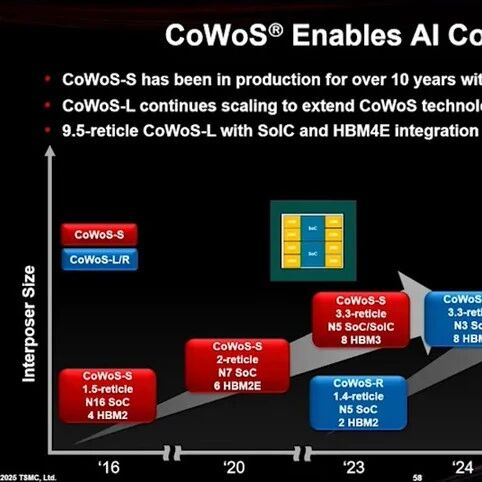
Core Viewpoint - The rapid proliferation of AI applications is driving demand for advanced packaging technologies in the semiconductor industry, with TSMC's CoWoS becoming a well-known solution. The company is also developing next-generation packaging technologies like CoPoS and CoWoP to enhance area utilization and cooling efficiency [1][10]. Group 1: Advanced Packaging Technologies - CoWoS (Chip-on-Wafer-on-Substrate) integrates multiple chips on a substrate to reduce space and improve performance, particularly for AI chips requiring high bandwidth and low latency [2][6]. - TSMC's CoWoS-L variant has seen a significant increase in demand, accounting for approximately 60% of CoWoS sales, due to its lower cost and ability to integrate passive components [6][9]. - The next-generation packaging technologies, CoPoS and CoWoP, aim to reduce costs and improve efficiency, with CoPoS utilizing a rectangular panel to enhance area utilization [10][11]. Group 2: Market Growth and Projections - The Taiwanese semiconductor packaging industry is projected to reach NT$710.4 billion by 2025, with a CAGR of 13.9%, and further growth to NT$759 billion by 2026, driven by AI and HPC infrastructure demands [1][2]. - TSMC's advanced packaging capacity is expected to grow significantly, with CoWoS capacity increasing by over 80% and SoIC capacity by more than 100% from 2022 to 2026 [2][9]. Group 3: Industry Challenges and Developments - The semiconductor industry faces challenges in meeting the increasing demand for advanced packaging, necessitating collaboration and innovation among manufacturers [10]. - TSMC is expanding its advanced packaging facilities in the U.S. and Taiwan, with plans to start testing CoPoS by 2026 and mass production by 2028 [8][9]. - The shift towards advanced packaging is shortening the time from design to mass production, reducing the development cycle from approximately 1.5 years to less than a year [9][10].