Vipshop(VIPS)

Search documents
港股风险偏好持续上行


SINOLINK SECURITIES· 2025-06-08 15:26
Investment Rating - The report maintains a positive outlook on the Hong Kong stock market, indicating a strong risk appetite and suggesting investment opportunities in various sectors, particularly in virtual assets and Web 3.0 [3][10]. Core Insights - The Hong Kong stock market is experiencing a significant increase in risk appetite, with improved asset quality and trading volume, highlighting the value of asset trading platforms [3][10]. - There is a notable uptrend in multiple sectors such as AI, new consumption, and innovative pharmaceuticals, with a particular focus on small and mid-cap stocks in media and consumer sectors [3][10]. - The report emphasizes the ongoing development of virtual assets and the Web 3.0 market, driven by stablecoin policies and recent IPOs, suggesting that more regulatory frameworks will emerge [3][10]. - The trend of Chinese companies returning to Hong Kong for IPOs is gaining momentum, with increased trading of companies like NetEase and Ctrip in the Hong Kong market [3][10]. - The valuation of overseas Chinese assets remains influenced by US-China trade relations and the broader economic environment, necessitating close monitoring of trade policies and domestic economic changes [3][10]. Summary by Sections Education - The K12 education sector maintains high growth, with leading institutions reporting over 20% revenue growth during the winter training period, and an increase in non-academic course retention rates [5][11]. Luxury Goods - The luxury goods market shows slight pressure due to macroeconomic factors, but brands that align with demand trends are performing well, with cautious price increases observed [5][20]. Coffee and Tea Drinks & OTA - Coffee and tea remain key categories for delivery platforms, with strong performance from major brands like Luckin Coffee, which continues to expand its store presence [5][25]. E-commerce - The e-commerce sector faces slight pressure, but major platforms like Alibaba and JD.com are expected to benefit from ongoing promotional activities [5][26]. Streaming Platforms - Music streaming platforms are viewed as high-quality internet assets, with sustained profitability driven by scale effects [5][34]. Virtual Assets & Internet Brokers - The stablecoin leader Circle's IPO saw a 168% increase on its first day, marking a significant event in the virtual asset space [5][38]. Real Estate Transactions - Recent data shows a slight decline in second-hand housing transactions in major cities, suggesting a need for caution in the real estate market [5][50]. Automotive Services - The automotive aftermarket is under pressure, with traditional fuel vehicle service visits declining, while new energy vehicle service visits are increasing [5][45].
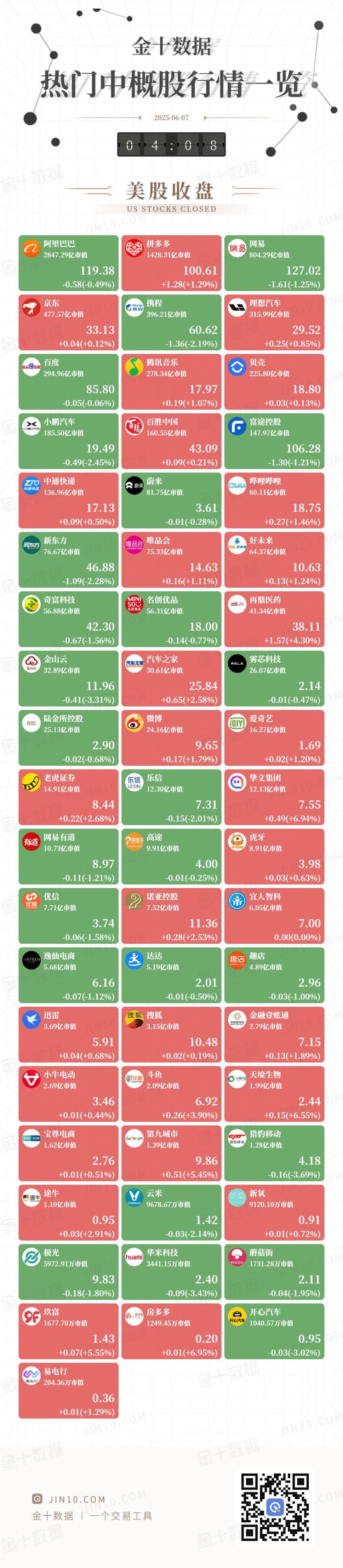
金十图示:2025年06月06日(周五)热门中概股行情一览(美股收盘)
news flash· 2025-06-06 20:14
Market Capitalization Summary - New Oriental has a market capitalization of 13.696 billion [2] - TAL Education has a market capitalization of 8.011 billion [2] - Vipshop has a market capitalization of 8.175 billion [2] - 51Talk has a market capitalization of 7.533 billion [2] - Xunlei has a market capitalization of 6.438 billion [2] - 76.67 billion market capitalization for another unspecified company [2] - 56.88 billion market capitalization for another unspecified company [2] - 32.89 billion market capitalization for another unspecified company [2] - 16.27 billion market capitalization for another unspecified company [2] - 12.30 billion market capitalization for Lexin [2] - 9.91 billion market capitalization for Youdao [2] - 5.19 billion market capitalization for Dada [2] Stock Performance - New Oriental's stock increased by 0.09 (+0.50%) [2] - TAL Education's stock decreased by 0.01 (-0.28%) [2] - Vipshop's stock increased by 0.27 (+1.46%) [2] - 51Talk's stock decreased by 1.09 (-2.28%) [2] - Xunlei's stock increased by 0.16 (+1.11%) [2] - 76.67 billion market capitalization company increased by 0.13 (+1.24%) [2] - 56.88 billion market capitalization company decreased by 0.14 (-0.77%) [2] - 32.89 billion market capitalization company increased by 0.65 (+2.58%) [2] - 16.27 billion market capitalization company increased by 0.02 (+1.20%) [2] - Lexin's stock increased by 0.22 (+2.68%) [2] - Youdao's stock decreased by 0.11 (-1.21%) [2] - Dada's stock decreased by 0.06 (-1.58%) [2] Additional Company Insights - The market capitalization of various companies ranges significantly, with some exceeding 10 billion [2] - Companies like New Oriental and TAL Education show contrasting stock performance trends, indicating varying investor sentiment [2] - The overall market appears to be volatile, with both increases and decreases in stock prices across different companies [2]





双节消费观察:节令美食回归“实在”,消费者重视传统节日仪式感
Bei Ke Cai Jing· 2025-06-05 04:00
Group 1 - The consumption market during the Dragon Boat Festival was active, with sales reaching 4.18 billion yuan, a year-on-year increase of 1.6% [1] - There is a noticeable trend of consumers shifting from "novelty" to "practicality" in their preferences for seasonal foods, with a growing emphasis on health, particularly low glycemic index (GI) options [3][4] - Sales of zongzi (sticky rice dumplings) saw significant growth, with platforms like Dingdong Maicai reporting over 20% year-on-year increase in sales, and a 43% increase in sales volume in the week leading up to the festival [2][3] Group 2 - Low GI zongzi have gained popularity, with new products being developed that replace traditional glutinous rice with healthier grains like oat rice and include low GI certified ingredients [3][4] - The trend towards health-conscious food options is not limited to zongzi, as traditional festival foods like mooncakes and yuanxiao are also expected to evolve towards healthier and more nutritious versions [4] - Consumers are increasingly willing to spend on products that enhance the ritualistic aspects of traditional festivals, such as艾草 (mugwort) and香囊 (fragrant sachets), indicating a growing appreciation for cultural significance [5][6]



唯品会Q1:SVIP扛旗,不过不失
Sou Hu Cai Jing· 2025-06-04 00:43
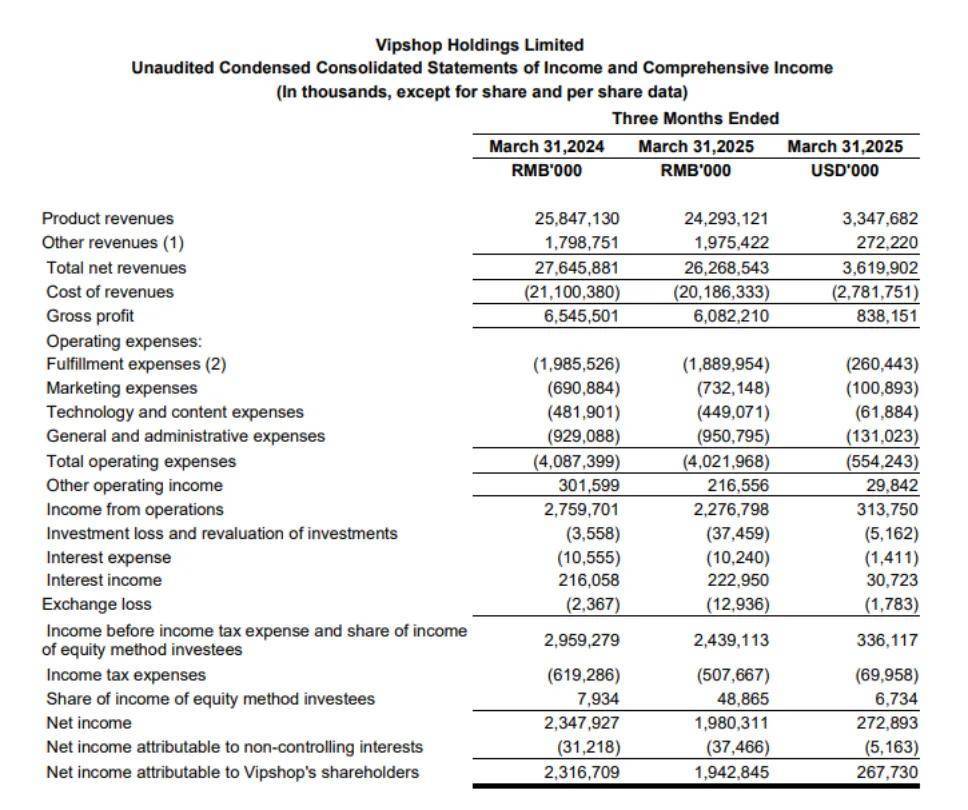
Core Viewpoint - Vipshop's Q1 performance shows resilience in high-value user consumption despite overall revenue growth being insufficient, indicating a stable but challenging market environment [1][2] Financial Performance - In Q1, Vipshop achieved net revenue of 26.3 billion RMB and Non-GAAP net profit of 2.3 billion RMB, with GMV at 52.4 billion RMB and active users at 41.3 million [1][8] - The Super VIP (SVIP) user base grew by 18% year-on-year, contributing 51% of online sales, highlighting the importance of high-value users [1][9] - The company reported a gross profit of 6.5 billion RMB, with operating income of 2.8 billion RMB and net income attributable to shareholders at 2.3 billion RMB [8][9] Market Trends - The overall consumer sentiment in the wearable category was subdued in Q1, with a 0.1% decline in clothing sales, reflecting a shift towards essential goods over discretionary spending [3][4] - The early timing of the Spring Festival led to reduced demand for new clothing, as many consumers had already purchased their festive attire [3] Strategic Initiatives - Vipshop is focusing on exclusive collaborations with over 200 brands to enhance product differentiation and attract high-value users [4][5] - The introduction of promotional strategies like "limited-time flash sales" and "everyday low prices" aims to strengthen the perception of value among consumers [4][5] User Engagement - The company organized over 20 exclusive sales events for SVIP users, attracting around 300,000 participants, and offered unique lifestyle benefits to enhance user retention [9][10] - Management remains optimistic about maintaining double-digit growth in the SVIP segment throughout the year, emphasizing the need for unique value propositions [9][10] Future Outlook - Vipshop faces challenges in customer acquisition and needs to enhance its supply chain to sustain growth in core categories [10] - The company has set a revenue guidance of -5% to 0% for Q2, indicating potential pressure on short-term performance [9][10]
越活越透彻的年轻人,带火“折扣”
Sou Hu Cai Jing· 2025-05-29 14:05
Group 1 - The core consumer behavior of young people has shifted towards valuing quality and price, leading to a preference for discount retail models [1][7] - The global discount retail channel is projected to grow at a rate of 8.2% in 2024, with the Z generation's consumption in discount retail increasing by over 5 percentage points annually in the past three years [3] - Outlet malls have become popular among young consumers, even in suburban areas, as they seek out discounted products [3] Group 2 - A specific example highlights that a pair of sports shoes priced at over 800 yuan in retail can be purchased for just over 400 yuan at an outlet, demonstrating the appeal of significant savings [5] - E-commerce platforms like Vipshop are gaining traction among young consumers by offering deep discounts on branded products, with a reported 18% year-on-year increase in active SVIP users [5] - The rational consumption mindset of young people is forcing retailers to adapt their strategies, emphasizing the importance of balancing brand prestige with affordability [7]

年轻人买奢侈品追求折扣,行业出现了一个反常现象
Sou Hu Cai Jing· 2025-05-29 09:08
Group 1: Company Performance - CHANEL reported a 30% drop in operating profit and a 28.2% decline in net profit for 2024, marking its first negative growth in five years [1] - Other luxury brands are also facing challenges, with LVMH experiencing a 5% revenue decline in Q1, Kering down 12% last year and 14% in Q1 this year, and Hermès showing a 7% increase, which is 10 percentage points lower than the previous year [3] Group 2: Market Trends - The luxury goods market is undergoing a collective downturn, influenced by global economic instability and changing consumer attitudes, particularly in China where the enthusiasm for brand logos is waning [3] - Bain & Company forecasts an 18%-20% decline in China's personal luxury goods market sales in 2024, with similar challenges expected in the first half of 2025 [3] Group 3: Consumer Behavior - Young consumers are shifting towards "intelligent consumption," focusing on value and personal needs rather than blindly pursuing high prices or marketing narratives [5] - The discount brand sector is thriving, with China's outlet sales projected to reach 239 billion yuan in 2024, a 4.5% increase, and Vipshop reporting net revenue of 26.3 billion yuan in Q1 2025 with 41.3 million active users [5] Group 4: Sales Strategies - Vipshop's recent promotional event achieved record sales for the COACH brand, indicating that consumers are not opposed to high-priced items, but rather seek compelling value propositions [7] - The emphasis on cost-effectiveness or value-for-money has become a crucial factor in consumer purchasing decisions, suggesting a potential new strategy for luxury brands to adapt to changing market dynamics [7]
年轻人买奢侈品必须要折扣,消费风向变了
Sou Hu Cai Jing· 2025-05-29 02:46
Core Insights - The luxury goods market is experiencing a significant downturn, with global sales projected to reach approximately €1.48 trillion in 2024, reflecting a growth rate of only -1% to 1%, marking the first overall decline since 2008-2009 [1] - The industry is facing a "price dependency syndrome," with iconic products like the Chanel 2.55 handbag seeing a price increase from ¥38,100 in 2019 to ¥84,000 in 2024, a rise of 120% [3] - Consumer sentiment is shifting, with younger generations increasingly valuing cost-effectiveness, leading to a decline in the willingness to pay high premiums for luxury items [3] Market Trends - Discount channels are becoming a significant avenue for luxury purchases, with outlets and platforms like Vipshop gaining popularity among consumers seeking better value [5] - The search volume for discounted luxury items surged during events like the 618 Mid-Year Shopping Festival, with brands such as COACH and Burberry seeing heightened interest [5] - Promotions on platforms can lead to substantial price reductions, exemplified by a Burberry bag originally priced at ¥16,200 being offered for ¥4,199, representing a 75% discount [5] Consumer Behavior - The luxury market is transitioning from "symbolic consumption" to "quality consumption," emphasizing the need for brands to balance price and value to thrive in the evolving consumer landscape [7] - The true essence of luxury is increasingly defined by the value of the consumer experience rather than just the price tag [7]
Vipshop: Declining Fundamentals Amid Competition And The Need For Overseas Growth
Seeking Alpha· 2025-05-25 03:21
Group 1 - Vipshop (NYSE: VIPS) reported stagnating GMV growth in 1Q25, indicating a challenging market environment influenced by macroeconomic factors and competition [1] - The lack of meaningful upward movement in GMV growth suggests potential difficulties in maintaining market share and profitability [1] Group 2 - Astrada Advisors specializes in investment research across technology, media, internet, and consumer sectors, providing insights into high-potential investments [1] - The firm emphasizes a data-driven approach to understanding market developments, regulatory changes, and emerging risks, aiming to empower investors with timely research [1]

金十图示:2025年05月23日(周五)中国科技互联网公司市值排名TOP 50一览


news flash· 2025-05-23 02:54
Core Insights - The article presents the market capitalization rankings of the top 50 Chinese technology and internet companies as of May 23, 2025, highlighting significant players in the industry [1]. Group 1: Market Capitalization Rankings - Xiaomi Group ranks 4th with a market capitalization of 1754.49 billion [3]. - Pinduoduo follows in 5th place with a market capitalization of 1700.74 billion [3]. - Meituan is ranked 6th with a market capitalization of 1086.84 billion [3]. - JD.com holds the 8th position with a market capitalization of 485.64 billion [4]. - Dongfang Caifu is in 9th place with a market capitalization of 468.01 billion [4]. - SMIC (Semiconductor Manufacturing International Corporation) ranks 10th with a market capitalization of 428.82 billion [4]. Group 2: Additional Notable Companies - Li Auto is ranked 11th with a market capitalization of 306.9 billion [4]. - Baidu is in 12th place with a market capitalization of 289.01 billion [4]. - Kuaishou is ranked 13th with a market capitalization of 268.52 billion [4]. - Tencent Music holds the 14th position with a market capitalization of 262.23 billion [4]. - Beike ranks 15th with a market capitalization of 219.97 billion [4]. - XPeng Motors is in 16th place with a market capitalization of 195.11 billion [4]. Group 3: Lower Rankings - 36Kr Holdings is ranked 21st with a market capitalization of 99.46 billion [5]. - NIO is in 22nd place with a market capitalization of 87.87 billion [5]. - New Oriental Education ranks 23rd with a market capitalization of 76.79 billion [5]. - Bilibili is in 24th place with a market capitalization of 76.7 billion [5]. - Vipshop is ranked 25th with a market capitalization of 74.92 billion [5]. - Kingsoft is in 26th place with a market capitalization of 69.3 billion [5].

Vipshop: Half The Stock Price Is Cash
Seeking Alpha· 2025-05-22 19:17
Core Insights - Vipshop Holdings Limited (NYSE: VIPS) has demonstrated strong capabilities in increasing active user counts and executing effective marketing strategies, positioning itself for long-term growth from 2008 to 2025 [1] Company Analysis - The company has accumulated expertise in enhancing customer growth, indicating a well-prepared strategy for future expansion [1] - Vipshop's financial models may include various metrics such as cash flow statements, unlevered free cash flow, cost of capital, cost of debt, WACC, share count, and net debt, which are essential for evaluating its business model [1] Investment Perspective - The article emphasizes the importance of analyzing historical financial figures to make informed forecasts about the company's future free cash flow [1] - The focus on trading multiples like EV/FCF, net income, and EV/EBITDA suggests a thorough approach to valuation and investment analysis [1]