XIAOMI(XIACY)

Search documents
小米集团-W:IOT和汽车毛利率超预期,高端化和规模化推高盈利能力(简体版)-20250529
第一上海· 2025-05-29 05:40
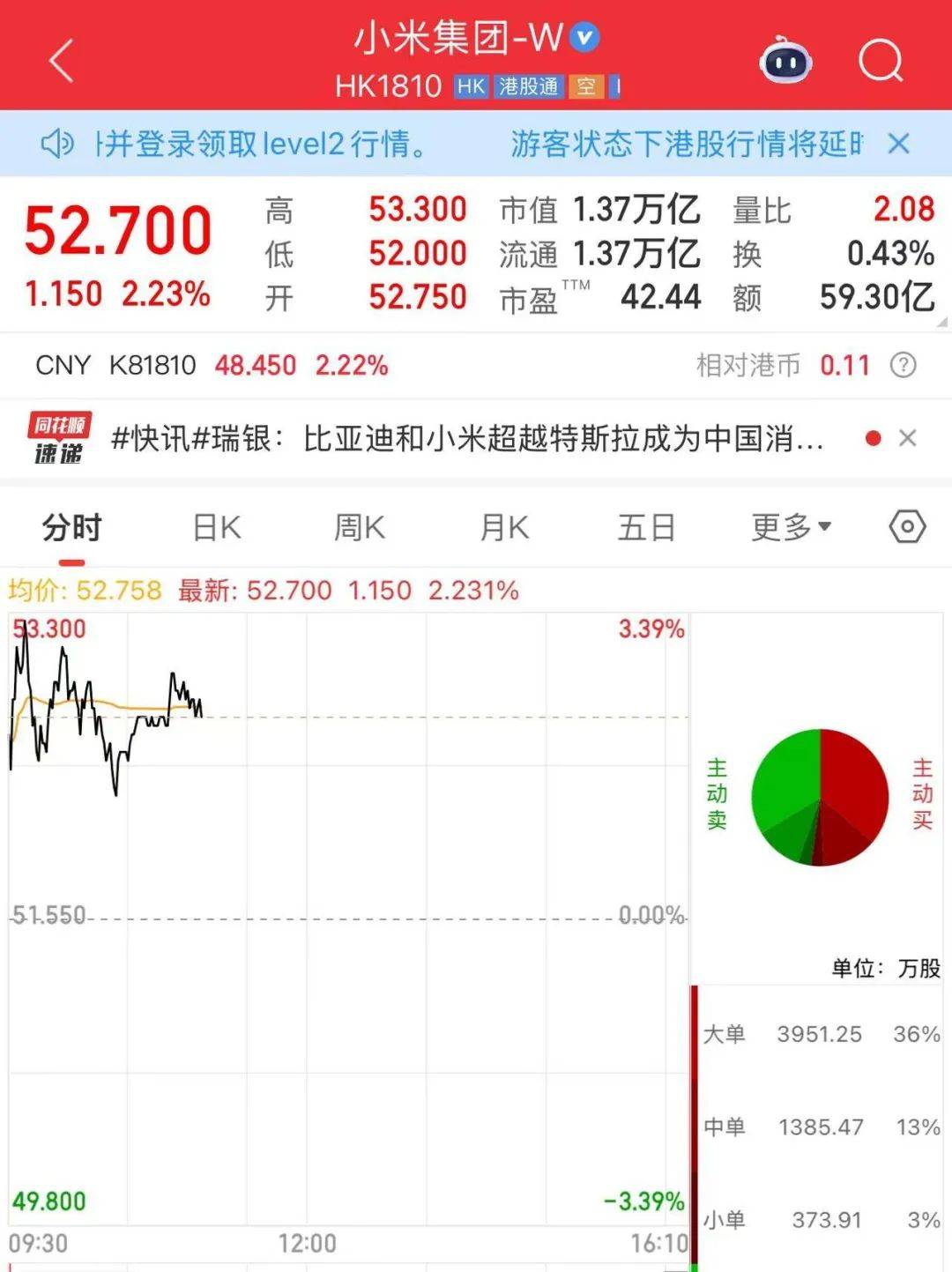
Investment Rating - The report maintains a "Buy" rating for the company with a target price of HKD 67.9, indicating a potential upside of 29.28% from the current price of HKD 52.50 [5][8]. Core Insights - The company achieved revenue of RMB 111.3 billion in Q1 2025, a year-on-year increase of 47.4%, surpassing market expectations of RMB 109 billion. The overall gross margin improved to 22.8%, up 0.5 percentage points year-on-year, with a net profit of RMB 10.9 billion, reflecting a 161.0% increase year-on-year [1]. - The smartphone segment returned to the top position in the domestic market with revenue of RMB 50.6 billion, a growth of 8.9%. The market share reached 18.8%, with a shipment increase of 40%, significantly outpacing the industry growth rate of 4.6% [2]. - The IoT segment saw a revenue increase of 58.7% to RMB 32.3 billion, with a gross margin of 25.2%, marking a historical high. The growth was driven by a doubling in revenue from smart home appliances [3]. - The automotive business reported revenue of RMB 18.6 billion, with a gross margin of 23.2%. The new luxury SUV model YU7 received a positive market response, indicating potential for increased average selling price (ASP) [4]. Summary by Sections Financial Performance - For the fiscal year ending December 31, 2023, the company reported total revenue of RMB 270.97 billion, with an adjusted net profit of RMB 19.27 billion, reflecting a 126.26% increase year-on-year. Forecasts for 2025 and 2026 predict revenues of RMB 495.65 billion and RMB 627.04 billion, respectively, with adjusted net profits of RMB 45.56 billion and RMB 57.75 billion [6][10]. Market Position - The company has regained its position as the leading smartphone vendor in China, with a significant increase in high-end smartphone shipments, contributing to a rise in average selling price (ASP) to RMB 1,211 [2]. - The IoT segment's growth is attributed to the increasing demand for smart home devices, with a notable rise in gross margin due to government subsidies and a higher proportion of large appliances [3]. Future Outlook - The company plans to invest RMB 200 billion in R&D from 2026 to 2030, focusing on AI and chip technology to strengthen its competitive edge [1]. - The automotive segment is expected to continue its recovery, with the YU7 model anticipated to enhance the company's market competitiveness and ASP [4].

小米集团-W:IOT和汽车毛利率超预期,高端化和规模化推高盈利能力(繁体版)-20250529
第一上海· 2025-05-29 05:40
Investment Rating - The report maintains a "Buy" rating for the company with a target price of HKD 67.9, indicating a potential upside of 29.28% from the current price of HKD 52.50 [6][10]. Core Insights - The company reported revenue of RMB 111.3 billion for Q1 2025, a year-on-year increase of 47.4%, surpassing market expectations of RMB 109 billion. The overall gross margin improved to 22.8%, up 0.5 percentage points year-on-year. Net profit reached RMB 10.9 billion, a significant year-on-year increase of 161.0%, with adjusted net profit at RMB 10.7 billion, up 64.5%, exceeding market expectations of RMB 9.1 billion [2]. - The company aims to invest RMB 200 billion in R&D from 2026 to 2030 to strengthen its technological moat, with a focus on AI and chip technology, expecting to invest RMB 7.5 billion in AI this year [2]. - The smartphone segment saw revenue of RMB 50.6 billion, a year-on-year increase of 8.9%, with a market share of 18.8%, marking a return to the top position in domestic smartphone shipments after ten years. The average selling price (ASP) of smartphones increased by 5.8% to RMB 1,211 [3]. - The Internet of Things (IoT) segment experienced explosive growth, with revenue increasing by 58.7% to RMB 32.3 billion, and a gross margin of 25.2%, up 5.4 percentage points year-on-year [4]. - The automotive business reported revenue of RMB 18.6 billion, with a gross margin of 23.2%, and a significant reduction in operating losses, with the new luxury SUV model YU7 receiving positive market feedback [5]. Financial Summary - The company’s projected revenues for 2025, 2026, and 2027 are RMB 495.6 billion, RMB 627.0 billion, and RMB 721.4 billion, respectively. Adjusted net profits are expected to be RMB 45.6 billion, RMB 57.8 billion, and RMB 70.2 billion for the same years [6][7]. - The gross margin is projected to improve from 21.21% in 2023 to 23.33% by 2027, reflecting enhanced operational efficiency and product mix [13]. - The company’s earnings per share (EPS) is forecasted to grow significantly from RMB 0.69 in 2023 to RMB 2.61 in 2027, indicating a robust growth trajectory [7][13].
小米集团-W:自研“玄戒O1”正式发布,持续完善“人车家”全生态-20250529
Great Wall Securities· 2025-05-29 05:40
Investment Rating - The report maintains a "Buy" rating for Xiaomi Group [4][23]. Core Viewpoints - Xiaomi has launched its self-developed "Xuanjie O1" chip, enhancing its "Human-Vehicle-Home" ecosystem. The company plans to invest an additional 200 billion yuan in core technology research and development from 2026 to 2030 [2][21]. - The company is expected to see significant growth in revenue and net profit, with projections of 309.48 billion yuan, 400.08 billion yuan, and 501.72 billion yuan in net profit for 2025, 2026, and 2027 respectively [23]. Summary by Relevant Sections Financial Indicators - Revenue (million yuan): 270,970.14 in 2023, projected to reach 673,424.43 by 2027, with a CAGR of 16.89% [1]. - Net profit (million yuan): 17,475.17 in 2023, expected to grow to 50,172.45 by 2027, reflecting a growth rate of 25.40% [1]. - ROE: Expected to increase from 10.66% in 2023 to 16.19% in 2027 [1]. - EPS: Projected to rise from 0.67 yuan in 2023 to 1.93 yuan in 2027 [1]. Product Launches and Innovations - The "Xuanjie O1" chip is a significant milestone, utilizing a second-generation 3nm process and featuring a 10-core CPU and a 16-core GPU [11][12]. - The Xiaomi 15S Pro, Xiaomi Pad 7 Ultra, and Xiaomi Watch S4 were launched, all equipped with the new chip, showcasing advancements in technology and design [2][11]. - The high-performance SUV, Xiaomi YU7, was introduced, featuring impressive specifications such as a maximum horsepower of 690PS and a 0-100 km/h acceleration time of just 3.23 seconds [3][21]. Market Position and Strategy - Xiaomi's smartphone business remains strong, consistently ranking among the top three globally for 19 consecutive quarters. The company is also expanding into the electric vehicle market, which is expected to provide a second growth curve [17][23]. - The report emphasizes the importance of maintaining high R&D investments, totaling 1,020 billion yuan over the past five years, to support product upgrades across its ecosystem [17][21].
小米集团-W:2025Q1业绩点评:IOT业务高速增长,单季度业绩再创新高-20250529
Minsheng Securities· 2025-05-29 05:23
Investment Rating - The report maintains a "Recommended" rating for Xiaomi Group [6] Core Views - Xiaomi Group achieved record revenue of 1112.93 billion RMB in Q1 2025, representing a year-over-year increase of 47.4% and a quarter-over-quarter increase of 2.1% [2] - The company continues to advance its all-ecosystem strategy, with significant growth in IOT and automotive sectors, contributing to overall revenue growth [2][3] - The company is investing 200 billion RMB over the next five years to deepen its core technology capabilities, including the launch of its self-developed 3nm flagship SoC chip [4] Financial Performance Summary - In Q1 2025, Xiaomi's adjusted net profit reached 106.76 billion RMB, up 64.5% year-over-year, with an adjusted net profit margin of 9.6% [2][3] - The IOT business generated revenue of 323.39 billion RMB, a year-over-year increase of 58.7%, with a gross margin of 25.2% [3] - The smartphone segment reported revenue of 506.12 billion RMB, a year-over-year increase of 8.9%, with a gross margin of 12.4% [3] - The automotive segment achieved revenue of 185.80 billion RMB, with a gross margin of 23.2% [3] Revenue and Profit Forecast - Projected revenues for 2025, 2026, and 2027 are 5062.65 billion RMB, 6052.13 billion RMB, and 7008.88 billion RMB respectively, with corresponding net profits of 357.09 billion RMB, 457.75 billion RMB, and 598.89 billion RMB [4][5] - The report anticipates a PE ratio of 35 for 2025, decreasing to 21 by 2027 [4][5]
小米集团-W(01810):IOT业务高速增长,单季度业绩再创新高
Minsheng Securities· 2025-05-29 04:21
Investment Rating - The report maintains a "Recommended" rating for the company [6] Core Insights - The company achieved a record revenue of 1112.93 billion RMB in Q1 2025, representing a year-over-year increase of 47.4% and a quarter-over-quarter increase of 2.1% [2][3] - Adjusted net profit reached 106.76 billion RMB, up 64.5% year-over-year and 28.4% quarter-over-quarter, with an adjusted net profit margin of 9.6% [2][3] - The company is focusing on its all-ecosystem strategy, which includes smartphones, AI, and IoT, contributing to robust growth across its business segments [2][3] Revenue Breakdown - The smartphone and AIoT segment generated revenue of 927.13 billion RMB, a year-over-year increase of 22.8% [2] - The IoT business saw revenue of 323.39 billion RMB, up 58.7% year-over-year, driven by a doubling of income from smart home appliances [3] - The automotive segment generated 185.80 billion RMB, with a gross margin of 23.2%, despite a quarterly operating loss of 5 billion RMB [3] Financial Projections - The company forecasts revenues of 5062.65 billion RMB, 6052.13 billion RMB, and 7008.88 billion RMB for 2025, 2026, and 2027 respectively [4] - Expected net profits for the same years are projected at 357.09 billion RMB, 457.75 billion RMB, and 598.89 billion RMB [4] - The report anticipates a decrease in P/E ratios from 35 in 2025 to 21 in 2027, indicating potential growth in profitability [4] Research and Development - The company plans to invest 200 billion RMB in core technology over the next five years, with R&D spending reaching 67 billion RMB in Q1 2025, a 30.1% increase year-over-year [4]
汇丰升小米集团(01810.HK)目标价4.2% 预计Yu7望为新的利润增长点
news flash· 2025-05-29 02:16
Group 1 - HSBC Global Research has raised its target price for Xiaomi Group (01810.HK) by 4.2%, from HKD 73.5 to HKD 76.6, indicating a potential upside of approximately 49% [1] - The upward revision in net profit forecasts for Xiaomi Group for 2025-2027 is by 6% annually, driven by a more optimistic outlook on the company's Internet of Things (IoT) revenue [1] - The report highlights that Xiaomi's IoT and electric vehicle (EV) gross margins are expected to continue to improve, with the first quarter earnings exceeding expectations [1] Group 2 - HSBC anticipates that the Yu7 electric vehicle model could become a new profit growth driver for Xiaomi [1] - The company is expected to reach a critical point in its high-end product strategy and in-house chip development, which will enhance smartphone profit margins [1] - Starting from 2026, Xiaomi is projected to expand the deployment of its XRing O1 SoC to mid-range smartphone models, significantly reducing unit costs of chipsets and overall material costs [1]

小米集团单季净利首破百亿 2万人研发获全球专利4.3万件
Chang Jiang Shang Bao· 2025-05-28 23:43
Core Insights - Xiaomi Group reported record high revenue and net profit for Q1 2025, with revenue reaching 1112.93 billion yuan, a year-on-year increase of 47.4%, and net profit of 108.93 billion yuan, up 161% [2][5][6] Financial Performance - The company achieved a quarterly revenue exceeding 1100 billion yuan and net profit surpassing 100 billion yuan for the first time in its history [3][5] - Q1 revenue of 1112.93 billion yuan represents a 2.1% increase from the previous quarter's revenue of 1090.05 billion yuan [5] - The adjusted net profit for Q1 was 106.76 billion yuan, marking a 64.5% year-on-year increase and a 28.4% quarter-on-quarter increase [6] Business Segments - Xiaomi's smartphone segment saw global shipments of 41.8 million units, maintaining a market share of 14.1%, ranking among the top three globally for 19 consecutive quarters [3][7] - The AIoT and consumer electronics segment generated revenue of 927 billion yuan, a 22.8% increase year-on-year, while the smart electric vehicle and AI segment contributed 186 billion yuan [6][11] R&D Investment - The company invested 67.12 billion yuan in R&D during Q1, a 30% increase year-on-year, with R&D personnel accounting for approximately 48% of total employees [3][12] - Xiaomi's cumulative R&D investment from 2021 to 2024 has shown a consistent increase, with plans to invest 200 billion yuan over the next five years [13] Product Development - Xiaomi launched its first self-developed flagship processor, the Xuanjie O1, in May [4] - The company reported a significant increase in high-end smartphone sales, with a 25% share in the high-end market segment in mainland China [8][9] Automotive Business - The smart electric vehicle segment delivered 75,869 units in Q1, with an annual target of 350,000 units [10][11] - The automotive segment reported a revenue of 181 billion yuan, with a gross margin of 23.2%, although it incurred an operating loss of 5 billion yuan [11]

小米集团-W:升目标价至70港元,重申“买入”评级-20250528
Daiwa Securities· 2025-05-28 09:40
Investment Rating - The report maintains a "Buy" rating for Xiaomi Group-W (01810) [1] Core Insights - Daiwa Securities raised the target price for Xiaomi from HKD 65 to HKD 70, an increase of 7.7%, based on a 38x P/E ratio for 2025-26 and a 4.4x P/S ratio for the electric vehicle business [1] - Xiaomi's Q1 2025 performance exceeded market expectations by 13% in adjusted net profit, with gross profit margins for IoT and electric vehicles surprising positively, exceeding market expectations by 4 percentage points and 2 percentage points respectively [1] - The upcoming investor day on June 3 and the listing of YU7 in July are expected to serve as short-term catalysts for the stock [1] - Based on the revised gross profit margin forecasts for electric vehicles and IoT, the report has increased the earnings per share estimates for 2025-27 by 8-19% [1]
小米集团-W季报点评 —— 营收和经调整净利润创季度新高
Orient Securities· 2025-05-28 07:35
Investment Rating - The report maintains a "Buy" rating for the company, with a target price of 75.52 HKD based on a 38x PE valuation for 2026 [3][10]. Core Insights - The company achieved record high revenue and adjusted net profit in Q1 2025, with revenue reaching 111.3 billion CNY, a 47% year-on-year increase, and adjusted net profit of 10.7 billion CNY, up 64% year-on-year [9]. - The smartphone segment showed significant growth, with a 9% increase in revenue to 50.6 billion CNY and a global market share of 14.1%, ranking among the top three globally [9]. - The IoT and lifestyle products segment also saw strong performance, with revenue of 32.3 billion CNY, a 59% increase, and a gross margin of 25.2% [9]. - The internet services segment reported revenue of 9.1 billion CNY, a 13% increase, with a gross margin of 76.9% [9]. - The electric vehicle segment generated 18.6 billion CNY in revenue, with a gross margin of 23.2%, and the company continues to expand its sales network [9]. Financial Summary - Revenue projections for 2025-2027 are 477.67 billion CNY, 575.30 billion CNY, and 690.22 billion CNY, respectively, with year-on-year growth rates of 31%, 20%, and 20% [5][10]. - Adjusted net profit forecasts for the same period are 35.12 billion CNY, 47.32 billion CNY, and 59.00 billion CNY, with growth rates of 48%, 35%, and 25% [5][10]. - The company’s gross margin is expected to improve from 22.5% in 2025 to 23.1% in 2027, while net profit margin is projected to increase from 7.4% to 8.5% [5][10]. - The earnings per share (EPS) forecast for 2025-2027 is 1.35 CNY, 1.82 CNY, and 2.27 CNY, respectively [5][10].
小米集团,大爆发!卢伟冰:SU7没对手!雷军发声——
Sou Hu Cai Jing· 2025-05-28 05:47
Core Insights - Xiaomi Group has reported record-breaking quarterly net profits, with significant growth in revenue and adjusted net profit for Q1 2025 [5][6][7] Financial Performance - In Q1 2025, Xiaomi's revenue increased by 47.4% year-on-year to 111.3 billion RMB, while adjusted net profit reached 10.7 billion RMB, marking a 64.5% increase [6][8] - The company has achieved three consecutive quarters of sequential growth in adjusted net profit since Q3 2024 [7] Market Position - Xiaomi ranks third in quarterly profit among Hong Kong-listed internet companies, following Tencent and Alibaba [8] - The company's stock price has seen significant increases, with a 121% rise in 2024 and over 50% increase year-to-date in 2025 [10][11] Institutional Investment - Public funds have increased their holdings in Xiaomi, with a total of 49.31 million shares added in Q1 2025, bringing the total market value of holdings to 43.1 billion RMB [12] Business Segments - Revenue from the mobile and AIoT segment reached 92.7 billion RMB, a 22.8% increase, while the smart electric vehicle and AI segment generated 18.6 billion RMB [13] - Xiaomi's smart home appliances saw a remarkable revenue growth of 113.8% in Q1 2025, with significant increases in unit sales for air conditioners, refrigerators, and washing machines [16] R&D and Innovation - Xiaomi's R&D expenditure in Q1 2025 was 6.7 billion RMB, a 30.1% increase, with a record number of R&D personnel [16] - The company plans to invest 200 billion RMB in R&D over the next five years, focusing on product differentiation and technology development [17]