晶澳科技

Search documents
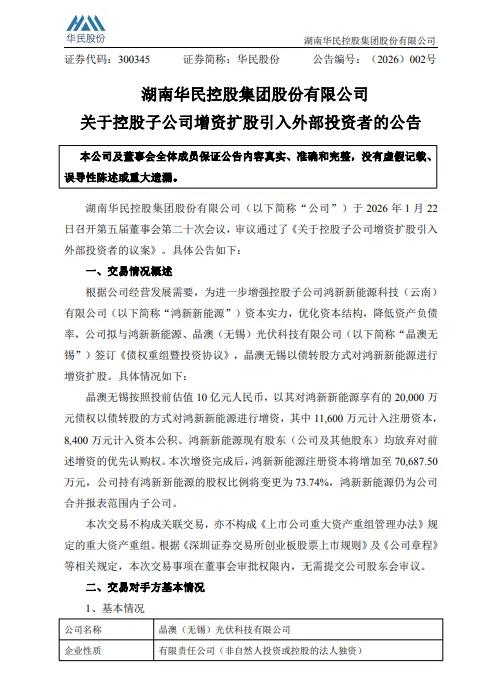
晶澳无锡对鸿新新能源债转股增资2亿元
Xin Lang Cai Jing· 2026-01-27 14:44
润阳股份之后,光伏又现又"债转股"案例。1月22日,华民股份(300345)召开第五届董事会第二十次 会议,审议通过了《关于控股子公司增资扩股引入外部投资者的议案》。 | 公司名称 | 晶澳(无锡)光伏科技有限公司 | | --- | --- | | | | | 企业性质 | 有限责任公司(非自然人投资或控股的法人独资) | 根据公司经营发展需要,为进一步增强控股子公司鸿新新能源科技(云南)有限公司(简称"鸿新新能 源")资本实力,优化资本结构,降低资产负债率,公司拟与鸿新新能源、晶澳(无锡)光伏科技有限 公司(简称"晶澳无锡")签订《债权重组暨投资协议》,晶澳无锡以债转股方式对鸿新新能源进行增资 扩股。 晶澳无锡按照投前估值10亿元人民币,以其对鸿新新能源享有的20,000万元债权以债转股的方式对鸿新 新能源进行增资,其中11,600万元计入注册资本,8,400万元计入资本公积。鸿新新能源现有股东(公司 及其他股东)均放弃对前述增资的优先认购权。本次增资完成后,鸿新新能源注册资本将增加至 70,687.50万元,公司持有鸿新新能源的股权比例将变更为73.74%,鸿新新能源仍为公司合并报表范围 内子公司。 截 ...


光伏反内卷攻坚,政企同心方得始终
第一财经· 2026-01-27 13:08
Core Viewpoint - The photovoltaic industry is undergoing a deep reform to combat internal competition, with regulatory measures and policy adjustments reflecting a commitment to high-quality development. However, many companies are still facing significant losses, indicating that this battle is not a short-term fix but a necessary step to resolve structural issues within the industry [2][5]. Industry Performance - Major companies like Tongwei Co., Ltd. and LONGi Green Energy are projected to incur substantial losses in 2025, with estimated net losses of 9 to 10 billion yuan and 6 to 6.5 billion yuan respectively. Other companies such as JA Solar, JinkoSolar, and Trina Solar are also expected to report significant losses, highlighting the severe challenges faced by the industry [2][3]. - The average gross margin for the entire industry is only 3.64%, with many companies trapped in a cycle of "production equals loss" due to oversupply and rising raw material costs [3][4]. Causes of Losses - The industry's performance crisis is primarily attributed to excessive homogenous production capacity and fierce price competition, compounded by soaring raw material costs. The supply of silicon materials is projected to exceed global demand by more than double over the next three years, leading to a significant imbalance [3][4]. - The price of silver, a key material in photovoltaic cells, has surged by 231% in 2025, pushing companies to adopt cost-cutting measures at the expense of technological innovation and quality [4][5]. Recommendations for Improvement - Companies must shift their focus from price competition to technological innovation and quality improvement, investing in advanced battery technologies such as TOPCon, BC, and ABC to enhance efficiency and reduce costs [4][6]. - The industry needs to establish self-regulatory standards to combat unfair competition practices, such as selling below cost and misrepresenting product capabilities, while promoting collaboration among companies to consolidate resources [4][6]. Government Role - Government policies and regulatory actions are crucial for supporting the industry's reform efforts. A unified and clear policy direction is necessary to stabilize market expectations and foster industry consensus [5][6]. - Regulatory bodies should enhance oversight on low-price dumping and set higher energy consumption and environmental standards for mature production stages, while also optimizing bidding rules to prioritize technology and quality over price [5][6]. Future Outlook - The photovoltaic industry is at a critical juncture, with the potential for recovery as companies begin to reduce losses and improve profitability. Analysts suggest that the industry may see a turning point in profitability by early 2026 [6][7]. - A collaborative effort between companies and government is essential to ensure that innovation becomes the cornerstone of industry development, allowing China to transition from a manufacturing hub to a center of innovation in the global energy transformation [7].





多数光伏企业2025年延续亏损状态,部分企业锚定2026年业绩扭亏
第一财经· 2026-01-27 12:49
Core Viewpoint - The photovoltaic (PV) industry in A-shares is facing significant losses, with many leading companies projecting substantial pre-loss figures for 2025 due to a challenging operating environment and supply-demand imbalances [2][3]. Group 1: Financial Performance and Projections - Major PV companies are expected to report significant pre-loss figures for 2025, including Tongwei Co. with a projected loss of 9 to 10 billion yuan, LONGi Green Energy with 6 to 6.5 billion yuan, and JinkoSolar with 5.9 to 6.9 billion yuan [2]. - The overall operating environment remains difficult, with many companies experiencing nine consecutive quarters of losses since Q4 2023, driven by price declines and insufficient end-demand [3]. Group 2: Industry Dynamics - The PV module prices are under pressure due to "involutionary competition" and a lack of terminal demand, with market transaction prices around 0.6 yuan per watt expected in mid-2025 [3]. - The industry is witnessing a supply surplus, with production rates declining across various segments, while core material prices, such as silver, continue to rise [3]. Group 3: Recovery Efforts and Future Goals - Some companies are beginning to emerge from the loss cycle, with LONGi Green Energy projecting a maximum reduction in losses of 30.38% and Aiko Solar up to 77.44% compared to 2024 [4]. - The China Photovoltaic Industry Association noted a 16.9% year-on-year decline in revenue for the main industry chain in the first three quarters of 2025, but an improvement in gross margins to 3.64% [4]. - Several leading PV companies have set profit targets for 2026, with Trina Solar aiming for a net profit of no less than 200 million yuan and LONGi Green Energy targeting positive net profits in subsequent years [5].

多数光伏企业2025年延续亏损状态,部分企业锚定2026年业绩扭亏
Di Yi Cai Jing· 2026-01-27 10:56
Core Viewpoint - The keyword "pre-loss" has become prominent in the 2025 performance forecasts of various photovoltaic companies, indicating that most firms continue to face losses due to operational challenges and supply-demand imbalances in the industry [1] Group 1: Financial Performance - Leading photovoltaic companies are forecasting significant losses for 2025, with Tongwei Co. expecting a loss of 9 to 10 billion yuan, LONGi Green Energy forecasting a loss of 6 to 6.5 billion yuan, and JinkoSolar projecting a loss of 5.9 to 6.9 billion yuan [1] - The overall photovoltaic industry has experienced nine consecutive quarters of losses since Q4 2023, driven by a decline in component prices due to intense competition and insufficient end-user demand [1][2] Group 2: Industry Challenges - The photovoltaic industry is facing a supply surplus, with core raw material prices rising while product prices continue to decline, leading to significant operational pressure on companies [2] - The ongoing low operating rates and the deepening market reforms in the domestic electricity sector, along with increasing trade barriers abroad, have created a complex and challenging operating environment for photovoltaic companies [2] Group 3: Recovery Efforts - Some companies are beginning to emerge from the loss cycle, with LONGi Green Energy expecting to reduce losses by up to 30.38% and Aiko Solar by up to 77.44% compared to 2024 [2] - The China Photovoltaic Industry Association reported a 16.9% year-on-year decline in revenue for the main industry chain in the first three quarters of 2025, although gross margins improved to 3.64% [2] Group 4: Future Goals - Companies like Trina Solar have set profit targets for 2026, aiming for a net profit of no less than 200 million yuan, with increasing targets for subsequent years [3] - LONGi Green Energy's employee stock ownership plan also includes targets for positive net profit in 2026, with specific profit goals for 2027 and 2028 [3] Group 5: Price Adjustments - Trina Solar has raised its component prices three times this month, with prices now ranging from 0.88 to 0.92 yuan per watt, reflecting a response to industry self-discipline [4] - Major component manufacturers are increasing prices by 0.02 to 0.04 yuan per watt, and there is a growing willingness among intermediate suppliers to support price increases [4]
解读2025年全球裁员潮:AI还不是关键因素
经济观察报· 2026-01-27 10:42
Core Viewpoint - AI is transforming the way companies employ labor, but it is not necessarily the main driver behind the current wave of layoffs. Instead, AI serves as a narrative framework for structural adjustments within companies while also being a significant force in productivity transformation [1][6]. Group 1: Layoff Trends - A massive layoff wave is expected globally by 2025, affecting various sectors from tech giants to traditional manufacturing and finance. The true drivers behind these layoffs include economic slowdown and strategic restructuring rather than solely AI [2][4]. - In the U.S., approximately 153,074 layoffs were announced in October 2025, marking one of the worst months in over 20 years. By the end of November 2025, total layoffs reached around 1.17 million, the highest since the COVID-19 pandemic [2]. - AI-related layoffs accounted for only about 4% to 5% of total layoffs in the U.S., indicating that economic pressures and strategic realignments are more significant factors [3][6]. Group 2: Regional Differences - In Europe, layoffs are primarily attributed to cost control, profit pressure, and business restructuring, particularly in the automotive and manufacturing sectors [4]. - In China, layoffs are closely linked to macroeconomic adjustments and structural changes, with youth unemployment rates remaining high. The layoffs are driven by economic slowdown and industry cycles rather than a clear AI factor [5]. Group 3: AI's Role in Employment - AI is reshaping job structures, particularly affecting roles in customer service and support. However, the broader causes of layoffs remain economic conditions and strategic business decisions [6][10]. - AI is expected to create new talent demands, with job postings related to AI increasing by approximately 78% in 2025, while the talent pool only grew by 24% [11]. Group 4: Skills and Training - The future workforce will require a combination of skills, including the ability to learn continuously, understand business deeply, and collaborate effectively. These meta-skills will be crucial in the AI era [14][15]. - Companies that invest in employee reskilling and development tend to perform better in terms of innovation and long-term competitiveness compared to those that focus solely on layoffs [19][20]. Group 5: Organizational Change - Successful companies are not just reducing headcount but are also investing in employee skill upgrades and organizational restructuring to adapt to technological changes [20][21]. - The focus should be on optimizing processes and reallocating talent to higher-value roles rather than merely cutting jobs, as this approach supports long-term growth and productivity [21].

壹快评丨光伏反内卷攻坚,政企同心方得始终
Di Yi Cai Jing· 2026-01-27 04:26
Core Viewpoint - The photovoltaic industry is undergoing a significant transformation towards high-quality development, driven by both internal corporate self-discipline and external government support, as evidenced by recent regulatory measures and policy adjustments aimed at combating price competition and fostering innovation [1][4][7]. Industry Performance - The photovoltaic sector is currently facing severe financial challenges, with major companies like Tongwei Co. and LONGi Green Energy projected to incur substantial losses in 2025, highlighting the industry's struggle with low-price competition and rising material costs [1][2]. - The average gross margin for the industry has plummeted to just 3.64%, leading many companies into a cycle of "production equals loss" [2]. Competitive Landscape - The industry is experiencing an oversupply of homogeneous production capacity, with silicon material capacity exceeding global demand by more than double, resulting in a fierce price war among companies [2][3]. - Companies that previously relied on scale advantages are now also facing revenue declines and negative profits, indicating a widespread crisis across the sector [2]. Material Costs and Innovation - The price of silver, a critical component in photovoltaic cells, has surged by 231% in 2025, pushing companies to adopt cost-reduction technologies such as "less silver" or "silver-free" approaches [3]. - The focus on price competition has led some companies to neglect technological innovation and quality improvement, which are essential for long-term survival [3]. Government Role and Policy Recommendations - Government intervention is crucial for the success of the anti-involution measures, requiring a unified and clear policy direction to stabilize market expectations and foster industry consensus [4][6]. - There is a need for coordinated regulatory efforts across various government departments to effectively combat unfair competition and ensure sustainable industry practices [5][6]. Future Outlook - The current challenges in the photovoltaic industry present an opportunity for transformation, shifting from a focus on quantity to value creation, which is expected to be a long-term process [7]. - Some companies are beginning to reduce losses, and there is optimism that the industry may see a profitability turning point in early 2026 [7].
2025年光伏上市公司业绩持续承压
中国能源报· 2026-01-26 13:28
Core Viewpoint - The photovoltaic industry is currently experiencing a cyclical downturn, with companies facing significant operational pressures, but there are signs of improvement such as narrowing losses and recovering gross margins [3][4][12]. Group 1: Industry Performance - As of the latest disclosures, the photovoltaic sector remains at the bottom of the cycle, with most companies reporting losses, including major players like TCL Zhonghuan, Trina Solar, and LONGi Green Energy, with expected losses ranging from tens to hundreds of billions [3][5]. - The China Photovoltaic Industry Association reported a 16.9% year-on-year decline in revenue for the main industry chain in the first three quarters of 2025, while gross margin improved to 3.64%, reaching 5.61% in Q3 [3][4]. Group 2: Losses and Variability - Despite widespread losses, there is a notable divergence in the extent of losses among companies. For instance, LONGi Green Energy's expected loss of 60 to 65 billion is a significant reduction from the previous year's loss of 85.92 billion [6]. - Some companies, like Daqo New Energy, are also showing signs of resilience with losses narrowing by 52.17% to 63.21% year-on-year [6]. Group 3: Market Dynamics - The industry is facing a severe imbalance between supply and demand, exacerbated by concentrated capacity release, leading to aggressive price competition and declining product prices [8]. - Key raw material costs, such as silicon and silver paste, have risen sharply in the second half of 2025, but this cost increase has not been effectively passed down to downstream products, further squeezing profit margins [8]. Group 4: Strategic Responses - Companies are adopting various strategies to navigate the downturn, focusing on technological innovation, global expansion, and business collaboration [10]. - R&D and innovation are seen as critical for overcoming challenges, with companies like LONGi Green Energy and Trina Solar investing in advanced technologies and exploring new market applications [10]. - The integration of energy storage solutions alongside photovoltaic manufacturing is emerging as a new competitive focus, with companies like JinkoSolar and Trina Solar emphasizing the growth of their storage businesses [10]. Group 5: Future Outlook - Industry leaders believe that the current downturn does not signify a decline but rather a necessary adjustment towards high-quality development in anticipation of future demand surges [12].
天合光能:26年目标扭亏为盈,前瞻布局太空光伏-20260126
GUOTAI HAITONG SECURITIES· 2026-01-26 13:25
股票研究 /[Table_Date] 2026.01.26 26 年目标扭亏为盈,前瞻布局太空光伏 天合光能(688599) | [姓名table_Authors] | 电话 | 邮箱 | 登记编号 | | --- | --- | --- | --- | | 徐强(分析师) | 010-83939805 | xuqiang@gtht.com | S0880517040002 | | 吴志鹏(分析师) | 021-23215736 | wuzhipeng@gtht.com | S0880525070004 | 本报告导读: 公司股权激励草案计划的目标 26 年扭亏为盈,在太空光伏领域进行前瞻布局。 投资要点: | [Table_Finance] 财务摘要(百万元) | 2023A | 2024A | 2025E | 2026E | 2027E | | --- | --- | --- | --- | --- | --- | | 营业总收入 | 113,411 | 80,282 | 78,589 | 86,891 | 103,652 | | (+/-)% | 33.3% | -29.2% | -2.1% | 10. ...
天合光能(688599):26年目标扭亏为盈,前瞻布局太空光伏
GUOTAI HAITONG SECURITIES· 2026-01-26 12:52
股票研究 /[Table_Date] 2026.01.26 26 年目标扭亏为盈,前瞻布局太空光伏 天合光能(688599) | [姓名table_Authors] | 电话 | 邮箱 | 登记编号 | | --- | --- | --- | --- | | 徐强(分析师) | 010-83939805 | xuqiang@gtht.com | S0880517040002 | | 吴志鹏(分析师) | 021-23215736 | wuzhipeng@gtht.com | S0880525070004 | 本报告导读: 公司股权激励草案计划的目标 26 年扭亏为盈,在太空光伏领域进行前瞻布局。 投资要点: | [Table_Finance] 财务摘要(百万元) | 2023A | 2024A | 2025E | 2026E | 2027E | | --- | --- | --- | --- | --- | --- | | 营业总收入 | 113,411 | 80,282 | 78,589 | 86,891 | 103,652 | | (+/-)% | 33.3% | -29.2% | -2.1% | 10. ...
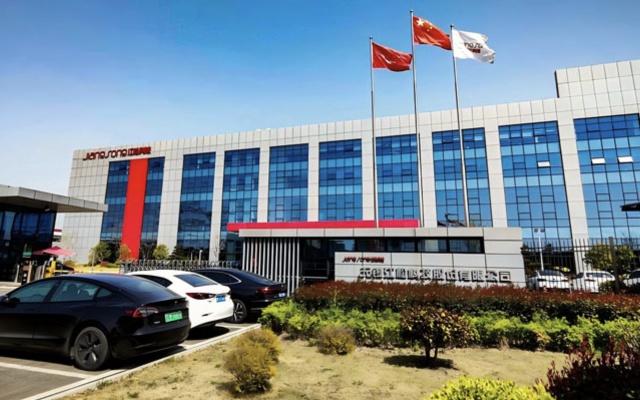
江松科技在手订单缩水31%业绩临考 拟拿3.1亿募资补流占比29.5%
Chang Jiang Shang Bao· 2026-01-26 02:11
光鲜的业绩背后,光伏行业整体承压也给这家设备制造商带来严峻挑战。 最突出的问题是现金流恶化。2023年,公司经营活动现金流净额尚为3.93亿元,2024年急转直下为-1.18 亿元,2025年上半年为-3173.84万元。招股书解释称,这主要是由于2023年采购规模大幅增加的款项于 2024年集中支付,叠加新签订单下降导致预收款减少。 长江商报记者注意到,随着收入规模扩大,公司应收账款规模快速增长,在下游客户经营承压背景下, 回收风险凸显。2022年—2025年上半年,江松科技应收账款账面余额分别为2.97亿元、4.07亿元、6.01 亿元和8.23亿元,占当期总营收的比重分别为36.86%、32.91%、29.75%和69.68%。 深交所最新披露的信息显示,无锡江松科技股份有限公司(下称"江松科技")IPO的状态从中止变更为已 问询。这标志着这家国内光伏电池智能自动化设备领域头部企业,创业板IPO进程迈入关键阶段。 在光伏行业整体承压的2024年,多家光伏电池厂出现巨额亏损,江松科技却走出业绩独立行情,营收从 2022年的8.07亿元增长至2024年的20.19亿元,实现翻倍增长,同期归母净利润也从0.8 ...