
极氪

Search documents
1月车市分化加剧: 自主品牌座次洗牌 新势力环比普降
Zhong Guo Zheng Quan Bao· 2026-02-02 20:51
截至2月2日,国内主流车企2026年1月产销数据陆续披露。整体市场呈现"传统自主强势领跑、新势力普 遍承压"的鲜明格局:上汽、吉利、奇瑞等头部车企销量同比多实现20%以上增长,自主品牌座次因新 能源与出口表现差异出现重构。 1月传统自主车企集团凭借完善的产品矩阵与全球化布局,交出亮眼成绩单,头部阵营座次因各板块增 长动能差异出现显著调整。 具体来看,上汽集团(600104)延续领跑态势,1月实现整车批售32.74万辆,同比增长23.9%,终端零 售36.3万辆,批发与零售双双领跑行业。分板块来看,自主品牌表现尤为突出,销量达21.4万辆,同比 增长39.6%,占集团总销量比重升至65.3%。 其中,上汽乘用车销售7.7万辆,同比增幅达53.8%;上汽通用五菱销售10.5万辆,同比增长37%。新能 源与海外市场成为核心增长引擎,1月新能源汽车销量8.5万辆,同比增长39.7%;海外销量10.5万辆, 同比增长51.7%,仅MG品牌在欧洲市场就交付近2.6万辆,同比增长15%。 吉利汽车以27.02万辆的销量位居次席,同比增长1%,环比增长14%,新能源业务成为重要支撑。1月新 能源汽车销量达12.43万辆,同比 ...


汽车图谱|1月车市调整:上汽销量居首 吉利逆势增长
Xin Jing Bao· 2026-02-02 13:58
2026年1月,在政策切换与年终促销透支的双重作用下,国内车市经历深度调整。 据乘联分会初步推算,1月狭义乘用车零售市场规模约为180万辆,环比下降20.4%,同比微增0.3%。多家传统车 企和造车新品牌发布的销量数据也显示,今年1月汽车市场整体呈现销量环比下滑、同比上扬的局面。 上汽集团1月销量达32.74万辆,同比增长23.94%,为当月销量规模最高的车企。 吉利汽车集团1月乘用车销量达27.02万辆,同比增长1.29%,环比增长14.08%,成为目前唯一实现同环比正增长的 企业。 比亚迪1月销量国内下滑、海外增长。当月总销量约21万辆,其中海外市场销量超10万辆,同比增长51.47%。海 外市场的快速拓展正成为比亚迪重要的增长引擎。比亚迪品牌及公关部门总经理李云飞年初透露,公司计划在 2026年向中国以外地区销售130万辆汽车。 (文章来源:新京报) 新势力车企中,小米汽车1月交付量超3.9万辆,首次超越零跑汽车。赛力斯、极氪、蔚来1月销量同比分别增长 104.85%、99.7%和96.08%,成为当月表现亮眼的高增长梯队。 吉利汽车集团 14.08% 270167 1% 比亚迪 210051 -30. ...



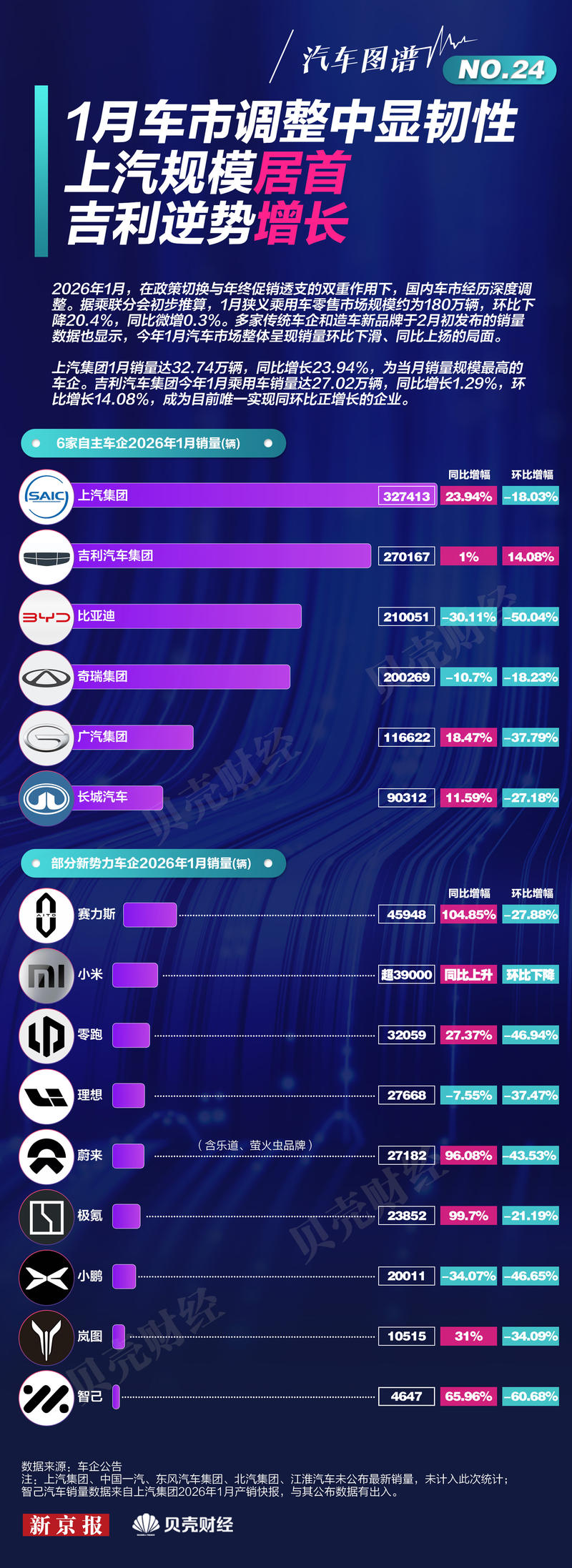
1月车市调整:上汽销量居首,吉利逆势增长
Xin Jing Bao· 2026-02-02 13:57
Core Insights - The domestic automotive market in January 2026 experienced a significant adjustment due to policy changes and year-end promotions, with a retail market size of approximately 1.8 million vehicles, reflecting a month-on-month decline of 20.4% but a slight year-on-year increase of 0.3% [1] Group 1: Traditional Automakers - SAIC Motor Corporation achieved sales of 327,400 vehicles in January, marking a year-on-year increase of 23.94%, making it the top-selling automaker for the month [1] - Geely Automobile Group reported sales of 270,200 vehicles, with a year-on-year growth of 1.29% and a month-on-month increase of 14.08%, being the only company to show positive growth in both metrics [1] - BYD's total sales reached approximately 210,000 vehicles, with domestic sales declining but overseas sales exceeding 100,000 vehicles, reflecting a year-on-year growth of 51.47% [1] - Chery Group's total sales across five brands exceeded 200,000 vehicles, showing a year-on-year decline of 10.7% [2] - GAC Group's sales were 116,600 vehicles, with a year-on-year increase of 18.47% [2] - Great Wall Motors sold over 90,300 vehicles, achieving a year-on-year growth of 11.59% [2] Group 2: New Energy and Emerging Automakers - Xiaomi Automobile delivered over 39,000 vehicles in January, surpassing Leap Motor for the first time [2] - Emerging automakers such as Seres, Zeekr, and NIO reported year-on-year sales growth of 104.85%, 99.7%, and 96.08% respectively, indicating strong performance in the high-growth segment [2] - The sales data for several new energy vehicle companies showed significant fluctuations, with some experiencing declines while others achieved substantial growth [4]


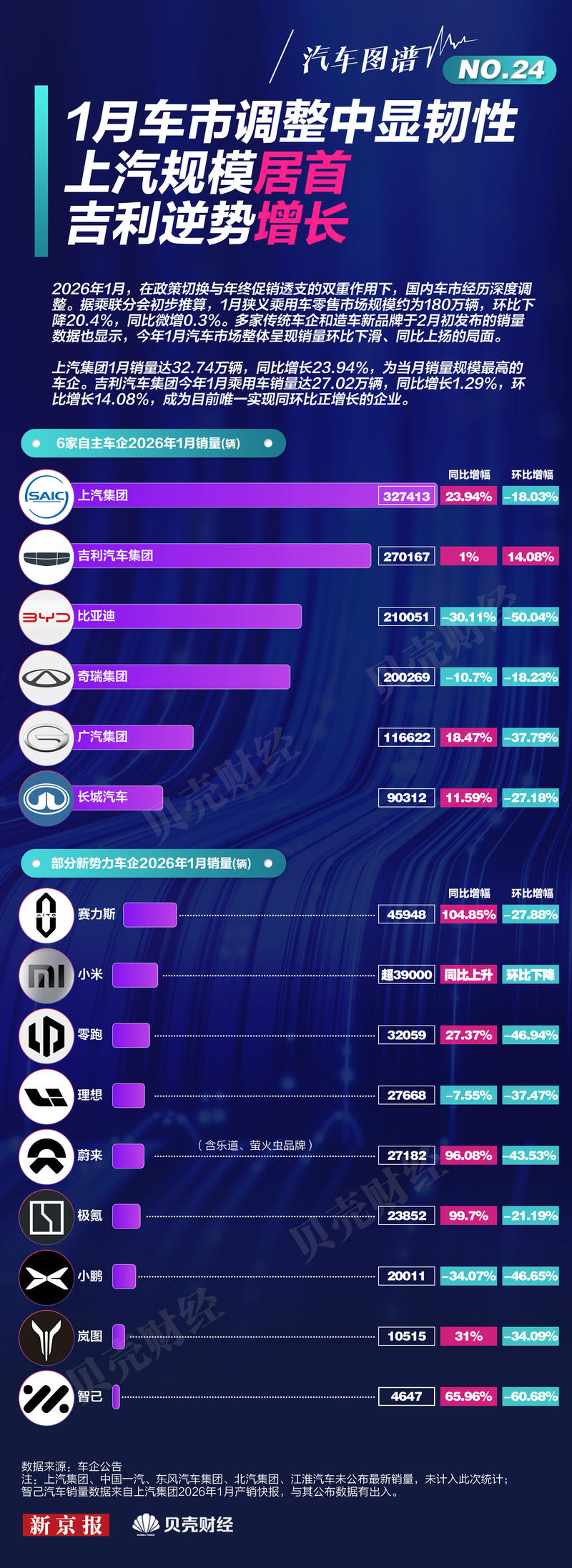
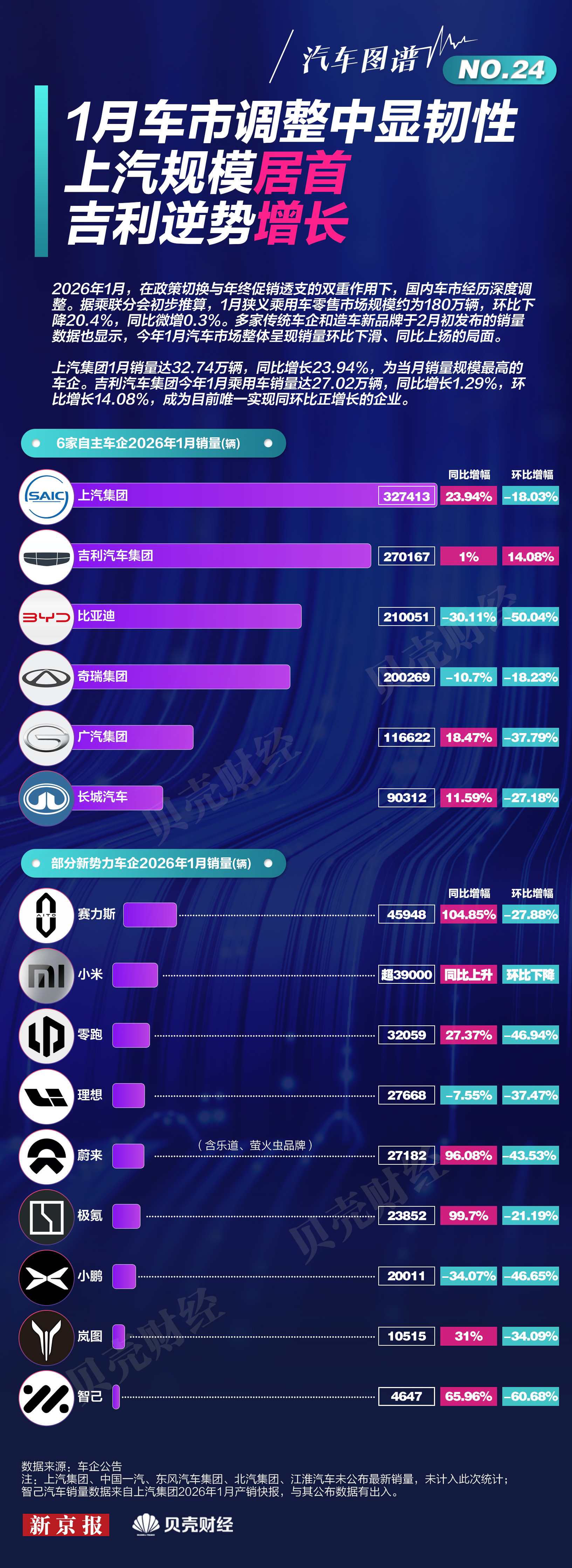
汽车图谱㉔|1月车市调整:上汽销量居首,吉利逆势增长
Bei Ke Cai Jing· 2026-02-02 13:57
2026年1月,在政策切换与年终促销透支的双重作用下,国内车市经历深度调整。 据乘联分会初步推算,1月狭义乘用车零售市场规模约为180万辆,环比下降20.4%,同比微增0.3%。多家传统车企和造车新品牌发布的销量数据也显示,今 年1月汽车市场整体呈现销量环比下滑、同比上扬的局面。 上汽集团1月销量达32.74万辆,同比增长23.94%,为当月销量规模最高的车企。 吉利汽车集团1月乘用车销量达27.02万辆,同比增长1.29%,环比增长14.08%,成为目前唯一实现同环比正增长的企业。 比亚迪1月销量国内下滑、海外增长。当月总销量约21万辆,其中海外市场销量超10万辆,同比增长51.47%。海外市场的快速拓展正成为比亚迪重要的增长 引擎。比亚迪品牌及公关部门总经理李云飞年初透露,公司计划在2026年向中国以外地区销售130万辆汽车。 新京报 业 贝壳财经 统筹 廖爱玲 6家自主车企2026年1月销量(辆) 0 O 上汽集团 SAIC 吉利汽车集团 比亚迪 奇瑞集团 *汽集团 长城汽车 部分新势力车企2026年1月销量(辆) ● O 赛力斯 小米 0 零跑 理想 (含乐道、萤火虫品牌) 蔚来 极氪 小鹏 岚图 . ...
23亿的天价官司,暴露出车企自研电池的「致命隐患」
3 6 Ke· 2026-02-02 12:02
Core Viewpoint - The lawsuit involving a 2.3 billion yuan claim highlights significant quality disputes in the domestic power battery industry, emphasizing the need for automakers to learn from this incident [3][5][22]. Group 1: Lawsuit Details - A lawsuit was filed by Weirui, a subsidiary of Geely Group, against XINWANDA Power, claiming that the battery cells delivered from June 2021 to December 2023 had quality issues, leading to a demand for 2.3 billion yuan in compensation [3][5]. - The core component of the problematic battery pack in the Zeekr 001 WE86 version is the battery cell sourced from XINWANDA, while the pack and BMS were developed in-house by Weirui [4][5]. - XINWANDA argues that Weirui's aggressive charging strategy and "lock battery" operations altered the battery's usage conditions, which they claim are the real causes of the issues [5][6]. Group 2: Financial Implications - If Weirui wins the lawsuit, XINWANDA could face a loss equivalent to approximately two years of its net profit, which was reported as 1.068 billion yuan, 1.076 billion yuan, 1.468 billion yuan, and 386 million yuan for the years 2022 to Q1 2025 [5][6]. - The lawsuit not only poses a financial threat but also risks damaging XINWANDA's brand image, potentially affecting future customer acquisition [6]. Group 3: Industry Implications - The dispute underscores the risks associated with automakers developing their own battery packs while relying on external suppliers for battery cells, as seen with companies like Leap Motor, Li Auto, and Xiaomi [6][15]. - The case illustrates the complexities of determining responsibility for battery pack quality issues, particularly between battery cell manufacturers and BMS developers [7][17]. - The trend of automakers moving towards self-manufactured battery packs is likely to continue, despite the challenges highlighted by this lawsuit [22]. Group 4: Technical Considerations - The core debate in the lawsuit revolves around the responsibility for battery pack quality issues, specifically between the battery cells and the BMS [7][9]. - Variability in battery cell production, including differences in materials and manufacturing processes, can lead to performance discrepancies, complicating quality assurance [8][19]. - The BMS plays a critical role in managing battery performance, and its strategies can significantly impact the longevity and efficiency of the battery pack [10][11]. Group 5: Future Outlook - The ongoing legal proceedings may lead to a settlement, but the complexities of quality disputes in the battery industry will likely prompt more automakers to pursue self-manufactured battery solutions for better control over quality and costs [22].
23亿的天价官司,暴露出车企自研电池的「致命隐患」
36氪· 2026-02-02 09:39
Core Viewpoint - The article discusses a significant quality dispute in the domestic power battery industry, highlighting the lawsuit filed by Weir against XWANDA for 2.3 billion yuan due to battery quality issues, which raises concerns about the implications for automakers who develop their own battery packs [4][6][26]. Group 1: Lawsuit Details - Weir has sued XWANDA for 2.3 billion yuan, claiming that the battery cells supplied by XWANDA from June 2021 to December 2023 had quality issues [4]. - The lawsuit stems from problems with the Zeekr 001 WE86 version, which experienced slow charging and abnormal battery degradation [5][6]. - XWANDA argues that the issues are due to Weir's aggressive charging strategies and modifications to battery usage conditions, not the quality of the cells themselves [6][7]. Group 2: Financial Implications - If Weir wins the lawsuit, XWANDA could face a loss equivalent to approximately two years of net profit, as their projected net profits for 2022 to Q1 2025 are 1.068 billion, 1.076 billion, 1.468 billion, and 386 million yuan respectively [6][7]. - The lawsuit not only poses a financial threat but also risks damaging XWANDA's reputation among customers, potentially affecting future business opportunities [7]. Group 3: Industry Trends - The dispute highlights the risks associated with automakers developing their own battery packs, as seen with companies like Leap Motor, Li Auto, and Xiaomi, which have sought to reduce reliance on major battery suppliers [7][24]. - The trend towards self-manufactured battery packs aims to lower costs and enhance product quality control, but the lawsuit illustrates the complexities and potential liabilities that can arise from this approach [24][26]. Group 4: Technical Considerations - The core issue in the dispute revolves around the responsibility for battery pack quality, specifically the roles of the battery cells and Battery Management System (BMS) [9][15]. - Variability in battery cell production can lead to quality differences, complicating accountability when issues arise [11][27]. - The BMS plays a crucial role in battery performance, and its strategies can significantly impact the longevity and efficiency of the battery pack [15][18]. Group 5: Future Outlook - Despite the challenges highlighted by the lawsuit, the trend towards self-manufactured battery packs is expected to continue as automakers seek greater control over supply chain safety and cost management [35].

23亿元天价官司,没有吓退车企自制电池包
3 6 Ke· 2026-02-02 09:19
Core Viewpoint - The lawsuit involving a 2.3 billion yuan claim against Xiwanda by Weirui highlights significant quality disputes in the domestic power battery industry, particularly concerning the battery cells supplied by Xiwanda to Weirui for the Zeekr 001 WE86 model, which experienced issues such as slow charging and abnormal battery degradation [1][2][3]. Summary by Sections Legal Dispute - Weirui claims that the quality issues with the battery cells supplied by Xiwanda led to costs for battery replacements and damage to the Zeekr brand image, thus seeking 2.3 billion yuan in compensation [2]. - Xiwanda argues that Weirui's aggressive charging strategy and "lock battery" operations altered the usage conditions of the batteries, which contributed to the problems [2]. Financial Impact - The potential loss of 2.3 billion yuan in compensation could equate to approximately two years of net profit for Xiwanda, which reported net profits of 1.068 billion, 1.076 billion, 1.468 billion, and 386 million yuan from 2022 to Q1 2025 [2]. - The lawsuit has negatively impacted Xiwanda's corporate image among end consumers, leading to a cautious stance from potential clients [2]. Industry Implications - The dispute underscores the risks associated with automakers developing their own battery packs and the complexities of determining responsibility for battery quality issues [3][4]. - The trend of automakers like Leap Motor, Li Auto, and Xiaomi to self-develop battery packs and BMS systems to reduce reliance on major battery suppliers is now facing scrutiny due to this legal case [3][13]. Technical Aspects - The core controversy revolves around the responsibility for battery pack quality issues, specifically between the battery cells and the Battery Management System (BMS) [4]. - Variability in battery cell quality between different production batches can lead to significant performance differences, complicating quality assurance [5][6]. - The design and control of battery cells, particularly in terms of manufacturing consistency, are critical to ensuring performance and longevity [5][6]. Future Trends - Despite the challenges highlighted by the lawsuit, the trend towards self-manufactured battery packs is expected to continue as automakers seek greater control over costs and product quality [19]. - The complexities of determining liability in battery quality disputes may lead to more collaborative approaches between automakers and battery manufacturers to mitigate risks [19].
极氪1月交付同比激增99.7% 上半年还有重磅车型上市
Zhong Guo Qi Che Bao Wang· 2026-02-02 08:23
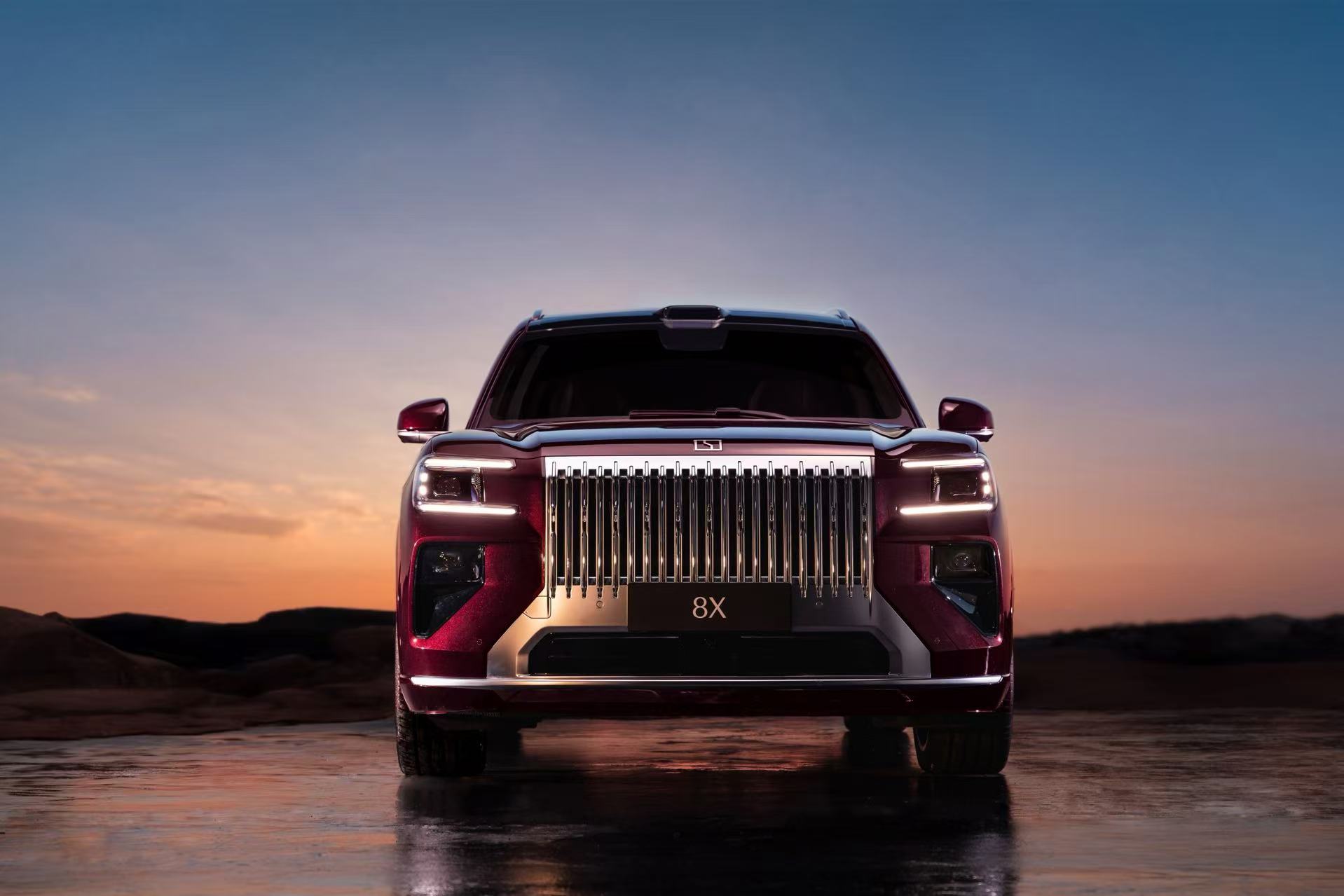
Core Insights - Zeekr, a luxury electric vehicle brand in China, reported impressive delivery figures for January, with a total of 23,852 vehicles delivered, marking a year-on-year increase of 99.7%, making it the fastest-growing high-end electric vehicle brand [2] - The brand's success is attributed to the recovery of its reputation, sustained sales of the 9X model, and rapid growth in orders for the refreshed 001 and 7X models, providing strong confidence in the high-end luxury automotive market [2] - Since the second half of 2025, Zeekr has adopted a more transparent communication strategy with users, proactively announcing model refresh timelines and introducing various customer protection measures, which have received positive market feedback [2] Product Launch - The new flagship model, Zeekr 8X, is set to launch in the first half of this year, positioned in the 450,000 RMB range as a high-performance hybrid vehicle, aiming to compete with key performance models from BMW, Mercedes-Benz, and Audi [3]
极氪荣获“2026胡润至尚优品奖项”
Feng Huang Wang Cai Jing· 2026-02-02 05:29
Core Insights - The report reveals the evolving lifestyle, consumption habits, and brand preferences of China's high-net-worth individuals (HNWIs) [1][3] - The report is the 22nd edition by Hurun Research Institute, aiming to provide insights into the quality of life among HNWIs in China [1] Group 1: Demographics and Lifestyle - The average living area for HNWIs in China is 205 square meters, with an average of 4.1 residents per household [2] - HNWIs average 6.7 hours of sleep per day and engage in over 2 hours of exercise weekly, with hiking and running being the most preferred activities [2] - They spend an average of 6.3 days per month with family, favoring Cantonese cuisine for family meals and Japanese cuisine for dining with friends [2] Group 2: Consumption and Spending Habits - HNWIs plan to reduce material consumption by 10% and increase service experience consumption by 12% in the coming year [2] - 75% of HNWIs are considering self-education or further studies, with younger individuals leaning towards MBA programs and older individuals favoring online learning platforms [2] - The average annual vacation days for HNWIs is 21, with an average of 5 international trips in the past year, including 2.1 for leisure and 2.9 for business [2] Group 3: Investment Preferences - The top investment direction for HNWIs in the coming year is gold, followed by overseas investments such as U.S. and Hong Kong stocks, funds, and insurance [2] - On average, overseas assets account for 15% of their investable assets [2] - The average age at which HNWIs plan for their children to study abroad is 16 years [2] Group 4: Market Insights - The report highlights a shift towards experience-based consumption among HNWIs, emphasizing emotional satisfaction and experiential value in areas such as health management, education, entertainment, travel, and investment [3] - The number of high-net-worth families in China exceeds 2 million, with the Yangtze River Delta region accounting for 30% of this demographic [3] - The report is based on a survey of over 11,000 high-net-worth individuals in China, making it the largest study of its kind globally [3]
鸿蒙智行、小米登顶,零跑失榜一,2026新能源开局“冷热交织”
Feng Huang Wang· 2026-02-02 04:25
Core Insights - The new energy vehicle market in China is experiencing a mixed performance, with some companies showing year-on-year growth while facing month-on-month declines [1][2][3] - The sales data for January indicates a challenging start to the year, influenced by structural adjustments and consumer sentiment [2][4] Group 1: Sales Performance - BYD reported January sales of 210,051 units, a year-on-year decline of 30.11% [1] - Hongmeng Zhixing achieved 57,915 deliveries in January, marking a year-on-year increase of 65.6% and becoming the only new force to exceed 50,000 monthly sales [1] - NIO delivered 27,182 vehicles in January, a significant year-on-year increase of 96.1% [1] - Li Auto faced substantial pressure with declines in both year-on-year and month-on-month sales [1][3] - Xiaomi's performance was notable, with a strong delivery figure in January, and plans for new models launching in April [1][2] Group 2: Market Trends - The overall retail volume of passenger vehicles in China from January 1-18 saw a year-on-year decline of 28% and a month-on-month drop of 37% [2] - The new energy vehicle market also faced challenges, with a year-on-year decline of 16% and a month-on-month drop of 52% [2] - The end of the vehicle purchase tax exemption policy by the end of 2025 and the impact of year-end promotions have led to a demand recovery phase in early 2026 [2] Group 3: Strategic Adjustments - Companies are shifting from price wars to innovative financing solutions, with Tesla leading the way by introducing long-term low-interest financing options [7] - Xiaomi, Li Auto, and NIO have followed suit with similar financing plans, aiming to attract consumers without direct price cuts [7] - Li Auto is also exploring deeper strategic adjustments, including potential entry into the AI and humanoid robot sectors [7] Group 4: Future Outlook - The overall sales targets for major automakers in 2026 are ambitious, with a combined target of at least 24.55 million units, representing 71.37% of last year's total sales [6] - Analysts predict a growth rate of around 10% for new energy vehicle retail volumes in 2026, despite current market challenges [6][8] - The competition among automakers is expected to shift towards new model launches and enhancing user experience in the second quarter of 2026 [8]